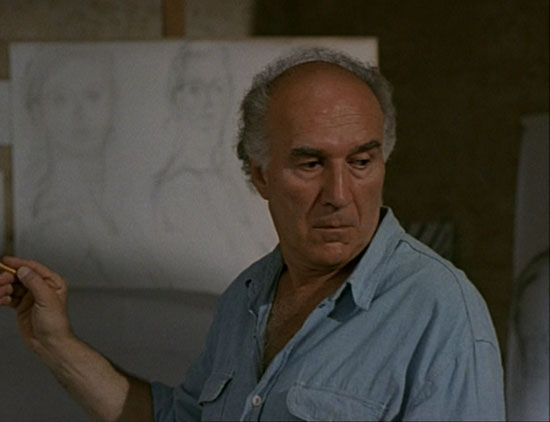
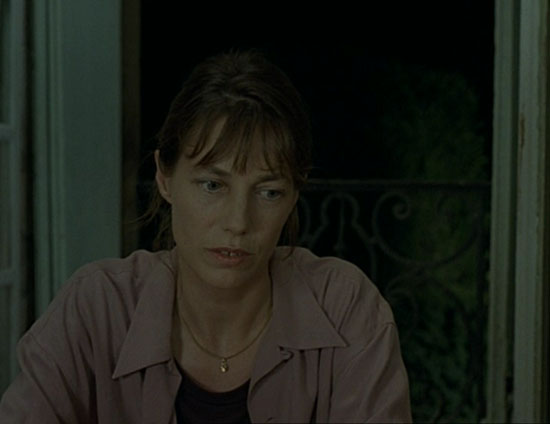
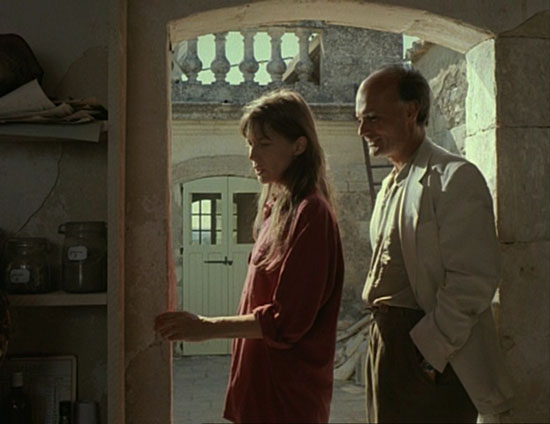
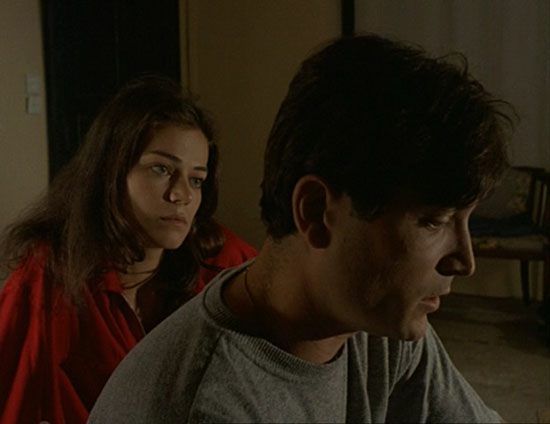
I was looking forward to this, due to my recent Rivette obsession, but didn’t expect to love it, since it’s a period piece about upper-class people unable to declare their love for each other because of societal restrictions, and I tend to hate that kind of story. It’s nice to watch fave Rivettian actors Bulle Ogier and Michel Piccoli and Barbet Schroeder (all sharing a scene) but they’re hardly in the movie and they play gentle, wise elder friends and relatives, with a bit of dialogue but no passionate acting showcases. I got my Rivette themes and trademarks served up: conspiracies, secret rooms, performance (explicitly at the convent, but throughout as the two toy with each other), real locations with creaking wood floors, oceanside drama, but all enslaved to this book-to-film adaptation of Balzac – something that I thought Rivette just said he’d never do in the DVD interview on Belle Noiseuse, that he dances around Balzac in his film writing (that one and Out 1) because a direct adaptation would be impossible. In the story, Montriveau is one of the notorious 13, but the name of the group is never stated here. Anyway, we also get very good performances from the leads – Guillaume Depardieu, lookalike son of Gerard who once played his dad in flashback in Les Misérables, with his false leg used to great effect here on the wooden floors… and Jeanne Balibar, who I don’t remember from Code 46 or Clean, and haven’t seen yet starring in Va savoir.
Not much outward passion to the movie, emotions seem detached (I know, that was the point, sorta) but it has a quietly affecting ending aboard Montriveau’s ship after he breaks into the convent and finds the Duchess dead. The plot being easy to follow, I started paying attention to nerdy cinema stuff like the quality of light (all supposedly from sunlight and candles) and the sound (music used very sparingly, as usual). Sound was rough because of the loud hissing and gurgling noises coming from the ceiling at the Landmark, and picture was even rougher since the film was projected out-of-focus (except for the left third of the screen, which looked lovely). So it was easier to measure the quality of light than, say, the details of costumes and decor. I’m not much for decor anyhow.
Definitely closer to Hurlevent (Wuthering Heights) than to anything else I’ve seen Rivette do. At least I learned how Duchess of Langeais is pronounced (vaguely: “lawn-jay”). This Balzac story was previously filmed a few times, from a 1910 lost silent to a 1995 TV version adapted by the co-writer of Goya’s Ghosts.
————
Excellent analyses found on other sites:
E. Howard:
Games are the film’s central conceit, in fact, whether they be word games, mind games, literary games, games played between appearance and feeling. The game being played at the narrative level takes place between a General and a Duchess … But this is only one game that Rivette is toying with, and he plays an entirely different one with the audience, a game of subtle winks and sly nods that continually disrupts the placid surface of the narrative … This narrative disruption is mirrored in the way the General’s story to the Duchess, about his time lost in the desert after escaping from the enemy’s imprisonment, is continually interrupted, usually by the listener’s short attention span and her tendency to divert the flow of the conversation just as the story is reaching a critical juncture. This results in the General’s story being doled out across three successive evenings that they spend together early in their relationship. On the third night, as they settle in to continue the story, Rivette frames the Duchess in a tight closeup as she asks her would-be lover to finish the tale. At this moment, she turns a sly sidelong glance directly into the camera, maintaining eye contact with the audience, as though to include them in the game.
This game of narrative interruptus is also carried through in the way Rivette uses the text of the film’s original source, a novella by Honoré de Balzac. This is a rigidly faithful adaptation… with texts from the novel periodically included as intertitles to highlight certain moments or get at the characters’ internal states. The titles are also used to convey the passage of time, which is parceled out in scrupulously precise measures: “one hour later,” “twenty-two minutes passed,” “she waited twenty-four hours.” These titles often seem to abruptly cut off the action, sometimes flashing up on screen when, after a long scene of near-stasis, a character is right in the middle of completing the scene’s first real movement or action (most often: leaving the room). The passage of time, like everything else in the film, is subject to Rivette’s subtle humor. After the Duchess kicks her friend out of her house, a title informs us that it one hour passes (a very common interlude), and surprisingly in the very next scene there’s the General again, still standing in her parlor, walking around it aimlessly, looking like only five minutes has passed since she ordered him to leave. Rivette’s use of these titles is obviously very sardonic and mannered, as when he uses a long series of images of the Duchess at a party as though it constituted a clause in between two dashes in a sentence: “the Duchess searched for him —” followed by the visuals and then, when the dangling phrase had almost been forgotten, “— in vain.”
J. Romney:
Characterised as a sort of Napoleonic wild beast ill at ease in the tameness of Restoration Paris, Armand – a general newly returned from Africa who initially fascinates married duchess Antoinette with stories of his exploits – is associated from the start with the great outdoors, prowling Mallorca’s windlashed ramparts, while Antoinette is first seen doubly imprisoned, in nun’s cowl and behind a grille.
The film is largely set in a series of enclosed salon and boudoir interiors, an overtly theatrical domain in which Antoinette is a surpassing mistress of mise en scène. Preparing for Armand’s first visit, she arranges herself for maximum effect on a canapé, in discreet déshabille, ordering her servant to lower the lighting (the thematics of light and heat later extended in the fireplace that Armand pokes with barely contained sexual frustration, and in the brand with which he threatens Antoinette).
As actress, Antoinette is skilled at the well-timed entrance and exit, whereas Armand habitually arrives too early, or storms inopportunely into the star’s dressing room. It is part of Armand’s revenge that he at last masters both mise en scène and performance, in a startlingly excessive scene that replaces Antoinette’s poised comedy of manners with a lurid melodrama: in it, he plays a menacing Byronic ravisher, supported by masked men hovering around a brazier. This sudden eruption of violence in the middle of an analytical drama may seem wildly incongruous, yet the tonal discontinuity comes directly from Balzac’s story, and Rivette achieves the seemingly impossible in making such a disjunction work convincingly on screen. The violence at the heart of the story, together with its cautionary-tale aspect, is foregrounded by Rivette’s reversion to Balzac’s original title for his novel. The reference is to a veiled warning that Armand gives Antoinette, the axe being the English one that beheaded Charles I – the implication is that the reckless cause their own downfall. In reality, however, Armand himself figuratively wields the axe that will destroy his own chance of happiness.
D. Kasman:
How strange that a filmmaker who through the years has so loved process, often in terms of acting and theatre, of seeing the expression of things worked out awkwardly before us, and conspiracy, in terms of the hints that everything out there, out of sight and out of the film frame, may be connected, has decided to adapt a reserved, 19th century historical chamber romance. Oh, but with such a surprise we then get to engage in the pleasures of the hunt! For then we find things like this: how is the navigation of social rules and norms—a very real thing with a very allusive existence—like the theatre and how is it like a conspiracy? Well, it is not without reason that Rivette opens the film at the melodramatic peak of the couple’s aching separation—the Duchess a nun on a remote Spanish isle and separated from the General by the convent’s metal bars—and then transitions and flashes back five years to the couple’s meeting and affair through two sweeps of a theatre curtain. The stage then is not the actual island (filmed on location), but is the interiors of the Restoration period, in all their glory, wood boards creaking like an empty stage. …
It is like a game played again and again with different moves but the same results, the repeating drama inside the haunted house of Celine and Julie transposed to thinking, feeling participants. The drama exists in a hanging kind of closed-off world, all frustrated performances that are almost content, as the playfulness and acting gets close to true expression, true connection. But something holds everyone back, holds the drama back, holds the love back, and gradually both General and Duchess become obsessed with this vague, menacing limitation, a mysterious stopgap to happiness that can neither be seen nor surmounted.
Whew, I love all these themes that get read into Rivette’s work. I always wonder whether he’s aware of them and consciously shaping his films in this way, or if the themes are unintended and they are more or less created by the critics, or if they’ve just become a part of his creative process, so much that he doesn’t think about them as consciously as he used to, and they become more subtle and have to be drawn out by a viewer well familiar with his previous films.
D. Ehrenstein:
The film is “dryly funny. Especially so when “the 13” make their appearance in the last act, looking more like a left bank version of the Keystone Kops than a fearsome secret society.