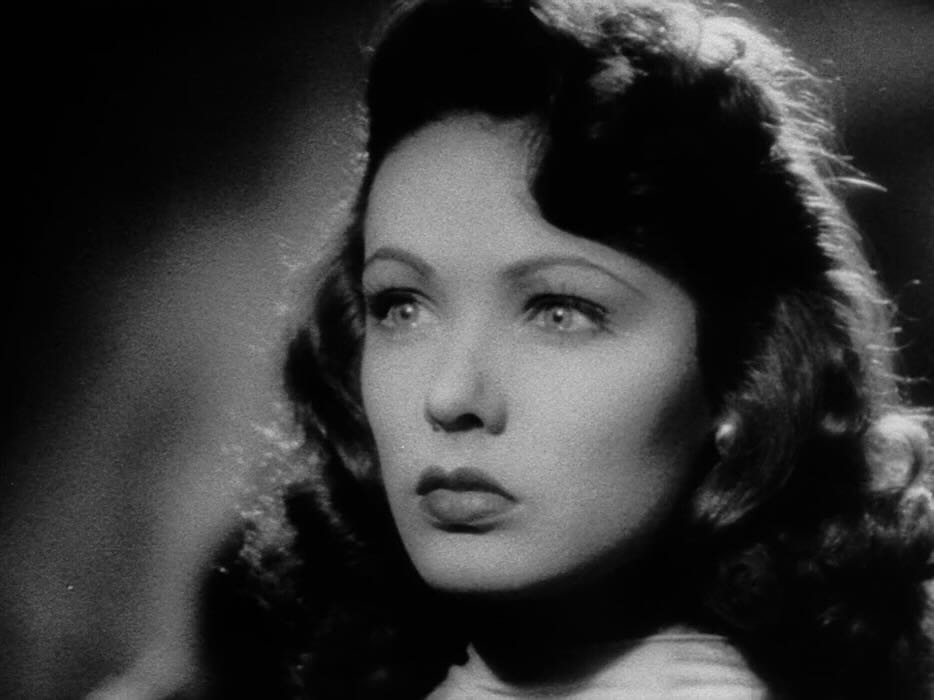
Dixie (Toothpaste girl Phyllis Brooks) arrives in Shanghai from Brooklyn, immediately runs into trouble due to being broke and clueless, has to be rescued by hat-guy Vic Mature (before his postwar breakout in My Darling Clementine). At the casino, “Mother” is Ona Munson of Scandal Sheet (not that one). Neither of these gals are no Marlene Dietrich, though Ona does call herself Lily at one point – but the movie is rescued by a delightful Gene Tierney (year after The Return of Frank James), who is the lost daughter of bigwig Walter Huston.
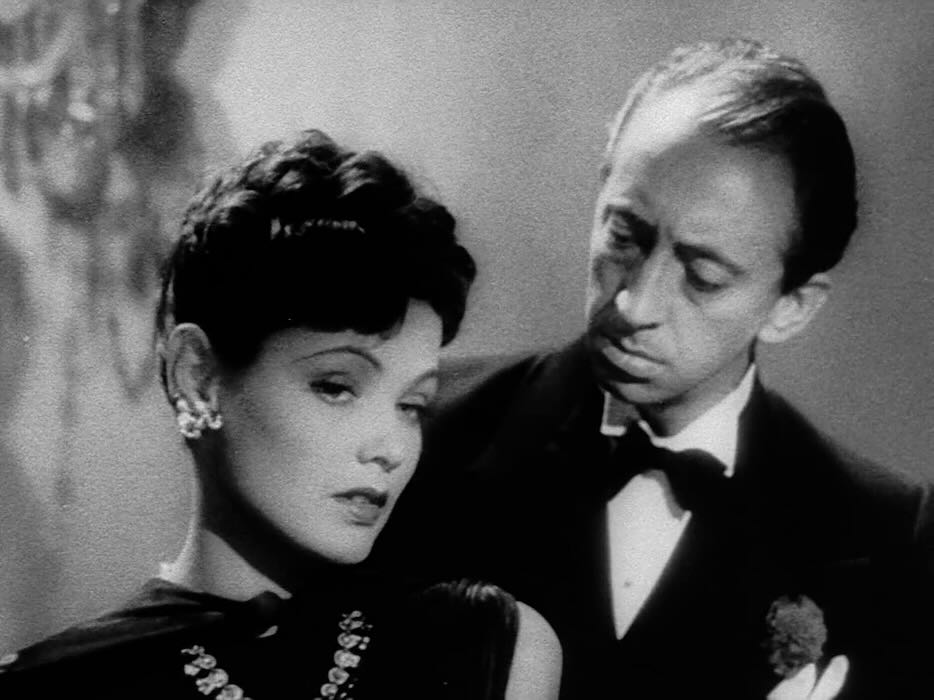
In fact everyone’s got Big Secrets and half the room wants to kill the other half when Mother invites all the major players to her new year’s table – between this and Mildred Pierce I met my melodrama quota for the month. Unfortunately these secrets and rivalries aren’t interesting, and the movie fizzles after a first half that was full of possibility. Rosenbaum: “Given the censorship of the period, much of the decadence is implied rather than stated.”

Mother has been watching Uzumaki:
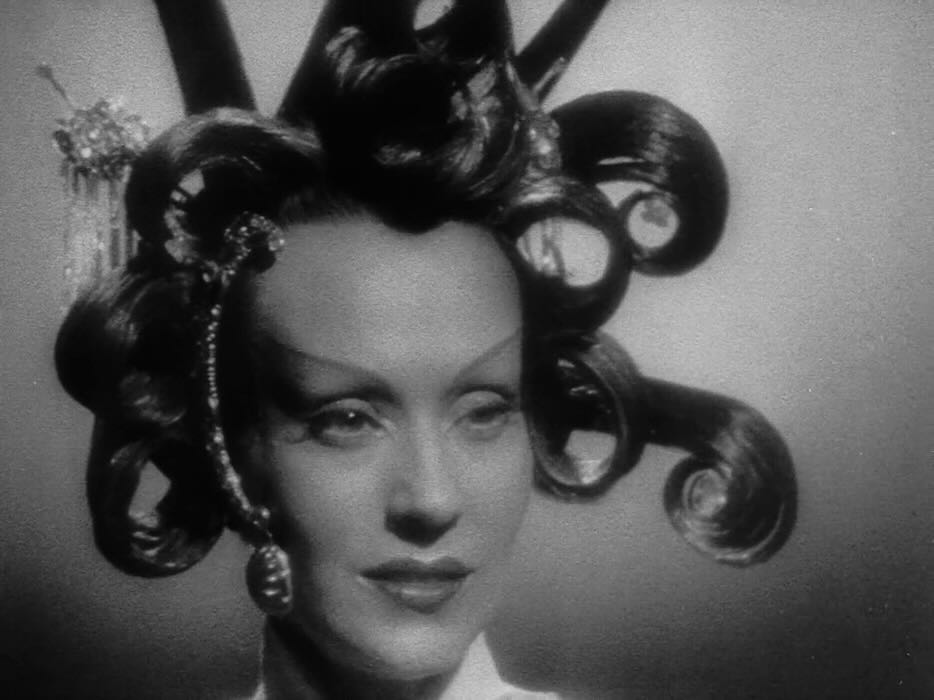
This movie needs a restoration, I demand one:
Tuba guy (Kenny Bee of some early Hou movies) barely meets short-haired Shu (Sylvia Chang of some early Edward Yang movies) under a bridge when the war started, now trying to meet her at war’s end as planned. They each get pickpocketed and rip off pedicab drivers, identities and intentions are mistaken, it works out.

An atrociously dubbed comedy. After buying the Once Upon a Time box set and watching some twenty Tsui Hark movies, it cracks me up that this is the one that’s universally loved by the letterboxders I follow. Them: “just pure joy and beauty at every turn” … “A work of pure balletic grace, and a reminder that Hong Kong’s romcoms are every bit as ahead of the pack as their action movies.” Only Dave Kehr makes sense: “Hark’s colors have the almost startling intensity of old Technicolor; combined with his stroboscopic cutting, they make the film seem to fizz and sparkle on the screen.”

Pure joy and beauty?

Interview film, Shanghai stories, people talking about their parents and their own childhoods. Many stories end in death or disappearance. Very stylish looking doc, with some non-doc segments, including a recurring ghost woman (Zhao Tao of Still Life, Platform, The World).

Clips from a 1959 film by a different Wang Bing (the Coal Money director was born in ’67), from Red Persimmon, Two Stage Sisters, Spring in a Small Town, Flowers of Shanghai, Days of Being Wild, Antonioni’s China, and interviews with filmmakers and participants.

Wei Wei, star of Spring in a Small Town:

Tony Rayns:

Jia was invited to make a film “about Shanghai” to mark the opening of the Shanghai World Expo … his idea was to focus mainly on émigrés from Shanghai – politicians, soldiers, artists, gangsters – and to follow some of those émigrés to their subsequent bolt-holes in Taiwan and Hong Kong. … No film made anywhere has previously attempted a pan-Chinese view of the fall-out from the conflicts in China’s civil war.

I don’t have the context Tony Rayns has, have missed a lot in Jia’s films, but at least this one was fully narrated (and quite beautiful).

S. Kraicer:

[The interviewees] are mostly famous, and predominantly from the arts world: this is a top-down historical chronicle, unlike the bottom-up small-town tales that made Jia’s name 10 years ago … Many of the stories come from Shanghai’s two brief “golden ages.” The swinging cosmopolitan (and colonially controlled, gangster-ridden, Japanese-threatened) jazz age of the 1930s is the first. The second revival followed the Second World War during the civil war that culminated in the Communist Party victory in 1949 and the dispersal of many of the film’s interviewees to Hong Kong and Taiwan.