I passed up seeing The Scarlet Empress in 35mm for this, but it was probably worth it [later note after having finally watched The Scarlet Empress: nope].

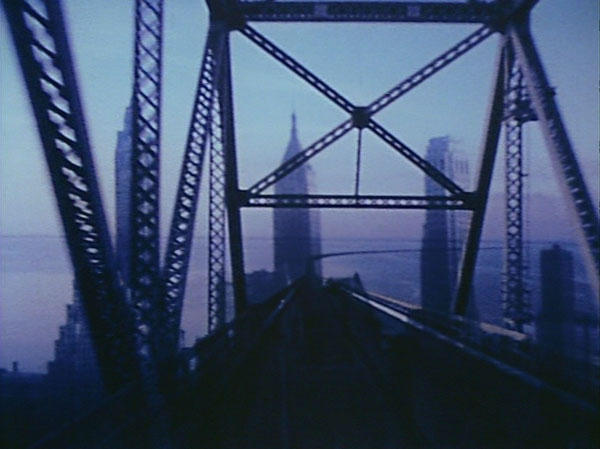
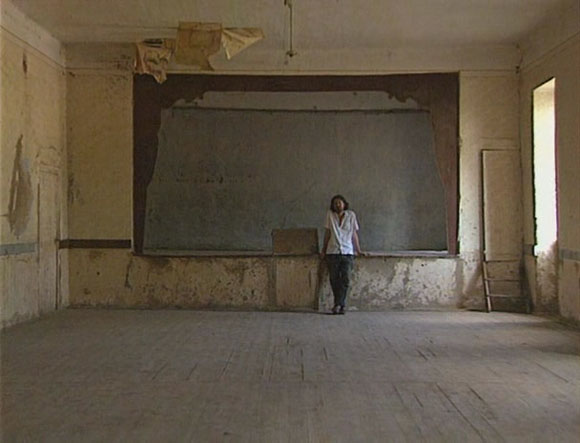
Meshes of the Afternoon (1943, Maya Deren)
One of the great poetic movies of the 40’s. Love when she’s climbing the stairs, bouncing off the walls as the camera twists from side to side. Love the multiple Mayas sitting at a table in the same shot (technically impressive, too). Love the movement, the plot (avant-filmmakers take note: an actual plot), the look, that iconic shot of Maya at the window.

Fuses (1967, Carolee Schneemann)
Fairly rapidly-edited shots of director having sex with James Tenney, with other scratched and weathered colored filmstrips superimposed over it. The editing and content are exciting for about ten minutes, but the movie is twenty minutes long, and silent. Girl in front of me tried reading from the reflected light of Tenney’s alarmingly red-tinted penis on the classroom wall, then texted people for a while. I sat wondering why there were so many shots of her cat staring out the window. Maybe it was supposed to be boring, and that was the point. Worth watching on pristine 16mm, glad I saw it, just saying it felt long. Schneemann has few film credits, but they’re in collaboration with Andy Warhol, Yoko Ono and Stan Brakhage. The Brakhage influence can plainly be seen here, and the film process work makes for some wonderful images. This was apparently a reaction to the objectification of women in movies, with Window Water Baby Moving named as an example. The director: “I wanted to see if the experience of what I saw would have any correspondence to what I felt – the intimacy of the lovemaking… And I wanted to put into that materiality of film the energies of the body, so that the film itself dissolves and recombines and is transparent and dense – as one feels during lovemaking.” Won a special jury prize at Cannes.

Reassemblage (1982, Trinh T. Minh-ha)
Black with ambient sound. Then shots of a rural scene in Senegal with silence. More shots with narration. More shots with ambient sound. More narration. Eventually, more black. The sound is rarely commenting directly on the visuals, and even the ambient sound rarely seems to line up. Shots of bare-breasted African women, daily chores, kids (two albinos!), youth playing in the river, and so on, with comments about ethnography. The commentary might make sense written down, but as we heard it, all scattered and edited (the sound editing was pretty poor), it seemed to circle around some points without managing to make any. Got nothing against the film, was fine to hang out in Senegal for a while. L. Thielan: “By disjunctive editing and a probing narration this ‘documentary’ strikingly counterpoints the authoritative stance typical of the National Geographic approach.”
Reassemblage:
image

First Comes Love (1991, Su Friedrich)
Pop music by the Beatles, James Brown, Willie Nelson and more, but someone please get this woman a cross-fader – it’s all so abruptly edited. The songs sometimes work really well with the images, though. Image is of four wedding ceremonies, astoundingly woven together into an ethnographic study of heterosexual marriage ceremony, interrupted by a text crawl of all the countries in which homosexual marriage is prohibited (every country but Denmark). Bell & Zryd: “This simple strategy, which contrasts the lush life of heterosexual ritual with the stark legal and constitutional realities of gay and lesbian relationships, reframes the anthropological text with political rigor.” Rigor isn’t something I look for in a movie, but avant-critics love to proclaim it. What rigor! Anyway, would like very much to see more of her work.

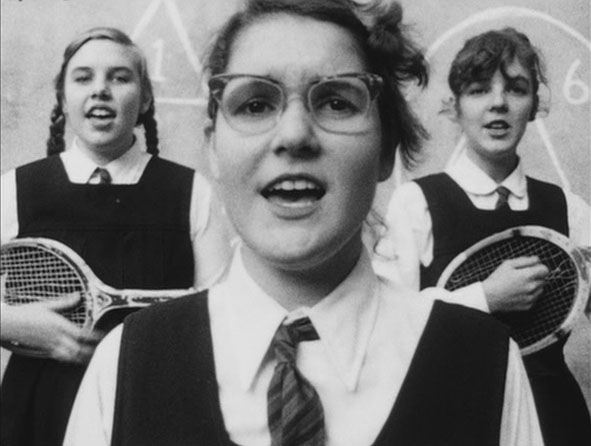
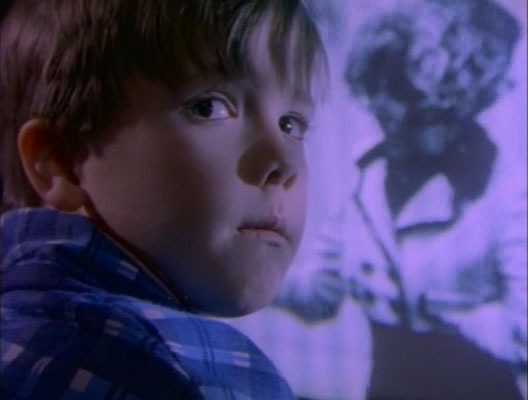
Girlpower (1992, Sadie Benning)
I hear the intro feedback of a Sonic Youth song and all is right in the world. Even though this movie (the shortest of the bunch, I expect) is a half-res crap-quality videotape, the music and narration are clear. About the narration – sounds like either a petulant girl or a woman in performance-art mode… an impressionistic video diary of disaffected youth, comfortable with herself but not with society. Aha, Benning was 30 at the time. Lotta shots of the television. Punk film, but with nicer sound editing than the Friedrich, weird. Short, enjoyed it. Ooh, she’s James Benning’s daughter.

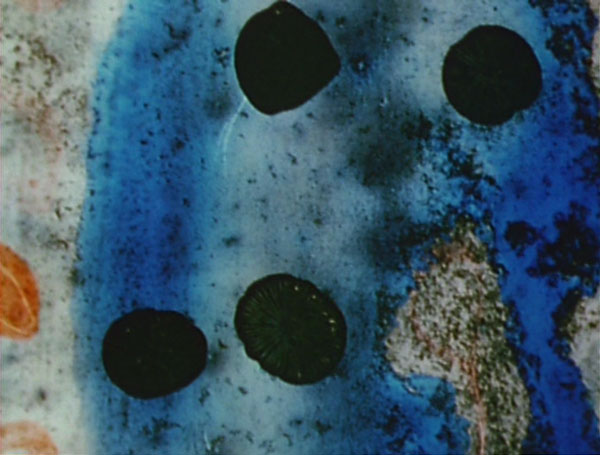
Allures (1961, Jordan Belson)
I don’t know Belson very well, but this reminds me of my favorite parts of Norman McLaren and Len Lye, abstract animation set to music. Not frenetic, slow swirls and twirls, overlapped colored light patterns set to sparse music with dark electronic manipulation (composed by Belson and Oscar-nom musician/humorist Henry Jacobs). Must see again.
image
Allures (c) Jordan Belson

Finger-Fan (1982, Linda Christanell)
Austrian title is FINGERFÄCHER so I thought I’d get something racy for my lunch hour, but no, we’ve got some hands fanning out some fabric on a table… a finger-fan. Synopsis says “objects tell a random story – objects are bearers of obsessions-issuing energy as fetishes,” which might be badly translated or it might not… with the avant-garde it is hard to tell. Camera shoots some objects and photographs, a mirror re-directs part of the frame, there are some basic stop-motion and optical effects, and I remain unimpressed but lightly amused.
image

La Cravate (1957, Alejandro Jodorowsky)
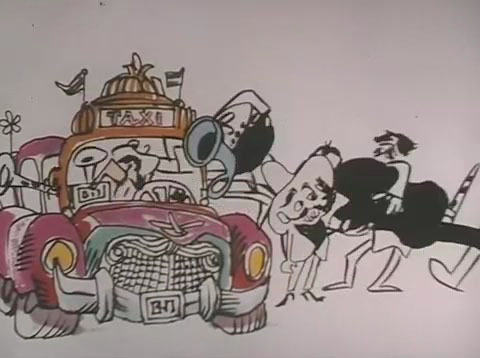
Glad it was short, I couldn’t have taken much more of that accordian score. Goofy mimes swap heads at the head-swap shop while a guy with a silly tie tries to land a girl. Strong, bright colors. I guess the concept of swapping heads can be kind of dark, but otherwise this is like a kid’s fairytale compared to El Topo. Fun movie.
image

The House With Closed Shutters (1910, DW Griffith)
A Dixie-loyal young girl runs a message to the confederate front lines after her supposed-to-be-messenger brother comes home drunk and afraid. When she’s killed (because she was playing like a kid in no man’s land), their mother covers it up by acting like her son was killed and forbidding her “daughter” to ever leave the house or open the shutters. Decades later his old friends walk by the house, he swings the shutters open and dies from the shock.

Dead guy on chair (left) while his mother orders the friends to leave
image

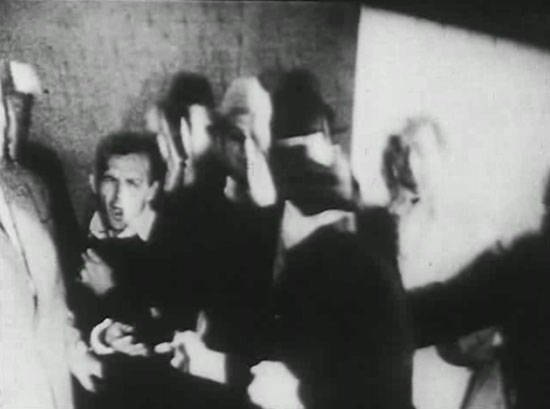
Suspense. (1913, Lois Weber & Philips Smalley)
After the servant quits and leaves the key under the mat, a vagabond takes the opportunity to enter the house, eat a sandwich and stab the woman and her baby to death with a knife. Or he would – but she calls her husband who races home from work in a stolen car followed closely by the cops (who, as cops do in silent movies, shoot their guns constantly not worrying about the casual damage they might cause – not to mention that it hardly seems fair to shoot a guy dead for stealing a car). Worth watching for the titular suspense, and the reaction of the guy whose car the husband stole when he finally catches up and sees the wife & baby safe: a big “well whattaya know” shrug to camera and a pat on the husband’s back. Co-director Weber played the wife.

Sweet split-screen:
image

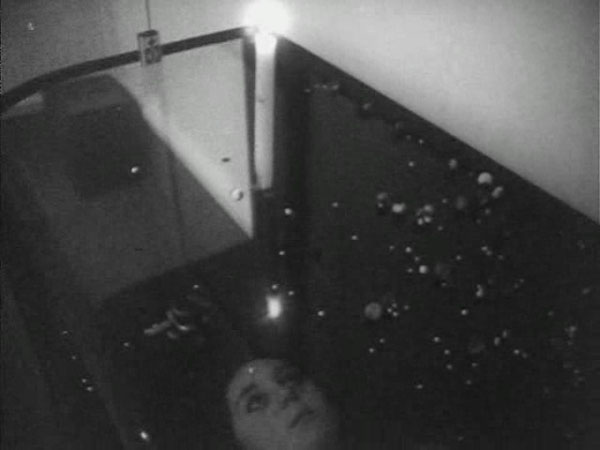
Return of Reason (1923, Man Ray)
Whirling carnival lights at night, nails and tiny beads exposed directly on the film, a tic-tac-toe structure twirling on a string, all in stark black and white. Ends with negative image of a topless woman with psychedelic light patterns on her body.
image

The Starfish (1928, Man Ray)
A reputedly beautiful woman is shown behind distorting glass. A man holds a starfish in a jar. Terrifying close-up of starfish. Mirrors, split-screens and superimpositions. This is nice – how come poets don’t make movies anymore? Adaptation of a poem by Robert Desnos.

image

image

Emak-Bakia / Leave Me Alone (1926, Man Ray)
Twirling, swirling light patterns, spinning prisms, a girl with painted eyelids (paging Mr. Cocteau), broken dice, a tad of stop motion. The notes say Ray uses ‘all the tricks that might annoy certain spectators,’ and eighty years later he has annoyed me. Or maybe I’ve just watched too many of his movies in a row. I’d seen no films by Man Ray, then poof, I’ve seen half of them. Good stuff.

image

Oooh look, her painted lids are half-closed so you can see all four eyes:
image

The Life and Death of 9413: A Hollywood Extra (1928, Robert Florey & Slavko Vorkapich)
Far and away the greatest of these shorts. Intense shadowy miniatures interspersed with close-up photography of actors tells the story of a young hopeful actor defeated by the ruthless Hollywood star system. After he dies, he rises to heaven, where there is always open casting. A predecessor to Mulholland Dr.? Incredible-looking homemade film, very expressionist-influenced. Florey went on to direct 60+ features before moving to television, Vorkapich edited montage sequences for Hollywood films in the 30’s, and assistant cinematographer Gregg Toland shot Citizen Kane.

image

image

Rhythmus 21 (1921, Hans Richter)
“generally regarded as the first abstract animated film”, wow! Squares of light and dark get bigger/smaller, more complex patterns start to appear, pretty slow movement, never gets outrageously intricate, but if it’s the first film of its kind, it’s a great start.
image

Gardner: “Forest of Bliss is intended as an unsparing but ultimately redeeming account of the inevitable griefs and frequent happinesses that punctuate daily life in Benares, one of the world’s most holy cities. The film unfolds from one sunrise to the next without commentary, subtitles or dialogue. It is an attempt to give anyone who sees it a wholly authentic though greatly magnified view of the matters of life and death that are portrayed.”

Gorgeous doc from American anthropologist/filmmaker Gardner assembles this “day in the life” through many days of shooting (either that or he’s the most efficient filmmaker in history), with beautiful artistic shots and editing. There’s a clear plot/progression, as he shows fragments, actions, people, with no indication of who they are or what they mean, then it all gets woven together. The “ladders” being built are stretchers for the dead. The shipful of timber is for funeral pyres. The stone courtyard being washed down is where bodies are prepared. The man bathing in the river is a priest who performs funeral ceremonies. Some shocking images (bodies get dumped right into the river!) but for the most part it’s an awe-inspiring ecstatic film.

Andy opened with Den of Tigers (2002, Jonathan Schwartz), a decent Gardner-influenced short doc from West Bengal featuring people speaking to us in English (so it wasn’t too Gardner-influenced).

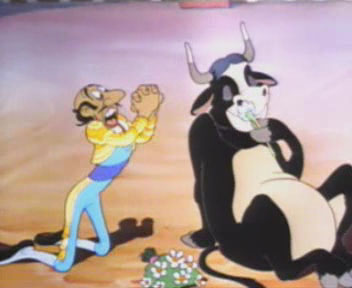
Three Little Pigs (1933, Burt Gillett)
Musical short feat. “Who’s afraid of the big bad wolf” song. Great sound work by Carl Stalling. Uncle Walt did the voice of the brickhouse pig, one of only a couple credited non-Mickey voice roles. OMG, inside the brick house there’s a framed picture of sausage links on the wall with the caption “father”.
image

Mirror of Holland (1951, Bert Haanstra)
Greeeeat movie. He shoots reflections of Holland on the river, then flips the camera so they’re rightside-up. Looks for cool subjects and cool effects off the water. All woodwind and harp music, no narration, gorgeous. Didn’t know there was a golden palm for shorts at Cannes, but this won it.
image

Quiet As Kept (2007, Charles Burnett)
“That little-ass FEMA check sure don’t go very far”
Actors are real actorly, especially the kid (he’s in Ned’s Declassified). Video is real videoey. Script is real good, a sketch about a family of black New Orleans ex-residents post-Katrina, but the movie is ehhh. Oops, All Movie Guide calls it a documentary – bozos. Can’t find anyone talking about this online, probably because when Killer of Sheep came out on DVD, everyone got in line to praise it and didn’t want to look out-of-touch by talking about the not-great shorts it was packaged with.
image

Mr. Frenhofer and the Minotaur (1949, Sidney Peterson)
Distorted film of actors, string music, and voiceover, none of which has anything to do with the other. “To pose, or not to? I love him, I love him not? Or rather, since I love him less already, why not? An old man mad about paint, Frenhofer…” Yep, definitely from the same source as La Belle Noiseuse. “Once upon a time there was an old man who had been painting one painting for ten years. His name was Frenho… for what? … He started looking for a model to compare. All he wanted was the most beautiful woman in the world to prove to himself that his painting was more beautiful than any possible woman.” It’s all in here: Marianne’s man (also a painter) offering up her modeling services, Porbus the art dealer.

The script/narration is pretty swell but I wouldn’t be following if not for having seen the Rivette, and the visual is just nothing to me… a clock, a fencing match, cats, blurry nonsense, movie would be just as good with a black screen. Sorry, Sidney Peterson. Hmmm, at the end a fencer stabs the painter.
image

Eurydice – She, So Beloved (2007, Bros. Quay)
Very underlit ballet. Kinda dull. I preferred The Phantom Museum (and Dracula: Pages from a Virgin’s Diary).
image

Victory Over The Sun (2007, Michael Robinson)
Weirdly shaped monuments and the whispering wind. Would probably help if I could understand what the chanting people are saying. There’s some abstract 3D Animation thrown in. Towards the end goes into sound from some cartoon… Transformers? Some very familiar symphonic music. Pretty nice… I didn’t love it by any means, but I like it better than the disappointing Light Is Waiting.

Waaait, I looked this up online and found all sorts of stuff about it, something about being shot on the former sites of Worlds Fairs, but now I can’t find where I wrote that down.
image

The Wizard of Speed and Time (1979, Mike Jittlov)
Oh My God. This is three minutes of pure joy. Now that I have found this movie, I will watch it always. It’s my new The Heart of the World, using jaw-dropping stop-motion to express pure cinema love. The look is dated, but the music is swell, and Mike is a grinning god.
image

Andy: “Since the early 1960s, Nathaniel Dorsky has been one of the great practitioners of meditative cinema. Projected at the non-standard rate of eighteen frames per second (which he refers to as ‘sacred speed’), Dorsky’s films are an explicit invitation to increase our awareness of moment-to-moment existence and experience a sense of reverence for the visual world.”

Nice program with perfect-quality 16mm prints of four silent twenty-minute shorts. Gotta remember to attend all of Andy’s screenings from now on.

Alaya (1987)
The first one was just shots of sand. Just sand (one special appearance by an insect). No camera movement, but the sand is always moving, blowing in the wind. Goes from wide, wide shots of a huge desert (Death Valley) to extreme super-closeups, the sand crystals looking like boulders on the screen (but boulders that flit about in the breeze). An intensely beautiful movie, my favorite of the bunch.

Triste (1996)
Variations (1998)
The next two were similar to each other, and reminded me of Warren Sonbert (though I couldn’t remember Sonbert’s name until Andy announced that they reminded him of Warren Sonbert). Shots of varying length (8-45 seconds), extremely well-composed, of almost anything Dorsky came across: people, nature, the city. Second one was more exciting, with more quick bursts of shorter shots, and seemed to have a visual theme of seeing, looking, through glass and mirrors. Halfway through the first film the ceiling fan stopped making its rhythmic knocking sound which had made me think of the editing sounds in Zorns Lemma, so I had to imagine my own soundtrack (’twas TV On The Radio for a while). Fun and difficult to try to figure out relations between the shots while watching.

The Visitation (2002)
Then came a discussion, during which Andy talked about film stocks (these were all made on a Bolex, just like Sonbert) and mentioned that of course the second movie was called Triste, which means “sad”, which is why it felt like a lull, edit-wise, between exciting films. There’s all this hidden meaning in these films which the simple likes of ourselves can never understand. I don’t like being made to feel stupid by avant-garde filmmakers so I was determined to assign meaning to every last shot in the bonus fourth movie The Visitation, and I succeeded easily. Visitation = alien invasion. Lots of shots of light from above, and representations of alien bodies (mostly tentacles, via cords and long plant leaves). Aliens have many eyes – we see the eyes, and their view of our world. Ends with a gorgeous shot representing their planetary invasion, two low waves approaching each other over sand, the alien wave easily covering the human wave, but the human wave slowly fighting back at the end, regaining victory. A lot like War of the Worlds.

“A gradual unfolding, an arrival so to speak. I felt the necessity to describe an occurrence, not one specifically of time and place, but one of revelation in one’s own psyche.” -N.D.

Thanks to Andy, I finally had the chance to see one of the most talked-about avant-garde films of all time. While it’s important to talk about experimental film, it’s more important to actually see the damned things – and while anyone can order a copy of Visionary Film for $26.95, it’s nearly impossible to see Wavelength on any given day.

Unfortunately, it’s one of those times (see also The Leopard) when I check out one of the Great Important Works of Cinematic Art and come out less than impressed. I didn’t find the audiovisual experience very enlightening compared to the descriptions I’ve read of the film. Didn’t dislike it (though I came close to disliking the soundtrack) but not an overwhelming experience like Zorns Lemma, either. A few updates to those written descriptions: (1) It’s not a single, continuous zoom a la Last Days – the zoom moves sporadically and the camera slightly changes position from time to time. (2) There’s sound – a sinewave tone that starts low and ends high, with other quieter tones joining it at times and sync sound during the four action scenes. Those action scenes: Woman gets bookshelf delivered, two women listen to “Strawberry Fields Forever”, man dies, girl makes phone call expressing concern that there’s a dead man in her apartment. (3) There’s a twist ending – after zooming the full length of the apartment, the photograph on the wall is of waves in the sea. I get it, ha ha. After reading Sitney and Snow, I see why the movie is interesting, even exciting in theory, but the viewing experience just wasn’t there… wouldn’t want to see it again anytime soon.

P. Adams Sitney: “This is the story of the diminishing area of pure potentiality. The insight that space, and cinema by implication, is potential is an axiom of the structural film.”

Snow: “I wanted to make a summation of my nervous system, religious inklings, and aesthetic ideas. I was thinking of planning for a time monument in which the beauty and sadness of equivalence would be celebrated, thinking of trying to make a definitive statement of pure Film space and time, a balancing of ‘illusion’ and ‘fact,’ all about seeing. The space starts at the camera’s (spectator’s) eye, is in the air, then is on the screen, then is within the screen (the mind).”

Hollis Frampton: dead man:
image

Actors included Joyce Wieland and Hollis Frampton (as the man who dies). Assisted by Ken Jacobs, and sound by Ted Wolff, who unsurprisingly didn’t do any other film sound after this. Snow screws with the camera a bunch: focus, filters, film stocks (supposedly – I hardly noticed), light settings, time of day and lighting inside, etc. My favorite part is one or two frames where the picture on the wall towards which we are slowly zooming is highlit by a sunburst of drawn lines (screenshot below). I’m glad I got to see it anyway, and glad Andy played this and not Warhol’s Empire or something.

image

When I got home, watched WVLNT (2003) and Prelude (2000). The former was a shortened version of Wavelength “for those who don’t have the time” – he cut the movie into three equal parts and superimposed them. Except for the now-intolerable soundtrack, I liked this version much better! There’s much more to look at.

image

Prelude was a cute intro bit from the same Toronto Film Festival that brought us The Heart of the World. It’s hard for me to tell exactly how cute since my copy is such low-quality (think it came from streaming realvideo on the TIFF site), but it seems to be a single camera take, clean picture on a clean set, with unsynched sound edited in all over the place – actors and film crew talking about films in general and the one they are presently inside. This and WVLNT travel a similar road as Snow’s SShtoorrty, with its color-coordinated set, single camera move and superimpositions.

image

Fred has a decent life with his wife, who is expecting a second baby, when old friend (actually an old friend’s ex) Chloe resurfaces and they start meeting in the afternoons. Fred lunches with Chloe, then goes shopping with her, then kisses her, then sees her naked, then almost sleeps with her but runs back to his wife for a tearful finale.

Fred & Chloe:
image

Progressions from the previous films:
– Fred is married with two kids, so stakes are higher
– We meet the wife and get to know her more than we’ve gotten to know the other “chosen girls”, again raising the stakes.
– a dream sequence wherein Fred meets the girls from the other movies on the street while wearing a magical crystal
– At the end, Rohmer beautifully shows us (below) Fred’s decision to cut it off with Chloe and return to his wife instead of having Fred explain it to us in voiceover.

image

Felt self-conscious watching this with Katy, who didn’t like it. Overly-talky French films with protagonists who have crappy ideas about women should apparently be watched alone, cuz I felt fine watching the five other talky entries with cad protagonists in this series.

As Fred, Bernard Verley is the guy I just saw playing Jesus in The Milky Way (he’s very different here, and not just because he has no beard and is not playing Jesus). Fred has better hair and a better personality than any guy since My Night at Maud’s. Zouzou (Chloe) appeared in a 1977 Edgardo Cozarinsky revolution comedy with Dennis Hopper. Guy who plays Fred’s business partner Gerard was in Stolen Kisses and Bed & Board. Fred’s wife, unfortunately, was in nothing else of note.

Fred’s wife is def. more attractive than Chloe:
image

“What Rohmer gets better than anybody else, I think, is the way in which we justify ourselves, the way we talk ourselves into such silly and demeaning but human interactions with people, that we can justify just about anything. He’s one of the great justifiers. He loves to watch these men squirm their way along through life.” – Neil LaBute, director of the Wicker Man remake. It’s actually a very nice interview, a ten minute appreciation of Rohmer’s cinema.

The famous shot:
image

Fred with a dream-sequence girl… is that Haydée?
image

also: Veronique and Her Dunce from 1958, before the Moral Tales. Shot by Charles Bitsch, who did Le Coup du berger and Paris nous appartient for Rivette. Veronique shows up to tutor a kid who isn’t too good at math or composition and likes to ask questions. Then she goes home. That’s really it! Not exactly The 400 Blows here, or even Le Coup du berger, but it’s a likeable little sketch. Veronique would return the next year in Charlotte et Veronique written by Rohmer and directed by Godard – it’s on the A Woman is a Woman DVD. As for this short, I liked the tile floor, and am glad they showed it so often.

Veronique before meeting her dunce:
image

Where did this movie come from, and what happened to it? How come this and Chacun du cinema, anthology films with tons of super-famous directors, aren’t well known and out on video? Paris, Je T’aime did pretty well, right? Whatever… we’ve got two 90-minute anthologies here, “The Trumpet” (the first seven listed below) and “The Cello”. Each has short films with the theme of ten minutes, or else something to do with time and the number ten. Each begins with some light jazz, abstract images of water, then the signature of the director on a black background and the title of the short.


The Trumpet

Aki Kaurismäki – Dogs Have No Hell
image
More dry wit from Aki. Guy spends the night in jail, gets out and has ten minutes until the train leaves for Siberia (via Moscow). In that ten minutes, he finds a girl he knows, proposes to her, buys a wedding ring and gets them both train tickets. Not much in itself, but a good start to the anthology, setting up the whole ten minutes thing.

Víctor Erice – Lifeline
image
A sleeping baby starts bleeding while its twenty-or-more family members are each doing their own thing. Time passes, tension mounts. Someone finally notices the baby and fixes him up, no problem. Great camerawork here! The kid above is listening to a watch he drew on his wrist.

Werner Herzog – Ten Thousand Years Older
image
A sad ten-minute documentary. Twenty years ago in Brazil, contact was made with the last tribe of people anywhere in the world who didn’t have watches and t-shirts and chicken pox. We gave them all three of those things, the chicken pox killed most of them, and now there aren’t many left. Werner, along with a member from the original team, checks up on them. The younger generation is embarrassed by their parents, want to move to the city. The older ones, represented by the war chief (above right, with his brother on left) ponder their fates and the passage of time.

Jim Jarmusch – Int. Trailer Night
image
Chloe Sevigny tries to unwind in her trailer on a film shoot for ten minutes. There are interruptions. It’s pretty, but what else is it?

Wim Wenders – Twelve Miles to Trona
image
Wenders manages to make a ten-minute desert road movie. This is kinda hilarious actually… straight guy accidentally overdoses on unknown hallucinogenic drug, has to drive himself to the hospital in another town ten minutes away. He doesn’t make it, but a passerby gets him there and he’s okay. Looked a bit like one of those Masters of Horror episodes where they mess with the camera to make things look trippy, but it pulled me in pretty well. They played two loud Eels songs from the Souljacker album.

Spike Lee – We Wuz Robbed
image
A compressed mini-doc about Bush II stealing the 2000 presidential election from Gore (with help from the mass media and supreme court), snappy and nicely done, using all interviews and TV news graphics.

Chen Kaige – 100 Flowers Hidden Deep
image
Crazy guy brings a moving company to a dirt lot to move his furniture. Finally they pretend like they’re moving furniture to appease the guy, until one mover “drops” a “vase” and breaks it. Not great, but cute. Wish it didn’t end with an awful, sub-2046 wireframe 3D animation though.


The Cello

Three of the seven Trumpet shorts made me tear up with emotion (hint: Spike Lee yes, Wim Wenders no), but most of the Cello disc left me sad, tired or bored. Huge difference there, but I’d rather have it that way than have the crap diluting the good stuff over both discs. If only the Michael Radford short had been on the Trumpet disc, I could’ve just sold Cello.

Bernardo Bertolucci – Histoire d’eaux
image
I kinda liked this, but it still gave me a sort of “uh oh” feeling about The Cello when it started. Foreigner (Indian?) is in Italy with a pile of other foreigners, confused thinks he’s in Germany. Old guy wanders away from the group asks our man for a drink of water. Our man finds a girl, fixes her motorcycle, marries her, has kids, gets a nice job, buys a car, crashes the car, wanders off from the car crash site and sees the old man still waiting for his water.

Claire Denis – Vers Nancy
image
A dry, academic conversation on a train about outsiders & foreigners, with the writer and one of the actors of Denis’ 2004 feature The Intruder. I haven’t seen Intruder, but this is obviously a companion piece, prequel or commentary on it. It almost put me to sleep, and I wasn’t even tired.

Mike Figgis – About Time 2
image
Figgis was the oscar-nom director of Leaving Las Vegas, but I don’t think the producers of Ten Minutes Older realized that in 2002 his career was on the verge of death after Timecode and the critically bashed Hotel (it would die for real the following year with Cold Creek Manor). This is a nonsense short, shot Timecode-style. So far, it is the least-bearable ten minutes I have watched this year… I was itching to fast-forward.

Jean-Luc Godard – Dans le noir du temps
image
In collaboration with Anne-Marie Miéville, I think this was actually a trailer for Histoire(s) du Cinema. They’re definitely related. The most unfortunate similarity to Histoire(s) is that this was only partially translated – none of the onscreen French text has subtitles.

Jirí Menzel – One Moment
image
A very nice tribute (using archive footage) to Czech actor Rudolf Hrusínský who acted in more than ten of Menzel’s movies and died in 1994.

Michael Radford – Addicted to the Stars
image
Guy travels 80 light years in suspended animation in a space capsule, gets back to earth and doctors say he has only aged ten minutes. Goes to visit his son, who was a young boy when he went away, now a very old man. Movie has an awesome sci-fi look to it, and I liked the story and atmosphere – a very nice short, my favorite of the Cello bunch. Fresh off Lara Croft Tomb Raider, Daniel Craig starred as the astronaut.

Volker Schlöndorff – The Enlightenment
image
Camera zooms around an outdoor party while unseen narrator ponders the nature of time. At end camera flies into a bug light and dies. It turns out we have been a mosquito. Har!

István Szabó – Ten Minutes After
image
Szabó is the Hungarian director of Lovefilm and Sunshine – I haven’t seen anything else of his. A husband comes home extremely drunk and angry, starts storming around the house while his wife watches upset, “what’s wrong? you never drink!”, finally he tries to strangle her, she stabs him, emergency crew arrives in like fifteen seconds, cops question her, the end. Why? I thought it was gonna be all one long shot, but then I saw a cut towards the end, so there were probably a couple others.

Les Miracles de la cene (1988, Pascal Aubier)

Jesus as cheap magician. The water-into-wine and one-loaf-into-many tricks impress the Last Supper crowd, but yanking out the tablecloth doesn’t work as well. Very short, wordless comedy – lovely.

image

Blood of the Beast (1949, Georges Franju)

Wowie, I’d put off watching this short doc because I figured it would be intense and horrifying. Then I had some time to kill at our hotel in Virginia, and there it was on my laptop, so I put it on… a slaughterhouse documentary, hours before going to a fancy restaurant with steak and veal dishes, stupid. So I had to order the fish. Movie has the same fascinating combination of beauty and horror, poetry and death which permeated Night and Fog. A classic, but not one to watch very often.

image

image