The Ugly Duckling (1939, Jack Cutting)
Katy said the baby swan wasn’t ugly enough, but I think it’s that (1) he’s different from the ducks and therefore ugly to them, and (2) when he sees his reflection in the funhouse ripples of the water he appears ugly. IMDB says it was the final Silly Symphony cartoon, but it wasn’t very musical… no songs about what it’s like to be a duckling.

Katy: “They’ve turned The Ugly Duckling into a marital dispute.”
image

Me: “Hey there were six baby swans in that shot! There are only s’posed to be five.”
image


Atlanta (1996, Miranda July)
Miranda July’s performance as both the 12-year-old swimmer and her overbearing mother is wonderful. However, this is “video art”, which means it’s like a short film but it’s full of video static and looks like shit. The sound was defective on my copy, and since it’s all interviews, the sound is kinda important.
image

The Summit (1995, The Bros. Quay)
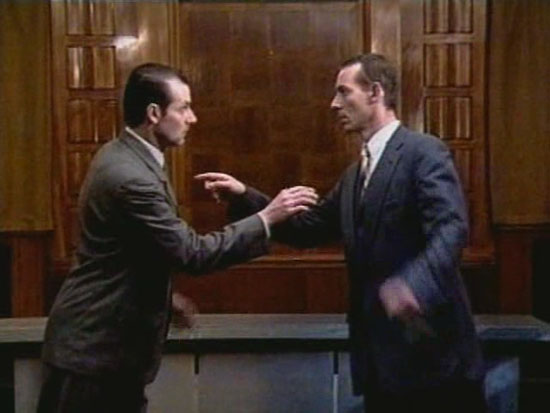
For the first minute I thought “hey wow, the Quays have made something totally different from their usual pretentious goth stop-motion” and I was happy. A few minutes later that thought still stands, but I am not happy. In what language are these guys giving monologues in a featureless room? Oh wait, I get it, “summit”. Funny. Some sites list this as a short satirical art piece, another calls it a 70-minute failed pilot. I saw the short version. The Quays come out and shake their hands at the end. Jonathan Stone, one of the two guys, was in Institute Benjamenta.
image

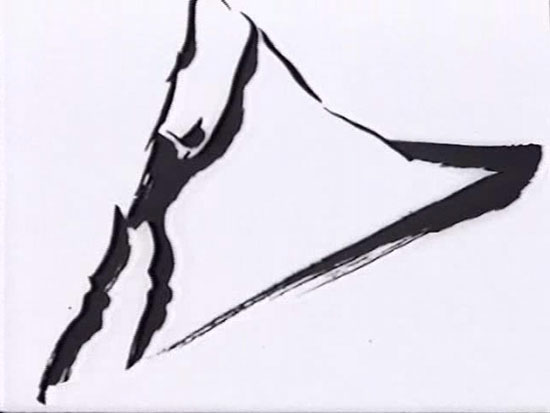
Jumping (1984, Osamu Tezuka)
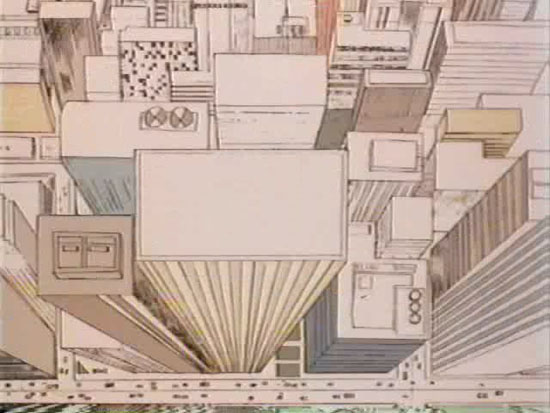
Half a funny concept piece about someone who is an awfully good jumper and the places he ends up (incl. stereotype-africa and hell itself), and half a showoff reel of first-person perspective animation. Excels at both… wonderful.
image

Sisyphus (1975, Marcell Jankovics)
Another showoff reel, this time of bodily poses and stress as Sis. rolls the rock uphill, but this one not as delightfully enjoyable as Jumping, and all full of horrible gasping groaning noises.
image

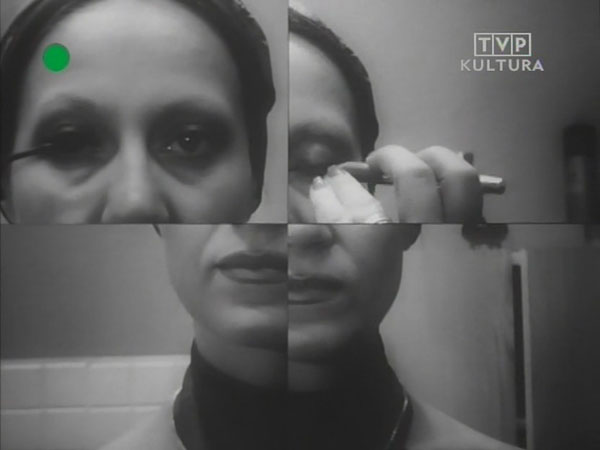
5/4 (1974, Hieronim Neumann)
A split-screen stunt used to more wonderful effect than Timecode (or About Time 2), sometimes seeming to fragment a single image, and sometimes looking like different takes of the same action. Playful. Music is light and quiet and not in 5-4 and there are spacey 70’s-sci-fi sound effects whenever something cool happens, which is most of the time.
image

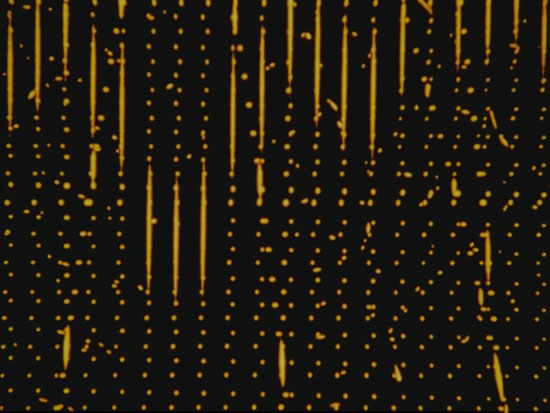
Allures (1961, Jordan Belson)
I don’t know Belson very well, but this reminds me of my favorite parts of Norman McLaren and Len Lye, abstract animation set to music. Not frenetic, slow swirls and twirls, overlapped colored light patterns set to sparse music with dark electronic manipulation (composed by Belson and Oscar-nom musician/humorist Henry Jacobs). Must see again.
image
Allures (c) Jordan Belson

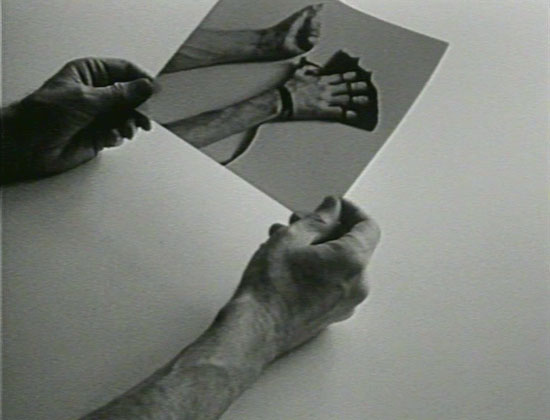
Finger-Fan (1982, Linda Christanell)
Austrian title is FINGERFÄCHER so I thought I’d get something racy for my lunch hour, but no, we’ve got some hands fanning out some fabric on a table… a finger-fan. Synopsis says “objects tell a random story – objects are bearers of obsessions-issuing energy as fetishes,” which might be badly translated or it might not… with the avant-garde it is hard to tell. Camera shoots some objects and photographs, a mirror re-directs part of the frame, there are some basic stop-motion and optical effects, and I remain unimpressed but lightly amused.
image

La Cravate (1957, Alejandro Jodorowsky)
Glad it was short, I couldn’t have taken much more of that accordian score. Goofy mimes swap heads at the head-swap shop while a guy with a silly tie tries to land a girl. Strong, bright colors. I guess the concept of swapping heads can be kind of dark, but otherwise this is like a kid’s fairytale compared to El Topo. Fun movie.
image

The House With Closed Shutters (1910, DW Griffith)
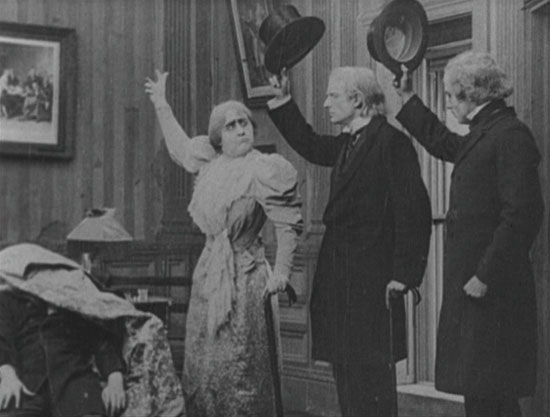
A Dixie-loyal young girl runs a message to the confederate front lines after her supposed-to-be-messenger brother comes home drunk and afraid. When she’s killed (because she was playing like a kid in no man’s land), their mother covers it up by acting like her son was killed and forbidding her “daughter” to ever leave the house or open the shutters. Decades later his old friends walk by the house, he swings the shutters open and dies from the shock.

Dead guy on chair (left) while his mother orders the friends to leave
image

Suspense. (1913, Lois Weber & Philips Smalley)
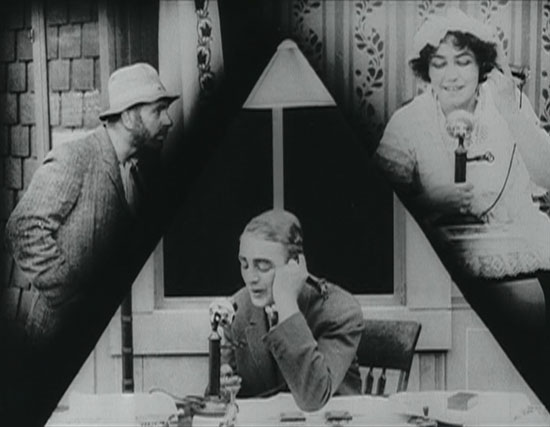
After the servant quits and leaves the key under the mat, a vagabond takes the opportunity to enter the house, eat a sandwich and stab the woman and her baby to death with a knife. Or he would – but she calls her husband who races home from work in a stolen car followed closely by the cops (who, as cops do in silent movies, shoot their guns constantly not worrying about the casual damage they might cause – not to mention that it hardly seems fair to shoot a guy dead for stealing a car). Worth watching for the titular suspense, and the reaction of the guy whose car the husband stole when he finally catches up and sees the wife & baby safe: a big “well whattaya know” shrug to camera and a pat on the husband’s back. Co-director Weber played the wife.

Sweet split-screen:
image

Return of Reason (1923, Man Ray)
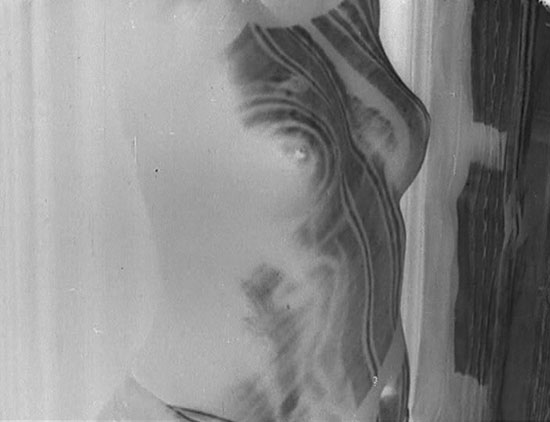
Whirling carnival lights at night, nails and tiny beads exposed directly on the film, a tic-tac-toe structure twirling on a string, all in stark black and white. Ends with negative image of a topless woman with psychedelic light patterns on her body.
image

The Starfish (1928, Man Ray)
A reputedly beautiful woman is shown behind distorting glass. A man holds a starfish in a jar. Terrifying close-up of starfish. Mirrors, split-screens and superimpositions. This is nice – how come poets don’t make movies anymore? Adaptation of a poem by Robert Desnos.

image

image

Emak-Bakia / Leave Me Alone (1926, Man Ray)
Twirling, swirling light patterns, spinning prisms, a girl with painted eyelids (paging Mr. Cocteau), broken dice, a tad of stop motion. The notes say Ray uses ‘all the tricks that might annoy certain spectators,’ and eighty years later he has annoyed me. Or maybe I’ve just watched too many of his movies in a row. I’d seen no films by Man Ray, then poof, I’ve seen half of them. Good stuff.

image

Oooh look, her painted lids are half-closed so you can see all four eyes:
image

The Life and Death of 9413: A Hollywood Extra (1928, Robert Florey & Slavko Vorkapich)
Far and away the greatest of these shorts. Intense shadowy miniatures interspersed with close-up photography of actors tells the story of a young hopeful actor defeated by the ruthless Hollywood star system. After he dies, he rises to heaven, where there is always open casting. A predecessor to Mulholland Dr.? Incredible-looking homemade film, very expressionist-influenced. Florey went on to direct 60+ features before moving to television, Vorkapich edited montage sequences for Hollywood films in the 30’s, and assistant cinematographer Gregg Toland shot Citizen Kane.

image

image

Rhythmus 21 (1921, Hans Richter)
“generally regarded as the first abstract animated film”, wow! Squares of light and dark get bigger/smaller, more complex patterns start to appear, pretty slow movement, never gets outrageously intricate, but if it’s the first film of its kind, it’s a great start.
image