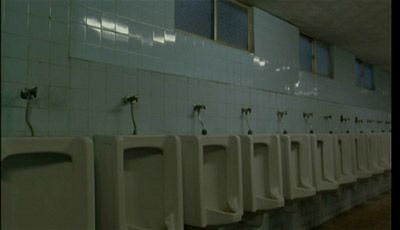
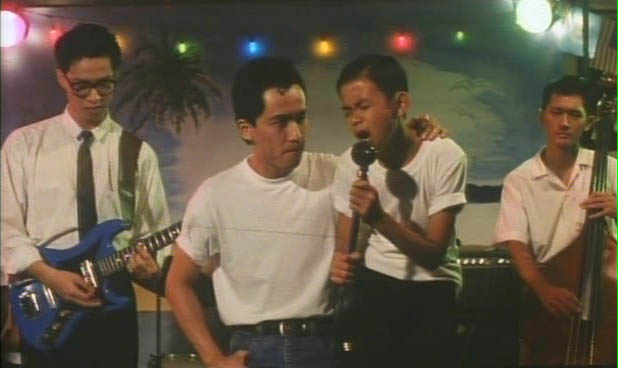
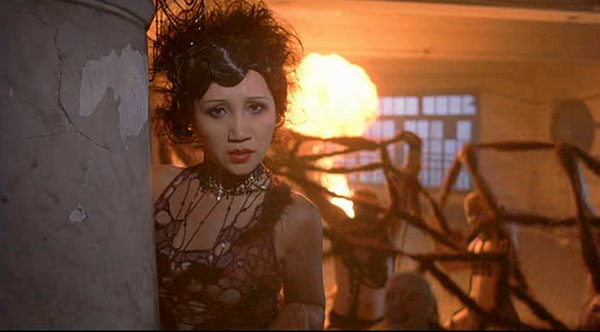
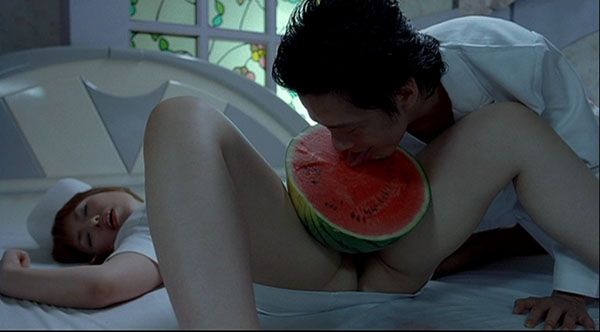
Okay, I am dumbfounded. Just gonna have to look up what others said about this. There were lavish erotic song-and-dance scenes (remember: this is the director of Goodbye Dragon Inn), watermelons, a country-wide water shortage, a friendship between a quirky girl and a porn actin’ dude, and a crazily offensive ending.

image

Apparently it was a giant hit in Taiwan. Not here, I’m guessing. Reading the rave review in Reverse Shot, I’m thinking if this was an American indie movie by a filmmaker with no history, it’d be dismissed as an amusing, well-shot quirkfest-turned-rude. I did kinda enjoy it, but the ending left me with a bad taste in my mouth (HA HA HA). So I disliked both of Tsai’s features I’ve watched, but I’ll inevitably watch more of them, because I am a big sucker.
image

M. Koresky:

If the method to all this madness seems a little hard to decipher, then the final 20 minutes are a terrifying crystallization. The mild courting between Lee and Chen finally intersects with the pervasive sexual exploitation going on upstairs. Yet Tsai’s final, truly shocking images are not bolstered by casual moralizing; rather, we realize we’ve been watching the literal deterioration of a civilization. It’s in the face of Chen Shiang-chyi, and her growing moral awareness, that Tsai finds his emotional outlet. In one of the film’s sole moving shots (if not the only one, but only a second viewing can corroborate this), the camera creeps ever closer to her horrified face as she watches a particularly nasty porn scenario being enacted on the other side of a windowed wall. Her witnessing isn’t voyeurism as much as it is coming to terms with social decline (which she had been staving off through out the rest of the film, endlessly re-filling bottled water and hoarding melons). Here there is no way to reclaim what’s been lost; her head becomes nearly literally impaled on a penis. Nearly dystopic in its portrait of decline, The Wayward Cloud shows Tsai giving up a little restraint. It may be slightly out of control, but the mess suits Tsai well.

image

A.O. Scott:

Mr. Tsai’s placid camera seems unusually restless; the number of zooms and pans reaches double figures. At least as shocking are the fantastically costumed, sloppily choreographed musical numbers, by far the noisiest and most kinetic moments in his oeuvre. These departures, and the explicit sex, suggest an impulse to break new formal ground, but they are also evidence of imaginative fatigue.

Hsiao-Kang was selling watches on the street in “What Time Is It There?” when he encountered Shiang-chyi (Chen Shiang-chyi). In “The Wayward Cloud,” Shiang-chyi has returned from Paris (or so we must infer) to a drab apartment building in Taipei. She spends her time scavenging for water and inhabiting the wide, static shots that are Mr. Tsai’s most consistent signature. She and Hsiao-Kang cross paths and edge toward a glum, twitchy romance, consummated in a final sequence that has already become something of a conversation piece.

With this scene, Mr. Tsai joins the ranks of filmmakers — not all of them French — who have trampled the boundary that separates simulated on-screen sex from the real thing. (A long close-up erases any ambiguity …) But the display is less shocking for its sexual frankness than for its aesthetic crudity. It feels willed, aggressive and unconvincing — clammy rather than cool — in a way that suggests artistic frustration rather than discovery. The water shortage may be a metaphor for the director’s creative desiccation, which his admirers can only hope is temporary.

image

K. Uhlich:

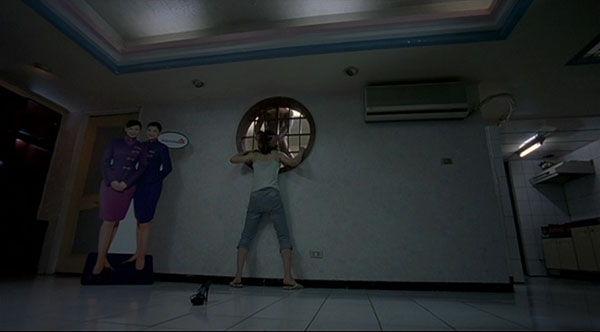
Tsai’s comical sense of alienation, heightened by several ribald musical interludes, makes for uneasy bedfellows with his politically charged and quite baldly apparent thesis: that Taiwan itself is a wayward cloud, trapped between various and sundry pan-Asian interests and influences. If that reads as didactic as it felt to write then we’re one step closer to grasping the film’s highly problematic nature, not that Tsai makes much of an attempt to cloak it. One need only look at the infamous final sex sequence (which, in addition to Lee and Chen, features a comatose Japanese porn star and a Chinese airline stewardess cutout—theoretical signposts both—placed perfectly on opposite sides of a dividing wall) to experience the solidity and conviction of Tsai’s intent.
image

N. Lee:

The Wayward Cloud’s sexual explicitness goes hand in hand with a shift from nuanced melancholy and stealth monumentalism toward garish, befuddled negativity. The result feels … ill-suited to Tsai’s delicate sensibility. … Tsai newbies are encouraged to start anywhere but here and work their way though the contemplative angst of Rebels of the Neon Gods, the plaintive geometry of Vive L’Amour, the moist musical apocalypse of The Hole, and the chic sentimentalism of What Time Is It There?, the most overrated of Tsai’s films, yet an essential prelude to the hardcore what-the-fuck (and why-the-fuck, and who-the-fuck) of The Wayward Cloud.
image

Briefly in 2004 I thought I’d like to be a film reviewer. It didn’t work out – I’d just go on and on like I do now, but instead of writing my own thing for my own self, I was aiming to describe why You, The Reader should be interested in each movie. Ugh. I just read through these again, and the only one I enjoyed was this piece on Goodbye Dragon Inn, though it worked better with white text on a black background.


What does Goodbye Dragon Inn want from me?
image

What do I want from Goodbye Dragon Inn?
image

Some reviewer on the IMDB calls it “spectacularly dull… limp… smitten with its own stasis”.
image

Stylus Magazine calls it “yet another masterpiece… starkly minimal… sublime”.
image

Who is right?
image

They are both right.
image

Incredible movie that I feel terrible for not having seen in theaters. So many wide shots with super-fine detail of masses of people or rock or industrial waste, and that detail is wasted on my ridiculously outdated 480-line interlaced TV screen. Affordable hi-def can not arrive quickly enough.

Watched this right after Derrida, and it seems they had some of the same intentions with the music in the two films (Derrida had music by Ryuichi Sakamoto, who scored Tony Takitani and various De Palma films, and won an oscar for The Last Emperor), but I loved the music far better in this one (music by first-timer Dan Driscoll, so that shows what I know). As for the image, well it’s unquestionably great, and fascinating. The filmmakers follow photographer Edward Burtynsky, who shoots monumental landscapes that have been formed by human interaction – factories, strip mines, the Three Gorges dam. Unlike 99% of documentaries about artists, the rest of the film is just as nice as the photographs, as the filmmakers have an eye for composition and are more interested in learning about the subject matter of the photographs than asking the photographer dumb questions about his art. Political and conservation issues are obviously brought up, given the scale of manmade environmental change visible in the film, but we don’t spend too much time debating those with talking-head experts – movie is mostly content to show us the landscapes (in places that most people never see – not exactly hot tourist spots) and let us see for ourselves. The result is a constantly surprising and gorgeous work, which I will gladly watch again when we can get a higher-res copy.

Katy was disappointed because she thought this was the movie about the guy who shoots whole bunches of naked people (that would be Naked States and Naked World, both about photographer Spencer Tunick). But she liked it anyway, just not as much as I did.

“You women, you know nothing about friendships between men. Besides being suspicious, what else are you good for?”

image

Edward Yang died two weeks ago. The least I can do is watch his extremely acclaimed four-hour movie from ’91 that I bought on bootleg DVD almost four years ago and never watched before.

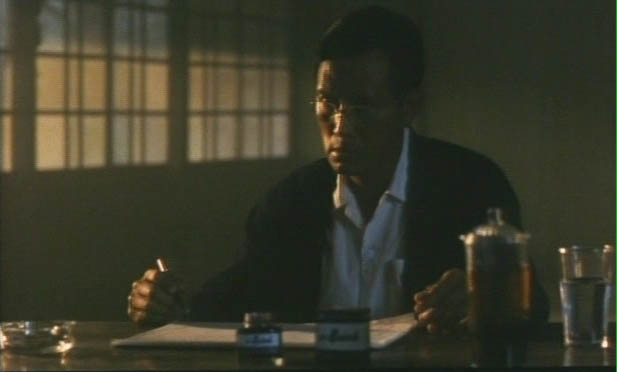
Unfortunately, “there are over a hundred speaking parts in the film and it is necessary to stay focused in order to keep track of what’s going on and to whom, which is a good trick to make sure your audience is always paying attention” (KS Kincaid). And my copy is a fuzzy bootleg disc from a decent-quality print. Not many close-ups and picture resolution is just poor enough that I usually can’t tell who is who. I try to latch on whenever someone says a character’s name, so I struggled somewhat through the storyline and lost many of the side characters and threads. Also there’s the occasional close-up on a letter or page with no subtitle translation. Criterion has done Edward Yang’s Yi Yi, so maybe there’s enough interest that this will get an eventual nice release.

image

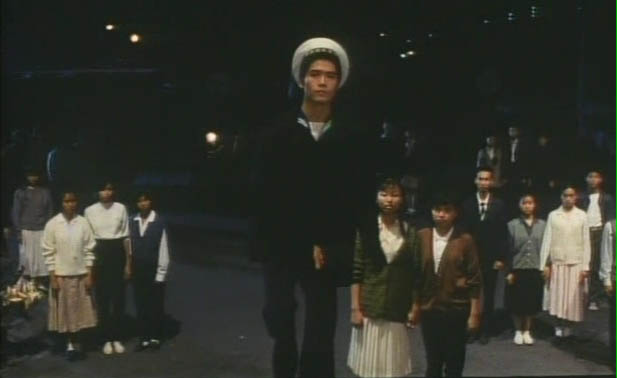
Set in Taiwan in the early 60’s during military rule, an uneasy time according to the intro text, when many kids formed street gangs to strengthen their sense of identity and security. I sort of lost the gang thread, but kept up with lead character Sir and his family (gov’t worker dad, mom, younger sister, MIA older brother Honey) and friends (Cat & Airplane, girlfriend Ming), so when the bloody nighttime gang war (lit only with flashlights during a blackout) comes a half hour into disc two, I wasn’t sure who was slaughtering who, or how come it wasn’t a big deal to anyone the next day after a bunch of people had been killed. Instead, the secret police round up Sir’s dad and subject him to at least one full day and night of questioning and confessions and statements at an ominous ice factory.

image

Ming is actually Honey’s girl, but ends up briefly with Sir. After he gets expelled, she ends up with one of his friends, and is rumored to never have been faithful to Honey in the first place. Sir kills her with young Cat’s sword, a shocking action, but not as senseless as it first seems, given Sir’s history of violence, his idols and friends, everything leading up to the killing.

image

During more innocent times, the kids watch a John Wayne movie (?), send tapes to Elvis Presley, and hang out at the film studio next to the school.

image

The line “Honey’s dead” was probably not inspired by the Jesus & Mary Chain album of that title.

I’m interested in what people who understood the movie better than I did thought.

IMDB reviewer:

Edward Yang’s own father fled from Shanghai. Artifacts from other countries have great impact in this film, the use of Japanese samurai swords which are ultimately used as murder weapons, Russian novels are read by teenagers and understood as `swordsmen’ novels, a family’s observation that the Chinese fought the Japanese for 20 years only to then live in Japanese houses listening to Japanese music, an old tape recorder that has been left behind by the WWII American forces is used to adapt American lyrics and American rock n roll music for the Chinese, the film features American doo-wop music, first love, cigarettes, casual dress, the influence of Hollywood motion picture magazines and movies, the voice of John Wayne can be heard in one of the movie theaters, the title of the film comes from the Elvis Presley song, `Are You Lonesome Tonight,’ a comment on the dark cloud hanging over everyone’s heads, hardly a brighter, summer day.

“Inspired by a true incident of a 14 year old boy murdering a 13 year old girl, the first juvenile murder case in Taiwan’s history, the film opens and closes with an old, broken down radio broadcasting the lists of graduating students.”

“The film is so meticulous in its construction and its feeling of community (its preparation, filming and post-production took several years) that at the same time its length automatically gives it an epic quality it is a remarkably intimate film that is about as far from an epic in the traditional (Hollywood) sense as possible.”

“Like Hou Hsiao-hsien’s City of Sadness, A Brighter Summer Day is not a political film but a work of art that shows how individual experience is impacted by the flow of time and history.”

“The film is laced with nostalgia, but never at the expense of intelligence. He deftly creates a manifesto here that sums up his volatile, often conflicting, attitudes about his country’s modern history. Watching the film, with its seemingly limitless ability to examine the country, one laments the fact that every developing nation doesn’t have a storyteller as gifted as Yang probing the history of its progress.” (Movie Martyr)

Senses of Cinema on Yi Yi: “The film conveys a magnificent sense of life being lived, of time taking its toll on these characters as we watch them, unmatched in world film outside two of the other pre-eminent auteurs of Third World cinema: Abbas Kiarostami and Hou Hsiao-hsien. Yang is gifted with a remarkable sense of framing, alternating between a tighter framing that glimpses into the characters’ interior lives, and a more idiosyncratic framing that removes the characters from the immediacy of the close-up, and inserts physical-psychological-mental space between us and them.”

J. Rosenbaum also compares Taiwanese Yang and Hou with Kiarostami (as well as Makhmalbaf). “Part of what’s valuable about these four directors is what’s also made their films relatively unmarketable here–meditative narrative rhythms combined with a preference for long shots and medium shots over close-ups, an approach that both assumes and encourages analytical distance rather than simple immersion in the action.” “I have no doubt that the 230-minute version of A Brighter Summer Day… belongs in the company of key works of our era. … Indeed, Yang’s film surpasses these other masterpieces in its novelistic qualities, richly realizing a physical and social world as dense with family, community, and other personal ties as any John Ford film, and furnished with more sheer physical presence (including characters, settings, and objects) than any other fiction film I know of from the 90s.”

Oh wow, the actor who played Sir later appeared in Happy Together, Three Times and Crouching Tiger, played Mimi’s boyfriend in 2046 and the lead in Wong’s The Hand.

Hope I get to see this again sometime with better picture clarity… would be worth the trouble.