White doctor Ebbo has opened a clinic in Cameroon and is sorry to be leaving. Three years later Black doctor Alex arrives to find that WD never left and the clinic’s finances and practices are problematic. As the tension ramps up, WD disappears, possibly shot and/or eaten by a hippo.
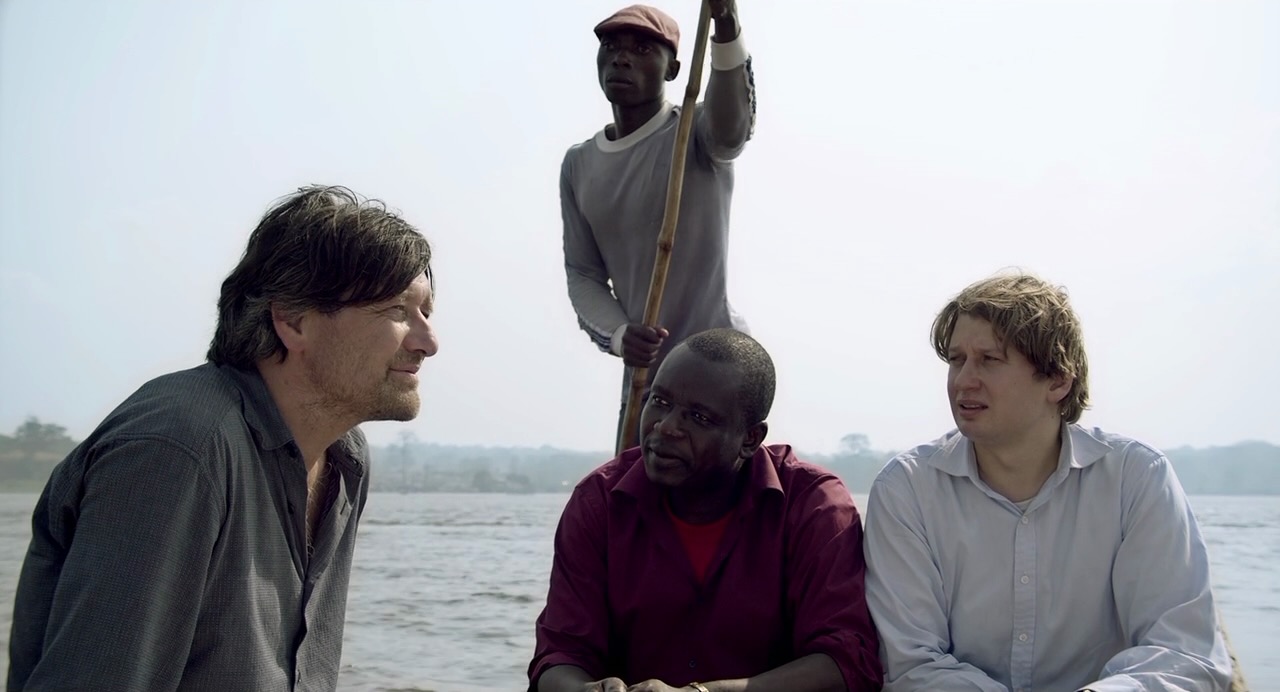
Produced by Maren Ade, this won a prize at Berlin alongside The Turin Horse and A Separation. White doctor was in Prospero’s Books, Black doctor in 35 Shots of Rum, wife in The Strange Little Cat, and fellow white doctor Hippolyte Girardot was in everything, including the last couple Resnais movies. Hippolyte, Hippo… hmmm.

Mark Peranson in Cinema Scope:

The masterstroke in Kohler’s screenplay is how the destabilizing aspects of the narrative place viewers – for entirely different reasons – in the same off-balance mental space as Alex, who comes across as permanently jetlagged, despite the fact that Cameroon and France share a time zone. Something has instilled a bit of the Kurtz in Ebbo, and though Kohler surely has some idea, he leaves the gaps in for us to fill – daring simpletons to proclaim the cause as “Africa” – and then takes it up a notch. In the last extended sequence – one might say the film’s third part – Kohler places us in the nighttime jungle, and lets us get lost again.

Opens handheld with a total Veep gag, an incompetent newsman who turns the camera off whenever he meant to turn it on. Our newsman Armin (Hans Löw, who had a small part in Toni Erdmann) takes a girl home from a bar, makes an ass of himself and she ditches. He goes home to be with his father and dying grandma. Then he falls asleep by the river, and wakes up as the last man on earth.

The movie is into long takes, but not absurdly showy long takes (though a dizzy race through abandoned streets in a stolen sports car is impressive). The sounds of dying grandma, and a dying dog the next day, are prominent and awful, and seem to soundtrack Armin’s helplessness. But then there’s a jump forward by an unknown amount of time…

Michael Sicinski in Cinema Scope:

In cinematic terms, Köhler’s treatment of Armin’s survival is highly unique in that he solves almost all of his major crises in an undefined but clearly substantial temporal ellipsis. Following the time gap, Köhler gives us a completely transformed Armin. In a nearly silent second act, we see that Armin has lost weight, become a skilled horseman, and, most astonishingly, built … a deluxe home with running water, solar panels, a menagerie of useful farm animals, and most importantly, fully reliable shelter from the elements.

Armin has a gas generator but is working on getting his hydroelectric going, to be fully self-sufficient. That old helpless Armin is still with us at times, like when his newborn goat (more notable sound effects: the mama goat giving birth) is stolen by a dog. This is Armin’s introduction to the only other person in the latter half of the movie, Kirsi (Elena Radonicich). And even though the movie has constructed a little paradise for these two survivors, when old “civilized” Armin starts creeping back, Kirsi decides to get back on the road.

Played Cannes in the Certain Regard with Long Day’s Journey Into Night, Rafiki and Border. Ulrich Köhler made Sleeping Sickness, and is not Ulrich Seidl who made that Safari film at True/False – I will try to stop getting my Ulrichs confused. His romantic partner Maren Ade is a producer, and I just saw her name on Synonyms as well.

As for what it all means, see the Sicinski article. Köhler:

For me, the interesting point is that a character who refused to adapt to a bourgeois lifestyle starts building a future once the society he didn’t want to be part of disappears.