First of three Chabrol memorial screenings in September. I remember liking his Le Beau Serge and L’Enfer from the dark pre-blog days, and since then I’ve greatly enjoyed La Rupture and been slightly disappointed in A Girl Cut In Two. Obviously for such a Rivette/Truffaut/Varda/Rohmer/Marker/Godard (not to mention Hitchcock) fan as myself, that’s not enough attention paid to a founding New Waver with over 50 films to his name.

The Guardian’s headline the day Chabrol’s death was announced read “Claude Chabrol anatomised the French middle class with a twist of the scalpel,” which could almost be a poster description of this movie, but maybe changed to “with a blast of the shotgun.” Immediately after watching it was impossible to avoid comparing it to Funny Games – they’re not similar in plot so much as in impact.
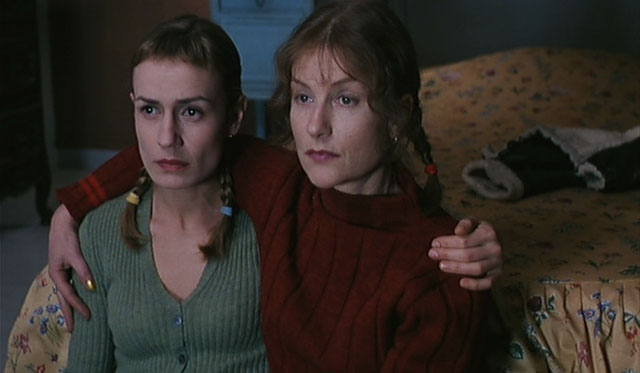
The great Isabelle Huppert (I wonder if Haneke had felt the Funny Games connection when he cast her in The Piano Teacher) got much attention and acclaim for this movie, but younger Sandrine Bonnaire (just off Joan the Maid) is the central character. She takes a housekeeper job for the Lelievre family (Jacqueline Bisset of Day for Night and Under the Volcano and Jean-Pierre Cassel, the amoral baddie in La Rupture), which she performs dutifully and quietly, keeping her personal life to herself, until she starts spending more time with fiery friend Huppert, a postal clerk long suspected by Cassel to be reading the family’s mail.

The two women egg each other on, growing more defiant in the faces of authority (Bonnaire’s employers, the church where Huppert volunteers) and more disturbingly, finding out about each others’ dark, possibly murderous pasts. Seems like a hard place to keep secrets, and Bonnaire’s past has managed to follow her into these distant suburbs. But the one thing she doesn’t want discovered is her illiteracy, so when the family daughter (Virginie Ledoyen of Cold Water & 8 Women) finds out and threatens to tell, it’s the beginning of the end.

Possibly dyslexic Bonnaire trying to read a note… filmed in a mirror (nice touch)

Sure I noticed the blatant introduction of shotguns into the movie earlier (Cassel cleans them in prep for a hunting outing) but I didn’t quite think it would come to this: Bonnaire and Huppert sneak into the house after Bonnaire has been fired for threatening the daughter, and they quietly trash the place while the family watches opera on television, each pretending to enjoy the opera for the sake of the others (that’s how it seemed to me anyway – and I think Cassel really does enjoy it). Then, when discovered stalking the kitchen with shotguns in hand, they blow away the entire family. Also didn’t see coming, despite the blatant early introduction of Huppert’s car troubles, that her getaway stalls in the middle of the road and she’s killed by oncoming traffic (her former employer the priest drove the other vehicle). Killer finale: as Bonnaire walks past the accident scene, emergency workers play the tape machine recovered from Huppert’s car, which was set up by the family son to record the opera but instead faithfully recorded the entire crime.

NY Times: “When Sophie arrives by train to begin her new job, she turns up on the wrong side of the tracks. This film takes quiet, devilish pleasure in every such hint of something awry. For instance, there is the impassive way that Sophie behaves around the Lelievres, and how it contrasts with her coarse, ravenous manner when she’s eating alone.” Senses of Cinema: “In crime fiction, criminal behaviour is often not so much a result of free agency as something determined by psychological and social factors. However, in Chabrol, the urge to explain crime is undermined by the competing view that evil itself is unexplainable. Sophie and Jeanne’s illicit behaviour is not simply a compulsive backlash against class inequality but a curiously ordained ritual.”

Bonnaire likes to watch movies on the TV in her room – I recognized Stéphane Audran from La Rupture in one of them, and sure enough it’s 1970’s Chabrol film Wedding In Blood they are viewing.

J. Reichert in Reverse Shot described it best: “The characters’ constant behavioral irrationality makes the first half of Wild Grass a frustrating watch, but these rougher waters, in which Resnais schizophrenically navigates through genres (thriller, romance, comedy), eventually calm somewhat and the film enters into a groove where possibilities become expansive and the discontinuity becomes the subject in itself.”

Halfway through the movie, it became definitely better than Private Fears and even Not on the Lips. Maybe it’s because Resnais deviated from the novel here, allowed improvisation to shape the script, and reportedly based his humor on Curb Your Enthusiasm. It felt a hundred times more free than those previous two movies – especially over Not on the Lips, which felt like it was being performed by ancient ghosts locked in the same performance for eons (hence the fading-out as they walked offstage). Not sure that I approve of the plane crash idea, and I already know I was paying attention to some of the wrong things so will have to watch it again, but that point halfway through when I realized that the irrationality of the lead characters has spread virus-like into the rest of the movie was my most thrilling moment in theaters this year.

Jeunet has made his brownest film since Delicatessen. Surely City of Lost Children and A Very Long Engagement were very brown indeed, but this one wins the brownness prize of the decade. I was very pleased with this overall – nevermind the haters, it’s more mad Jeunet fun, junkyard contraptions and insane plot contrivances help one obsessed individual win out, yay. Until the minute after it ended… then the whole thing felt kind of empty. I guess Dany Boom (My Best Friend, The Valet) had a valid reason for going after the two big arms companies in town (run by Nicolas Marié, who I’ll only recognize again if he wears those same glasses, and the great André Dussollier of Coeurs and Wild Grass) and I guess the junkyard denizens can help him out, because that’s the sort of thing that happens in movies, and I suppose he sort of succeeds (one CEO goes to jail and the other disappears). But it feels like all the thought went into the mechanisms and mannerisms, and not enough was put into the big picture. If I sound like a cranky newspaper critic, so be it – I felt like one. Maybe it’ll improve on repeat viewing – Engagement did.

More cast. Marie-Julie Baup plays Calculator, a diminutive, bespectacled number cruncher who reminds of the female lead in Delicatessen (and in case you weren’t thinking of Delicatessen, Jeunet drops a non-sequitur reference to that film in the middle of a spy sequence, just like he drops references via highway billboard to Micmacs itself). Michel Crémadès is a junk artist with a smiling, elfin face that seems like it should have appeared in Jeunet movies past, yet somehow hasn’t. Dominique Pinon gets to be his merry self. Omar Sy has a thing for turns-of-phrase sayings that doesn’t really translate (or just isn’t funny, don’t know which). Then you got cutie contortionist Julie Ferrier and parental figures Jean-Pierre Marielle (Coup de torchon, The Da Vinci Code) and chef Yolande Moreau (Amelie, Vagabond).

All I’ve seen from Luc Besson since The Fifth Element has been trailers for The Messenger and Angel-A, so I’ve been thinking of him as this slick-ass hyper-stylist, forgetting the earlier action grit of The Professional. Well, this one takes The Professional, drops a load of dirt on its head and plants it firmly in the 80’s. So it’s got that pre-Reservoir Dogs, pre-CGI version of hyper-stylization, which from today’s perspective makes it hard to discern from its anonymously-directed peers like Predator or License to Kill.

Or maybe I wasn’t paying enough attention because I was busy being horrified by the lead character (Anne Parillaud, who somehow went on to be a Catherine Breillat regular), introduced as a strung-out nihilist who shoots a cop in the face. I wonder if the TV remake used that scene. The movie proceeds to stretch believability even more than Predator, as the government (personified in “Bob”: Tchéky Karyo of The Patriot, Wing Commander) gives her weapons and trains her to be a secret assassin. I thought it really came to life whenever Jean Reno was onscreen, but maybe I’m just a big Jean Reno fan.

Here are three that’ve been hanging about for the last couple months because I haven’t felt like watching any more awful movies lately.

Seven Pounds (2008, Gabriele Muccino)
After flashing-back to the time he killed his wife and six other people because he wouldn’t stop looking at his cellphone, Will Smith lowers himself into a bathtub full of ice and jellyfish. I think he died and donated his heart to Rosario Dawson, because she wakes up seeming all sad then goes and hugs Woody Harrelson in the park. Seeing all these people cry makes me wanna cry. The director made The Pursuit of Happyness which would probably also make me wanna cry, and the writer once did an episode of Sabrina The Teenage Witch.

Blindness (2008, Fernando Meirelles)
I wasn’t expecting this jaunty Thomas Newman-sounding music (it’s not by him), nor this confused, fuzzy montage-looking filmmaking – hmmm, it’s from the guy who made City of God, so maybe I should’ve. This movie would seem to call for more straightforward direction, like Seven Pounds, which looked totally reasonable, but maybe Meirelles doesn’t know how to be straightforward. Anyway, Julianne Moore leads everyone to her house, Danny Glover has an eyepatch and tells some girl he loves her, and then Yusuke Iseya (who ruled as the white clan leader in Sukiyaki Western Django) can see again and everyone is glad. Just like the book, but blurrier.

Swing Vote (2008, Josh Stern)
Montage: two cute girls (Costner’s girlfriend[?] Paula Patton of Mirrors, and daughter Madeline Carroll of Resident Evil: Extinction) are reading mail to scruffy Kevin Costner in front of a whiteboard while media types are gathered outside his trailer. Arianna Huffington has some awkward dialogue, then there’s a Texas debate between Kelsey Grammer and Dennis Hopper staged just for Costner, but then why is Costner doing all the talking? Why, it’s a big patriotic speech to America, in which he declares himself an enemy of America for being a crappy citizen all his life. Hopper didn’t get to say a single word, and we don’t see who Costner votes for – booo! Director Stern previously wrote an Amityville sequel and directed an absolutely star-studded fantasy movie I’ve never heard of called Neverwas.

A very grey-brown movie (because it’s so “real”) about the “real” Jean-Claude Van Damme (“really” named Jean-Claude Van Varenberg) in his “real” hometown, who gets caught in the middle of a “real” action adventure when “real” thieves are robbing a bank (or is it a post office – I didn’t get that part). Not done mockumentary style (in fact, there are some impressive showoff long-shots), although JC does have a talk-to-the-camera monologue in the middle, where he gets real with his fans.

I’ve got nothing against JC (Steven Seagal, on the other hand…) and could’ve enjoyed this if it was more what I’d expected – a fake-reality situation in which JC kicks some righteous ass while getting real about his career. But after a not-much-happening mistaken-identity hostage situation is shown again and again from multiple perspectives, JC finally does kick a dude… in his imagination! Really he’s saved from the thieves by the cops who then arrest him for extortion, haha! It’s so real. Kind of depressing, really. I’ll take the first ten minutes and leave the rest.

Indy Week: “What could have been a crisp little concept movie (how do you say Phone Booth in French?) is instead a limply paced, murky-looking attempt to state the obvious: that big action stars are not, in fact, invincible.” But Cinema Scope calls it remarkable: “By pitting JCVD the axiom against JCVD the person, JCVD deconstructs and deepens the understanding of both. It is nothing if not a triumph of humanism.”

A silly TV western series in which the good guys smile all the time, with an episode written/directed by the great Sam Fuller in his prime (between Underworld USA and Shock Corridor) and guest starring Lee Marvin. In 1884, Marvin shoots gang leader Sharkey (Warren Kemmerling of Close Encounters) and takes over the gang (were they called gangs back then?), plotting revenge on Judge Garth (Lee J. Cobb of Party Girl, Call Northside 777, Our Man Flint) for sending him away years earlier (of course, that’s always why dudes in westerns want revenge on judges). It’s up to our gang of interchangeable white-hats to stop him – and stop him they will, but not before Lee Marvin gets in a good bit of badassery (oh, spell-check doesn’t like that word).

I assume Fuller was working with a rush schedule and stock crew, but he was always a guy who worked fast, so he gets in plenty of striking shots. He also crams the script with literary quotes and references to newspapermen (Joseph Pulitzer is a major presence in the episode). Glad I tracked this one down.

I can’t remember if I finished watching this. I know I watched the first hour, but can’t be sure of anything after that. Or was it only an hour long? Anyway I know two things: one, that I was under the effects of dramamine at the time of the viewing, and two, that I found it disappointingly plain after the advance hype of Davies’ big festival comeback and the nostalgia poetry of his previous features.

I guess it wasn’t universally loved. The Telegraph: “Rarely have I had the misfortune to sit through such a relentlessly maudlin drool of clichés and sentiment. … As a poet of the proletarian past, Davies is no Bill Douglas or Dennis Potter. He has nothing of any profundity to say about time except that it passes.”

A good, if depressing, baseball movie. Funny that it was made in the 80’s and not more recently – a writer today could make some good parallels to today’s baseball fans feeling cheated after the steroid scandals.

Sayles is good with ensembles, and he masterfully introduces most of the players and other characters mid-game at the beginning of the movie. The movie was high-quality throughout even if it didn’t blow me away. I thought each game of the world series was too montagey, though I don’t have a better suggestion of how to get through eight baseball games in a two-hour movie. Katy liked how it showed the strained personal relationships on the field when the team started underperforming – especially strained since some team members weren’t in on the fix and didn’t know why their teammates were playing such crappy ball. I also dug how the sports reporters kept scorecards on possible cheaters, gathering evidence, because who would know better than the reporters what constitutes a dodgy play? Funny how the small-time gamblers (Richard Edson and an under-used Christopher Lloyd) even testified at the trial, apparently having nothing to lose legally. The players were so screwed financially that they agreed to throw the series, and they were rewarded with a little money and with a lifetime ban from the sport.

John Cusack (fresh off Tapeheads) plays a neighborhood boy who grudgingly accepts the situation but tries not to look too bad in public, or get dragged down into the scandal. His teammates: Charlie Sheen (who directly followed this film with Major League), David Strathairn (Good Night and Good Luck) as a shame-filled pitcher, DB Sweeney (The Cutting Edge) as Shoeless Joe Jackson, Michael Rooker (Slither, star of Henry: Portrait of a Serial Killer) as the lead schemer, and Gordon Clapp (Sayles’ Return of the Secaucus Seven) as the frustrated catcher. Also money man Michael Lerner (the movie mogul in Barton Fink) and Comiskey (played by Clifton James of Cool Hand Luke, The Last Detail).