30 Rock seasons 1 & 2

So apparently I like sitcoms now. Katy and I enjoyed this a lot. I don’t want to talk about TV shows (“remember that one episode?”), so instead I looked up the credits.

Writers with movie connections: Tina Fey and Kay Cannon (co-producer of Baby Mama), along with veterans of Norm, Animaniacs, Just Shoot Me, Spin City, The Weird Al Show and Futurama

Directors with interesting credits: Dennie Gordon (Joe Dirt, What a Girl Wants), Don Scardino (lead actor of Squirm), Gail Mancuso (lead director on Roseanne), Beth McCarthy-Miller (Demetri Martin’s show, 200+ eps of Saturday Night Live, the superbowl halftime show when Janet Jackson took her shirt off, Nirvana Unplugged), Michael Engler (Sex and the City episodes), Scott Ellis (an upcoming movie from the writer of Untamed Heart, he hopes), Adam Bernstein (It’s Pat: The Movie), Juan José Campanella (oscar winner The Secret In Their Eyes), Richard Shepard (The Matador) and Kevin Rodney Sullivan (Barbershop 2).

Oh, the guests!
Paul Scheer (as the head page) and his Human Giant costar Rob Huebel, Jerry Seinfeld, Steve Buscemi, David Schwimmer (as “Greenzo”), Kristen Wiig, Edie Falco, James Carville (yay), Andy Richter, Matthew Broderick, Conan O’Brien, Whoopi Goldberg, Paul Reubens (as the last of the Hapsburgs), Isabella Rossellini, Charlyne Yi, LL Cool J (as “Ridikolus”), Wayne Brady, Nathan Lane, Molly Shannon, and hundreds of TV people I don’t know.


The Mighty Boosh season 1

I didn’t care for this at first, but oh boy did it grow on me. I’d like to thank Fumi for insisting for years that I watch it.

Howard Moon (Julian Barratt) started out on Edgar Wright’s Asylum, which I really must watch now that I’ve found a copy. He and Vince Noir (Noel Fielding) were in the seemingly popular Nathan Barley and the barely-known-to-IMDB Unnatural Acts together. Naboo seems to have only ever been Naboo, which is fine by me because he is a perfect Naboo.

Director Paul King made a darkish Gilliam-esque movie called Bunny and the Bull with some Boosh cameos, and worked on a promising-sounding show called Garth Marenghi’s Darkplace.


Stanley Kubrick’s Boxes (2008, Jon Ronson)

A fascinating look through Kubrick’s research with glimpses into his working methods and various obsessions (like collecting stationery, and having a location scout photograph every single doorway in a certain neighborhood, only to have Kubrick end up creating the doorway in a studio). Can’t say I was enthused by Ronson’s role as gleeful narrator, but I’m thankful for his valuable work peeping at Kubrick’s private life and showing us the results (especially dug the rapid-fire location-photo montages set to the music from the Clockwork Orange sex scene). Lots of talk about Eyes Wide Shut and a couple never-completed projects, so I wonder why there wasn’t a single mention of A.I.. Ronson wrote the book The Men Who Stare At Goats was based on, and he hopes he’s written the book Edgar Wright’s next movie will be based on, but he shouldn’t hold his breath.

I guess this movie gets lots of credit for being a Hollywood anti-nazi resistance comedy released soon after U.S. entry into the war. Not a lot of funny Hitler movies going around back then, and reportedly it pissed off some audiences that German-born Lubitsch would try bringing his trademark lightness to such a heavy situation. But if anything, today it suffers from being not enough of a comedy. I couldn’t watch half the scenes without flashing back to The Great Dictator or Inglorious Basterds. Not that it has to go as far as Basterds, letting a couple of Jews machine-gun Hitler at close range as the whole theater explodes, but it came off closer in tone to 49th Parallel than Great Dictator.

One of the things that stood out about Lubitsch’s The Smiling Lieutenant a decade earlier was its pre-censors sexual frankness, and now this one gets away with having Carole Lombard (Twentieth Century star in her final role – she died in a plane crash) cheat on her husband with young bomber flyer Robert Stack (House of Bamboo, Written on the Wind – very early in his career) and get away with it.

Jack Benny (about to ditch the movies for a long TV career) leads an acting troupe along with wife Lombard and also Felix Bressart (Shop Around the Corner), Lionel Atwill (lots of Frankenstein movies) and Tom Dugan (bit player who averaged a movie per month in the 40’s). The play they’ve been rehearsing is censored by the nazis on the eve of its opening, so they go back to performing Hamlet, during which Robert Stack keeps leaving the audience at the start of Benny’s big soliloquy, brushing past everyone in the second row to meet Lombard backstage (why doesn’t he get an aisle seat?). Later at the height of the war, the theater troupe has joined the Polish resistance and Stack is fighting in the UK when a spy (Stanley Ridges of Canyon Passage, heh) with critical information about the resistance makes it into Poland and wants to meet with Lombard to inquire about the “code” he’s been given for her, “to be or not to be”. Stack flies into Poland and fills everyone in, so now the actors have to do their best impressions of nazi officials (Benny: “So they call me Concentration Camp Ehrhardt?”) to get back the secret papers.

The premise got away from me towards the end, when I thought Benny and his gang, having Hitler and a thousand nazis rounded up in a theater, aimed to do some damage. But of course, that’s Basterds talking again – I think they were just trying to get away from occupied Poland by stealing Hitler’s personal plane. Remade in the 80’s with Mel Brooks, Anne Bancroft and Christopher Lloyd for some weird reason.

Opens with grainy shaky videocam footage of cussy drug addicts in an alley who then shoot a girl while on a hectic motorbike ride – meaningful cut to black with the words, in tiny print, “a film by daniel barber,” signaling that this will be an Important Film About Urban Problems (see also: the overbearing music throughout). That’s how Michael Caine treated it in interviews also. Normally Caine wouldn’t be into this sort of grimy personal revenge story of course, but this is an Important Work on a Meaningful Topic, not just some action catharsis. And some viewers even treated it that way – it won a couple of best-film awards – but me, I wanted some action catharsis and found that the movie delivered that well.

Also: Emily Mortimer plays a cop:

MC’s violent spree kicks off (after he has Lost Everything He Had, of course) with a parody scene of extreme urban decay. Caine visits an illegal dealer who sells him a gun while shooting up heroin into his leg while firing a pistol and smoking crack out the barrel while growing pot in his basement while sexually exploiting a young girl while threatening his partner and swearing up a storm and playing loud electro music. Predictably, that scene doesn’t end well, with Caine killing the dudes, taking the guns and burning the whole fucking place, which explodes behind him as he drives the girl to safety. There’s a long action-movie history of vigilante violence by One Man With Nothing Left To Lose Who Couldn’t Take It Anymore, and I don’t see why Sir Michael and crew have to deny that proud tradition and fake like they’re making some documentary expose about the streets, especially when their baddies are so cartoonishly evil. They could do with a few viewings of The Wire. Or hell, maybe street life is really this shitty in England – if so, I’ll take Baltimore any day.

“You’re botching my gramophone!”

Jean-Pierre Mocky (also the film’s writer, who would later write/direct/produce/star in something called Mocky Story) is our rebel star, a fuckup biker who borrows money all over town and carries on affairs with pretty ladies. The sister of the husband of one of those ladies (Anouk “Lola” Aimée) comes by to warn Mocky away, but she instantly falls for him because he is bad. Then he goes home, burns some of his dad’s work papers, and gets arrested and committed to a mental institution.

Movie slows right down, becomes an exposé of institution life, and more importantly, the impossibility of ever leaving. Mocky meets Charles Aznavour (who was in this and Testament of Orpheus before starring in Shoot The Piano Player), who seems alright but falls into seizures at moments of great stress, and the two talk about being (or seeming) cured, or of simply escaping from the facility.

Not my favorite kind of story, but Franju keeps it visually amazing, as he always does. He and cinematographer Eugen Schüfftan (Eyes Without a Face, Port of Shadows) do such a job with the black-and-white, I can’t imagine it being filmed in color (one of these days I’ll get around to watching color Franju film Shadowman). Some memorable moments: a patient gets violent with a saw, Aznavour has a fit during an escape attempt, he and Mocky ride a little train around the facility, the two doctors coldly discuss their patients outside a cage full of doves (symbolism, anyone?) and Edith Scob (below), in her first film, starts singing.

The “good” doctor (if Aznavour can be believed) whose ward is always full is noble-looking Paul Meurisse (Army of Shadows, Le deuxième souffle, Diabolique), and our man’s doctor (distinctive-looking with his beard and spectacles) is Pierre Brasseur (Port of Shadows and Children of Paradise, later star of Eyes Without a Face and Goto: Island of Love). Mocky’s evil dad is Jean Galland (the masked dancer in Le Plaisir, also star of Renoir’s Whirlpool and Pál Fejös’s Fantomas).

Another failed escape: Mocky tries to walk out with Anouk Aimée on visiting day:

Edgar Wright sets out to prove he can do good work without Pegg and Frost. He and cowriter Michael Bacall adapt a video-game-obsessed comic book for the big screen, so many mediums combine – noisily and awkwardly according to Katy, or with a powerful awesomeness if you ask me.

Somehow the Michael Cera thing hasn’t worn off on me yet. Good to see Kieran Culkin as his sarcastic gay roommate, Anna Kendrick of Up In The Air as his sister, and Brandon Routh of Superman Returns as a baddie who gains his powers from eating vegan. Jason Schwartzman as a corporate supervillain was an interesting choice. Had no idea that the main hair-dyed love interest (Mary Winstead) was in Death Proof, that Cera’s band’s drummer played Milk’s campaign manager, that the action-movie-star ex-boyfriend was Human Torch from Fantastic Four, or that Thomas “Dreamcatcher/The Punisher” Jane was a vegan policeman.

EDIT: Watched again in 2013, though it took me a couple tries to get past the beginning and title sequence, which I felt compelled to watch again and again.

EDIT 2016: I have seen this movie lots. It it the best movie.

It’s wise for Judge to dial back the visual ambition from Idiocracy, return to cheaply-shot office and home settings, since the CG in Idiocracy didn’t look so hot in theaters (during the one week it spent in theaters). Not sure why he dialed back the humor and personality as well.

Gene Simmons!

Jason Bateman is a regular white dude who owns a flavor factory (flavor-factory-related jokes in the movie: zero) and hilarious comedy actress Kristen Wiig plays his wife (number of hilarious lines given to Wiig in the movie: zero). Bateman hangs out with ringer A-list bartender Ben Affleck (less funny than ringer A-list bartender Philip Seymour Hoffman in The Invention of Lying) and decides to hire a guy to sleep with his wife in order to gain license to sleep with new hottie scam-artist Mila Kunis (Black Swan). Meanwhile, a factory worker named Step gets testicularly injured on the job and Kunis gets him to hire TV lawyer Gene Simmons (one of the funnier cast members, actually). Hilarity blandly fails to ensue as the movie rolls along on the light charisma of the cast. David Koechner plays a typical Judge character, an annoyingly socially-awkward guy, and the one surprise in the movie comes when Wiig finally unloads on him and he drops dead of a heart attack. Other than that one decisive moment, the script wants to avoid conflict, and plot threads don’t get tied up so much as quietly die off.

I’d never heard of Steve McQueen (the Hunger director, not the actor) or Tom Ford before their latest movies came out, but I sure expected to enjoy the work of “acclaimed visual artist” McQueen more than fashion designer Ford. So as usual I like all the wrong things, because I thought Hunger was alright and this was excellent. Shame about the ending though – Firth decides not to kill himself then has a fatal heart attack moments later, the kind of twist that would’ve seemed well-worn in 1962 when the film was set. But hell, that’s probably from the novel (from the writer of Cabaret, though I didn’t see that mentioned on the posters). Katy says it sounds like a typical literature ending.

Tom Ford (whose IMDB photo looks like a digital mash-up of Keanu Reeves and Kevin Spacey) is fond of jump cuts, slow-mo and focus tricks. He keeps the colors desaturated only to pump them up when his lead character’s emotions are sharp, plays with focus, edits whenever he damn well pleases, and throws in subjective fantasy scenes (like the bomb shelter above), but it all hangs together well, never calling dramatic attention to technique. I guess I could credit cinematographer Eduard Grau (the upcoming Buried) and editor Joan Sodel (Glass House 2) for the technique, but I’m surely not going to. Shout out, however, to Shigeru Umebayashi, whose music grabbed me right from the start (but only returned rarely – he’s just the “additional” composer, damn it).

Firth goes to work on the last day of his life (because he plans to kill himself), teaches his class and inspires spooky student Nicholas Hoult (the boy About a Boy was about) to stalk him. He also wishes death upon his whitebread next door neighbor (Ginnifer Goodwin of that awful movie) and her family, gives some free cash to a hustlin’ Spanish dude (Jon Kortajarena) he meets in the liquor store parking lot beneath an awesome huge Psycho poster, talks to longtime boyfriend Jim (Matthew Goode of Match Point) who died months ago in a car crash, and has a private party with old friend Julianne Moore who’s always had a crush on him. Lots of people have crushes on Colin Firth in this movie.

Shades of American Beauty… the period suburbs (actually Los Angeles but it felt like suburbs) featuring women with perfect hair while solitary men with hidden pain were threatened by gun violence and creepy young men with pointed eyebrows (Wes Bentley/Nicholas Hoult) lurked. Firth was up for an acting oscar but lost to The Dude. I thought the movie was nominated for best picture, but even after having seen both of them, I’m still confusing it with A Serious Man.

Julianne Moore gets down:

After playing the hellraiser in Le Ceremonie, Isabelle Huppert is back to being classy and restrained in this one. She’s the first and third wife of pianist André Polonski – he had a son by his second wife, who died in a car crash. In another part of town, Jeanne (Anna Mouglalis: Coco Chanel in the Jan Kounen film) learns from her mother that she was nearly switched at birth with Polonski’s son Guillaume. Since Jeanne is an aspiring pianist and looks up to Polonski, she takes this as a sign and visits his house, where he offers to give her private lessons.

Huppert and Dutronc:

It’s gradually revealed that icy Huppert, who runs a chocolate company, puts sedatives in the family’s chocolate every night, and drugged Guillaume’s mom the night of her car accident years ago. Jeanne drives off to the store at night with Guillaume in the car, knowing very well that she’s been drugged. Why does she do this, other than to offer us a climactic suspense scene? Huppert ends up like Sandrine Bonnaire in Le Ceremonie and Jean-Pierre Cassel in La Rupture: caught red-handed as the credits roll.

Mouglalis and Pauly, born on the same day:

All sorts of parallels and doubles – each kid is missing a parent, they were (nearly?) switched at birth, Huppert and Polonski were married twice, Jeanne dresses up as Guillaume’s mother – I’m not sure what it all adds up to, but it kept the movie from feeling thin even though very little happens, plot-wise, over 100 minutes. Guillaume is Rodolphe Pauly, who played the soldier who dies and swaps identities with Audrey Tautou’s beloved in A Very Long Engagement, and sharp-featured Jacques Dutronc was Pialat’s Van Gogh, also costarred with Huppert twenty years earlier in Godard’s Sauve qui peut (la vie).

Chabrol:
“Perversity guides its adept (or its victim) to a form of relative solopsism that leads us to provide other examples of relative solopsism; that of the musician, for instance, with infinitely more benign consequences that are nonetheless real. We have tried to illustrate this idea by the slow dissolution of the most definite certainties of our society – here, filial descent, and so the family. The main aim is to get across the idea that all certainties melt away as the story progresses.”

“All style, no substance.”
“That’s what dreams are made of.”

Dr. M, der Spieler:
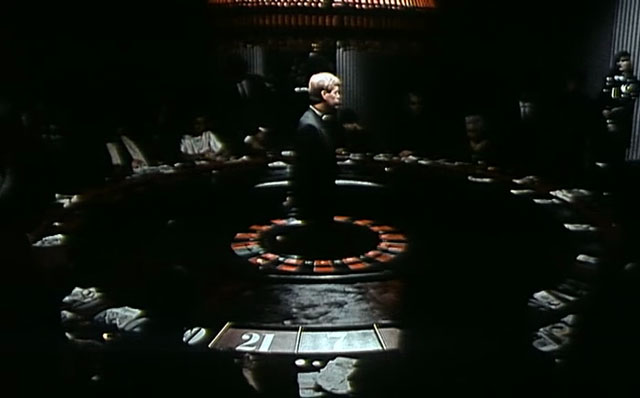
In between two highly-regarded Isabelle Huppert-starring late works by Chabrol, I watched this ambitious, now-obscure Fritz Lang homage. Almost the only mentions of it online appear in sentences such as: “Chabrol’s career wasn’t perfect; he also made disastrous flops for foreign distributors, such as the forgotten turd Dr. M.” So I was excited about the Mabuse connections (they were very slim) and M connections (there weren’t any), but kept very low expectations – then the movie turned out to be quite good.

It never tops the great opening: 3 minutes of cross-cutting between four tense, unexplained segments, each ending with a death, with a TV broadcast keeping time between locations. Looks like a high enough budget, judging from the scale of the fire and explosions that follow. So why did an interesting, high-tension sci-fi movie with good explosions turn into a failure? Well, the storyline and the actors aren’t actually all that amazingly good, rather made-for-TV quality. But more importantly, it’s set in a future where Germany was still divided by the Berlin Wall, which fell many months before the movie was released – so all of the script’s east/west occupation metaphors were seen as laughable by the time it shirked into theaters.

I’m not sure that Flashdance’s Jennifer Beals was the most bankable international star for a prestige picture, either. Beals was also in Sam Fuller’s Madonna and the Dragon in 1990, and Chabrol himself had appeared in Fuller’s Thieves After Dark a few years prior. Here she plays the spokeswoman for a vacation getaway company – Theratos – which advertises incessantly all over the city, cheapo-Blade-Runner-style. Movie was shot in Berlin and has that 70’s-80’s grimy film look, and also stars falsely-gruff-voiced German actor Jan Niklas as our rebel lieutenant hero. So maybe I overestimated the film’s budget.

Jennifer Beals:

Beals is introduced in a nuclear mosh-pit dance club. My favorite fanciful sci-fi detail in the movie is more social than technological – there’s a woman in her seventies drinking at the bar in the club amongst strobe lights and deafening thrash music. The city (or at least the TV news) is obsessed with a recent series of suicides, and Claus, the cop on the case, finds a connection to Beals, in that each suicide was darkly obsessed with her, taking photographs and advertisements with her face and mangling them. Meanwhile, her omnipresent ads for Theratos (pronounced somewhat like Toronto) has language like “drift off, let yourself go, leave it all behind, time to go” as the cops unveil more suicide victims – shades of They Live.

Claus and his partner Stieglitz (Benoit Regent: Binoche’s lover in Blue and the guy who stalks all the girls of Rivette’s Gang of Four for some reason I don’t recall) are the only two cops on the case of the suicides, and eventually, like more than halfway into the movie, they make the incredible discovery that the vortex-turtle medallions found on all the suicide victims are from Theratos! That’s right, the very logo of the company that seems to be the only advertiser in the nation, and they discover this halfway through the movie. Look, you can see it on the wall-mounted motion billboards:

But maybe the reason these two dull-wits are running the investigation is that their superiors are actually the evildoers behind the whole conspiracy. Mustachioed ham Doctor Marsfeldt (Alan Bates of Georgy Girl and the Mel Gibson Hamlet) is our Mabuse substitute, complete with a Dr-Claw-in-Inspector-Gadget array of video screens that can see anything in the city, and balding Captain Engler is his enforcer within the police. I can’t recall if Marsfeldt has some sort of government position or what power he holds over the police, exactly, but he turns out to be the owner of Theratos and father of Jennifer Beals – two things I would’ve thought would be public knowledge about the biggest company and most visible public figure in town.

Dr. M:

Filmed in English, in Berlin, so the rest of the not-great actors have a range of accents and delivery – including Peter Fitz (the lead guy’s sad-mouthed uncle in Werckmeister Harmonies), Hanns Zischler (Germany Year 90 Nine Zero, Kings of the Road) and William Berger (Devil Fish). Zischler plays Moser (pronounced Moo-zuh, reminded of Ma-bu-zuh) – not sure who he was exactly, but he got close to exposing mad doctor Marsfeldt before getting shot in the back by a LASER, one of the few reminders that we are in the future.

Return of the Jedi? No! It’s Dr. M – now with lasers!

I looked up Theratos online but the closest I found was Thanatos, the Greek death demon. I did find David Kalat’s “The Strange Case of Dr. Mabuse,” which has a whole chapter on the movie – counts as the most in-depth writing on the film to be found online, even if Google Books only has half the pages of that chapter. “Theratos is owned by Marsfeldt’s Mater Media. Like a nuclear explosion in which the atomic reaction generates the fuel that keeps itself blazing, Marsfeldt is sitting pretty on a recursive catastrophe. The more people commit suicide, the more desperate the citizens become to escape the city, the more they mob the Theratos offices to book vacations. The more people visit Theratos, the more people commit suicide. And as the cycle consumes more and more unwitting Berliners, Marsfeldt’s companies – Mater Media and Theratos – make gargantuan profits.”

The floating cult of theratos:

Kalat says it’s the last Mabuse movie to date, but as much as I want to believe, I wouldn’t even call it a Mabuse movie. There is, briefly, a character blatantly named Herr Lang. It’s definitely a stylish, intriguingly plotted movie, even if I have story detail problems and the dialogue is sometimes weak. The second-to-last Chabrol feature shot by cinematographer Jean Rabier, who also worked with Varda and Demy.

Engler and Claus:

Oh, anyway at the end the gruff cop hero (whose pregnant wife died 2 years ago, just to give his character some inner pain) saves the girl from crazies and they go off to Theratos, which isn’t as cool a getaway spot as promised by her own ads (as one attendee puts it after being isolated from his wife, “If you can’t screw on vacation, when CAN you screw?”). The cop and Beals do screw at some point, while Dr. M simultaneously watches disaster and atrocity footage on his fuzzy b/w TV – an unnecessarily disturbing detail. Eventually they break into the TV studio and Beals takes to the airwaves, saying some new agey babble about positivity that somehow undoes all the propaganda of the late-night talk hosts (have I mentioned them?) and her own Theratos ad campaign, as across the city people put down their suicide weapons and go on with their lives.

Chabrol:
“Dr. M stresses the fact that we are continuously manipulated… and that political speak has invaded every circle. … This is why, faced with steely-hearted strategy experts and computer brains, I hope that my film will be stimulating, since it does homage to lucidity as our only defensive weapon.”