How come whenever a speaking actor’s back is turned, the filmmaker thinks they can add a dubbed line and we won’t notice?

One of those DVDs I used to excitedly pick up at Tower Records and walk around with for an hour before deciding that it might not be worth $27 after all. Another was La Belle Noiseuse, which turned out to be decidedly worth $27. This one wasn’t even worth the time spent watching it.

As a former animator turned live-action director, Walerian joins (and sullies) the proud ranks of Tim Burton, Terry Gilliam, David Lynch, Jan Svankmajer, Frank Tashlin, the Bros. Quay, Emily Hubley and possibly Brad Bird and Andrew Stanton. I noticed all the snails in this movie and remembered his snail-porn animated short Escargot de Venus from the same year.

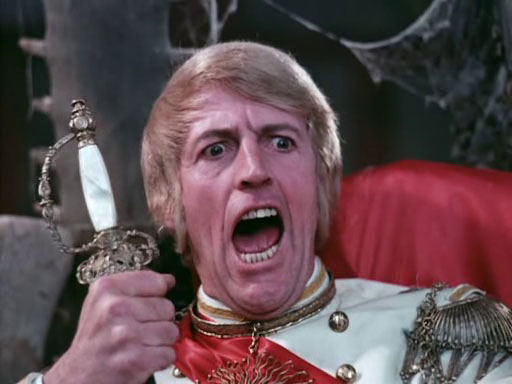
The movie opens with close-ups of horse sex, so I knew it wasn’t going to be elegant, despite its fancy trappings. A rich girl and her aunt head for the French countryside to see about marrying the girl to the French family’s son. But the story is just an excuse for the massive rape scene between “the beast” and some lucky girl.

I don’t know or care which characters were which, but two of the actresses were Sirpa Lane (of unrelated film The Beast In Space) and Elisabeth Kaza (of Castle Freak).

Can’t say it was the worst movie in the world because I kinda liked the harpsichord music.

Almodovar back in his comedy period, and his fourth movie in a row starring pre-Hollywood Antonio Banderas, this time as a released mental patient who methodically stalks then kidnaps actress Victoria Abril (also of Kika and High Heels), basically ties her up until she falls in love with him. It’s possibly the great women’s director Almodovar’s least feminist film in that respect.

Before the kidnapping, Abril is starring in the final film of director Francisco Rabal (Nazarin himself). He wants reshoots so people are looking for her, plus Antonio has the actress’s sister to deal with, as well as a drug dealer (Rossy de Palma) he ripped off. Happy ending, but Katy still didn’t love it because kidnapping isn’t funny.

What a thrill – Morris’s most energetic movie yet. The story of a certain litigious woman (let’s call her J) and her exploits – in her own words, and from the perspective of a couple insiders (a pilot she hired, a dog-cloning scientist) and outsiders (two tabloid journalists and an ex-mormon radio host). The result is what Morris calls a “Looney Tunes Rashomon,” in which you can never quite be sure of the true events because each side is enthusiastically, entertainingly promoting their own version.

The events in question: in 1977 J’s boyfriend/crush went away on a mission (or was kidnapped by the Mormon church). She assembled a militant team to rescue/kidnap and deprogram/rape him, depending whose story you buy. When the story came out, the tabloids hit her hard, finding and publishing supposed evidence that she’d been a sex worker. Towards the end of the movie as we’re running out of details and stories regarding the 70’s incidents, J lives alone with her dog, still pining after her now-married Mormon boy, when the dog dies – so she has him cloned in South Korea, and now lives with five perfect replicas of her former dog. The events in J’s life would be notable in themselves, but the genius of the movie is all in the telling. The editing is a little jittery and jumpcutty for my liking, but the welcome absence of the Mr. Death-style re-enactments and the wealth of valuable stock photos and the cool tabloid-headline graphics make up for that.

Morris:

I like this new film because it’s a return to a kind of absurdist version of what I do. I love the oddities of how people express themselves. Take [tabloid journalist] Peter Tory’s affection for the phrase “spread-eagled.” Every time he says “spread-eagled,” and he says it again and again and again, I ask myself, “Is he making this up? Is this tabloid journalism in its essence?” At one point, he’s talking about the “sex in chains” headline, and he says, “I think it was ropes, but chains sounds better.” Tabloid’s a story about narrative, about how stories are constructed as they’re being told. I wanted to achieve that effect in a movie, and I hope it’s there.

Surprise – a comedy that I liked. Guess it’s not that much of a surprise, since it’s written by Nick Frost and Simon Pegg. The movie is one long chase, with them trying to help an alien return home. Biggest surprise is that the more action-packed second half is better than the first – the comedy doesn’t let up when the car chases and shootouts ramp up.

Agent Jason Bateman’s secret is that he’s Paul’s friend, was trying to get to him in order to help, which is why he’s a dick to agents Bill Hader and Joe Lo Truglio. The movie’s secret is that Sigourney Weaver plays the big boss, but she talks on the radio often enough that I figured it out from her voice. A defiantly anti-Christian movie, announcing its pro-evolution message early on (and repeatedly) then expanding that to a straight-up “god doesn’t exist” message. References most of Spielberg’s early movies. Maybe it’s because I watched on my little TV, but Paul may be the first CG creation that I accepted as a character instead of always thinking of it as an effect.

The most anti-feminist crap imaginable – could’ve been hilarious camp if it wasn’t so boring and traditional. Each character seems close to expressing some kind of definition or interest before the movie yanks them back into its safe, bland, kiddy-pool world.

Debbie Reynolds (Susan Slept Here) is a successful New York actress, takes time off at her vacation house in Connecticut with her associate Eileen Heckart (Burnt Offerings, The Bad Seed). But they find six children with step-parents even more cartoonishly terrible than the ones in Million Dollar Baby. Debbie, naturally, throws her career away to live in the country and care for them – but first, whom to marry? Her slick New York agent who’s had a crush on her for years, David Janssen of Marooned? Or hunky local-hero minister Cliff Robertson, star of Underworld USA? It’s a no-brainer!

From the director of the great Mystery Science Theater short Once Upon a Honeymoon, the one where the woman sings about wanting a telephone in every room.

A fully excellent “neo-noir” with Panic Room levels of tension, slick and confident, and such a perfect cast. I only know the lead actors from one decade-old movie and physical characteristic each: Gina Gershon (Demonlover/big lips), Jennifer Tilly (Bride of Chucky/high voice), Joe Pantoliano (Memento/also high voice) but it seems they deserve more. And considering what great performances the Wachowskis got out of them, it’s surprising that their follow-up films were mainly known for great visuals and cardboard acting. I guess they are genre chameleons – a noir needs complex humans and sci-fi/comic films need flat Phantom Menace acting to not distract from the computer graphics.

Gangster moll Jenny Tilly falls for handyman lesbian-next-door ex-con Gina G. and they plot to steal two million from Jen’s man Joe. But will they pull it off, and will Jenny really stick with Gina and vice versa, when betrayal would be so easy? Yes, a happy ending. Every male character in the entire movie gets killed, and the two actually end up together. Some noir.

Among the dead: Richard Sarafian (director of Vanishing Point) as the big boss, Chris “Law & Order” Meloni as his trigger-happy son and John P. Ryan (its father in It’s Alive) as the secondary mob guy who comes looking for the others. Couldn’t find any good articles on the movie, only ones that are interested in how gay the movie is (answer: not gay enough for the people writing the articles).

“What a charming evening we might have had if you hadn’t been a spy, and I a traitor.”
“Then we might never have met.”

Another Sternberg/Dietrich movie, and this one just kills The Blue Angel, which I thought was overbaked and had too little Dietrich. Here not only is she perfectly lit and doing a better acting job throughout, but the story is a wartime (1915 Austria) spy vs. spy drama, all romance and excitement, more alive and relevant than the period self-punishment of Emil Jannings. Sternberg seems fully comfortable in his sound world now, maybe not pulling as beautiful images as in the silents, when it was all image, but making a movie that fully works. Some good expressive lighting (backlit against windows when she lets Victor escape) and long-held cross-fades.

Marlene with Austrian secret service man Gustav von Seyffertitz (Hymn Book Harry, who performs the wedding in Docks of New York):

The opening titles prepare us for tragedy and sexism, telling us that codename X-27 “might have become the greatest spy in history… if X-27 had not been a woman.” This is referring to the ending, when she lets the enemy spy she loves escape before his execution, which leads to her own. But of course the reason she’s a great spy in the first place is that she’s a woman, able to seduce and sleep with (whoa, pre-code) enemy officers in order to steal information, the Black Book of its time.

At the start, war widow Marlene is out streetwalking to pay the rent (whoa, pre-code!) when she picks up a gentleman with a droopy ‘stache who tests her patriotism, pretending to try recruiting her for anti-Austrian work, and when she has him arrested he reveals that he’s the head of Austrian secret service and actually wants to hire her for pro-Austrian work, argh.

Warner “Charlie Chan” Oland as the spy who shoots himself:

Some veils, feathers and masks later, she’s at a party with more confetti and streamers than I’ve ever seen in one place. She acts interested in Russian Mustache Spy and retires back to his place, where she discovers his secret spy stash, all the while acting super-fucking-cool while he creeps away and kills himself.

The colonel is Victor McLaglen, Lon’s strongman sidekick in The Unholy Three who’d win best actor for The Informer a few years later:

With a distinctive smile like Victor’s, what use is a mask?

Off to unveil the secret identity of the dead spy’s undercover colonel friend from the costume party, which is simple since he has the most excellently recognizable sinister smile. And a cute little mustache – every man has a mustache.

The colonel is onto her spying ways – she’s got him, then lets him escape. She goes to Russia and acts as a timid housekeeper at enemy headquarters, then back home where she sees the grinning colonel again and lets him escapes. Sentenced to death, she asks only for a piano and “any dress I wore when I served my countrymen instead of my country,” so gets killed by rifle squad in her feathers and veil.

Pre-execution, at her piano:

“They talk too much to be happy.”

Descriptions of this film focus on the blank-faced young married couple in crisis, visiting the fishing town where he grew up, debating whether they should stay together. But the couple seems to appear in about one third of the movie. The rest is about the town itself and its residents – daily fishing, problems with the law and health board, a teenage couple who want to start dating, a jousting competition in the river. Since most of the movie defies plot summary, the married couple gets more attention than they maybe deserve.

He says something like “you change your mind so much, I’m always a day or two behind.” And I’m so glad I never finished watching this with Katy (she made it about 20 minutes in), because most of their conversation is about their failing relationship, whether or not they’re in love and should break up. Katy will take this personally and think I’m trying to ask these questions indirectly myself. Also any movie containing any sadness makes her sad. Best to stick with Hello, Dolly!

Resnais-style camera moves (he was the film’s editor – the same year he made Toute la memoire du monde), some highly posed, French-poetic shots of the couple, which are all the more arresting against the reality of the small fishing village. But Varda doesn’t shoot it like reality. The sea, the clotheslines and nets, the shacks and neighborhood cats all look like an expensive set, arranged for the pleasure of her camera. An unbelievably accomplished debut.

Of the two actors, Silvia Monfort was in a couple movies with Jean Gabin, also a Robert Bresson movie I’ve never heard of, and Philippe Noiret was the uncle of Zazie dans le metro, also in Topaz and Coup de Torchon.

Ydessa, The Bears, and etc. (2004)

I like documentaries with twist endings. There’s a shocker at the end of artist Ydessa’s gallery display of thousands of framed photographs of people holding teddy bears: a bare-walled third room containing only a mannequin of Hitler, kneeling as if in prayer. Ydessa’s parents were holocaust survivors, and some of their family members didn’t survive – the exhibit is dedicated to them. I didn’t warm up to Ydessa very much, but I like the layout of her exhibit, the photos themselves and the film.

Nice Varda-esque touch: Ydessa says she’s created a fiction that looks like documentary: that everybody is happy and has a teddy bear. “Reality and fiction – I’m somewhere in between.” And of course in her montage of photos from the exhibit, Varda sneaks in a photo of herself as a child.

7 P., cuis., s.de b… (1984)

I think the title is real-estate shorthand for “seven bedrooms, kitchen and bath.” Shot in a former hospice during an exhibition created by Louis Bec, who played the older father. So I’m not sure which of the visual ideas came from Bec and which from Varda, but it’s a remarkable little film. Unseen realtor is showing this property to unseen doctor, the doctor moves in, starts a (large) family which grows up fast. They go through a couple maids and their oldest daughter gets a boyfriend and rebels against her father. Older yet, and the father has died. The rooms go from bare to slightly dressed to crazy – the bathroom totally covered in feathers at one point. Characters speak through each other, repeating phrases like in Marienbad.

Yolande Moreau, who’d play a chef in Micmacs:

You’ve Got Beautiful Stairs, You Know (1986)

A celebration of the Cinematheque and its front steps, intercutting with famous film scenes set upon steps. Some semi-re-enactments – I liked the buggy tossed down the steps, Potemkin-style, and the mildly concerned man at the bottom who leaned over to check that nobody was inside.

SHOCKtober is over in a big way (yes, I’m a month behind – what of it?). A colorful trifle, with fine music and dancing, and a fluffy plot blown up to double its natural runtime by extending every tune, adding a final verse and chorus at half speed for audience members too dull to get it the first ten times. Individual scenes aren’t poorly paced – the centerpiece restaurant scene is well-timed with a good energy – the movie’s just trying to be elegant by drawing things out.

Katy and I both thought that Streisand was very good and Matthau was a weird choice for a musical. We weren’t sure why Streisand wants so badly to end up with such a stinker as Matthau – though he is a half-millionaire and she seems to have transformed him into her beloved ex-husband by the end. Katy also recognized Gene Kelly’s style in the dancing, though he’s not the listed choreographer. This was the second-to-last feature he directed, not long after his Young Girls of Rochefort role.

Streisand (who had just won an oscar for her debut film role in Funny Girl) is a widowed matchmaker who’s tired of being alone herself. So she sabotages her current job – hired by grumpy feed-and-seed owner Matthau to hook up his niece Ermengarde with a nice boy of higher standing than her chosen sweetheart Tommy Tune (“possibly the tallest dancer in the country”), Streisand instead schemes to keep the two youngsters together, hook herself up with Matthau, and distract Irene, the city hatmaker Matthau has been dating, by foisting his head store assistant (Michael Crawford of a couple Richard Lester comedies) upon her. It all ends up with a hide-and-seek dance competition in a huge fancy restaurant, featuring (for a minute) Louis Armstrong.

A huge hit in 1969, yet also a huge flop because it was monumentally expensive. It had an unexpected resurgence in DVD sales after being featured in Wall-E. The play by Thornton Wilder (Our Town, Shadow of a Doubt) had been filmed before (including in 1958 with Anthony Perkins and Shirley MacLaine), but this was adapted from the mega-hit Broadway musical version.