Ooooooooooooooooh…

The claw!
Ooooooooooooooooh…
The claw!
For a few minutes I was mad at the Tara for projecting the film out of focus, not an unreasonable thought given previous disasters at that theater, but then I realized the movie was shot on low-grade DV – probably a good financial choice for a two-person three-year project, but less than ideal for landscapes, which the camera turns into mud. A would’ve-been-lovely shot of pack horses parading before distant mountains ended up looking like a blurry painting. K Uhlich agrees: “As subcultural anthropology, it’s unassailable. Yet the often ugly-looking DV aesthetic dilutes the cumulative effect. For every gorgeously low-res image (a blobby, white sea of sheep racing heedlessly toward their pen), there’s a correspondingly ineffectual visual or vista that one wishes had been captured with higher-end equipment and a keener cinematic eye.”
Jimmy wasn’t bothered by the camerawork so much as the editing, saying that each shot lingered too long, which became cumulatively frustrating. But we agreed it was neat overall, even if most of its value was in teaching us city folk how ranching works.
Perhaps I’ve suffered my own bout of amnesia because I already can’t remember much of this movie. I remember it wasn’t as rapid-edit-afflicted as I’d heard, but then I realized that’s the two Paul Greengrass sequels that people have said each contain so many edits as to render the entire film a work of abstraction. I don’t see how that would be desirable, but I’m willing to give it a go. This one is by Doug “Swingers” Liman, who somehow pulled off a very competent, not over-stylish, gripping action movie before immediately falling under Greengrass’s shadow when Liman’s follow-up Mr. and Mrs. Smith was a critical bomb. Co-written by Tony Gilroy, all of whose movies I’ve been enjoying lately.
Matt Damon wakes up on a fishing boat after apparently having a change of heart about killing an African leader. The CIA doesn’t need an ex-superkiller roaming around, slowly regaining his memories along with a newfound conscience and thirst for vengeance, so bosses Chris Cooper and Brian Cox send bunches of faceless assassins (silent badass Clive Owen stands out just because he is Clive Owen) to stop him and hapless co-traveler Franka “Run Lola Run” Potente. Even with no memory (or because he has no memory: discuss) Damon is a super-effective instinctual ultra warrior who outthinks and outfights many assassins and possibly kills either Cooper or Cox, I don’t remember, before earning his Shawshank island retirement scene at the end.
“It all began on a summer night in 1987. The idea for a television series based on Greek culture had just crystalized and we were facing a spectre which haunts the realm of the cultural documentary and that Chekhov defined for eternity: to say things that clever people already know and that morons will never know.”

Marker hosts banquets across the world and interviews subjects one-on-one (in front of giant pictures of owls), discussing Greece. Mostly it’s school, like a PBS doc without the music or the constant zooming around ancient photographs. Hard to stay interested, since I had no real curiosity about Greek culture, only a curiosity about Chris Marker’s movies (in the credits he’s listed as “skipper” and producer Jean-Pierre Ramsay is listed as “long-distance calls”).
Each episode is preceded by a disclaimer from the billionaire Greek funding agency distancing themselves from its content… way to go there, Chris. Something must have upset the rich people who thought ancient Greece would be a harmless, noble topic. Maybe it’s when Richard Bennett in episode six says: “Pythagoras was a great man. He was in the same league – I may shock some people here – as Moses, Buddha and Jesus Christ.”

–
1. Symposium, or Accepted Ideas
Droney keyboard sounds behind scenes from Olympia mixed with war films. One minute later we are looking at a storehouse of sculptures, supposedly underneath the roundtable discussion, and I’m already put in mind of Statues Also Die.
“This was an extreme example, but the fact remains that Greece, or at least the idea of Greece, has been used to fuel the spirit of totalitarianism, and it still does now and then. All the more need, then, to look for that Greek word which is theoretically the safest antidote to totalitarianism… the word “democracy.”

“We have this horrid image of Greece as a land of light and harmony. Abysmal nonsense. Greece is a land of incest, murder, where Oedipus blinded himself … In Greece, moderation and order are won against reality and not as their birthright, hence their obsession with aphorisms. ‘Be moderate.’ ‘Do not exaggerate.’ I can’t imagine a Swiss or a Dutch with such obsession for moderation. The Greeks are obsessed with it, obsessed with going too far, because it’s their natural tendency.” – Cornelius Castoriadis

–
2. Olympics, or imaginary Greece
It’s not in fact about the olympics, but about modern Germany’s relationship to and interpretation of Greek culture. The series can’t go on like this for eleven more episodes, can it? Interviews of people speaking in general terms about Greece and its perceived contributions to the current world? I will get bored.
Film clip of naked rituals from Paris 1900, a documentary which young Alain Resnais and Yannick Bellon both worked on, produced by Pierre Braunberger
Renate Schleisser:

Manuela Smith:

–
3. Democracy, or the city of dreams
Democracy vs. oligarchy, and the terrible truth behind greek democracy. Nice cut to a clip of George Bush Sr. right as a guy says “the large amount of hypocrisy.” Nostalgia for when people were passionate about participation in the system.
Clips from the Greek episode of Marker’s 1969-71 On vous parle series – I didn’t know there was a Greek episode. It’s not on IMDB.
John Winkler and Elia Kazan at a dinner party:

philosopher/economist Cornelius Castoriadis:

–
4. Nostalgia, or the impossible return
Much talk about Greek identity, nostalgia and homeland. I think I dozed off. Clips from a 1911 film and from Kazan’s America, America.
George Steiner: “The Greeks are nostalgic. Nostalgic for what? For everything and nothing. They have nothing left – it’s all in their heads.”
musician Angelique Ionatos:

–
5. Amnesia, or history on the march
About Greece’s sense of history vs. our own. A segment on the person (and the film) Z. Jean-Pierre Vernant mentions that the word autopsy means “the act of seeing with one’s own eyes”. Vassilis Vassilikos says the country has always been a battleground because it links Africa, Asia and Europe. And I got hooked on the story of the first king of independent Greece after 1820, a Bavarian who didn’t speak any Greek.
author of Greek and Roman histories Oswyn Murray:

director Elia Kazan:

–
6. Mathematics, or the empire counts back
All about logic and mathematics, with graphic examples in hyperstudio. Scenes from a Norman McLaren film and from something called Avant-Poste, featuring a totally-80’s feathered-hair blonde (it’s Arielle Dombasle, who I’ve seen in La Belle Captive) in closeup with tubular music playing telling us about Greek mathematics.
Daniel Andler gets brownie points for using owls in his example about uncertainty. I haven’t seen the dinner party for a few episodes now.
Michael Serres: “I wish the scientific heritage could recover its humanistic trail. I wish the humanistic heritage, also a bit lost at the moment, could recover its scientific trail. It’s one and the same heritage, but we are mediocre inheritors.”
The controversial Richard Bennett:

–
There’s more (I only watched half of the series) but I’m stopping here for now. I tried to struggle through for the sake of Marker completism but I’m not terribly interested in Greek culture at the moment and can’t imagine that three more hours of this will help. Maybe I’ll pick it up again sometime.

Credits: Co-writer Jean-Claude Carrière was Buñuel’s co-writer for some of his best work, then worked on The Tin Drum and Godard films, and recently on Birth. Some of the cinematographers would work with Angelopoulos, Youssef Chahine, Jean-Jacques Beineix. Other interview participants included Catherine Belkhodja (star of Level Five), director Theo Angelopoulos, artist Matta, Arielle Dombasle (star of movies by Terayama Shuji, Eric Rohmer, Raoul Ruiz and Alain Robbe-Grillet), Yukio Ninagawa (Funeral Parade of Roses), Alex Minotis (Howard Hawks’ Land of the Pharaohs), Melina Mercouri (Jules Dassin’s wife/lead actress), computer-music pioneer Iannis Xenakis and Vasilis Vasilikos (writer of Z). André Dussollier (Love on the Ground, Wild Grass) apparently narrated the French version, but not the version that I’ve got.
First time I watched this, I thought of Miike as a provocative ultraviolent action and horror director, based on Dead or Alive and Ichi the Killer and Audition. Most people still do, of course, since his quieter films (Bird People In China), his children’s films (Yatterman, The Great Yokai War) and his oddball art films (Gozu, Big Bang Love) don’t get as much attention. It turns out Izo is one of the art films masquerading as an action flick, and with that in mind, I enjoyed it much more the second time around. There are accepted ways of shooting action scenes or dialogue scenes, and these are not they. Miike uses strange and varied techniques to suit his strange, upsetting movie.

Tom Mes:
Taking the final scene of Hideo Gosha’s Hitokiri – the execution of homicidal 19th-century samurai Izo Okada – as its starting point, this was never meant to be any old chambara, but a meditation on mankind’s eternal propensity for violence and destruction.

From the oft-repeated plot description:
We learn that among Izo’s various guises was a doomed soldier who had to leave his lover (Kaori Momoi) to fight in World War II. He spares neither Buddhist monks nor schoolchildren, and eventually, Izo confronts Mother Earth (Haruna Takase) herself.

“Acid-folk” singer Kazuki Tomokawa is incredible, even if I’ve no idea what he’s singing – I have the old Cannibal King version of the DVD with no subs during the songs. Izo is crucified at the start of the movie, and born at the end, so I’m afraid a simple plot description won’t cut it, even if the songs were some sort of commentary. Lots of fun along the way, as he destroys hypocritical institutions, slaying religion and government (Beat Takeshi Kitano plays the prime minister and Ryuhei “Nightmare Detective” Matsuda plays the emperor), and a big fight with muscular black samurai Bob Sapp (a former Minnesota Viking) is an oft-cited high point. But he also spends lots of time killing innocents, moving down the weary ghosts of WWII soldiers, getting badly hurt and slow-morphing into a red-eyed demon as the frequency and repetition of the fight scenes start to wear on the audience.
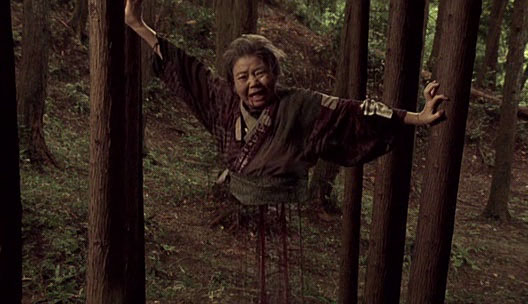
That repetition is why many people seem to hate this movie. It’s accused of being slow and overlong, which I would partly agree with, but it’s more varied and interesting than the also-slow Sukiyaki Western Django – and even that one I expect will improve on a second viewing. Tons of cameos significant to people more familiar with Japanese cinema than I am. Learned from Midnight Eye that the soldiers stabbing Izo to death in the opening scenes are Kenichi Endo (father in Visitor Q) and Susumu Terajima (Takeshis’).

Ben Sachs:
To begin with the obvious: Izo is one of the most difficult works of art to be made in recent times. . . . The film is pure theme and variation, deliberately lacking consistent rhythm or sense of progression that would allow you to enjoy it casually. Still, nearly every sequence boasts some fascinating juxtaposition—between character and decor, between dialogue and action, in the way images are ordered—that makes it consistently striking to watch, if something of a slog to keep up with.

“The resistance had its youth and it had its old age, but it never went through adulthood.”
Godard already in his mournful history/memory/holocaust phase (of course, I keep forgetting this was made after Histoire(s) du Cinema). Very nice black-and-white photography and lovely, sad string music, then after an hour it turns to super-saturated color, very unique and wonderful looking. Story/character/intent-wise, though, I didn’t get the movie at all.
Part of it is self-referentially about making a film, trying to cast it. There are mentions of Henri Langlois, Robert Bresson, Hannah Arendt, Juliette Binoche, May ’68 and Max Ophuls. Didn’t feel any more like a proper narrative film than Notre Musique did. I’d say that maybe the small-screen experience wasn’t cutting it and I needed to see in a theater, but I saw Notre Musique in a theater and fell asleep. Maybe I’m not smart enough, or wasn’t prepared enough to tackle this one… it’s the kind of thing I’d be better off reading a bunch of articles before watching. I never figured out the love story, or the flashback structure, and even the filmmaking story seemed elusive. But probably it’s just because I’m an American, and it’s not for me.

“Americans have no real past. They have no memory of their own. Their machines do, but they have none personally. So they buy the pasts of others, especially those who resisted.”
There’s some anti-U.S. business, a character hating on the fact that U.S. residents call themselves “Americans,” textually taking ownership over both continents, and a slap at Spielberg (“Mrs. Schindler was never paid. She’s in poverty in Argentina”). Godard reportedly took time at Cannes to attack Spielberg further… guess he’s not thrilled that the current Cahiers crowd voted War of the Worlds as their #8 pick of the decade. C. Packman at IMDB says: “The film is a critique on Hollywood and how capitalism is destroying cinema and love. … The film succeeds in offering a philosophical problem, but demonstrates philosophy’s inability to enter into any realm other than the abstract. Godard here follows Marx’ dictum: ‘Philosophers have only interpreted the world, the point is to change it’.”

“When did the gaze collapse?”
“Before TV took precedence over life.”
No actors I’ve heard of before, and the one I liked best (Audrey Klebaner, above, as Eglantine) has never been in another film. Shot on 16mm b/w film and color video by Julien Hirsch (Notre Musique, Lady Chatterley) and Christophe Pollock (Up/Down/Fragile, Class Relations), but I can’t figure out who shot which. Punctuated by repeated title cards and blackouts.

Salon is ruthless:
Godard’s artistic deterioration has been particularly heartbreaking because, as his sensibility has atrophied, his visual gifts have matured. … The burnish of the images in First Name: Carmen, combined with the flow Godard shows in the editing rhythms and in the use of Beethoven string quartets to underscore the images, can lull you into thinking that something is actually going on in the film. … What it adds up to, though, in In Praise of Love as in the films that have preceded it, is a retreat, a shutting out of the world.
Slant calls it “an inscrutable rumination on memory and history that only Godard is meant to fully grasp.” I’m looking for raves, not pans – I watched this because it was on multiple best-of-decade lists. Reverse Shot goes gaga over the use of images, touches lightly on the story, and complains that the original title Éloge de l’amour (WordNet defines “elegy” as “a mournful poem; a lament for the dead”) has been translated to In Praise of Love.
Interesting guy – besides the shorts I’ve seen, he made so many scientific research films, capturing and studying animals and behavior previously unknown. This was probably the best way to see those, in short excerpts with explanations of their significance, instead of trying to watch them through (not that they’re available to do so). This was a TV series, going chronologically through Painleve’s career, stopping at each film to discuss its creation and reception.
The Feuillade movies I’ve watched just keep getting better – from Les Vampires to Judex to Fantomas – and I’d heard this might be a total masterpiece, but I was disappointed. Mildly, I mean – it’s a fun movie and all, but it doesn’t hold up as a long-form piece as well as the others. Strange to think his films are a hundred years old. Supposedly he was assisted on this by a young Julien Duvivier.
Can you tell these two men in suits apart?

As usual, I dig the opening credits, motion portraits of each major character. Jacques (serious explorer, close light brown hair, wearing a robe for some reason) returns from Indochina (Vietnam) with Tih Minh, “a young Anamite who had saved his life,” with whom he is chastely in love. Jacques is played by René Cresté – Judex himself. In fact half the cast had recently been in Judex and would appear in Barrabas the year after this. Jacques’ comic-relief servant Placide (a goofball with center-parted hair) is glad to be home and see his fiancee, the maid Rosette (dark-haired and suspicious-looking, but she turns out to be a sweetie). Jacques’ sister Jeanne sets out to “educate” Tih while Jacques and Placide (poor guy) go off to India. Two years later they return and prepare for a double wedding.
1910’s special effects:
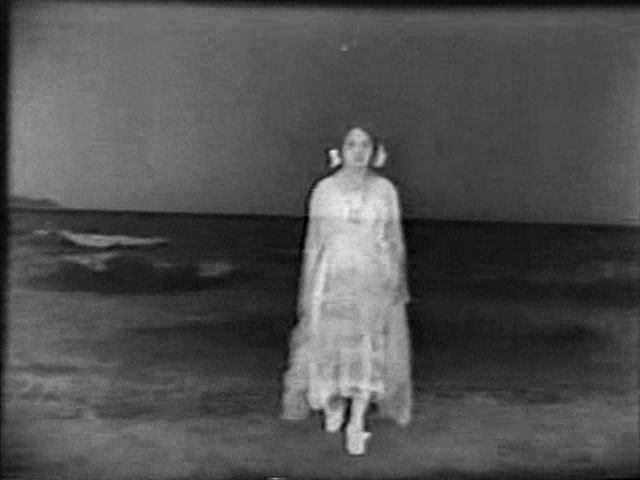
Meanwhile, Paris is plagued by a string of robberies and kidnappings perpetrated by evil Dr. Gilson (I can’t describe him, since he’s always got some kind of fake facial hair), Kistna (introduced with a turban and beard) and Marquise Dolores (sultry with big hair). Others mention Kistna as the “Hindu servant” of Dolores, but in private he’s shown bossing her around. The big buzz is that Jacques is bringing home a book from India, The Nalodaya, with a hand-written section by someone called Ourvasi. “In addition to revealing the existence of fabulous treasures, this testament could be of considerable importance in the event of a European war.” The baddies get Tih Minh alone when she’s taking a boat ride, kidnap and brainwash her to collect the book for them. But: “Motivated by what he believes is a laudable zeal, Placide erases Ourvasi’s testament,” so they get a worthless book.
Dolores in disguise:

And it goes on and on and on like this. The criminals don’t commit any more major crimes to terrorize Paris, they only try to get this book (well, now it’s the photograph Jacques took of the inscription before Placide erased it) for the next five hours, trying again and again and again with minor variations. Kistna comes over, all neighborly, and asks to borrow the book and see the photos. Tih Minh is kidnapped at least two more times (oh, and it takes dapper, puffy-cheeked Dr. Davesne weeks to restore her memory after the brainwashing incident). Each group breaks into the other group’s house at least once. Twice the baddies get a spy into the heroes’ house and twice they try to poison our guys. People hide in trunks. Fake beards and mustaches of every sort are used then discarded. It’s a cool flick but I’m not seeing how it’s on the level of Fantomas or Judex.
Dolores (?) and Kistna:

My copy of the movie had no sound at all, so I used soundtracks from elsewhere:
– Mike Patton’s Mondo Cane (I am obsessed with this disc lately)
– The Paranoid Park soundtrack
– Zbigniew Preisner’s Double Life of Veronique soundtrack
– Mihaly Vig’s Bela Tarr soundtracks (love those Werckmeister Harmonies songs)
– Volume 3 of the Toru Takemitsu set:
(“music from the films of Nagisa Oshima and Susumu Hani”) – this was ideal.
– Hajime Kaburagi’s soundtrack for Tokyo Drifter didn’t work out, so on to Philip Glass and Kronos Quartet’s Dracula, which didn’t work either.
– Peer Raben’s Fassbinder soundtracks (volume 1 – only the non-vocal numbers)
– Then back to Mike Patton and Mihaly Vig

Not a lot of writing on this movie online besides this nice article by A. Cutler of Slant, so I’ve perhaps quoted too much of it:
The movie doesn’t have a plot so much as a list of incidents. I don’t feel like I’ve given much away, since the one-damn-thing-after-another structure keeps the viewer watching more for what happens moment to moment than for where the story’s going overall. As a consequence of its cliffhangers, and despite its length, Tih Minh zips. … Feuillade is able to depict such wild happenings onscreen because his foundations are so solid. I mean this not just from a storytelling perspective, but from a visual one. The director consistently relies on static medium-to-establishing shots, proscenium-like in their orientation, the camera viewing the characters from a slightly elevated angle, and the lighting’s generally unobtrusive. In other words, Feuillade gives us a relatively normal, stable-looking frame so that the odd happenings within it can seem all the more disruptive.
Feuillade is filming a rousing adventure story, but he’s also questioning the future of the world. It’s a world explicitly without central authority figures, in which the characters fight to assert their own moral order—as one of d’Athys’s companions conveniently says late in the film to justify hunting the thieves, “why inform the police? We are mixed up in the most remarkable adventure in the world, let’s go all the way with it ourselves.” … The film balances its societal poles so that Nature ultimately has to intervene. Toward the end of the film, as the felons flee into the mountains, Feuillade moves his camera several hundred feet back and we see them as specks in the landscape. Unlike Les Vampires, in which the black-clad Irma Vep appears and disappears at her liking, the antagonists here never seem more than human; once the boulders crash, they seem especially so. D’Athys, a bland hero, triumphs over his adversaries not through skill so much as through luck and fate. Rather than a screenplay deficiency, this seems the movie’s point.
Les Vampires came out the same year as The Birth of a Nation, but as Jonathan Rosenbaum writes, Griffith and Feuillade “seem to belong to different centuries. While Griffith’s work reeks of Victorian morality and nostalgia for the mid-19th century, Feuillade looks ahead to the global paranoia, conspiratorial intrigues, and SF technological fantasies of the current century, right up to today.” The most appropriate comparison for Tih Minh isn’t to another silent film, but to a recent hit like The Dark Knight. Both films are about shape-shifting, disguise-donning villains and the heroes who take the law into their own hands to stop them. Both films structure themselves as a series of setpieces alternating between each party’s capture and escape. Both films are allegories about the wars their countries were then fighting (Tih Minh‘s gang is a gaggle of foreigners; several Dark Knight characters call the Joker a terrorist). Yet Tih Minh trumps The Dark Knight stylistically, tonally, and thematically. … The Dark Knight insists that wire-tapping, torture, and government cover-ups are necessary in the name of freedom, accepting these precepts fatalistically; Tih Minh, by contrast, shows us a world worth saving. … One film exhausts, the other liberates; the comic book film thinks it’s addressing reality, but the human film knows it speaks the language of dreams.

Jacques in asylum:

Notes I took:
“She is like Lord Stone. She will not betray us.”
Kistna comes right over and borrows the book, so why the brainwashing?
“But Tih Minh, the beloved, had drunk the potion of forgetfulness and did not even know how to speak anymore.”
I think they are saying that Gilson and the Marquise are psychic
The comedian got pushed over a cliff into water while the marquise tried to rob the house, caught by Jacques and passed out.
25 kidnapped girls in the basement!!

They encounter a petrified dog, aww Kistna is experimenting on cute puppies.
Kidnappees spend their days having pajama fights
Servant caught in wolf trap, Jacques leaves him.
Plac as hero is upright, not goofy as I expected.
Haha, he lures Tih out of the house to the beach using a cat.
Just as Tih is returned home, obsessed with a cat, Rosette is delivering the photos to fake-beard Gilson. Plac and Ros beat the hell out of him. Time for him to face the fact that he is a very ineffectual villain.
Music for In the Realm of Passion fits so well, I’d forgotten it wasn’t part of the movie.
“Agents of Germany” want to steal the secret. Wow, WWI wasn’t over yet.
Baddies hid microphones in the garden. That’s hell of high technology they’ve got there.
Now Gilson and Dolores are trying to steal the document – all they ever do is try to steal the document and it’s getting a bit boring.

Marx killed a servant after breaking in, then shoots her dad. Marx is Gilson!
This is the kind of car chase that was possible in 1918: the bad guys are driving away at top speed, Jacques is able to catch up by running.
Rosette is an excellent shot
Oh it’s all in goofy fun that we drive away the false nuns who threatened our lives by spraying them with a garden hose as they scurry away. They’ll be back in 15 minutes threatening your lives again.
Jacques seems to be telling Tih that pretty girls should be home arranging flowers, not out avenging the death of their father.
Now it’s an evil cook working in the house with a messenger dog, both of whom “no one suspects.”
Why don’t they stop letting people into the house. No nuns, no new servants, not anybody. Stupid rich people with houses like hotels, servants galore and people always coming and going.
Holy crap, one of the bad spies just killed Dolores with a rock.
The heroes’ plan fails, because of course it does. Our heroes are so foolish that when the baddies are disarmed they use Rosette and Placide as human shields, and this works. They’re DISarmed. You can just run around Rosette and punch the bad guys in the face. But no, they all escape.
I prefer inspector Juve and his reporter sideick Fandor from the Fantomas series. Not only are they in higher-definition than the identical suit-wearing blobs of this movie, they’re much smarter.
Oh good Dolores isn’t dead.
They escape to the rooftops! Finally. It’s just not Feuillade without a chase on the rooftops.

The three baddies turn on each other.
One’s head is smashed with a rock.
Gilson is still alive.
Gilson throws kistna off a cable car.
Gilson is blown up by dynamite!
Kistna is found dead.
Dolores kills herself.
Wedding!
Halfway through this movie I paused for an hour – or was it a day? Either way, I spent some time away from the movie just loving it, thinking so this is why people love Desplechin, this is great, not like A Christmas Tale which I thought was just so-so. Then I got back to the movie and the second half felt exactly like A Christmas Tale, not in terms of plot or character, but in that I just liked it pretty alright. So either the second half is disappointing, or I should not pause movies in the middle.
Large-mouthed Emmanuelle Devos is our star, who manages an art gallery, tends to her ten-year-old son, and is engaged to Olivier Rabourdin. Elsewhere, the ever-dependable Mathieu Almaric is introduced saying fuck you to the IRS on his outgoing answering machine message before he is taken away by men in white coats. I love that guy. Drama: Almaric is Devos’s crazy ex-husband who she contacts because her dad is dying. Is that what happened? I watched this a couple months ago now, so I’m not sure.
I thought the movie would center around Devos, but Almaric takes over for a long time, with his drug-addict lawyer, his superstar psychiatrist, new psychiatrist Catherine Deneuve, his family and a suicidal friend in the asylum who’s studying Chinese. In the second half it flashes all over through time, Devos breaking up with Almaric and driving her first husband to suicide. Energetic, emotional editing, not going for any sort of classical continuity, with very decent handheld camerawork. In the end, Almaric decides not to adopt (or be some kind of insurance-policy guardian for) Devos’s kid.