“You Can Get It If You Really Want” is the movie’s theme song and motto. Seems like Jimmy Cliff gets to have it all here: a film spotlighting his music, starring himself as a songwriter turned rebel turned cop killer, his character dying gloriously in a shootout.

First thing he does when he gets to Kingston is get robbed, and the second thing is to watch Django. He hooks up with a preacher’s girl, semi-legitimately gets a bicycle, falls into the drug business, becomes a celebrity fugitive. The final stand is intercut with a movie theater audience, life and death becoming a show.

The director’s daughter for Criterion:

He was already well established as a musical artist in Jamaica. All those tracks on the album, except “The Harder They Come,” had already been recorded by Jimmy before he was cast. But the recording of that song depicted in the film was the actual recording, and he wrote it after a conversation with Perry during the filming of the movie.

A corny white insurance agent, family man, workout nut, kinda racist, happily obnoxious to women and everyone else, wakes up Black one day. He freaks out, and his wife calls him a white supremacist while he focuses the blame on his sun lamp and tries to figure out how to whiten his skin again. I watched this on MLK Day, which I suppose might make me a bad person, but it’s good – a goofy but not stupid comedy (usually you get neither or both).

Lead actor Godfrey Cambridge had an excellent year, also starring in Cotton Comes to Harlem. When he goes out in public he’s hassled by cops (“He stole something – we don’t know what it is yet”). Finally his wife and boss and neighbors reject him, but he comes to terms with himself, starting his own business and plotting to lead the next Black revolution.

Ma Yongzhen is a tough dude working shitty jobs with his useless friend Cheng Kang-Yeh. Ma is introduced beating up a landlord, so he’s got our sympathy, though he seems to beat up pretty much everyone he comes across… this is fine, since it’s established that everyone in town’s a crook. Ma has annoyingly high standards, is poor and homeless and will accept nothing from anyone – though as principled as he seems, his dream is to ride in his own carriage with a fancy cigarette holder. He wanders into a brutal gang fight and takes on 20 guys armed with knives and hatchets, which gains him the attention of the local bosses, beginning his brief, violent career in organized crime. He’s finally ambushed in a teahouse by Boss Yang (Nan Chiang) and takes a hatchet to the torso, but doesn’t go down before killing everyone in the room. Good action scenes – I could watch about 300 more of these movies, and fortunately that’s how many they made.

Ma and his idol David Chiang (Legend of the Seven Golden Vampires):

Scar-faced Boss Fan (Yi Feng of Fist of Fury the same year) and his yes-man:

I skipped a couple Garrels since Le Revelateur, decided to watch some 1972 films on their 50-ish anniversaries. Garrel + Nico = an unexpected rock musical. Liturgical voice and organ songs, incredible long takes in different forbidding environments.

Nico cries in the desert with Vest Guy (Daniel Pommereulle of La Collectionneuse), both of them wearing flowy sleeves – this section features a 720-degree slow pan over a Nico song – then she follows and berates him down a white road.

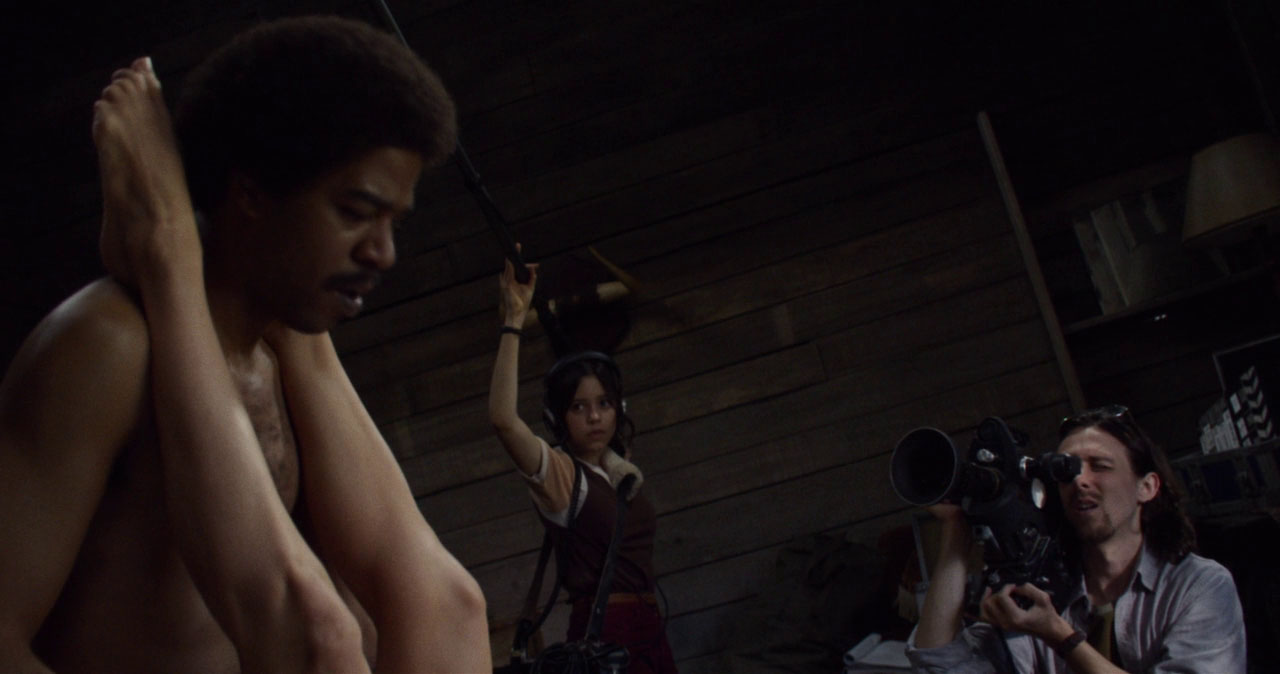
Another Nico song, a good one, kid leads a horse away from a flame circle, Vest Guy gives Nico a small goat, and so on… then Pierre Clémenti arrives nude. He journeys far and long, barefoot across a volcano, to bring gifts to a baby (played by his son) on an iceberg. Nico, practically the only person who speaks (in English and German), calls the nude archer “king.” There’s some kinda final confrontation near a rocky cave involving a sword. It’s all a very different kind of mythology than The Spine of Night, but felt right to be watching these two in the same week.

Watched on the exercise bike after Duel. Ultraviolent mythological epic, recalling Metalocalypse but with more rotoscoping. Swamp Witch and Ancient Guardian and Local Lord and Chief Librarian all struggle to obtain or protect or misuse a magic blue leaf that gives healing or destructive powers. I’m all in favor of this sort of thing.

There is in fact a spider, also a cat and a couple dogs, and MVP: an owl in a tree. Mainly it’s a breakup movie, Lisa moving out of Mara’s place into her own new place, family and friends and neighbors turning out to help, and Mara lurking and sulking. Doesn’t exactly have a strong narrative drive – it does have that surprising sense of discovery in the camera angles and scene structure that I loved in The Strange Little Cat. For the first half I was thinking “ehh there’s not much here,” and in the second half: “I’m German now and everyone in this movie is my friend.” Speaking of German, while listening to the words I learned that Hans Zimmer’s last name is Room, and Carolee Schneemann’s is Snowman.

Blake in ‘Scope:

Character motivation and cause-and-effect logic is either nonexistent or gets buried beneath myriad layers of movement and spoken phrases that may or may not make any sense to us. We can only get caught up and washed along in the film’s beautiful display of things resuming, moving along, never being the same again … A cut in a Zürcher film, especially this one, is almost always a revealing, never a suture. It exposes the mark that we heard being etched; the angle that reconfigures our understanding of the spatial dynamics of the setting or environment; the beholder that we and/or the character couldn’t sense was present watching what we were watching — the subject we never knew our gaze belonged to. There’s an acknowledgment, shot to shot, cut to cut, that there is more to the world than what we can presently see or say that we know … And at the present moment, I can think of few worthier undertakings for a narrative cinema practice than one that challenges and is curious about the ways that humans perceive themselves, others, and the perceptions of others.

Somehow the most delightful and enjoyable of the Cote movies I’ve seen, even though this one is just people standing still in fields, and the others were kinda a thriller and kinda a nature doc. He’s an unusual filmmaker – per AS Hamrah “Côté has made over a dozen low-budget, semi-conceptual films in Canada since 2005 and shows no sign of letting up. Each of his movies is a bracing delight designed to perk up an audience by asking it to see and listen in some new way.”

Early-Villeneuve star Maxim Gaudette is our lead, facing off vs. a different woman in every scene – first his sister, then both wife and girlfriend. He’s a thief, living in his car, dodging taxes, giving circuitous answers. Scenes are connected by whip pans, or pillow shots, or a girl named Aurora walking around the wilderness – turns out she’s following him, since he smashed her car windows and stole her laptop. At the end, his wife says something like “it’s a simple question and I forbid you from complicating it” – I could use that line.

with sister, Ghost Town Anthology’s Larissa Corriveau

with girlfriend Eve Duranceau (and chaperone)

There’s something odd to the frames, a mild Sokurov light-bending effect, and there seems to be a smear on the lens in a different spot in each shot. Then again, nothing falls apart faster in streaming video than wide shots of trees on a breezy day, so this looked pretty bad, that might be the problem. “I’m going to the cinema. I’ll sit in the first row. That way I’ll see the movie before anyone else.”

with victim, Éléonore Loiselle

Writer M. Night doing good work with the premise, not so good with the dialogue and details – and Director M. Night just going to town with the photography. Love the roving wide-angle long takes especially, but the whole thing looks ravishing. DP Michael Gioulakis also shot Us and It Follows and Under the Silver Lake, and is currently one of my favorite people.

AKA Old Beach: The Beach That Makes People Old, but most of them die one-by-one from various misfortunes, only Gael and Vicky make it to cute-elderly status. Dr. Rufus Sewell goes mad, or was mad from the start, and stabs Underground Railroad star Aaron Pierre before Vicky gives him fast-action blood poisoning. Sewell’s wife Abbey Lee (one of the Fury Road wives) has brittle bones and dies in agony chasing the kids through a cave. Ken Leung (cop in Saw) simply drowns trying to escape. Nikki Amuka-Bird (Jupiter Ascending) has fatal seizures, funny since the mad scientists studying curative drugs in unwilling time-accelerated test subjects call her case a success. The kids are more complicated since they’re played by multiple actors, but most notably by siblings Alex “Hereditary” Wolff and Thomasin “Soho” McKenzie, and as Alex’s short-lived girlfriend: Beth March of Little Women.

Adam Nayman sums up my pleasure in talking about a different film: “The fun of Malignant is watching Wan apply such sophisticated technique to ridiculously dumb material.” Also wrote down a line from Social Hygiene the next night: “Stupid and useless things are often the most beautiful.” Great movie.

Game of Death (1978, Robert Clouse)

Time for the post-Bruce-Lee movies in the Bruce Lee box set. Bruce had filmed about ten minutes of fights for this one, then he inconveniently died. The American studio knew Bruce was profitable, and that’s all they knew, so they cobbled together a new movie, blatantly using stand-ins and cutting reaction shots from other movies. Once they simply pasted a still photo of Bruce’s face over another guy. It’s full of callbacks to the previous movies (thanks to a films-with-the-film subplot), but anyone who enjoyed those is gonna be sad about this one. Even doc footage from Bruce’s actual funeral is used, when lead character “Billy Lo” is supposed to be faking his own death. And this is all in service of a third-rate crime thriller. 1 star for the music, 1 for Sammo Hung, zero for the rest.

After filming a scene, Billy is calmly threatened by a white suited gangster who wants protection money. He works for an evil bald guy who’s somehow involved in both a record pressing plant (which threatens Billy’s girlfriend’s music career) and a championship fight in Macao (their star fighter is Carl: Robert Wall from Enter the Dragon, who died last week). The gangster protection money plot had already been used in Way of the Dragon (and the Chang Cheh movie I just watched), but so what, it’s a plot, and movies need those.

Billy’s in hiding, letting the gangsters think he’s dead, which gives all the non-Bruce actors an excuse to wear heavy disguises. Carl cheats and beats Sammo Hung in the ring, but Sammo puts on a good showcase, then Billy slaughters Carl in the lockers. The girlfriend (Colleen Camp) inevitably gets kidnapped, and a stuntman wearing Bruce’s yellow tracksuit and a dark helmet fights some motorcycle dudes in a warehouse. Finally, the one true Bruce fights some dudes (including the absurdly tall Kareem Abdul-Jabbar), and it’s glorious for a few minutes. He never even touches the old bald gangster (Dean Jagger, the sheriff of Forty Guns), who falls off a roof while running away, the credits rolling before he even hit the ground.

Movie magic via still photo:


Game of Death II (1981, Ng See-yuen)

The only sense that this is a sequel is it’s playing the stand-in game with old Bruce footage (the film stock still doesn’t match). Bruce is hilariously dubbed by some cowboy-ass American. He chills with an ass-kicking abbot then gets an incriminating film from some girl. At a friend’s funeral, he’s shot and falls to his death while chasing a helicopter that was stealing his friend’s casket(!), and now Bruce’s sad brother Bobby takes over as the lead, like Bruce took over from James Tien in The Big Boss – but not exactly like that, since Tong Lung is playing both brothers here. Now with an hour to go, the movie doesn’t have to pretend to star Bruce Lee anymore, and can cut loose. The dubbing is atrocious, but the Chinese/Koreans in charge of this movie have got more respect for Bruce’s legacy and more filmmaking and fighting talent than the doofus Americans in part one.

Lewis trying to be intense despite the cute monkey:

Bobby gets intel from a white monk that the evil Lewis and his scarfaced brother, masters of the Palace of Death, are responsible, so he heads on down. Lewis can’t be that evil – he keeps pet peacocks and monkeys. The Whatever Brothers (I didn’t catch their names) challenge Bobby, and he proves his mettle, then a sudden blonde girl gets suddenly naked, tries to kill him, then a guy in a lion suit joins in! Movie is already kinda nutty, and that’s before Bobby descends to the subterranean MST3K sci-fi lair with spacesuited harpoon-armed flunkies and electrified floors. Lewis is found dead, the scarface guy is suspected so Bobby beats his ass, but Bruce’s “dead” friend, who was stealing his own coffin to avoid discovery, is behind the whole thing. Friend/enemy Chin Ku is Jeong-lee Hwang of Drunken Master, the abbot was in Temple of Doom and Sammo’s Enter the Fat Dragon.


Bruce Lee: The Man and the Legend (1973, Shih Wu)

Polishing off the Criterion box set with a return to the shameless, shoddy quality of Game of Death 1, this time in documentary form. Opens with ten minutes of news film from Bruce’s funeral, which doesn’t sound like such a long time but really felt like it, making me realize I am not cut out to watch Loznitsa’s State Funeral. Then a chronological run through his life and career, with lots of slow zooms into photographs, and a narrator who sounds like he’s from some MST3K short, like How to Go on a Date. Why is the dialogue in the movie Bruce was in as a child covered up with horn music? Why does the English narrator sometimes talk over people speaking English, telling us the same story at a slightly different pace? When Bruce defeats Bob Baker in Fist of Fury, “Baker studied for seven years under Bruce, but he is still no match for his teacher,” the narrator confusing an actor’s skill with a scripted scenario. It closes with then-unreleased Game of Death footage – in fact, Enter The Dragon wasn’t even out yet – in Hong Kong, this quickie doc beat it into theaters by a week. Shih Wu was an assistant director on A Better Tomorrow III, which I’ll probably end up watching eventually.