Remember thrice-oscar-nominated Lasse Hallström? I liked his Gilbert Grape, thought his Cider House was alright, then gave up after Chocolat, but he continues to turn out handsomely-shot romances about people realizing their true calling. Here you’ve got an expat Indian family run by Om Puri opening a restaurant across the street from a fancy/traditional French place run by snooty Helen Mirren. The family’s secret weapon is son Hassan (Manish Dayal of 90210 Remake), who takes a job across the street and becomes Mirren’s secret weapon, offending love interest Marguerite (Charlotte Le Bon of Mood Indigo) since he becomes a chef before she does. Everyone is very concerned with getting star ratings from a travel guide (no mention of yelp reviews), and after Hassan earns a second star for Mirren he immediately moves to an ultra-cool place (ignoring the rule we learned from Ratatouille that if a head chef leaves a place it automatically loses a star), but loses his will to live in the cold city. Happy ending: Hassan returns to the countryside to open a French/Indian fusion place with Marguerite.
Author: Brandon
Brandon's the guy who runs this site.
Film Socialism (2010, Jean-Luc Godard)
Slogan on cover of the press book: “Ideas separate us, dreams bring us together.”

An essay film without the essay? At least he’s removed the parts of his argument that would allow a simpleton like me to follow along. So far my experiences with Late Godard: I loved Nouvelle Vague even if I rarely understood it. Repetition, layering, stolen quotes as dialogue, showy editing of picture and stereo sound. Also, traditionally gorgeous cinematography and a somewhat decipherable story – both of which disappeared for Histoire(s) du Cinema and Éloge de l’amour, where the layering is increased and I’m less able to follow what he’s on about. Couldn’t make head nor tail of Notre Musique, which I saw in theaters with no preparation.

So now Film Socialism(e) seems like an Éloge de Histoire(s), the onscreen text and stuttery editing and quoting, rambling scenes and an (apparent) essay film with an (apparent) narrative short dropped in between them, all to mysterious purposes. A mix of cameras: wind noise and low-res picture, then sleek HD with the colors enhanced. Apparently full of wordplay that makes no sense in translation, hence the poetically incomplete English subs in the premiere (not the version I watched). Hard stereo panning, as I discovered re-listening to the movie in headphones while searching for articles online.

“It’s impossible to propose an off-the-cuff interpretation of an object we wouldn’t know how to describe” – the Film Socialisme Annotated article found on Moving Image Source.
Film Socialisme in the news: an economist in the first section was killed in the Charlie Hebdo attack and the boat on which it was filmed sank.

Focus of the third section:

“The day will come when language will turn itself against those who speak it,” presumably related to his next feature Adieu au langage, but I prefer to think of Pontypool.
Played in Cannes alongside I Wish I Knew, Aurora and The Strange Case of Angelica.


“Let’s bring back duration.”
Excerpts from A. Picard’s article for Cinema Scope:
The first section of Film Socialisme, or “movement” (as this film, also, is about notre musique, our harmonies and disharmonies), takes place on a cruise ship touring the Mediterranean; the second follows the French family Martin who run a garage and are hounded by a camera crew after one of its members announces a candidacy for the local elections; and the third is a coda collage … Editing images so that they emerge as the visual equivalent to his infamous aphorisms, Godard has increasingly become “interested not only in thought, but in the traces of thought.” … French philosopher Alain Badiou delivers a speech on Husserl to a large, empty room filmed in a long shot emphasizing the space and weight of absence. Godard says an announcement was made over the loudspeaker inviting all passengers to attend and not a single soul showed up.
Patti Smith and Lenny Kaye:


from Godard’s interview in Telerama:
“Palestine is like the cinema: it’s searching for independence.”
“[People] have the courage to live their life, but they don’t have the courage to imagine it.”

X-Men: First Class (2011, Matthew Vaughn)
Major prequelitis, all about its digi-effects and massive Henry “Hugh” Jackman score. X and Magneto are buddies, meeting a bunch more friendly mutants and trying to defeat Kevin Bacon, who starts the Cuban Missile Crisis and killed Magneto’s mom. At least Oliver Platt and Michael Fassbender were good. And at least, since it’s a male-driven comic movie, all the girls get sexy and half-naked.
Sexy J-Jones:

Sexy J-Lawrence:

Mutant Round-Up: Magneto (Fassbender), X (James McAvoy), energy-consuming, anti-psychic-helmet-creating Shaw (Bacon). Shaw’s crew: disappearing devil Azazel (Jason Flemyng, chasin’ women), diamond-fleshed psychic Frost (January Jones of Mad Men), tornado-chuckin’ Riptide (Alex Gonzalez), fire-breathing dragonfly Angel (Zoe Kravitz). X’s crew: Beast (Nicholas Hoult, Firth-stalker in A Single Man), scream/flying Banshee (Caleb Jones of Antiviral), energy-whip-shooting Havoc (Lucas Till), easily killed gill-man Darwin (Edi Gathegi of Gone Baby Gone), shapeshiftin’ Mystique (Jennifer Lawrence), and their no-powers CIA contact Rose Byrne (Sunshine, Insidious).
Sexy Byrne:

Sexy Kravitz:

IMDB says Azazel and Mystique are Nightcrawler’s parents, and that Bryan Singer couldn’t be arsed to direct since he was devoting four years of his life to Jack The Giant Slayer. Vaughn later made Kingsman: The Secret Service, which I didn’t watch on the plane since they had a lousy looking, censored version.
Mighty Morphin’ Bacon in nuclear mirror room:

Our Hospitality (1923, Buster Keaton)
We managed to watch this despite obstacles (DVD gone missing, Amazon’s lies about runtime). Keaton’s second feature, a vast improvement over his first. Keaton takes a train to brutal, rural America to claim his family estate, which turns out to be a crumbling shack. So instead he focuses on the hot girl who rode the train out west with him (played by Keaton’s wife), but her dad (familiar heavy Joe Roberts) and two brothers are out to kill him because of a century-old family feud.
After a flashback open where Keaton’s dad and Joe Roberts’ brother kill each other, the first half of the movie is mostly the ride out west on a ridiculous wood-fired train said to be based on an actual vehicle. Second half is Keaton, having been invited over by the girl, unable to leave since the men won’t shoot him while he’s a guest in their home. He finally escapes dressed as a woman, then after a mountaintop chase culminating in one of the best stunts in movie history – Keaton swinging on a rope to catch the girl coming over a waterfall – they marry, ending the feud. Watched with Katy as history lesson after the first Story of Film episode, though we mostly forgot to analyze editing and obsess over the 180 degree rule.
Top Five (2014, Chris Rock)
Good combo of the Before Sunrise slow-romance and the maturing-artist drama, a nice surprise from Rock after two Grown Ups and three Madagascars. Between the Chaplin references, the wonderful Cinderella ending and the overall walky, chatty New York vibe, it feels like he’s got a sense of movie history, is trying to craft something more timeless than the usual hard-mugging studio comedy. The movie doesn’t aim for laughs in every scene, casting Rosario Dawson instead of a comedian as Rock’s foil and spending much of the plot on struggles with alcoholism (although while in jail after a drunken relapse, Rock gets serenaded by DMX, singing Chaplin’s “Smile”). Rock’s fiancee (Gabrielle Union of Bring It On, Bad Boys 2) is prepping their wedding for a Bravo series, but Rock doesn’t waste time mocking reality TV, even with both Tracy and Angie “Queen of” Jordan in his supporting cast. Dawson’s character seems to have plenty of time to hang out even though she juggles a kid, a series of relationships, alcoholics anonymous, and at least three writing personas (sex columns for Cosmo, pseudonym film reviews, plus the feature interview she’s supposedly writing on Rock). JB Smoove is cool as Rock’s friend/handler and Cedric the Entertainer is hilarious as a hedonist promoter in a low-point flashback sequence.
By Brakhage, Volume 2, Program 1
Watched bits and pieces of this anthology, but never all the way through before – which I guess is sad given how much I’d been looking forward to its release. I put on a shuffled playlist of instrumental albums, soundtracks, ambient and other strange sounds since Brakhage films tend to be silent. I know you’re supposed to watch them silent, As The Artist Intended, but you’re also supposed to watch them projected off 16mm film in an art gallery with fifty other people all shifting uncomfortably in their folding chairs, instead of at home on a comfy couch accompanied only by birds. I prefer my way.
–
The Wonder Ring (1955)
Brakhage nerding out on photography in a train station, then on the train itself, shooting through its warped windows. Not knowing in advance where the movie was set, I kicked off the music with Sqürl’s I’m So Lonesome I Could Cry, a song that prominently mentions trains. After the Sqürl, iTunes offered 75 Dollar Bill and a peaceful John Zorn number from The Mysteries. I first saw this movie at a Film Love screening of Joseph Cornell works – supposedly he codirected, but the onscreen credits say “by Brakhage.” Fred Camper only says Cornell commissioned this film, a record of a New York elevated train before it got decommissioned. Camper credits Brakhage with the finished work, says he’s “finding a real-world version of the superimpositions Brakhage would later create in the lab.” Elsewhere are mentions of GniR RednoW, a film Cornell made from Wonder Ring outtakes.

–
The Dead (1960)
Paris cemetery, in positive and negative, overlapped upon itself – the superimpositions mentioned above, making this a great follow-up to Wonder Ring. Heard a long, ambient Per Mission song, worked beautifully. The few living humans on screen are not shot in any great detail, but internet rumors claim Kenneth Anger was one. Doesn’t have much in common with the John Huston/James Joyce version.

–
Two: Creeley/McClure (1965)
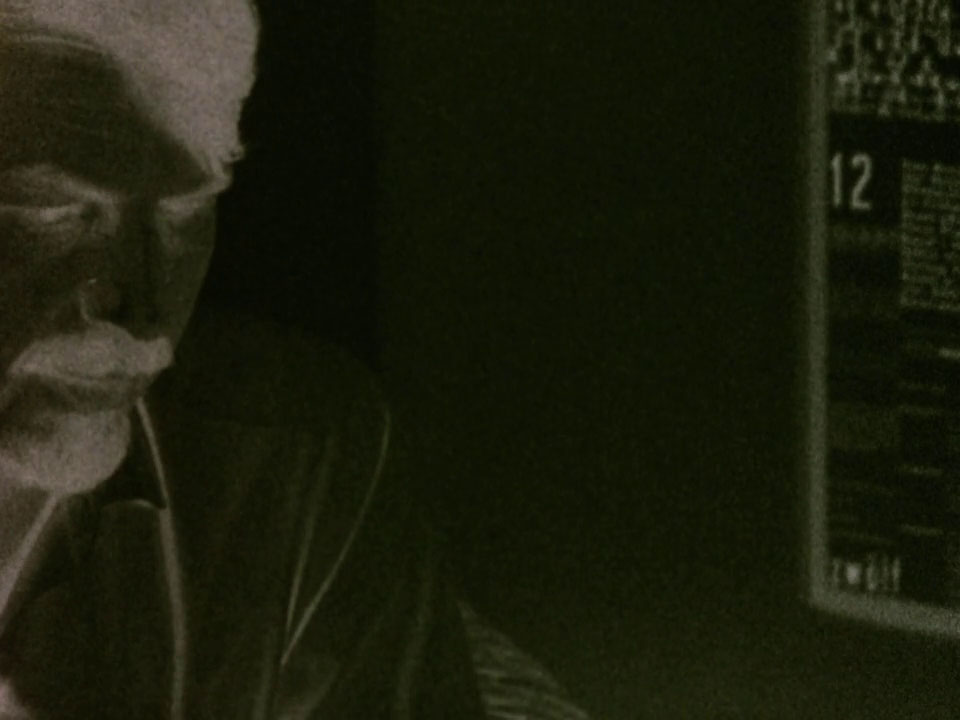
This and the next film were part of the thirty-one Songs series. This one’s technically separate from the Songs, but was edited into the 15th in the series, the 38-minute 15 Song Traits. Portraits of poets Robert Creeley and Michael McClure. Again with some reversed footage. Final section is jittery mania. I watched twice, and the second time Guano Padano’s story-song Dago Red came up, inappropriate since it makes the audio the main focus, turning Brakhage’s film into a music video, but interesting.
–
23rd Psalm Branch (1967)
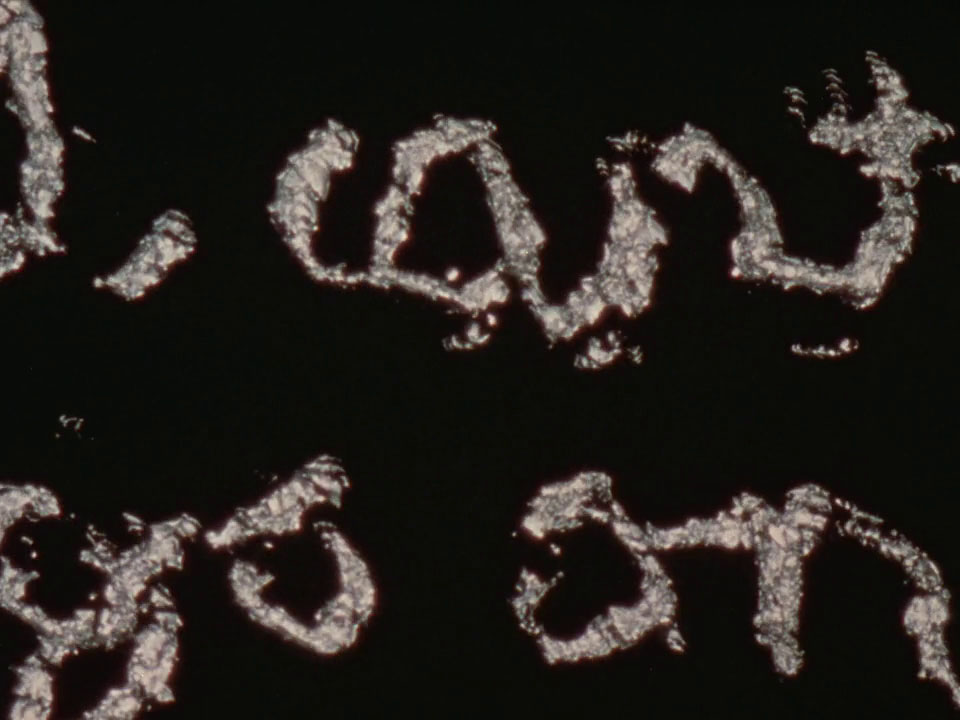
Watched on the plane home from a trip. Images of war, wreckage and parades, remixed, with black and brief colored frames. Something Brakhage wouldn’t have expected: myself in place of the blackness, reflecting in laptop monitor in the overlit cabin. Something else: he shoots clouds out a plane window, I look to my left and see clouds out a plane window. A couple of long songs that worked very well: The Nymphs by Zorn and Recks On by Autechre. Prefuse’s Infrared was lyrically appropriate. The film’s second half contained more black than my Dramamine-drowsy state could handle, had to restart some sections. As Film Quarterly puts it, “he has used black leader so brutally this silent film gives the impression of roaring, booming sound,” and part two specifically is “abstract and full of private symbols, difficult to absorb and to watch.” Music by Sqürl, Per Mission and Morricone. Written letters and section headers. Kubelka’s Vienna, then Brakhage’s Vienna, all dim red figures disappearing into the blackness, a few shots of fire recalling Frampton. Marilyn Brakhage called it an attempt “to reclaim person and personal vision from the onslaught of television news.”


Maps to the Stars (2014, David Cronenberg)
“I have the flu. I need cigarettes.”
Julianne Moore is an actress who sees ghosts, trying to get a film part where she’ll play her own mother in a bio-pic (like a terrible Clouds of Sils Maria remake). Evan Bird (of TV’s The Killing Remake) is a horrid child star, son of Rosemary Cross and new-age massage therapist John Cusack. Evan’s older sister Mia Wasikowska is out of an asylum and back in town, gets a job as Moore’s assistant and hangs out with limo driver Rob Pattinson.

Eventually connections fall into place, and people start dying. Moore gets the role because her rival’s son drowns. Evan murders a young costar who’s been upstaging him. Mia bludgeons her employer Moore with a film award. Rosemary Cross somehow catches on fakey digital fire. Then Mia and Evan creep away and take handfuls of pills. Throughout, the music and editing and shots are pretty unexceptional and I’d be worried about Cronenberg except that I read his terrific novel which released around the same time at this movie.

M. D’Angelo:
Mostly, though, it’s just an excuse for [writer] Wagner to depict “scathingly” bad behavior, as when Moore’s fading starlet leaps around her house with joy upon learning that a rival’s adorable little son has just drowned, freeing up the plum role that Moore had just lost to said rival. Cronenberg, for his part, shoots this cavalcade of random potshots as functionally as possible — this is easily his least visually distinguished film (and also, perhaps not coincidentally, the first film he’s ever shot in the U.S.). Hollywood may be a nest of vacuous vipers, but it deserves a less feeble takedown than this.
The Last Ten Minutes vol. 14: First-Person Camera Edition
Men In Black 2 (2002, Barry Sonnenfeld)
Hey, I never saw this, always wanted to, but heard it was bad. Just the thing The Last Ten Minutes was invented for. The two mismatched partners are joined by Rosario Dawson with nuclear jewelry and pursued by Evil Lara Flynn Boyle till she’s eaten by a subway monster. Jones tells Dawson she’s the fifth element, Smith is attacked by shockingly subpar effects. Did you know there was a part 3? Neither did I.
[Rec] 3: Genesis (2012, Paco Plaza)
Previously watched [Rec] 1 and remake-sequel (remaquel?) Quarantine 2. Can’t find [Rec] 2 on netflix because their search is ridiculous, so let’s pick up here. Loving couple is trapped in kitchen by encroaching zombies until loudspeaker bible recitation stops them. Dude has a sword, which actually seems like a smart zombie weapon. Girl is bitten by an elderly fellow (bad hearing, immune to loudspeaker), guy cuts off her arm but he’s stupid and slow, and they both die. From one of the directors of the first one, but not shot first-person, so the title doesn’t make sense anymore. The girl was in Ramin Bahrani’s Man Push Cart.
[Rec] 4: Apocalypse (2014, Jaume Balagueró)
Oh, this is from the other director of the first one, and looks a lot worse. Stars Angela from parts 1 & 2. A guy with bad hair helps Angela kill zombie monkeys with a boat motor. Why does the bad guy have a snake-tongue? A boat explodes!
The Interview (2014, Goldberg & Rogen)
Those two guys are trying to escape N. Korea. Cue the loud action scenes. Katy Perry soundtracks the fiery death of President Randall Park (Danny Chung in Veep), then we get an anticlimactic escape from the country. One of the directors wrote for Da Ali G Show.
Horns (2013, Alexandre Aja)
The one where Harry Potter is a demon, from the director of the great Hills Have Eyes Remake. Dang, no horns, Harry must’ve had them cut off already (a la Hellboy?). His brother (Joe Anderson of Across the Universe) is sad, so Harry goes walkies with Max Minghella, and there are guns, and wow, Harry sprouts wings then turns into a full flaming demon and has homicidal maniac Max brutalized by snakes. I think Harry’s dead girlfriend is alive again but I stopped watching because my roomie locked his keys in his car. Is this Wolf Parade over the ending?
The Sacrament (2013, Ti West)
Sorry Ti, but after two-and-a-quarter disappointments you join Aja in Last Ten Minutes purgatory. Joe Swanberg in death cult compound is running from gunmen, everyone is dying, and it’s shot first-person a la [Rec] 1. Isn’t this the same plot as one of the V/H/S/2 segments from the same year, which West and Swanberg were also heavily involved with? Joe semi-rescues AJ Bowen (of every Adam Wingard movie) with the shakiest shaky-cam I’ve ever witnessed. Ends with unnecessary solemn title cards. Boo.
Maniac (2012, Franck Khalfoun)
Fuuuck, this is also shot first-person – and out-of-focus, no less. Co-written by Alexandre Aja. Khalfoun made P2 and acted in Aja’s Haute Tension – they’re as close as the West-Swanberg-Wingard crew. I think Elijah Wood kidnaps Nora Arnezeder then she stabs him with a mannequin arm and runs him over. Then she dies, so he marries a mannequin. Most of these movies are very bad, but this one looks unusually, especially, very very bad.
The Conspiracy (2012, Christopher MacBride)
Grainy first-person pinhole camera with blurred-out faces. Why do all these movies hate cinema? Dude wakes up in the ritual sacrifice room, then is chased through the dark woods while wearing an animal head. Finally a series of talking heads dismiss whatever conspiracy theory the hunted/murdered cameraman presumably uncovered. MacBride has made no other movies and hopefully it’ll stay that way.
Automata (2014, Gabe Ibáñez)
It’s balding trenchcoat dudes with shotguns vs. slow, clunky robots. The robots are talking wise, getting themselves shot, when a fully bald Antonio Banderas arrives. His plan of action is poor but he still kills two guys and the third is dispatched by a Short Circuit lizard. Weird/nice to see a robot-future movie where some of the robots (not the lizard) are actual props, not people or digital effects.
I, Frankenstein (2014, Stuart Beattie)
From the trailer this looked like epic nonsense, but it’s actually more coherent than most of the others I just watched. Bill Nighy! The final battle: Frankenstein Eckhart vs. angels, gargoyles, a merman, lots of fire, men in suits, poor digital effects and Bill Nighy! Meanwhile there’s a bunch of computer progress bars and “access denied” messages. Progress bars are always a great source of tension in movies, eh? A massive Matrix-like chamber full of bodies begins to self-destruct. Eckhart (is he the monster or the doctor?) defeats demon-Nighy, saves some lady from a fiery apocalypse and collapsing castle. Beattie wrote the Pirates of the Carribean movies (and Collateral), his cowriter was an actor in Men In Black 2.
White God (2014, Kornél Mundruczó)
Deserved winner of the Palm Dog at Cannes. Truly, the dogs were great. However I was frustrated and confused by the rest of the movie, which was relentless misery until the climactic explosion of dog vengeance. The movie has been compared to Au Hasard Balthasar, but it’s maybe closer to I Spit On Your Grave.

Girl is abandoned by her mom to live with her shitty dad for the summer. She is devoted to her dog Hagen, gets kicked out of her orchestra by the asshole band leader because of Hagen, but after pressure from horrid neighbors, Dad kicks the dog out on the street. Horrible people + handheld camera = no fun. Dog catchers, dog fighters, etc. The fighter trains Hagen to be hateful and violent, a la this movie’s great namesake. The girl’s bike is stolen, woman at dog shelter is a liar and dog murderer, and so on. Then: a well orchestrated bloodbath of revenge, with a picturesque but mysterious ending.

M. D’Angelo:
This movie’s stupid. I suppose it’s slightly less stupid if one views it allegorically — that is, if the dogs are supposed to represent minorities — but that barely seems tenable, especially w/r/t the laughable ending. Otherwise, its sole point of interest is its use of real dogs at the climax, which isn’t remotely scary (Mundruzcó has no feel whatsoever for horror) but does at least represent an impressive feat of screw-you-CGI logistics. And then he goes and ruins that by using said climax, which should arise out of nowhere, as a surreal flash-forward “grabber” at the outset, a ploy that smacks of bad television. At best, this might have worked as a segment of Amores perros (which it explicitly apes for a while); two hours is beyond laborious, and every cut away from Hagen to the little girl and her dad feels like Mundruzcó deliberately wasting your time.