OK, sure, I guess. But every time I’m almost having a fun time with the dour zombie-action movie, it stops for some “fan service” callback to the Sam Raimi movies.

Evil Mom is Alyssa Sutherland of shipbound nazi vampire movie Blood Vessel, her dead necronomicon-meddling son Morgan Davies was in a Willem Dafoe movie, and her sister who survives while rescuing only the youngest kid is Lily Sullivan of a Picnic at Hanging Rock remake.

IMDB says Cronin’s The Hole in the Ground “premiered at Sundance Film Festival in 2019 to critical acclaim,” but that’s not how I remember it.

Will Sloan:

“What if they did Evil Dead in an apartment instead of a cabin in the woods?” is not an interesting enough spin on the material.

Onscreen text, no narrator, the music all howling wind and doom tones. I thought this might be the coolest feature at the Ann Arbor fest – and so far I’m right – but it wasn’t part of their online program so I had to find it separately.

Uranium factoids, then settles into a kinda observational doc about a gigantic nuclear plant being dismantled in Lithuania, but keeps distracting itself with colors and artworks and models and the snake from the movie poster. Where’d they get the underwater mine photography, wow. The archive footage is all credited at the end, but I can’t tell if that was archival – the director was also production designer and swimmer in one awesome wide shot, and the new footage is seamlessly blended with the borrowed stuff.

An upsetting movie to watch after Tina’s death. It recounts how she had a bad life with Ike, then divorced him but the press kept saying “haha where’s Ike” so she did an interview to say Ike was abusive, so the media wanted to know “HOW abusive” so she wrote down her life story about the bad times with Ike, so the media wanted her to talk about Ike more, then they made a feature film, and Tina sat at the Venice premiere next to Angela Bassett saying she hasn’t seen the movie and doesn’t want to, and just wants everyone to leave her alone about Ike already. Funny that Tina was initially as unenthused about her signature solo song as I am, complaining that it’s not her kind of music. Barely a glimpse of her superior work in Tommy and Thunderdome.

A change in mood from my last French movie, the actors perfect little models through the supernatural events – nobody cries, while Léa Seydoux rarely stopped.

Trying to watch this again with Katy, if she’ll agree. A short and straightforward pandemic project with just a few actors – but writing a story that depends on the performance of identical eight year-olds seems risky, and damn, they pulled it off.

Courtney Duckworth’s Cinema Scope writeup is the one.

Lovely French movie about life being complicated, starring the great Léa Seydoux, whose Blue Is the Warmest Color co-star I saw last night in The Five Devils. She’s a professional translator whose philosopher dad (Rohmer and Assayas regular Pascal Greggory) is losing his memory and stability and vision and needs to go into a home. The movie’s about heavy things but it moves beautifully.

Léa meets Melvil Poupaud, a cosmo-chemist who studies meteorites like in that Herzog movie, but he’s married, and goes back and forth with his intentions, as her dad gets moved to worse and then better facilities… it’s more like one fine year (the film is named after the dad’s unfinished autobiography).

Jordan Cronk in Cinema Scope: “In a year with no shortage of similarly themed French films (see Claire Denis’ [Both Sides of the Blade] and Emmanuel Mouret’s Chronique d’une liaison passagère), One Fine Morning makes a case for itself not by upending conventions, but by applying them with care and consideration.” Key review by Vadim Rizov, who liked it not as much.

Five Devils is unfortunately just the name of a sports complex where Adele Exarchopoulos works with her disfigured ex-friend Nadine – the movie isn’t about devils, but a girl with an incredible sense of smell. Her mom Adele tends the pool, and her dad Jimmy’s a fireman, so fire and water. Dad’s sister Julia comes to stay, after spending time in jail for the fire that messed up Nadine, so everyone’s on edge.

The girl Vicky makes jars of special scents, which cause her to black out and visit past events from before she was born – invisible to all except Young Julia, who panics whenever the girl appears. After the fire ruptures the two young couples (Adele and Julia, Jimmy and Nadine), mom and dad end up together, so V wouldn’t have been born if she hadn’t (passively) prompted the fire.

Fun movie to think about, and to watch – despite its three different “Total Eclipse of the Heart” scenes. Nadine also starred in Nimic with Matt Dillon. Hugo Dillon plays a fireman here, apparently no relation.

Mike D’Angelo:

I kinda loved it, perhaps because I’d given up hope of ever again being caught off guard by what I think of as the “La Jetée”/Twelve Monkeys theory of time travel, in which visiting the past means that you were always present there. Mysius and her co-screenwriter, Paul Guilhaume, deploy their eternalism in a unique fashion (homemade perfume as proxy-Proustian time machine, with a silent, watchful Vicky visible only to her future aunt) and for singularly perverse ends—this is basically a dual tragic love story rooted in kids’ inadvertently destructive power, acknowledging that their mere existence in the world (crucially, Vicky never actually does anything during her visitations) can fuck up adults’ lives, and leaving startlingly open the question of whether or not parents’ deep, abiding love for them is worth it.

Kind of a fully mad Solaris meets The New World, written by someone in love with death monologues. Astounding costume design, though after a while you realize all the locations are the same couple beaches and caves, and that the director’s opening statement about this movie being canceled during production wasn’t bullshit.

First-person camera from astronauts’ shoulder-mounted webcams, and people being really intense about philosophy. A long, delirious dying rant isn’t intense enough for Zulawski, who jumpcuts the speech, cutting out pauses and gaps between words. The astronauts find a new planet, their kids beget more kids and invent religion, then Astronaut Jesus Marek arrives from their home planet and shakes things up. In the meantime, humanity has become enslaved by the psychic sherm creatures. Marek tries talking with the sherms, whines about the earth woman who left him, then he finally falls for a girl on this planet and stops whining as much.

Not looking up all these characters and actors (or even recounting the rest of the plot), but I assume some of these people are returning from The Devil, just from their ranting endurance. Feels at times like a massive Dune-scale epic, then you realize you’ve spent the last half hour watching people in cool costumes rant on the seashore.

Never model yourself after Jesus, or you know what might happen:

We’ve been watching bird movies. Here’s a final roundup.


Alone Among Birds (1971, Janusz Kidawa)

Ornithologist Jerzy Noskiewicz lives on a nature preserve on a West Polish lake, watching and tagging the local and migrating birds. Beautiful and very birdy short, divided into chapters, with big doom music.


Ptaki (1963, Kazimierz Karabasz)

Much more bird-appropriate music here, with light guitars and woodwinds. Doc of a homing pigeon competition – the pigeons are trucked away from their starting point then fly back and get ranked on speed. After the birds’ release the movie flies back home itself, showing a birds-eye view via aircraft. All their legbands are removed by the judges, so how does any breeder get their own bird back?


Ptak (1968, Ryszard Czekala)

Opens with a beautiful animated bird made of free-floating triangles before following a lumpy crosshatch man with weird fingers who runs the public toilets. The man is in trouble with the government, and either the toilet job is his punishment or he’s paying the fine with toilet money. He frees the bird in the end. I didn’t get it. I saw Czekala’s The Roll-Call a few years ago, and he’s kind of a depressing dude.


Birds (1968, Frans Zwartjes)

Trix is bobbing a toy bird on a string, but every five seconds the camera flash-edits to her bare legs instead, and back, and again, until despite the film’s short five-minute runtime, even Trix gets tired and goes to sleep.


Los Pajaritos (1974, Antonio Mercero)

Air pollution montage then a bunch of dead birds, oh no. Royally costumed dude trades his getup for one of the last living birds, a woman with finely sculpted hair gets the only other bird in town, and they both lose their birds and give chase to recover, until they meet up at the park with two birds, making plans to flee the city. A silly dystopia, everything over-punctuated – I guessed it was by the Telephone Box guy pretty easily. Her bird chase is fun, using ever-larger chase vehicles, recruiting everyone she sees to help, and apparently having a grand time. Both leads also appeared in Luis García Berlanga’s Placido.


Birds (2012, Gabriel Abrantes)

Meeting scene in a Haitian forest with halting dialogue. Second movie of my Birds series where someone’s spouse is transformed into an animal – this time a goat. Good closeup of a buzzard, then into town where everyone is jumping and shouting in full bird costumes. Meta-conversation accusing Abrantes of using “shitty theory.” Maybe it’s an arthouse/festfilm parody, I dunno.


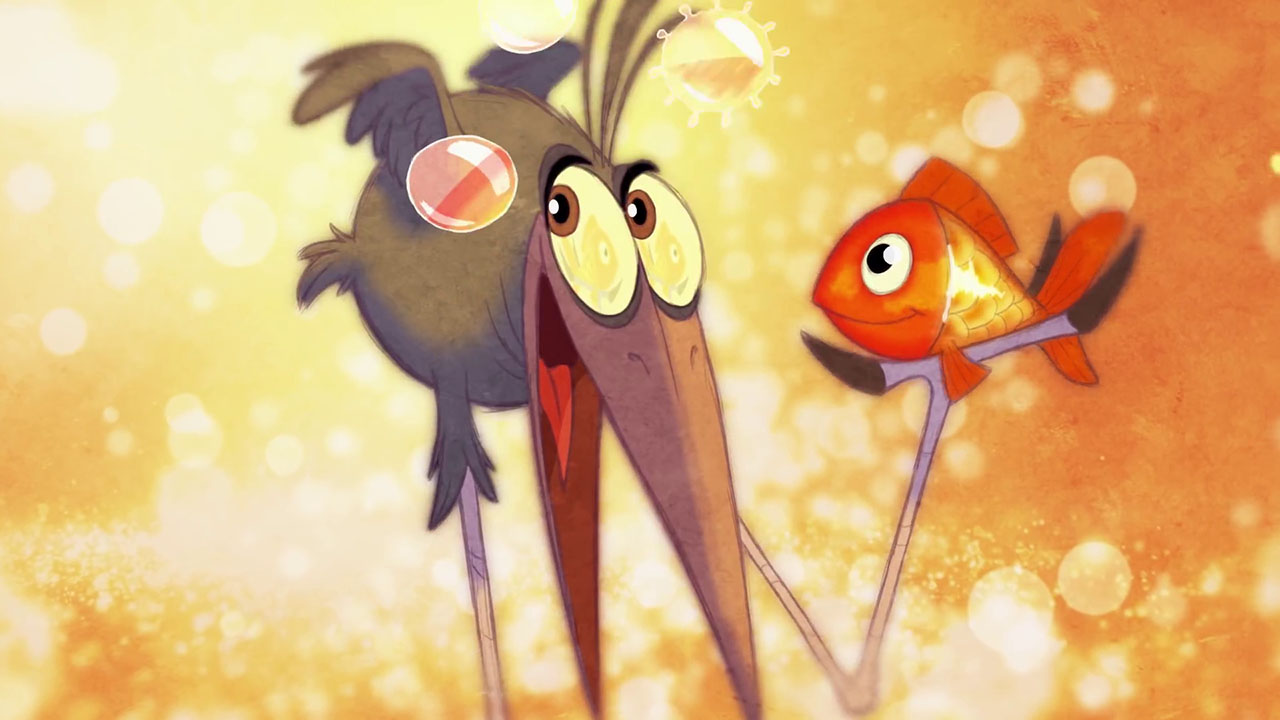
Bird Karma (2018, William Salazar)

Short, snappy and cartoony, produced by Dreamworks. Water bird has all the fish he can eat, but goes after the magic golden rainbow fish. Salazar worked on this year’s oscar short winner The Boy, the Mole, the Fox and the Horse.
At least Anne is Deragh Campbell, otherwise I would’ve lost all patience with her. Childish and giggling too much, she works at a preschool where the kids like her because she’s one of them. She manages to meet a grown-up named Matt (Johnson of The Dirties and Blackberry), but plays a “joke” while taking him to meet her parents, falsely announcing that they’re getting married. Nice ambiguous ending, her first solo skydiving trip after she’d been acting increasingly erratic.

I thought it’d be nice to watch a skydiving movie on a plane, and the best part was pausing to explain to the curiously concerned guy next to me the concepts of non-streaming video (how can movie exist without internet) and of indie cinema (he thought it was some kind of Deragh Campbell livecam).

Josh Cabrita in Cinema Scope 80:

So as to even further distanciate the viewer’s perspective of Anne’s life from her own view of these same events, Radwanski continually constructs his scenes around missing or partial information … As in Radwanski’s previous films, the close-up is never a window into a subject’s soul, and possesses no exploratory power. Instead of being a lugubrious exercise in the most facile form of humanist filmmaking – a limited register wherein all that matters is the director’s and viewer’s supposedly generous response to an apparently difficult person – Anne takes a purely external viewpoint that allows for the contemplation of various surfaces.