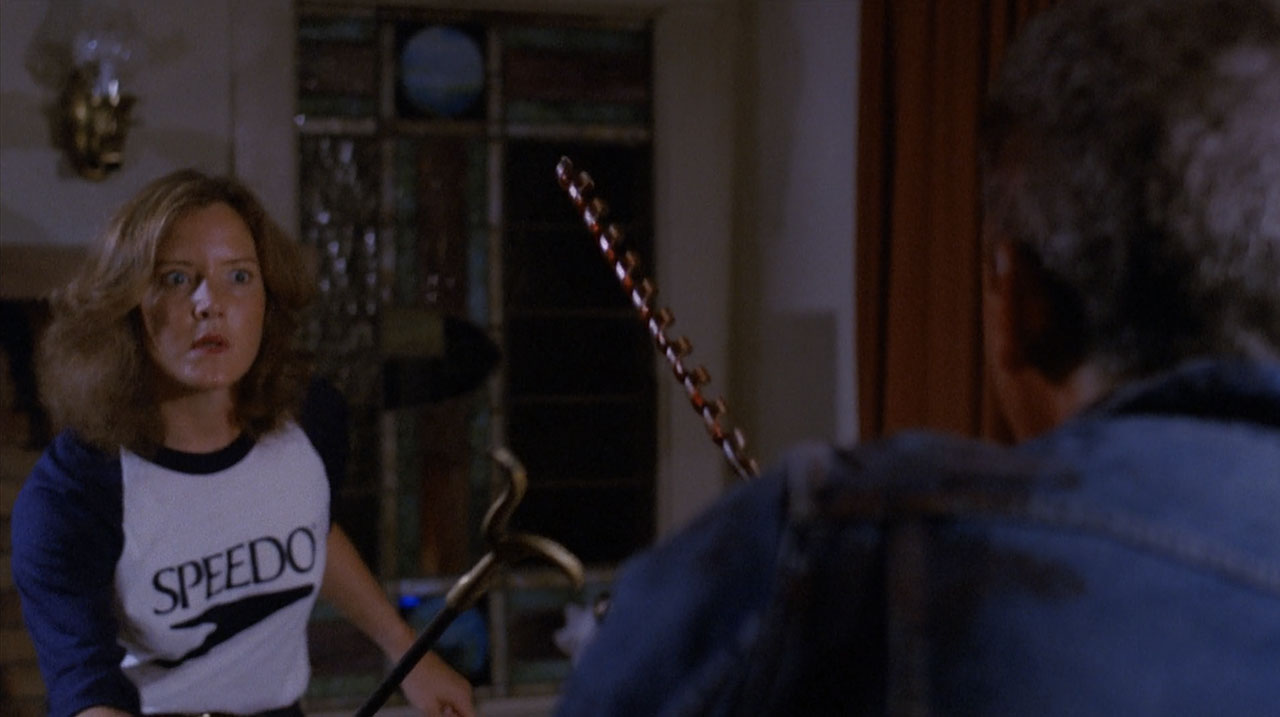
Apprivoisé (2017, Bertrand Mandico)

Music video with unsubtitled intro. Flamboyant feather-boa skeleton-hand guy is set loose on a dinner party, his frost breath bestowing jeweled rings and necklaces and cocks upon the guests, but he cannot be stopped, and dismembers their host. Extremely great, obviously.


Niemand (2019, Bertrand Mandico)

Another music video, this time sung in German, the story about a woman who keeps getting in car crashes, after which neon-eyed cannibal angels steal and eat whatever body part she’s injured.


Fou de Bassan (2021, Yann Gonzalez)

Checking in with Mandico’s buddy Yann. This is a bit of free-for-all perversity, a misty night scene lit by spotlights and artificial moon.

When Anthology Film Archives first opened in 1970, its inaugural screening – presented during a private event on November 30 – showcased four highlights from the foundational repertory cycle that would come to be known as the Essential Cinema Repertory Collection … The four films represented a short survey of film history, spanning from the turn of the century all the way up to the (then-)present day.

Voyage Across the Impossible (1904, Georges Méliès)

The hand tinted color is supremely excellent, the handcrafted, cardboard-looking sets and props very nice, and I couldn’t care less about the slapstick steampunk nonsense plot. More or less a sequel to A Trip to the Moon, this time to the sun. Jules Verne died the following year, so could potentially have seen this. When some passengers accidentally freeze into an ice block in the protective cooler car, their guide hurriedly warms them up by starting a fire with some hay… on the sun. I like the copyright notices hidden in plain sight, on cliff walls and the sides of trains and submarines.


The Midnight Party (1940s/1968, Joseph Cornell & Lawrence Jordan)

Stock Footage: The Movie. Sometimes the shots are flopped or frozen or repeated, with flashes of intertitles in between. The whole thing feels like it was made by mistake.


The Canaries (1969, Jerome Hill)

Canary songs and chirps are visualized as color blobs, which finally form new canaries made of pure sound and light which float away from the cage, visiting lovers on the beach. I wish I’d thought of this one.


Film No. 11: Mirror Animations (1956, Harry Smith)

I just watched this last year, probably my favorite of all the Harry Smith films I’ve seen.

One long-weekend in June, I watched a bunch of shorts, beginning with a bunch by New York/Berlin artist Henrot. Currently separated from my issues of Cinema Scope so I can’t revisit the article that first put her on my radar.

Million Dollars Point (2011)

Movie kinda fades in and out, as if showing excerpts. Hawaiian Christian on the soundtrack, preaching and singing. the visuals alternate between touristy Hawaiian dance scenes rephotographed off an SD TV, and beautiful undersea nature over the dumping grounds of human vehicles.


Strife of Love in a Dream (2011)

Manufacturing pharma – Atarax – but playing doom-drone music instead of KG+tLW’s “Ataraxia.” Long line of people winding up a mountain towards some event that involves fire and military control… an ornamental theatrical performance… and flash shots of snakes, which eventually take over the film, snakes in all forms, in life and art.


Grosse Fatigue (2013)

I loved Strife but this still feels like a huge leap forward. Narrator/singer rapidly goes through the history of the universe, the gods, mankind, as the visuals spring from a simulated mac desktop, windows overlapping, heavy on animal images. About 200 more dead birds in this than I would’ve liked, but still kinda great.


Saturday (2017)

No dead birds here except in the news ticker, but they’re replaced by close-up medical body-horrors. Fun experiments in rotoscoping, certain footage elements remaining in the foreground of the news ticker (which multiplies, its news becoming less informative) or breaking through the letterbox bars. The main topic is televised/radio call-in religious shows and baptism.


Film Spatial (2008)

“You have to learn not to understand everything.” She’s interviewing an older artist while camera roves around a busy house or studio in closeup. Lot of partially seen artworks and books, frequent visits to the dog on the floor. “In a really good film, it’s not just the content that’s important, it’s the visual impact … The content, in a way, is the pretext.”

Cool movie by Unsubtle Paul, opening with a spider on a crucifix. Writer Jeroen Krabbé (in a couple Soderberghs before going hollywood) is an absolute mess and an asshole to everybody. He’s haunted by his imagination, scenes tripping in and out of fantasies. He meets Spetters star Renée Soutendijk at a speaking engagement, and things get obsessive and weird. She brings home hunky new fella Thom Hoffman (who starred in Paul’s Black Book a couple decades later) and Jeroen suspects they’re both trapped in a murderous plot.

The writer is a religious nut hooking up with a killer widow, this is the Paul Career Template Film, following standard procedure of making you go “wowowowow” every ten minutes. Shot by Jan “Speed” de Bont. I am amused to realize that this week I also watched The 4th Man’s rhyming film The Northman. A letterboxd reviewer notes this “doesn’t work as a sequel to The Third Man.”

Toxic Roxy is young and blonde, frees buried criminal Kate Bush, who murders all Roxy’s friends then escapes, leaving the whole community angry at Roxy and her hairdresser mom. This all takes place on another planet, populated entirely by women who shun electronics and chemistry, after the earth became uninhabitable… well, only shunning these things to a point, since they have guns and androids (both named after fashion brands). While waiting for Kate, Roxy and her mom (Elina Löwensohn of course) bond with Kate’s fancy rich neighbor Sternberg, with her male android Olgar 2 and weirdo bounty-hunter bots Keifer and Climax.

Extremely horny sci-fi, Roxy masturbating at every opportunity, with dreamy visuals. We got zombie horses, geode-faced creatures, energy weapons, a pubic third eye, hats and fur coats everywhere, and everything is slimy or dripping and cross-faded onto everything else. I felt bad about not liking The Northman last night, then today I double-featured this with Mad God at the Plaza, and now I am feeling much better.

Opens unpromisingly despite Ethan Hawke… actors laboriously declaiming portentous dialogue in fake accents. It does start to get trippy, with more CG than expected (incl. cartoon-ass animals), and at the “years later” jump the tedious-to-thrilling ratio is 50/50. Subwoofer cinema, a sonically unpleasant movie – I should’ve played the Harriet Tubman album again. Alexander Skarsgård (Florence Pugh’s fake bf in Little Drummer Girl) swears revenge, loses his way, meets Björk, swears revenge again, kills Fjölnir’s son and refuses to say where he’s hidden the heart. Lotta people get chopped up with swords. Three good performances in this: Björk > Skarsgård > Dafoe

Willow Maclay argues there are four good performances:

Nicole Kidman also gives one of her best performances in some time as an incestual madwoman, driven berserk by the times, and dripping with salacious fury in her scene of revelation. This contrasts with her elegant work as a Queen and mother, and suggests that a proper feminine presentation can be hiding a cannibalistic fury behind doors.

Michael Sicinski:

Virtually every landscape is CGI’ed to the point of absurdity. The Northman strives for the painterly but more closely resembles those 4K test images they show on the TVs at Costco.

Part 1: The Golden Sea

I watched this in college on bootleg VHS for an ill-fated report on Lang’s cinema, and remembered pretty much nothing. A story in two parts, initially set in America with rival adventurers Kay Hoog and Lio Sha. These are meant to be American names? Kay is rich as hell, going after Peruvian gold despite Lio’s gang The Spiders warning him away. Even this early, Lang was into surveillance tech – Lio has an electric mirror showing a view of the next room: a webcam 100 years ahead of its time.

Kay in foreground, Lio being molested at the tables, Georgia flag in Mexican cantina:

Our teams travel to Mexico, hop a balloon over Chile, Kay parachutes out and immediately rescues the Princess of the Sun from a snake. Lio is safely captured, is to be sacrificed, while the Princess swoons for Hoog in her secret waterfall cavern. I love that the drama is less that a girl is gonna get sacrificed and her nemesis is launching a reluctant rescue mission, it’s that the Princess performing the sacrifice doesn’t wanna but her dad says she has to. A chaotic rescue, they find and steal the gold on their way out, then the spiders start killing each other in a frenzy over the gold, and also light the “holy candle” which is a bomb fuse, flooding the cave. The movie opened with a message in a bottle, and nearly ends with Hoog and rescued/kidnapped Princess adrift in a basket. It actually ends back at the Hoog Mansion when he runs out for an errand, returns to find his princess dead with a toy spider on her.

Princess Dagover in over her head:

The servants get into the wine:


Part 2: The Diamond Ship

Lio seeks a stone for a Chinese client. The opening robbery is filmed at an angle that just doesn’t work, not high enough, very un-Lang. Kay aims to stop the Spiders, still miffed that they killed his princess. With a single edit, Kay jumps off a plane onto a rooftop, hmmm. He hangs out in an opium den to scout for clues, spots Lio and takes her hostage, but they drop him through a trap door into a flooding pit from which he improbably manages to escape. I would’ve been happy watching Kay Hoog continue to escape from implausible scenarios, but the movie feels compelled to set up a big score for us, team Spider swimming in their full black bodysuits (with shoes and masks) to a diamond-laden boat. Somehow this leads to a final fight in a poison cave in the Falkland islands, a four-fingered villain and another kidnapped daughter, but it’s hard to pay attention whenever Kay isn’t falling through trap doors. Ultimately the plastic spiders and the Kay Hoog t-shirts weren’t selling, so the series was cancelled before they made a third episode.

Nemeses:

Kay was Carl de Vogt, who worked long enough to appear in a 1960’s Mabuse. His arch-nemesis Lio Sha’s real name was the just-as-unlikely Ressel Orla. A Jew in Berlin, she escaped the holocaust by dying of illness in the early 1930’s. Lil Dagover (of Lang’s Harakiri the same year) played the Princess of the Sun, and part two’s Diamond King (with the kidnapped daughter) was Rudolf Lettinger (in Cabinet of Dr. Caligari the same year).

Conference Call:

Caligari Man with Kidnapped Daughter:

Ben Model’s music seems fine, but after five minutes I realized I could be playing Zorn’s Nostradamus: The Death of Satan instead, so I did… then The Ninth Circle… so, the Simulacrum crew of Hollenberg / Medeski / Grohowski, and adding Marsella in the second half of The Golden Lake. For part two I played Harriet Tubman’s The Terror End of Beauty. If you keep falling asleep, resuming the movie where you left off the next night but starting the album over, Harriet Tubman is like the miracle of the oil lasting eight nights. But ultimately the movie is too long, so I moved on to their previous LP Araminta feat. Wadada Leo Smith on trumpet.

Dave Kehr says it best, as usual:

Fascinating … though it no longer plays particularly well. Already at this primitive stage in his development Lang was conjuring vast international conspiracies and drawing his hapless heroes into intractable webs of fate. The form is here, the meaning would come later. The visuals too are stamped with Lang’s personality; no one carved up screen space with his precision and expressiveness.

Miguel’s covid-era meta-movie, the days edited in reverse order, the title a reversal of an earlier feature. The movie starts as a light threesome drama, then begins to be about the complications around its own making. For all its formal games, it has a time-killing feeling of “no other movies being made during lockdown, so we made one” – there’s time-lapse and slow-mo and Gomes all but admitting he doesn’t know what happens in the film.

Robert Koehler in Cinema Scope:

Within the context of a playfully narrative feature, The Tsugua Diaries comes close to capturing what moviemaking actually feels like—at least moviemaking as practiced in the free-and-easy manner of Fazendeiro and Gomes. When the actors convey to the filmmakers their worries that the scenes aren’t working, Gomes’ response highlights a fact of life that auteurist critics in particular ignore at their peril: he informs the cast that he, Fazendeiro, and Ricardo are “finding that, overall, it’s been a good performance.” Gomes here demonstrates that he knows that actors drive the action, not directors—a notion that he takes all the way on Day 7, when he must accompany Fazendeiro to a prenatal exam, and tells his actors to direct themselves. How, they ask? “Work it out,” says Gomes—which could be the slogan for every film set.

Most importantly, there are two parrots, and baby peacocks:

Both the movie and its lead dude Cooper Hoffman move fast. He gets Alana Haim to be his chaperone on a promotional trip for his acting career, then things escalate, until he’s arrested for murder while selling waterbeds at a teenage fair, and flooding the house of Barbra Streisand’s boyfriend. She directs the ads for aspiring politician Benny Safdie, he opens a successful pinball palace. Haim gets to run a lot. The final scene, I dunno, but hey, why not.