Ellen “Juno” Page is a girl named Bliss with a beauty-contest-obsessed mom (Marcia Gay Harden of Mystic River), a non-participant dad (convincingly schlubby-looking Daniel Stern) and fellow beauty queen little sister Eulala Scheel. Juno and freckled friend Pash (Arrested Development’s Alia Shakwat) work at a burger joint with manager Birdman (I like the names in this movie) until Juno finds out about the local rollergirls, tries out for the team (under manager Andrew “Futureman” Wilson), makes the cut, becomes the team poster girl, quits to please her mom, rejoins to please her dad and her team and herself, wins over the mom and even earns the grudging respect of victorious rival Juliette Lewis.

No surprises from the story or characters, but we found it unusually good for a girl movie. Drew is now the first Barrymore to direct since Lionel in 1931.

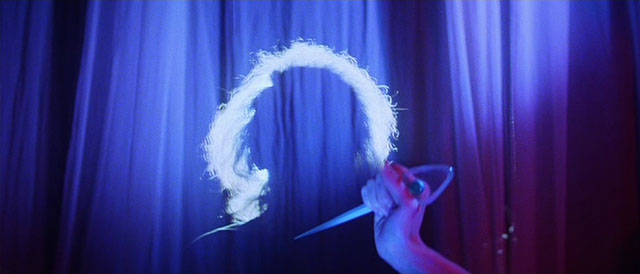
An awful lot like Inferno, with the ludicrous plot, hysterical acting and silly deaths. But also like Inferno, the visuals are excellent enough that I can forgive all that. I think I actually prefer Inferno, even though this one has better music and funnier death scenes.

Eva Axén went from working with Visconti in classy period pieces to getting stabbed, thrown through windows and hung by Argento:
img

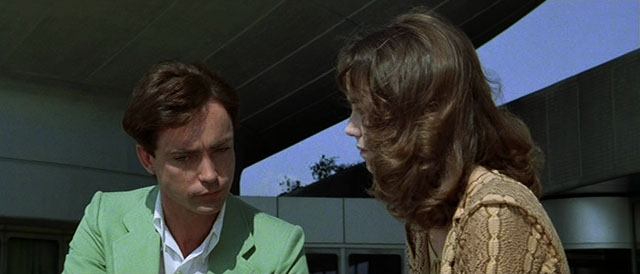
Eva up there escapes from a prestigious dancing school, goes to stay with a friend, and is dramatically killed (along with the friend) by an unseen evil which cares little for logic or reasonable dialogue, only for the picturesque posed deaths of young women.

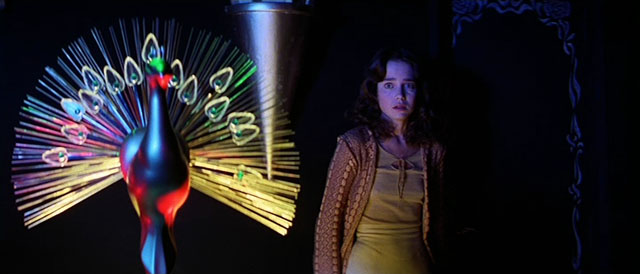
Our heroine in the middle is Jessica Harper (Phantom of the Paradise, Pennies From Heaven). At left is Stefania Casini, an older sister in Blood For Dracula.
img

New student Suzy picks up the narrative from there, discovering right off the bat that her school is creepy but not figuring until the end that it’s a front for a coven of witches run by a hundreds-year-old evil mother.

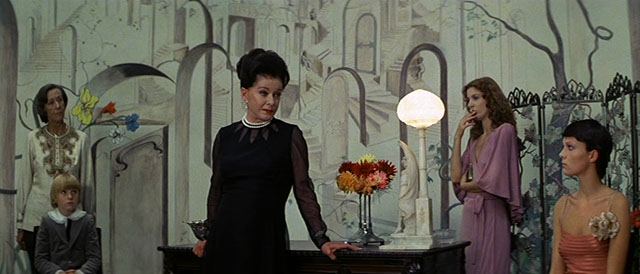
The Mother Of… something:
img

One thing the movie’s got going for it: casting Udo Kier. But it loses points for casting Udo Kier in a tiny, talky role, essentially letting everyone BUT Udo Kier overact. Bad call. Maybe Kier was busy in Fassbinder’s The Stationmaster’s Wife at the time.
img

While Suzy has fainting spells, deals with a plague of maggots falling from the ceiling, and talks with Udo Kier and some professor (Rudolf Schündler, actor since the 30’s and director in the 50’s and 60’s, also in The Exorcist and Wenders’ Kings of the Road and The American Friend) about historical nonsense, more deaths occur. Her friend Stefania Casini is murdered by the unseen hand in a similar over-the-top manner to the first death (barbed wire, razor stabbing, nails through the eyes). And the blind pianist is kicked out of school and walks through the abandoned square at night. The music warms up, the lighting declares the buildings to be a threat, and suddenly a stone gargoyle comes alive and flies overhead… but in the end, he’s simply killed by his guide dog.

Blind Daniel (Flavio Bucci of Il Divo) getting kicked out of school by mistress Alida Valli (star of Eyes Without a Face, Senso, Il Grido, The Third Man, played a caretaker in Inferno)
img

Joan Bennett (30+ years after Scarlet Street), in her final film role, has got some wicked wallpaper.
img

Amazing cinematography by Luciano Tovoli (from Antonioni to Argento to Barbet Schroeder to Titus), who shines red and blue colored lights on simply everything. The dubbing is mostly good, and I liked the pumping Goblin music surprisingly well. I dig when Goblin sings along quietly with a sinister “la la la.”

Argento’s debut seven years prior was titled The Bird with the Crystal Plumage.
img

OCT 2017: watched the new 4k restoration at the Alamo, wowie wow wow.

“Count Dracula may not seem like the ideal husband. … Of course he’s deadly pale, but then he’s a vegetarian and they all seem to look like that.”

image

The director admits the film is slow, even uses the word “boring,” but says they figured it’d be more poetic that way. He also claims little familiarity with the original Dracula story and vampire mythology, but says he’d try to respect it whenever a crew member would point it out (“hey Paul, Drac can’t walk out in sunlight like that”).

On the plus side, it has very nice piano music, decent well-lit cinematography by Luigi Kuveiller (who shot Avanti! and is as fond of zooms as Brian De Palma), Udo Kier acting off his nut, a humorous array of atrocious accents, and the longest blood-vomiting scene I’ve ever watched. Morrissey’s got the right idea about horror movies drawing in the viewer through slow buildup, but he misses the creepy horror atmosphere. Udo Kier’s Dracula is a pale weakling who gets ordered around by his enthusiastic German servant (Arno Juerging) and is eventually, humiliatingly killed by a loser rapist houseboy wielding an axe. Without the horror, or the over-the-top 3D humor of Flesh For Frankenstein, this one just sorta drags along.

Arno Juerging with Maxime McKendry:
image

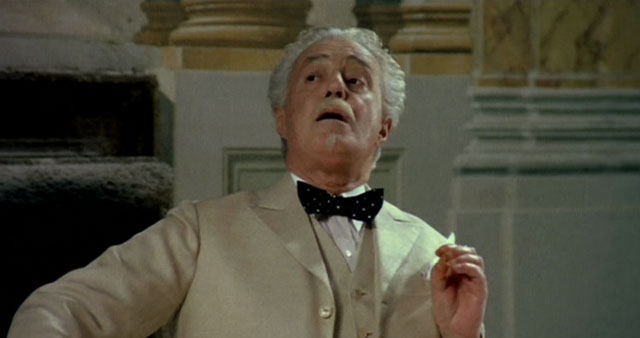
Dracula is sent from Romania to Italy to find virgins, since Romania is fresh out. Stays at a house run by the shabby, formerly wealthy couple of Maxime McKendry (seems like the best actress here, but never in another film) and the great Vittorio De Sica, below.

image

Drac is interested in the family’s four girls and tries to figure which is a virgin so he can drink her bl… I mean marry her. Unfortunately, the oldest two are having kinky sex regularly with beefcake houseboy Joe Dallesandro (Rivette’s Merry-Go-Round, a hitman in The Limey), the middle one has been engaged before so Drac writes her off (turns out she’s still a virgin so Joe kindly rapes her to save her from becoming vampire food) and the youngest is 14 (so unmarryable, but Drac is chasing her at the end).

Milena Vukotic:
image

Stefania Casini (Suspiria, a hitwoman in Bad, 1900, Belly of an Architect):
image

Not pictured: Fellini/Bunuel/Tarkovsky actress Milena Vukotic, and youngest Silvia Dionisio. It was a bitch to figure out the above screenshots since all four sisters look the same. See comment below for some clarification/corrections (thanks Jenna).

“What about your sister? What does she do all night? I’d like to rape the hell out of her.” “She’s only 14!”

image

The reason I watched this in the first place, kicking off an early start to SHOCKtober on the 29th, is Roman Polanski. During all the controversy while he sits in a Swiss jail I thought I’d watch myself a RoPol movie, but I can’t find my copy of Knife in the Water so I went for this instead. Apparently Udo Kier needed to take a day off for reshoots on another film, so they hurriedly wrote a scene in which Arno Juerging gets scammed by Roman (on left with the mustache) in a tavern.

image

Udo is as fun to watch as always (well, maybe less fun than always), but he’s surrounded by the usual sordid 70’s misogyny of a Morrissey/Warhol production. Dracula comes to a sad end, limbs all chopped off like the Black Knight and then staked by the gross houseboy. Better luck next time…

image

SHOCKtober gets off to a rocky start with this five-part British miniseries. The premise is that there’s an apocalyptic zombie attack which we see through the eyes of reality show Big Brother participants. I think maybe if I’d ever cared about the show (or even seen it) this might’ve made a bigger impact… movie seems geared towards fans.

Who loves Dawn of the Dead?
“Why do they keep coming towards the house?”
“This place used to be like a chuch to them.”

I hope to see no more work from director Demange and cinematographer Tat Radcliffe who provide garbage visuals for Brooker’s cliche but sometimes exciting story. Every time there’s a bit of action the cameraman goes spastic. Since the bits of action are what make zombie movies fun, this one kinda blows. Fun to see zombies unleashed on a reality TV set though, ripping up the only character I liked, a girl whose only line seems to be a dismayed “I don’t like it!” We’re supposed to be thrilled instead at the prolonged, gory death of mega-asshole producer Andy Nyman, but he was too cartoonish to hate – I just appreciated his death scene because it was the only zombie-attack bit where the camera stood still.

MPEG noise over gloomy clouds makes the sky appear to be full of tiny birds.

“Blue… blue is very important.”

I’ve mostly been giving Chabrol a pass in favor of other French filmmakers who seem more interesting, but I checked this out as part of Shadowplay’s Film Club. It has already received the proper attention there, so I’ll just skip through…

image

Wild intro and last 15 minutes, not much heated activity in between. Hélène Régnier (Stéphane Audran, star of Babette’s Feast, lead girl’s mom in Thieves After Dark, also Coup de torchon, Discreet Charm, Dead Pigeon and numerous other Chabrol pictures) is our lead, and she’s pretty great. Her drug-addict husband Charles (Jean-Claude Drouot, playing the opposite of his overjoyed husband in La Bonheur) frankensteins out of his room one morning, attacks her, then clubs his son’s head into the corner of a dresser. She spends the rest of the movie dealing with the repercussions and gathering her wits. The kid is practically forgotten – total plot device.

image

Everyone turns out to be pretty well decent except for the husband’s rich dad (Michel Bouquet of The Bride Wore Black) who wants to use this incident to kick lowly Helene out of the family, and Paul, the two-faced creep he hires (Jean-Pierre Cassel, above, fresh from Army of Shadows and previously star of Renoir’s Elusive Corporal).

image

Helene stays at a boarding house near the hospital populated by nice, handsome Dr. Blanchard (Angelo Infanti, who experienced death-by-montage in The Godfather), a crazily-bearded hammy actor, three card-playing old women (“the Fates,” screams the DVD commentary), landlady Mrs. Pinelli, her drunk husband and their movie-fakey impaired daughter.

image

Intrigue: Paul, in collaboration with his always-nude sex-fiend girlfriend Sonia (Catherine Rouvel: Black and White in Color, Va Savoir), gets the loony idea to kidnap the landlady’s daughter, show her satanic sex films and pin it on Helene. But she’s not as dumb as Paul thought, and knows the difference between our Helene and Sonia in a wig. Paul then drugs Helene to keep his plan from crumbling – meanwhile Drouot is on the rampage, having killed his poor, sympathetic mother, runs into Paul who panics and stabs D. to death while a tripping Helene and the three card-playing women space out in the park watching balloons.

image

Funny to me: Marguerite Cassan plays the mother of Jean-Claude Drouot. She was in Renoir’s Picnic on the Grass which inspired Le Bonheur, which starred Drouot.

Movie is more musically interesting than visually. The commentary agrees: “It’s music that announces itself as music – it’s not to be forgotten, it’s to be paid attention to… an element of the filmmaking.”

image

English title was The Break-Up.

More hits from the commentary:
“Things in Chabrol’s universe do not happen for a reason.”
“The tension… is between civilization… and the beast within.”
“I’d say if the film has a flaw, she is a saint.”

image

“This is almost a caricature of a retarded girl. This has no basis in naturalism whatsoever. The existence inside this house is an existence on a different plane in a different style. This is a horror movie, it’s just a very strange, muted…” Comment makes me think of Celine & Julie Go Boating, but the movie doesn’t. The other common comparison is Sunrise because of a train ride scene. I think people are stretching.

image

“We’re alone and we stay alone. But what counts is to want something… no matter what the cost. There’s a bit of happiness in simply wanting happiness.”

Oops, we were supposed to end Agnes Varda Month with Jacquot de Nantes but I couldn’t get the subtitles to work, so we watched Jacquot’s own Nantes-set first feature. Not a musical like we’d hoped, but a gorgeous widescreen black and white, slightly melancholic drama with a lovely Young Girls of Rochefort-reminiscent ending.

Our listless hero is Roland (Marc Michel of Le Trou), who just wants to get out of town until he meets his crush from a decade ago, dancer Lola (Anouk Aimée). He sticks around to see if anything will happen between them, but she’s not interested, waiting for her long-lost love (and father of her child), messing around with an American soldier (New Jersey native Alan Scott who speaks hilariously horrid French) in the meantime.

Separately, Roland and the soldier also meet a young teen girl named Cécile, and Roland meets her lovesick mother (Elina Labourdette of Bresson’s Les dames du Bois de Boulogne) who tries in vain to distract him from Lola. Roland kills time at his favorite cafe with a woman in her 60’s (one of the card players in La Rupture) who talks about her son who has been away for too long. Everyone turns out to be connected – she’s the mother of Lola’s missing boyfriend who returns home to them in the final scene – giving Nantes a small-town feel, but it’s made small through the characters, not by the crane shots which make Rochefort look like a stage set.

Demy’s cinema is interconnected: Lola returned in Model Shop and Roland is the guy who marries Catherine Deneuve in The Umbrellas of Cherbourg.

NY Times: “Cécile, it’s worth mentioning, is Lola’s real name. All these people are to some degree reflections of Lola or her vanished lover, and part of the pleasure of the movie lies in watching Demy choreograph this intricate play of mirror images as the characters flicker past one another – sometimes recognizing themselves, fleetingly, but more often not.”

R. Bergan: “Its circular construction, frothiness, and long tracking shots are reminiscent of Max Ophüls, the film’s dedicatee.”

Summer 2015: Watched again from the new blu-ray, replaced screenshots.

Loyally following the director’s intent, I watched this on an iPod. Seven episodes, supposedly released over seven days, but I started on day eight and watched at my own pace. Supposedly a fat young boy “blogger” is backstage at a fashion show watching events unfold over seven days, editing together segments from single-take interviews with participants backstage. Some of the performances are very fun to watch – especially Jude Law as a diva cross-dressing model who keeps dropping his fake accent. I’m happy to play along, expecting, if not a new favorite film along the lines of Yes and Orlando, at least a smart, good time. In the first place it seems a bad sign that she’s written a takedown of the fashion industry. I’ve seen enough Project Runway to know there’s no need.

J. Kipp:

The movie is supposedly being made on an intern’s camera phone and these actors embody characters eager to share their experiences about the bitter, hypocritical world of fashion. Does that sound remotely interesting to you? Not at all, I’ll bet, because you’re already way ahead of the movie—we know inherently that the fashion world is superficial, and having a gallery of famous personalities line up and preach to the art house converted is nobody’s idea of a good time.

Sorry, Kipp, but halfway through I realized the movie isn’t a fashion attack at all. It’s something worse – a woman my mom’s age coming to terms with the power of the internet. The fun performances start getting watered down by hysterical ones. Increasingly ludicrous plot developments undermine the movie’s believability, and it devolves into the kind of camp I’d feared it would be when I first heard the premise.

Potter:

Funnily enough, I never thought of it as a film about the fashion industry. I thought of it as a film about people who happen to be in that setting. But as a filmmaker, what’s interesting about it is that it’s a world dedicated to appearances. But what the story’s about is what lies behind appearances, the tension between what you see and the reality underneath. It’s not really about fashion so much as about industry in crisis and individuals becoming unmasked … and finally, the gradual dawning realization that the person in the room with power is the youngest one, because he understands this new age of information on the Internet.

So our blogger Michelangelo (never seen or heard) watches as fabulous designer Merlin (Simon Abkarian: “He” in Yes) launches his new fashion line with models Jude Law, Lily Cole (The Imaginarium of Doctor Parnassus), and at least two others unseen. Also at the company are serious Bob Balaban (Christopher Guest regular, the film critic in Lady in the Water), “invisible” hispanic worker Adriana Barraza (the medium in Drag Me To Hell), and Dianne Wiest (recently of Synecdoche New York but I remember her best from Edward Scissorhands) as a manager who yearns for the old times when everyone knew everyone and all manufacturing wasn’t done in China.

Highlights of the movie are the interviews with jaded critic Judi Dench, wiry war photographer Steve Buscemi, fashion mogul Eddie Izzard, and his nervous caffeine-addicted bodyguard John Leguizamo. Lily Cole and pizza delivery-man-turned-fashion runway motorcyclist Riz Ahmed (of Dead Set) have the only semi-interesting character developments (Cole flees the scene and stays at Michelangelo’s house – a sweet ending, and the only non-bluescreen shot)

Not faring too well: Swedish Ben Affleck-lookalike Jakob Cedergren and Last King of Scotland vet David Oyelowo as an ineffectual Shakespeare-quoting cop, both of whom act angry at Michelangelo towards the end yelling at him to stop filming, while they stand in front of his bluescreen and look into the camera.

A model dies in the runway, her long scarf caught in Riz’s motorcycle wheel and the company decides to hold another show two days later, in which another model is shot to death. By that time the movie’s plot has already become way suspect, and the themes of fame and success, image and the power of the internet have reared their ugly heads. Apparently guns were handed to all the models as part of the show, and the audience was overrun with kids attracted by Michelangelo’s blog videos and I’m not sure what happened then, but people start yelling into his camera that Mich is the one with all the power here because he controls their images’ distribution over the rabble-rousing internet. Adriana cries that she is no longer invisible, D. Wiest joins the protesters against her own company, and nobody thinks to slap Mich upside the head, take away his camera and remove him from the premises. Maybe it’s more of an interesting concept and performance piece than a finished product, but it got my strict attention and I’m still very interested in Potter and whatever’s on her mind, so I went quote-hunting.

NY Press:

Potter defies the digital era’s fascination with new technology by emphasizing its limitations. … Her video technique doesn’t substitute for cinematic variety or photochemical richness. Instead, strict adherence to the basic things that digital media record (a face, place, moment) helps to appreciate the difference between video and film. Eschewing the lazy carelessness of so many misguided digital enthusiasts, Potter’s rigor becomes a refreshing reminder of true cinematic values.

J. Romney:

The novelty turn is Jude Law cross-dressing as supermodel Minx, sporting a series of preposterous wigs and an intermittent Russian accent (is Minx from Minsk?). All flirty grandeur (“Are you shy because I am celebrity, yes?”), it’s Law’s most theatrical screen performance yet, but it’s perfect here, both a larky send-up of his own beauty and a comment on the catwalk model as imaginary woman. But the people most redolent of the flesh-and-blood humanity that fashion operates to obscure are Steve Buscemi and British model Lily Cole. … As a purely plastic creation, an unusually sensuous essay in cinema povera, Rage is oddly compelling, a genuine one-off.

Slant:

The sketch-like focus on dialogue and characterization, as opposed to plot or mise-en-scene, is clearly the most logical direction for the burgeoning online/mobile entertainment movement, where grandiose visual concepts are dwarfed into 3.5 horizontal inches and uninspired set pieces are scrubbed ahead with the flick of a pinky. The advantage of Rage is its stylistic redundancy and still-life portraiture feel; one could pause the film at any time to check their email and return without having severed the narrative flow. The disadvantage is that the movie’s serenely glabrous surface lacks dynamism: Aside from the colored backgrounds that match each respective character’s eyes, garments, and/or hair, there are no visual indicators of plot development or tension, which lends itself to 98 minutes of occasionally soporific sameness. … While the stark visual formalism of the experiment is ideal for shrunken PDA and laptop screens, the monochromatic backgrounds and crystalline digital sheen seem borrowed from online commercials. Mute the sound, and you’ve got an adequately produced Apple ad.

M. Atkinson:

Rage has made itself noteworthy as the latest effort of a name filmmaker to address … the fact that cinema, as it’s traditionally made and consumed, is being starved by digital culture. Everyone knows the drill – movies, TV, music, newspapers, publishing, etc. are all dying pig-stuck deaths because of the internet, although no one dares to say that the internet is, in fact, the problem, and increases its dominance at a very real and looming set of costs to us all. … The film’s proud artifice rubs the mock-doc set-up the wrong way if you’re keeping score, except that “fashion” is all about the dishonesty of surfaces, and Potter’s film seems to be less about its subject and story than about how to make movies with as little as possible (another Warhol principle) and conform them to the new digital world. (In an interview in the latest Sight & Sound, she calls it “survivalist filmmaking, a no-waste aesthetic.”)

Potter again:

I think there is a deeper feel of rage, a kind of quiet rage on a mass scale and not knowing where to focus this rage which is the negative end of globalization. The positive end is the internet in my view, but the negative end which is about greater and greater ownership by anonymous corporate entities and less and less about freedom for the individual.

About women filmmakers:

It is making some headway because when I first started there were no women in the context where I was working. And that was a very lonely place, and I’ve watched that shift gradually. People used to come up to me in all parts of the world and said oh I loved The Piano and I said no that was Jane (Campion). And she and I would meet up now and then at festivals and she would say that people keep telling me they love Orlando and I’d say yes, sorry. So it was as if there were two of us in a sort of vaguely conspicuous, visible place in the pantheon of directors and that’s changed surely.