Sitting up front at the fake-imax, the movie was as large as I could make it, and for such an interstellar voyage movie, I sure noticed lots of close-ups. It must be a total pain to light and film faces inside space suits, but Gray and the DP from Interstellar find some lovely and mysterious new angles. Wonderful to travel all the way to Neptune and find… the Nicolas Brothers. Malickian crosscutting between past and future with voiceover… and didn’t Malick already cast Brad Pitt in a cosmic movie with hard feelings between father/son?

Ultimately, the movie was a metaphor for my watching the movie. Brad Pitt (me) leaves behind his sweetie Liv Tyler (Katy) because he is dedicated to his mission (killing his father / watching the movie), voyages to the edge of space (or Atlantic Station) on an endless (2 hour) journey all alone (cuz my friends don’t answer emails anymore), enduring hardships on the way (Atlanta traffic!), only to discover that God doesn’t exist, aliens are a myth, and we’re all we have, and returns to Liv Tyler waiting for him at home (again, Katy).

Brian Tallerico on Roger Ebert:

Earthly disasters possibly caused by a creator who has been absent as the world has lost hope — the religious allegory embedded in Ad Astra is crystal clear if you look for it, but never highlighted in a way that takes away from the film’s urgency. Science fiction is often about search for meaning, but this one literally tells the story of man’s quest to find He who created him and get some answers, including why He left us behind.

Pitt gets clued in by family friend Donald Sutherland, flies commercial to the moon (which is like an airport mall, complete with Subway and Hudson News), escapes rover pirates, flies with a new rocket crew to Mars, stops once to answer a distress call and lose their captain along the way. Pitt takes over from the panicky man left in charge for a safe landing, goes to a secret recording studio to send laser voicemails to his dead father, then is told by Ruth Negga that his hero dad actually killed his entire crew, including her parents. She sneaks him back on board the rocket, where he defensively kills the crew and carries on alone to Neptune, to either reconcile with his dad or blow him up with nukes. The former proves impossible, since dad can’t be reasoned with, loving nothing except his absent alien friends, so Brad rides a nuclear blast back home. Some of this sounds silly in retrospect, and some didn’t even work for me in the moment, especially that emergency stop that killed the rocket captain – I guess it’s a medical research ship overrun by a mutant space monkey. I’ve heard whispers of studio tampering but I’m not enough of a Gray purist to assume that he’s got a masterpiece version of this movie stuffed in a closet.

Lena Dunham was a Manson cultist! Aha, the ex-boyfriend of Sharon Tate is played by Emile Hirsch – I’ve seen a bunch of his movies (including some great ones) but I never recognize him. Same goes for Scoot McNairy, who played Business Bob. Dunno what Kevin Smith’s daughter or Demi Moore’s daughter look like, but they were both in there somewhere.

Mostly I watched the movie so I could finally read all the articles about the movie…

ScreenCrush: “Cliff is actually the type of guy Rick plays on television.”

Roger Ebert: “a movie not so much about an era but about the movies of that era”

The movie’s wikipedia is surprisingly good, and I found an in-depth article on a music site about the song the ranch girls sing while dumpster diving.

Slashfilm has a LOT about the movie’s songs – I found it while searching for the “Behind the Green Door” novelty song DiCaprio sings badly on television in flashback (which is period-correct).

Burt Reynolds was supposed to play the blind ranch owner, but he died while rehearsing his lines. Pitt’s character was partly based on a stuntman who worked with Reynolds. And this is Tarantino’s second movie about a stuntman – the last one starred Kurt Russell (here he played the stunt coordinator on the Bruce Lee set) and Zoe Bell (she played Kurt’s wife whose car is wrecked by Pitt – and she’s the actual stunt coordinator of this movie).

For balance, The New Yorker was not impressed, says Tarantino is racist, sexist, and a wannabe cult-leader.

The Atlantic responds (“Charles Manson was a white supremacist, a fact that does tend to put a lot of white people in a movie”), attacking the New Yorker, and ending with a hilarious Brad Pitt anecdote.

Happy SHOCKtober 2019!

From the first five minutes, this movie is too energetic and stylized to be a standard-ass survival/horror. Even the character setup scenes, video phone calls with her family, are visualized in a way I’ve never quite seen before. After that you’ve got your surfer, stranded on a tiny island trapped by an angry killer shark, and we remember Open Water but we’ve established that she’s organized and resourceful so this could go either way. Some dodgy CG when she escapes to a buoy and the enraged shark chomps the metal railings, otherwise a colorful, terrific-looking movie. The winning move, crowning this the queen of all shark-attack films, is introducing an injured seagull as Blake Lively’s only companion, naming it Steven Seagull, then feeding it crabs and letting it live to the end. Guess I’ll have to watch the rest of Collet-Serra’s movies now, to thank him for this seagull generosity (not including any superhero spinoffs and/or theme-park-ride adaptations he may have in the works).

I only know Lively from Age of Adaline. The writer followed up with a Coachella satanism flick and a couple TV movies, and is headed back out to sea this year with Gary Oldman. DP Flavio Labiano has also worked with Alex de la Iglesia and Snoop Dogg, and shot Timecrimes.

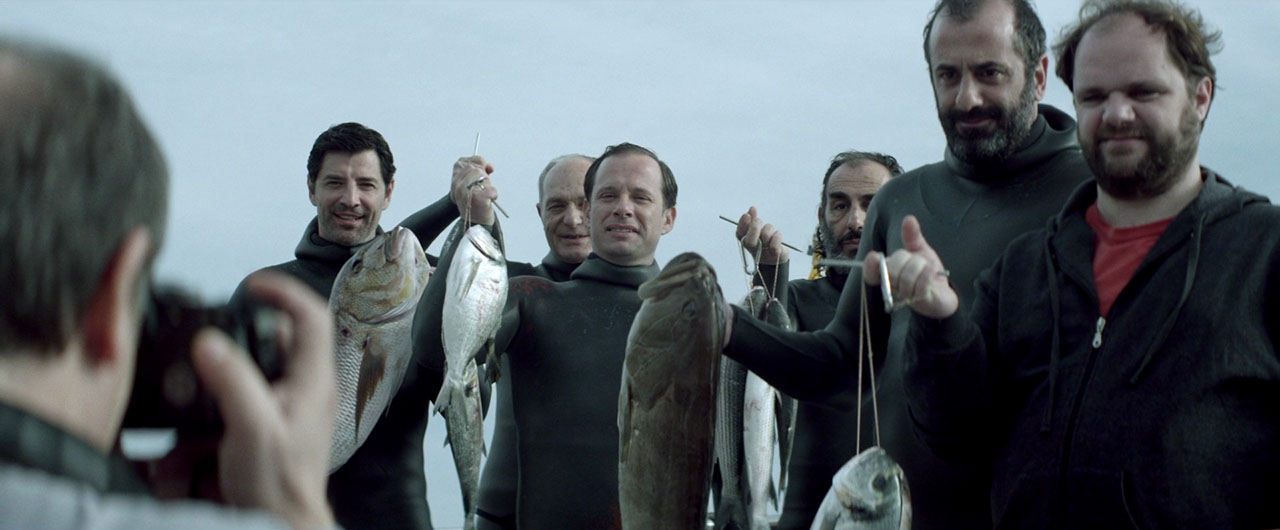
Deadpan comedy with a pretty mild punchline, though I suppose it’s about society/masculinity at large. A bunch of rich-seeming dudes on a yachting trip are one-upping each other, until one proposes a playful competition, and another ups it to a total competition, where they will rank each other on all manners of things, personality and behavior and performance, to decide which man is “the best in general.” The employees, ship captain, the cooks, get caught up in their own sad version of this, treating it like a reality show, rooting for favorites until they start judging each other as well.

Our guys skip stones (with the stone collection of Dimitris, the out-of-shape, hopeless one), they build Ikea shelves competitively, they listen to each other calling home to see who has the most supportive family, and there’s a literal dick-measuring contest. They make deals and cheat, and eventually I’ve got only Dimitris to root for. If they bother to tell us who “wins,” it’s underplayed and I’ve forgotten.

Samuel La France in Cinema Scope:

The director resists the urge to escalate the film’s contest towards an overwrought climax … keeping a potentially volatile premise on a relatively even keel. Chevalier is rich with bickering and petty squabbles, but the film is sustained thanks to the men’s ability to preserve (for the most part) a modicum of respect toward one another, and toward the rules of their absurd game — though this gentlemanly honour is very clearly strategic, since encouraging and reassuring others about their shortcomings is as important as hiding one’s own in a game where each participant is on double duty as both player and judge.

L-R: Christos, Doctor, Yannis, Josef, Yorgos, Dimitris

The waiter stars in the new Pity… Josef was in Attenberg, Yorgos appeared alongside Tsangari in Before Midnight, and Christos is a musician, known as “the only true pop star in Greece,” who did the Owen Wilson part in the Greek release of Cars.

LOL Forky. But was it worth making a whole theatrical sequel to showcase a makeshift toy who wants to be trash? Sure, why not, these have been reliably good, and it looked beautiful on the big screen, where we finally caught it before it closed so Joker could take over every theater. I suppose having the missing Bo Peep reappear as a bold carnival adventurer with misfit action-hero friends was a fun move, though I’m suspicious of Pixar/Disney’s intentions and read it as faux feminism. The door is open to more sequels, though Woody’s talkbox got removed by a ventriloquist-dummy surgeon and given to a friendless antique-shop Gabby Gabby doll, so there will be no more snakes in my boot.

Part three of our True/False Makeup Weekend. A counselor works with imprisoned refugees, while outside, millions of small crabs are freely migrating across the island. It’s a metaphor, you see – an irresistible one, with the bright crabs giving the film more visual texture, something entrancingly alien to cut to between close-shot stories of human suffering.

The movie opens with an escape, a man scaling a fence then hurtling through the woods, a staged version of something we hear about which may not have even happened, since we learn that the authorities are being misleading on purpose. The counselor’s view is that she can’t be helpful from just a single conversation, and there’s no guarantee if or when she’ll get to visit with her patients again. The final scene shows her packing up to leave the island with her family, the whole endeavor possibly a failure.

Mouseover to migrate the crabs:
image

In an essential article, The Guardian says the filmmaker and counselor Poh Lin Lee are friends, that the film was made from multiple visits over four years, and that interviews conducted on the island were filmed in secret from the government.

Slant:

Poh Lin uses a tableau of sand and small toy figures to help one woman process her trauma, poetically describing the grains of sand as mountains that have been reduced to their finest form, but mostly she just listens, and listens, and listens. She’s a willing sponge for their guilt, at one point moving over to sit next to and comfort the Syrian man who weeps as he remembers the various separations that have plagued his young life. It comes as no surprise to subsequently learn that Poh Lin is also in therapy.

Nanfu explores Chinese policy through the personal histories of her own family and neighbors, then expands to the country’s legacy of international adoption and a quest to trace adopted kids to their birth parents. As the country’s present-day propaganda shifts towards telling people that the perfect number of children to have is two, Nanfu tries to get people who lived through the previous era – parents who abandoned newborn children to die in the marketplace, party official abortionists, local government leaders who tore down the homes of residents who disobeyed the policy, families who made a business of selling abandoned babies to adoption agencies only to be imprisoned for human trafficking – to denounce the policy. But after decades of indoctrination, she manages to get one person to say it was a good idea, “but they took it too far.” Feels like too massive of an issue (and a country) for a single doc to cover, but the way she weaves the politics through her family’s own stories and memories makes it work beautifully – one of the best of this year’s T/F docs.

We had a True/False Makeup Weekend to celebrate One Child Nation‘s release in local theaters on the same day Amazing Johnathan premiered on streaming. As with this year’s fest itself, our programming was about half successful. We followed this one for a while, but as the filmmaker lost exclusive access to his subject, who also refused to quit or die, the director turned the movie towards himself (and itself) and tried to manufacture drama and stunts. Given how it ends up being about his competition with other Amazing Johnathan documentaries, and this one’s “twist ending” is its own executive producer credit, I’m surprised they didn’t film an addendum with our dude filming himself signing the Hulu deal. The other finished doc, Always Amazing, apparently scored a David Copperfield interview. In interviews, AJ says he likes the other movie just as much, which Berman says is impossible.

The most colorful African movie we’ve seen – well-acted, a high-quality production with a timely subject. Shame about the weak and obvious script. At least that was my position before reading Sarah-Tai Black’s Cinema Scope article, which basically says to shut up about the conventional structure and narrative, since it’s a groundbreaking film in other, important ways.

Kena (right) and Ziki should’ve known better than to hang out near these spies:

Kena’s dad is a shopkeeper who recently ditched Kena’s very religious mom to start a new family, and he’s in a political race against Ziki’s dad (Dennis Musyoka, a small role in Sense8). Kena starts ditching her would-be-boyfriend Blacksta and the daughter of the local gossip when she meets Ziki, and the two start growing closer until, inevitably, they get caught, beaten, arrested, preached-at and prayed-for, and permanently separated. I’m pretty sure Kena becomes a doctor at the end and Ziki moves away.

Kena hashes things out with Blacksta, but spies are everywhere:

Katy and I have also seen Kahiu’s awesome dystopian short and her feature drama about people connecting in the wake of Kenyan embassy bombings, and will be sitting tight waiting for the next one.