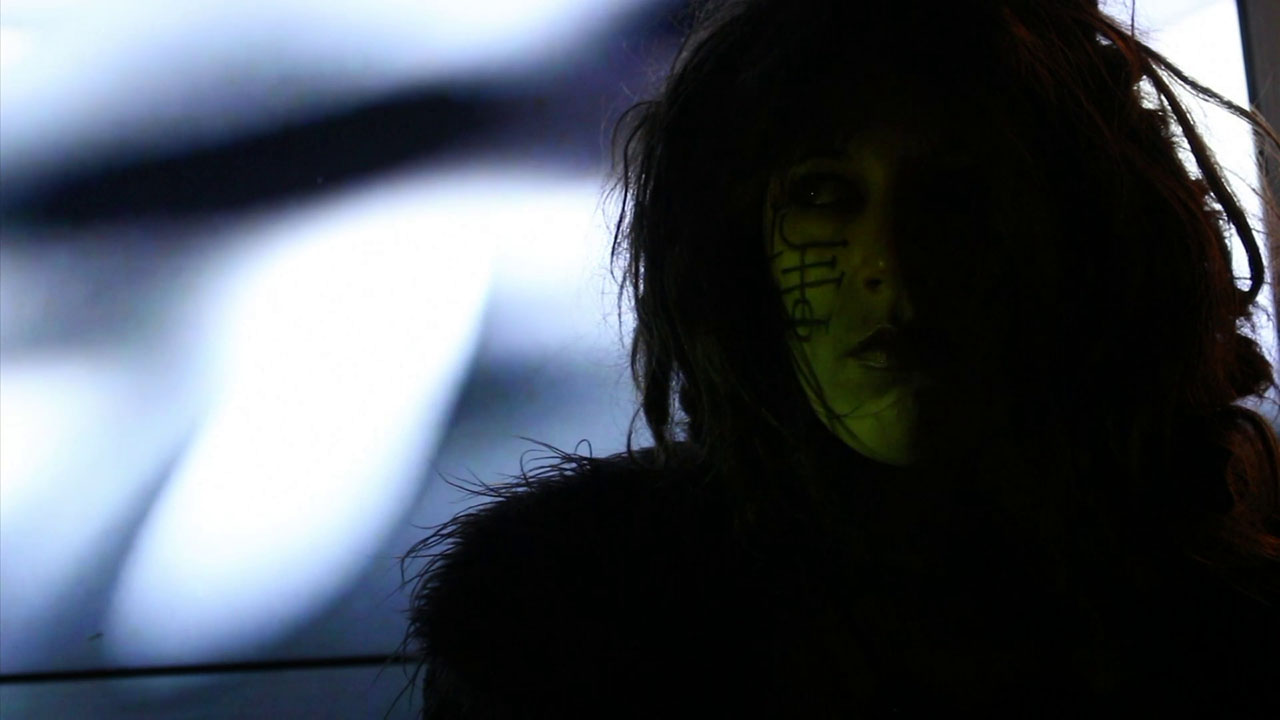
The second half reveals that Bradley Cooper’s washed-up drunk suicidal 1970’s jam-dude was the lead character all along, bumming out a movie that we thought would be more about the giddy excitement of Lady Gaga’s rise to stardom. She’s an amateur from nowhere with a golden voice, but being a pop singer in 2018 requires choreography and shitty beats, so Cooper loves and marries her but still gets to be the guy who keeps it real, commenting on her false costumes and dance moves, then goes back to barking indecipherable lyrics over Neilyoungian jams (backed by Neil’s band Promise of the Real).

Despite the Cooper obsession, it’s a well-paced beauty of a movie that seems to exist for that one song/scene, Gaga revealed to be far more talented than her work in Machete Kills hinted at. The camera dives and swoops through the rock concert scenes, Sam Elliott is cool as ever, and it’s not until the closing credits that we stop to wonder what Andrew Dice Clay and Dave Chappelle were doing in a movie together.

I was watching movies from last year’s Rotterdam and Sundance festivals, and now for a week on True/False movies. This is a transition film, premiering in last year’s True/False and showing up in this year’s Rotterdam (in Bright Future, with Long Day’s Journey Into Night, Manta Ray, Dead Horse Nebula). Opens with street scenes, talking with prostitutes, a squarish frame with v-hold issues and no sync sound, and I thought this might be a tough watch, then the editing sets it free – jumping around Jamaica meeting all sorts of people, beautiful photography and a vague structure around birth and death. It’s a poem of a movie, even less narrative than Hale County was, and at least as good.

The 16mm film full of light flares is interspersed with gliding HD. No subtitles and I can’t make out half the words, and zero sync sound, though sometimes we seem to be hearing the person we’re seeing speak, so it’s being shifted on purpose. So much Christianity – then an explanation for why that is, then an intro to rastafarianism and discussion of weed. I am an uncultured dummy who knows nothing about Jamaica or its culture, but there’s an echo effect on the end of sound clips and I wondered if this was dub-influenced. When the movie ended I was trying to remember how it started, watched the first half again before realizing that I was just going to keep playing it forever on a loop. Vikram Murthi saw it at T/F and notes that “the film is in direct conversation with the work by the Black Audio Film Collective.”

Opens with a boy named Niki playing with his school chums then coming home to bother his older sister Mila, who studies piano. This is Bulgaria, and she announces she’s going to Germany for school, so the rest of the movie feels like a countdown of the days she has left. The movie keeps focusing on something other than where the action or dialogue is, splintering conversations, not bringing the family (Niki, Mila and their dad – mom is mentioned but never seen) together visually until a nature hike at the end. Played in Rotterdam’s Bright Future section with Cocote.

Jordan Cronk in Cinema Scope:

The film’s musically inflected title seems to nod as much to three-quarter time as it does a fractured family unit … There’s … an effortless sense of family dynamics that feels organic and speaks fully to Metev and co-writer Betina Ip’s command of character and commitment to the quotidian moments that shape everyday life. There are no antagonists in 3/4, let alone villains–no dark or sadistic undercurrents meant to reflect contemporary Europe’s fraught sociopolitical temperament. By almost every conceivable tonal and stylistic metric, the film feels utterly removed from whatever continues to pass for serious international art cinema.

“This was important to me and I’m trying to figure out why.” Heard there was an overlooked Laura Dern trauma drama this year, so obviously I’m all over it. Premiered in competition at Sundance, with Blaze, Blindspotting, and Sorry to Bother You. A quarter of my top twenty movies of the year played there, but it’s still a scattershot festival so it’s hard to trust it. Hard to trust this movie too, when we’re already seeing flashbacks to earlier in the movie at the 18 minute mark.

Present Jenny + Past Jenny = the poster image

Dern is as good as expected, and Elizabeth Debicki (lately of Widows) is perfect as her riding instructor/molester, with handsome rapist husband Jason Ritter (Jeb in Oliver Stone’s W.). Documentary filmmaker Jenny’s mom Ellen Burstyn finds a disturbing story Jenny wrote years ago, wants her to come home and figure some things out, so we hang with Young Jenny (Isabelle Nélisse of both Mama and Mother) for half the movie and watch how she got into a relationship with a sexy attractive couple, which would be cool if Jenny wasn’t 13 at the time. Ends with Present Jenny talking with Past Jenny (given away by the movie poster). This is based closely on the filmmaker’s life, but The Rider it ain’t – the writing is obvious, and despite all the professionalism on display, it feels like a TV movie that scored a great cast.

Lovely, wholesome molesters:

Asger is a bad cop – we don’t know this yet, but can assume from context – forced, along with his supervisor, to a desk job working emergency phones until a little matter gets cleared up. He catches a kidnapping case (which nobody else on the overnight shift seems as excited about) and does a bunch of things wrong (some also illegal) trying in earnest to help the woman caller who has been abducted by her ex husband, leaving their two kids home alone.

The whole movie is confined to a call center, the second half in a private room after Asger decides he doesn’t want coworkers listening in, so it’s a one-man show with little visual flair. Asger eventually discovers she’s being taken to a psych hospital because she just stabbed one of their children to death, but she escapes and is gonna jump off a bridge, and it’s his fault, so he monologues about his own crime, essentially confessing to murder in front of a bunch of cops. Mostly I bought the kidnapping twists, but I’m not sure about this ending.

Won the audience award at Sundance last year in the world drama competition along with Pity, Rust, and a bunch I still haven’t heard anything about. This is Möller’s feature debut, after a short which was also about a woman in a psych hospital. The movie is Danish, but Asger is Swede Jakob Cedergren. The day after watching, I learned about the Jodie Foster remake starring Jake Gyllenhaal.

A theater group – not a very good one – is rehearsing the 1921 satire The Insect Play, but the guy playing Dung Beetle (Jirí Lábus, of a fascinating-sounding 1994 version of Amerika) keeps hallucinating insects (real and stop-motion) while learning his lines.

From the very beginning, Svankmajer and his crew appear onscreen, like the DVD extras have been cut into the feature. After a scene it’ll show the filming, the animation, direction, insect wrangling, sound effects (with constant scraping and clanking sounds plus the insect patter, they’re great throughout), or interview the actors about their dreams.

Fun movie, and only 93 minutes, a breeze to watch. To that point, it doesn’t seem like Svankmajer’s most consequential film, nor does it appear to be some kind of final statement on his career, unless I’m missing something about the Insect Play. Ungenerously, one could say choice of subject combined with the mechanics of behind-the-scenes production is the last word on his preference against humans and their messy realities. Jan: “I direct it like an animated film or puppet theater – short takes, minimal movement of the camera, stylized acting, no psychology, as if the actors had wires attached to the head and strings on the arms.”

Watching movies from last year’s Sundance and Rotterdam this week… this one premiered in Rotterdam’s Signatures section, playing with The Wandering Soap Opera, Lover for a Day, Mrs. Fang and Lek and the Dogs.

At the end of a year I usually make myself a list of movies, recent and old, that I really oughtta catch up with over the following year. And I usually get through a quarter to a third of the list, because a year is a long time and new distractions come up. I’ve also been missing theme months with Katy… so instead of the one big list this year, I’m gonna try a Theme Week approach (or for busy weeks or juicy themes, Theme Fortnights). Maybe all this is needlessly complicated, but when your goal is to watch All The Good Movies, which movie to watch next is a big question. It’s January, so Sundance and Rotterdam are coming, so this week I’m watching some movies that played there last year. Cocote premiered in Locarno, then played in Rotterdam’s “Bright Future” section with The Wild Boys and The Nothing Factory, and Cinema Scope wrote an article convincing me it’s essential viewing.

Was it essential? Maybe not, but a nice, slow/weird-cinema arthouse break from all the oscary things we’ve watched lately. At least I think it’s the first Dominican film I’ve seen – only previous reference to the country was when a Show Me a Hero character spent an episode there. As usual when watching a festival film from a previously unknown country, they’re not making it look like a great place to visit, the film displaying the corruption of the police force and overall rule of violence.

The style is all over, centering around long ceremonies related to the mourning of our lead dude Alberto’s dead father. Alberto is a groundskeeper in the city, summoned to his small-town home after his dad’s violent death at the hands of gangster loansharks. The picture moves from 16:9 to 4:3, color to b/w, tripod to handheld, with chapter-heading title cards. We get rituals (too many rituals) and endless arguments, and it’s slow and moody in between, often with very wide shots… also 360-degree pans, and conversations where you never see who is talking, culminating in Alberto’s final maybe-revenge action, an off-camera struggle with shots fired.

Jay Kuehner in Cinema Scope:

The latent revenge drama as such is periodically drowned out by an ethnographic musical, just as Alberto is lost in a sea of sorrow to which he can’t relate. Cocote circulates between states of rapture and downtime, the camera mediating the parameters of first- and third-person representation. De Los Santos Arias employs 360-degree pans to exquisite effect, often accommodating multiple experiential frequencies within the same shot, articulating Alberto’s indeterminate state — is it an awakening or an undoing? — with corresponding formal delineation.

Tao catches up with his old buddy Dong, a former photographer who’s figuring out what to do next while being needled by his family, wishing he could just stay drunk and hang out with his friends and listen to punk rock, dreaming of returning to his pastoral home town far to the north. Dong’s mom works with fabric, dad sells flutes, and Dong is coerced into starting a jade business. This doesn’t work out – Tao films Dong listening to a jade dealer explain what kinds of stones to buy and how to convince customers into spending more than a piece is worth, then venting into the camera later about this business being an elaborate scam, and that’s the end of the jade story. Dong has lived his whole life in Post-Mao China but still can’t adjust to capitalism.

I’m not always clear on chronology or location. We’re in Kunming in 2011 on Dong’s 30th birthday talking about taking a trip to Hailar, then “Spring arrived in 2013,” and Dong is on a train, pointing to cities on the schedule, talking about his parents and his childhood in Hailar. So, we assumed it’s 2013 and the trip has begun, before realizing a few scenes later that it’s still Dong’s 30th birthday and they’ve gone nowhere, will go nowhere (except for the jade expo) until the final minutes of the movie.

Watched because of a specific interest in China this year, to be further explored soon. Kunming is in the far (central) south of the country, and Guangdong (the jade expo, and the beach where the promo stills were shot) is far to the east, on the south side near Hong Kong. Beijing is in the northeast of the country, but Hailar is even further northeast, around the eastern tip of Mongolia, a stone’s throw from Russia. According to the description of his previous film, post-earthquake survival semi-doc On the Way to the Sea, Tao Gu and his family are from Wenchuan, just northwest of Chengdu and not near any of his Taming the Horse locations. I haven’t figured out the part where drunk, crying Dong says he wants to kill himself in Yanjiang where he first saw the sea, since Yanjiang appears to be just on the other side of Chengdu from Gu’s hometown, 15 hours from the nearest ocean.

Punk Rock tells the Truth:

A good pick to follow up Beale Street and Leave No Trace – another movie full of loveliness. Of the three, this will be the endlessly rewatchable one – extremely sharp dialogue, editing and performances – especially from Regina Hall as a restaurant manager having a complicated day. I love this movie so much, but don’t want to write about it now, will instead link to Mike D’Angelo in AV Club.

Having a hard time figuring how the same filmmaker made the unwatchably mumblecore Mutual Appreciation, the playfully bizarre Computer Chess, and this much slicker, almost mainstream comedy.