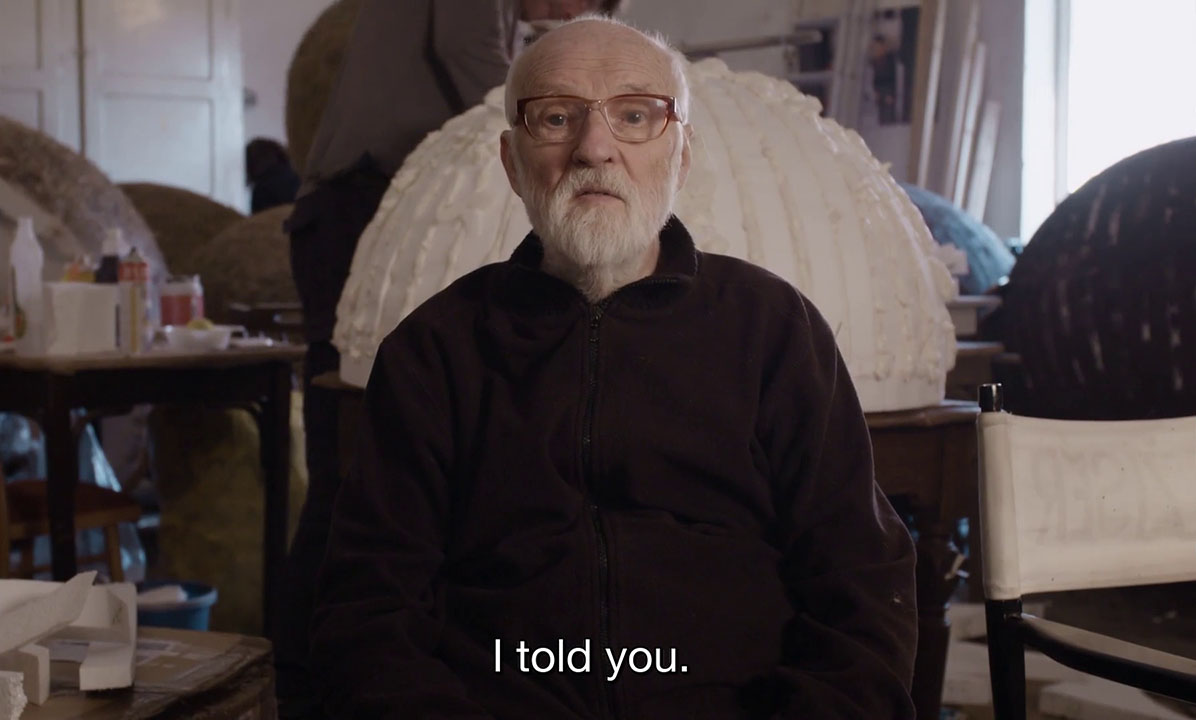
Tao catches up with his old buddy Dong, a former photographer who’s figuring out what to do next while being needled by his family, wishing he could just stay drunk and hang out with his friends and listen to punk rock, dreaming of returning to his pastoral home town far to the north. Dong’s mom works with fabric, dad sells flutes, and Dong is coerced into starting a jade business. This doesn’t work out – Tao films Dong listening to a jade dealer explain what kinds of stones to buy and how to convince customers into spending more than a piece is worth, then venting into the camera later about this business being an elaborate scam, and that’s the end of the jade story. Dong has lived his whole life in Post-Mao China but still can’t adjust to capitalism.

I’m not always clear on chronology or location. We’re in Kunming in 2011 on Dong’s 30th birthday talking about taking a trip to Hailar, then “Spring arrived in 2013,” and Dong is on a train, pointing to cities on the schedule, talking about his parents and his childhood in Hailar. So, we assumed it’s 2013 and the trip has begun, before realizing a few scenes later that it’s still Dong’s 30th birthday and they’ve gone nowhere, will go nowhere (except for the jade expo) until the final minutes of the movie.

Watched because of a specific interest in China this year, to be further explored soon. Kunming is in the far (central) south of the country, and Guangdong (the jade expo, and the beach where the promo stills were shot) is far to the east, on the south side near Hong Kong. Beijing is in the northeast of the country, but Hailar is even further northeast, around the eastern tip of Mongolia, a stone’s throw from Russia. According to the description of his previous film, post-earthquake survival semi-doc On the Way to the Sea, Tao Gu and his family are from Wenchuan, just northwest of Chengdu and not near any of his Taming the Horse locations. I haven’t figured out the part where drunk, crying Dong says he wants to kill himself in Yanjiang where he first saw the sea, since Yanjiang appears to be just on the other side of Chengdu from Gu’s hometown, 15 hours from the nearest ocean.

Punk Rock tells the Truth:

A good pick to follow up Beale Street and Leave No Trace – another movie full of loveliness. Of the three, this will be the endlessly rewatchable one – extremely sharp dialogue, editing and performances – especially from Regina Hall as a restaurant manager having a complicated day. I love this movie so much, but don’t want to write about it now, will instead link to Mike D’Angelo in AV Club.

Having a hard time figuring how the same filmmaker made the unwatchably mumblecore Mutual Appreciation, the playfully bizarre Computer Chess, and this much slicker, almost mainstream comedy.

Reliably a month behind on the blog, this was the first movie we watched in 2019. I maybe shouldn’t have read a (different) James Baldwin book right before watching this, since his language is never going to come through in a movie, but Jenkins tries hard to replace it with rich visuals. He gave the movie a “happy ending” which is that Fonny sees his family on weekends while doing years in prison on a trumped-up rape charge, so I wonder how he ends up in the book.

Our young couple is KiKi Layne and Stephan James (of the new series Homecoming). Her parents are Regina King (voiced both brothers in the Boondocks cartoon, played wives of Ice Cube, Will Smith and Cuba Gooding in the 90’s) and Colman Domingo (the Bishop’s accuser in Red Hook Summer), with sister Teyonah Parris (star of Chi-Raq, Coco in Dear White People). Fonny’s parents come over for the big announcement and get in a major fight – the movie has some surprisingly badass insult dialogue. Fonny’s restaurant bud is Diego Luna, Dave Franco plays a decent white(ish) landlord, and on the day of the crime they are hanging out with Brian Tyree Henry (Atlanta), who presumably betrays them in exchange for a deal on his own arrest. Cops do not come across well in this movie, nor in most movies. Despite the cops, the prison, the rape, the uncooperative witness, the systemic abuses – the movie is pure loveliness.

We hadn’t even seen a preview for this. A late-2018 animated Spider-man reboot movie sounded like the most skippable thing in the world, but it came out the same week as all the year-end lists, which kept awarding it the Best Animated Feature. Admittedly Ralph Breaks The Internet and Incredibles 2 both suffered from sequelitis, and The Night Is Short, Walk On Girl was too quirky to win awards, but I still didn’t expect some comic-book Spider-man re-reboot to show up and trounce the competition, so we went to see what the fuss was about.

The fuss: this movie is faithful to the comics to the point of emulating their printing quirks: the shading dots, the color layers slightly out of registration, making me feel like I’m supposed to be wearing 3D glasses whenever I pay too much attention to the edges. It’s a Peter Parker Spider-Man back-story re-boot but also extremely self-referential about being this, and contains multiple Parkers and reboots. No wonder it’s from one of the Lego Movie guys, but much wonder that it was allowed to be created on an obviously high budget and released in theaters during Peak Marvel Universe. We (highly) approve.

Ben Foster (Chris Pine’s trigger-happy brother in Hell or High Water) is too freaked out to join society, lives the survivalist life in the woods outside Portland, earning cash by hawking his PTSD meds. Problem is he’s got a daughter (Thomasin McKenzie) who’s good at finding wild mushrooms and hiding from the authorities, but would kinda like to eat normal food and meet other people sometimes. They are caught pretty soon, provided a home, escape back to the woods, are allowed to stay at a new home, escape back to the woods, etc., until McKenzie makes the decision to join civilization, even though her dad is psychologically unable to stay. One remarkable thing about the movie is that everyone they meet is generous and kind, the opposite of Winter’s Bone.

Love to spend years following rumors of the recreation of the lost masterpiece by an all-time great filmmaker, only for the thing to finally appear direct-to-video, then watch it in fragments over a week of late nights because I keep falling asleep. I watched the previously released scenes of this in the early days of the movie blog, never thinking there’d be a feature, and here we are, not quite knowing what to put in quote marks (the “complete” feature “by” Welles). Rosenbaum approves, so who am I to argue?

Stills, narration, and the line “that was long before cellphone cameras” mar the opening minutes, then hammy P-Bog becomes a main character, and the movie’s in trouble. It recovers easily – a party film with a magnetic John Huston as the Wellesian center, artists and hangers-on all around, cutting all over the place, and then the scenes of Huston’s never-to-be-completed film (this is an extremely self-aware movie – even Hammy P-Bog appears to be playing “hammy” “p-bog”), a miniature, fragmented work inside the work, which is both a beautiful art film and a pretentious parody of a beautiful art film, problematically starring an always-nude Oja Kodar, who in fact cowrote this film, making it knowingly, self-parodically problematic, I guess. Playfully homoerotic dialogue, apparently documentary sections, and all the colored lights making this more Suspiria-like than the Suspiria remake. The whole project and its implications fill your brain up all the way. Besides P-Bog there are a few overdone performances – I’m thinking of the film critic (Susan Strasberg) and Zimmy The Southern Gentleman (Cameron Mitchell) – but on first viewing it seemed 15% tiresome, 85% wonderful.


They’ll Love Me When I’m Dead (2018, Morgan Neville)

I remember this being fun… let’s see, my notes say “uses every bit of Welles footage they could find to place in dialogue with interviewees” and “ends with Why Can’t I Touch It, wow.” I should watch the making-of and the new Mark Cousins doc then rewatch the feature, but I also got things going on besides Orson.

Yorgos has been refining his bold visual style from Alps to Lobster to Sacred Deer, but it’s hard to notice while you’re busy making sense of his oddball characters and dialogue. So now something amazing has happened, and he’s applied those bold visuals (now featuring more fisheye lens than I’ve ever seen in a movie theater) to someone else’s script, a period comedy about women in high court behaving badly. The result wipes the floor with last year’s The Death of Stalin. And YL’s actors have always been splendid, but it’s been hard to tell since they fall into an uncanny valley of almost-not-quite human behavior, so now that they’re playing recognizable humans with killer comic insult dialogue, they’re all getting award nominations.

Queen Olivia Colman’s best friend Rachel Weisz handles all the complex policy issues while the queen hides away in her rabbit room, and this is fine until Rachel’s cousin Emma Stone shows up and starts insinuating herself. These are all based on real people according to the wiki, though it doesn’t mention whether the real Queen had 17 pet rabbits representing all her miscarried children. Nicholas “Beast/Nux” Hoult plays a parliament member who tries to get Emma to spy for him, and maybe if I see him in a few more movies I’ll start to recognize him, but probably not. Premiered at Venice with Roma, Buster Scruggs, Suspiria and Vox Lux, and sold out Phipps on a Sunday matinee, which I thought was impressive until I realized Phipps got those gigantic lounge seats and now only 24 people can fit in their tiny theaters.

The second movie I’ve seen this year with a sea turtle girl at the beach. The wikipedia version of this movie is a frustrated teen off her meds who finds a community in a weirdo theater troupe, but conflicts arise between the girl (Helena Howard) and her mom (Miranda July), spilling into her acting and vice versa, and this is encouraged past the point of comfort by theater director Molly Parker.

The experience of watching it is something different, with editing and camera focus and framing just all over the place. Butter on the Latch was similarly disorienting, but more energy here from characters and story drives the thing into a jittery madness which is extremely fun to watch.

Fourteen Things That Haunt Me, from most intense to least:

1. the birth scene…
2. the beach scene…
3. Trying to park the giant family car in the narrow driveway
4. Taxidermied dog heads on wall of the country house
5. Group martial arts demo with guru who stands on one leg
6. Solo nude martial arts demo
7. Dad taking the bookcases, leaving the books
8. All the dog shit in the driveway
9. Department store confrontation between Cleo and Fermín during a riot
10. Fermin going to the bathroom and never returning
11. Father going on a “business trip” and never returning
12. Mom calmly explaining to the kids that father has left
13. Drunken new year’s forest fire
14. The pried-in references to previous Cuarón movies