Time-lapse landscape photography with different parts of the frame running at different rates… or moving in slow-motion, then skipping ahead… or fading one time into another… or flipping back and forth between shots from different times… or looping back on itself. Since it’s all about glitching the time-movement, it’s odd that he chose some shots with hardly any movement.

“A survey of the physical qualities and metaphysical quandaries of the United States-Mexico border. Follows the boundary and its immediate surrounding topography incrementally from the Gulf of Mexico to the Pacific Ocean,” says the official description. Rappmund also made a Nebraska movie called Vulgar Fractions, and studied under James Benning (obviously). Cinema Scope has an interview, and a visual map of all the shots in the film. “Repeating images reinforces the stability of the portrayal; it gives viewers a chance to catch small things in dense snapshots; it highlights movement as well as clearly accentuating the static; it breathes a rhythm and a three-dimensional life into pictures that’s difficult to capture with traditional filmmaking techniques alone.”

My still screenshots are can show off the lovely photography, but not the time/motion tricks that bring each scene to life. Atmospheric sound, presumably recorded at each camera site, featuring some birds who got my cockatiels all flustered. It plays like installation art, and my attention phased in and out… I should have been staring raptly at the photography but Katy wrote to ask if I could find any indie movie theaters in Shanghai (short answer: nope), so that took precedence for a while.

Where can I get one of these?

Naturalistic slowcore – I think it’s another hybrid-doc film, and it was a bad move for my attention span to play this right after Orleans and the Sarah Morris shorts. On the other hand I’ve been meaning to watch anything by Pereda since the 50 Under 50 list almost five years ago, so I’m glad I finally did.

Gabino seems to be rehearsing a breakup poem composed of song titles – ah, no he’s selling mp3 discs of romantic songs, and for some some never-explained reason he thinks he needs to memorize the titles of all included songs. Gabino lives with his mom, has a couple siblings, and his dad is trying to get them involved in a pyramid sales scheme with his friend Gonzo. Gradually we figure out that the dad abandoned the family many years ago and has just returned… Gabino is tentatively spending time with him but mom is trying to throw him out. I lost the thread of things towards the end, when the dad returns as a different actor.

Dad #1 would like to sell you a CD:

Enter Dad #2:

Oddball film techniques: sometimes the action freezes, people standing still without speaking for minutes while some harpsichord-sounding music plays, recalling My Son My Son, What Have Ye Done. At least once we simply repeat a scene, but it plays out differently. A few durational “see how long any audience will put up with this” shots. Then mid-movie, someone behind the camera starts talking to an actor, asking about his past. Role-playing: in my favorite scene, Gabino pretends to be his father, making in-character excuses and pleas while mom rehearses telling him to leave. By the end I didn’t know what’s real, and was convinced that Gabino really sells CDs on the subway, but no, he’s an actor who has been in 40 other movies. He also plays “Gabino” in all the other Pereda movies.

Pereda in Cinema Scope:

Greatest Hits is a film where the same scene happens more than once in the film, and some of the scenes that repeat themselves were separate takes. I enjoy the repetition, but when I see that a take is a bit different than the first one, only I can enjoy this difference. In this film I tried to give the audience the pleasure I would get from noticing the differences from one take to another.

At times I sort of interview them, Gabino and his real father, and I ask them real things about their real lives. When the film starts over, in the second half, that’s when it becomes a lot more obvious, because there’s one new actor who’s playing a character that we saw before, but the new actor — my uncle actually — is more of a documentary subject. He doesn’t know when we’re filming him, so he’s just talking away. I told him what the movie was about, but I didn’t tell him at that point that he had to act, I just said we’re making a movie and this is your character.

Some ancient maps and drawings and texts about Joan of Arc – good timing, since I was just reading about Bruno Dumont’s new Joan movie before putting this on. Then a half hour spent at a strip club (or exotic pole-dancing, if there’s a difference). The girls spend most of their time trying to uncomfortably (to me) hard-sell patrons to join them in the expensive private cabins. In private conversations we learn this is a job where girls tend to stay too long, as we’ve recently seen in LoveTrue. “But in my case I know this is only temporary,” says the new girl.

New Girl and her mentor finally venture out into town and meet the girl playing Joan in the town celebrations, spending a moment alone with her horse in the woods. They go to the parade to see their new friend in all her glory, then wander to a church… it’s all pretty low-key, a pillow-film between more substantial LNKarno screenings, but it ends the way all movies should end: telling secrets to a falcon.

A hybrid-documentary, it turns out. Vernier looks prolific, and his Mercuriales appears to be a similar sort of movie. Of the actors, I’m only seeing that Damien Bonnard later starred in Staying Vertical… but who was he, a strip club patron? If so, you could barely make him out under the murky red lighting.

Low-key indie comedy about a weirdo misfit pyro stand-up comedian. Bits of surreal dream-logic invade the story now and then, and I like how there’s no “normal” reality that the movie returns to. The comedian buys an apple from a fruit-stand seller in a cheap devil suit, and after eating it an an apple tree starts growing through his skin. He kills his abusive neighbor with a baseball bat, commits petty arson & vandalism, has basic money problems, sometimes bombs onstage and sometimes does alright, and all these things are given equal weight. This could forever sit comfortably on the cult shelf of any video store, if video stores still existed.

Theoretically we’re rooting for pyro drifter Joshua Burge (also of Buzzard and Coyote) even though he’s really not a good comedian, has rage issues and nothing much going on. His rivals, besides the now-dead neighbor, include a bald fellow comedian, the comedy club owner who keeps bumping Josh from the schedule, a werewolf car-lot mascot, a convenience store clerk, a bike thief, a heckler, and of course The Devil. After taking care of the neighbor, Joel has a string of good luck and minor rebellions, but is also getting taken down by the apple tree, and finally he ends up inside the ape suit.

Potrykus in Cinema Scope, on debuting in Locarno:

Growing up, European cinema was always exotic and incredibly distant. I wasn’t prepared for the tables to turn. Suddenly, I felt like we were the ambassadors of not so much American independent cinema, but of the Midwest as a landscape. Ape’s empty city streets and mundane convenience-store bureaucracies were now the exotic. Locarno as a whole quickly picked up on the politics of the film that are normally overlooked in the US, the subtle racial commentary and economic issues. To them, it became a full-blown political film … I plan on sticking around Michigan as long as I can. I think it’s important to stick with the people who understand you and have been there since the early days … In the end, I just want to hammer out a weird little shack in the forest with my friends, not construct a tacky skyscraper with a bunch of strangers.

Bonus: the illustrated movie poster is great… this is the second LNKarno pick with a poster I wanna own (and both movies have scenes where audio tapes get destroyed, hmm). The guy who played the devil became a director, making a string of demon and alien movies… must’ve gotten really into his role. The rival comic and even Dorito Guy are also directors – looks like there’s a happening scene up in Michigan.

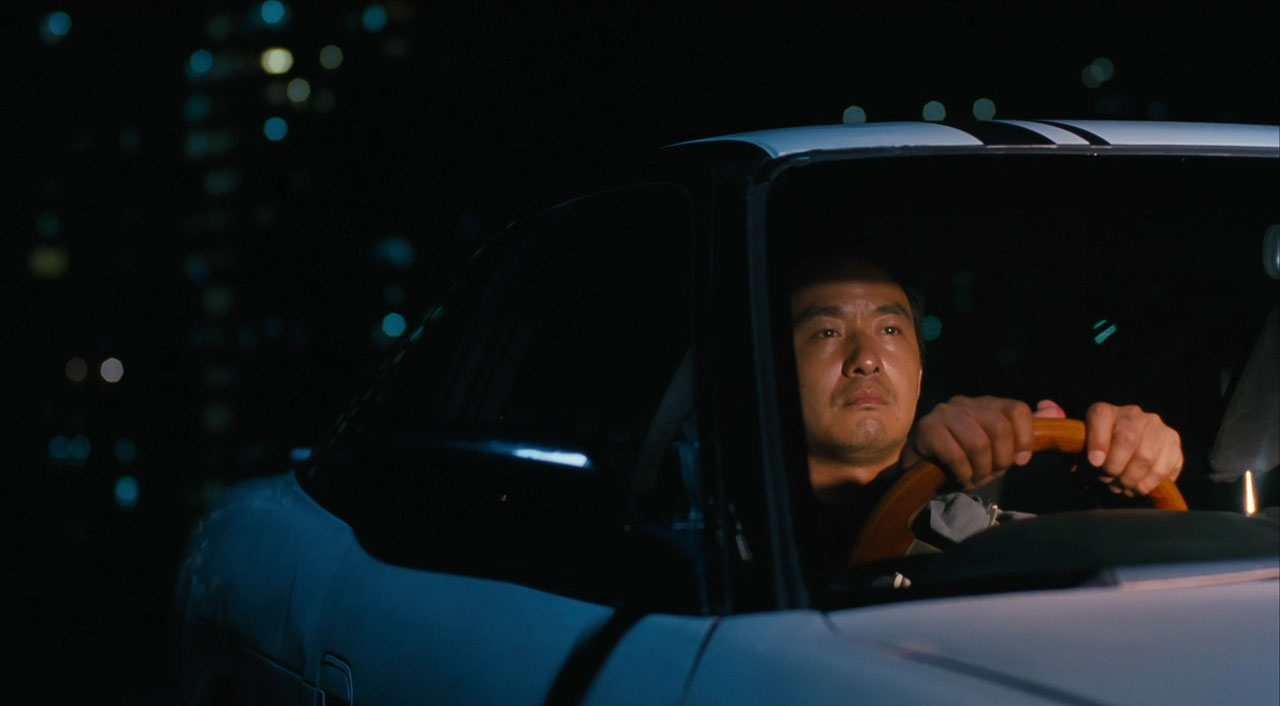
I should’ve watched an actual Johnnie To movie, but instead I watched this generic cops & robbers flick from his production company. A super-hot getaway driver breaks a jewel thief out of prison in time for their big heist… meanwhile, fiery young cop learns a special automotive technique from his about-to-retire partner, who is killed by the baddies post-heist, provoking a cathartic faceoff finale. It couldn’t sound more generic, but fortunately the movie is full of delicate character details which really… haha no I’m kidding, it is totally generic. I bought Heat last week on blu-ray, and should’ve rewatched that instead.

I guess I’m not enough of a gearhead to be excited about the film’s magic getaway technique (which I’m calling the Hong Kong Drift), in which the driver makes the wheels spin awfully fast, squealing without the car driving forward, then turns the wheel in order to rotate in place. So, in a week when I’m watching trailers for this summer’s fast-driving heist movies, Baby Driver and Logan Lucky, this movie’s showcase is… making the cars barely move.

Noble Cops:

Cheang went on to make The Monkey King and Kill Zone 2. Our hotheaded hero is Shawn Yue (Young Tony Leung in Infernal Affairs and its prequel), his mentor is Anthony Wong (also Infernal Affairs, and star of Exiled), and enemy driver is Xiaodong Guo (Tsui Hark’s Missing). In true Johnnie To fashion, there is a minor character named Fatso, but distressingly he is not played by Suet Lam. Oh and hey, there’s even a lady in the film: a doctor whose name I didn’t catch, but was probably Barbie Hsu of Future X-Cops and Croczilla.

They record their chases on in-car VCRs. I’m watching a bunch of 2012 movies this week – this one has VHS tapes, and both Ape and Jack & Diane have audio cassettes – what’s the deal?

Bad Dude in Killer Car:

“Cheang’s background as an horror director serves him very well as every chase becomes a slasher film cat and mouse game full of menace and the white Nissan that serves as the film real villain and one true memorable character gains an almost serial killer status.” Of course Furtado loved it – he likes Alien vs. Predator.

Anne (Mary Margaret O’Hara: Catherine’s sister, known as a singer) is called from Montreal to Austria for being her cousin-in-a-coma’s closest relative. Not having any conscious friends in town and without much expendable travel money, she hangs out extensively in an art museum, where she meets guard Johann. They start to meet outside the museum in his off hours too, though unusually, the movie never becomes a romance.

Cohen:

The audience has been conditioned to automatically think this will be a love story … But the cinema I care most about is about the drive toward the everyday, how we actually do live, how we feel, about things that actually happen. People love the fairy tale, but that’s not what happens here. It’s weird that there aren’t more movies about friendship.

Sometimes we linger quietly in the museum or around the city of Vienna – slowly, rhythmically edited slideshows of miniature scenes. Johann sometimes narrates, says his favorite is the Bruegel room, and we get a long sidetrack following a tour guide discussing Bruegel’s paintings with tourists, including the painting that was meticulously recreated in The Mill and the Cross. We see reality emulating the paintings when the museum attendees are portrayed as nude as some of the painting subjects they’re admiring, and I assumed that was a one-off quirk. But there’s a moment early on which I think lets us in on a prime Cohen concern: Johann is scrutinizing a Bruegel, seeing previously unnoticed details, and we cut from stray garbage on the ground of the painting’s scene to stray garbage on the ground in a nearby park, with equal attention paid to each. The movie ends with Johann’s museum-style narration of a humble windowboxed street scene, and other scenes nearby, art criticism of the everyday world… “and one begins to wonder what the main subject is.”

Cohen is, of course, the director of Benjamin Smoke, which I bought on DVD a decade ago and have never watched. He’s a music scene guy – the film was exec produced by Guy Picciotto and Patti Smith, and…

Adam Cook:

It sounds like a terribly dry and academic exploration (and there is even an art history lesson halfway through) but there is a great warmth and intimacy here reflected in the human connections and ephemeral details that surround the characters … Any film that encourages an audience to engage with the world, seeing both the cities we live in and their transient beauty anew, without resorting to manipulative sentiment must be applauded.

Single-take camera move (always on the move) through a crowded park in Chengdu, China – further into the center of the country than Katy will travel this month (while I watched this, she was some 900 miles east, in Shanghai). There’s dancing and games and crafts and napping and work and food and commercial demonstrations and so much music – I don’t think there’s a moment where you can’t hear live or recorded music playing.

The camera seems to be waist-high (I later learned that Cohen held the camera while Sniadecki pusher her in a wheelchair), and it’s not hidden – people stare back all the time, and most of my interest in the movie (since the park itself isn’t historically/architecturally fascinating) comes from watching the people, and seeing their reactions as they watch back. I wouldn’t say there’s enough people-watching interest to justify its full 75-minute length though, and roaming a park from my couch kept making me wanna get up and go outside. Funny how far removed this felt from last week’s people-watching doc Austerlitz. The ending is good, the camera circling around a crowd watching a dance routine then breaking through into the center, ending on a great image.

Dennis Lim got the press kit:

Over three weeks they shot 23 takes ranging from 45 to 100 minutes, with many more aborted because of mishaps like miscommunication with each other or children running into their path. The final film… uses a 75-minute segment from the 19th try.

F. Furtado:

In a film with such an evident voyeuristic aspect as this, one usually expects to see the shot at eyes height; but, instead, the vantage point in People’s Park is lower, an unexpected perspective which sometimes breaks with the more repetitive patterns of some of its moments and procedures … There is undoubtedly an element of intrusion in these images: people often look straight at the camera suggesting curiosity and, other times, irritation (the film never allows us to forget that the filmmakers are not an element that belong to that landscape; this is literally a foreign look).

Glimpsed through the crowd – man with rooster on a stick:

Vadim:

Bursts into musical numbers via karaoke fiends co-existing with refreshing indifference to each other, mass dances and sing-alongs to Cultural Revolution standards, the state otherwise conspicuous by its absence … Few people stand out in memory, the point being the democratic proliferation of things to watch.

Produced by the Harvard Sensory Ethnography Lab (Sweetgrass, Leviathan). Codirector Sniadecki made earlier HSEL movie Foreign Parts, and later The Iron Ministry, and both were thanked in the Manakamana credits.

Turned this off halfway through and continued a couple days later, but I thought about abandoning the movie because I knew how it was going to end up, and wasn’t relishing the idea. We’re following Clara (Sonia Braga of Moon Over Parador, Kiss of the Spider Woman) who lives in a nice seaside condo, has lived there forever, full of memories and good records, hanging out with friends and family. But the building has new ownership, and every tenant except Clara has sold and moved out, and the realty company is starting to act funny, and vague threats are being floated by the underhanded old developer Geraldo and his young project head (and grandson) Diego. As vibrant and well-liked a person as she is, Clara is not gonna be able to stand up to a determined developer with a seaside property – we’ve got another Leviathan on our hands. So imagine my surprise.

Flashbacks to 1980, starting with the birthday of an aunt, establishing Clara as a cancer survivor and a Queen fan, back when her husband was alive – now in her sixties minus the husband and one breast, the movie still manages to have plenty of sex scenes. Anyway, she talks to people who work with the development company, gets help from her lifeguard friend Roberval (Irandhir Santos, star of Neighbouring Sounds), digs up a scandal with help from her lawyer, finds the termite nest they’ve planted in her building and brings it, along with the paperwork/evidence, to their office, suddenly reminding me that the Cinema Scope article on this movie was titled “Termite Art.”

Barry Lyndon:

“People like you who took a business course but lack basic human decency, who have no character … no, I mean, you do have character; your character is money. Therefore, honey, you have no character.” It’s like a superhero movie, establishing a lead character on the side of good, gradually introducing her support team, then uniting against evil at the end.

With Roberval in the termite apartments:

Strike Team: niece/lawyer, nephew, brother

R. Koehler:

All of his narrative films, short or long, entail examinations of life in various urban spaces in his beloved coastal city of Recife, in the northern Brazilian state of Pernambuco. These spaces, sometimes simply street corners, sometimes — as in his extraordinary 2012 feature debut, Neighboring Sounds — city blocks, develop into zones of competing sources of power through the course of patiently crafted narratives … Even more than in Neighboring Sounds, Aquarius contains a keen sense of history, and how the fundamental questions of identity and personal physical space can tie together memory and objects, music and the body, and how family itself is a living embodiment of history.

AKA Journey to Agartha… anime adventure story, which gets into some grand life-and-death mythology and re-enacts Orpheus… it didn’t exactly pull all of its component parts into a coherent whole, and it lacked the emotional impact of Your Name, but was full of incident and beautiful light and backdrops and fantastical beasts, so I have no major complaints.

Asuna has a pet cat, working mom, dead father, and no particular characteristics. One day she meets an underworld boy who saves her from a giant creature then promptly dies. Soon she travels to his land along with her cat, the dead boy’s twin brother, and her homicidally bereaved super-soldier substitute teacher, who plans to descend into the land of the dead with a magic crystal and a submachine gun and demand the resurrection of his late wife. It’s kind of a crazypants movie.

Also, the cat dies and is eaten by a Quetzalcoatl. And so are our heroes.

Shinkai’s third feature (Your Name is his fifth). Our copy was English dubbed, which seemed just fine, but the commentary is in subtitled Japanese, so I can’t really play it while working.