Set on the Isle of Man, where a former TV star returns after many unsuccessful years in Hollywood because a murder suspect is obsessed with his character. Not as funny as even the opening credits of Alan Partridge, but it’ll do. The Boosh’s Julian Barratt plays the washed-up Mindhorn, Alan PaSteve Coogan as his hated ex-costar who became hugely successful by sticking with the show and not fucking off to Hollywood, Richard McCabe (of a couple Greenaway pictures) as his terrible PR guy, Babadook star Essie Davis as his ex, and Simon Farnaby (who played the Howard Moon imposter in Mighty Boosh) as her new husband. Cowriters Farnaby (acting with a Scandinavian accent) and Barrett are lots of fun, as is lead cop David Schofield. I don’t think anything is learned at the end, but the killers (the town mayor, and corrupt cop Andrea Riseborough) are stopped, at least.

What came first, the movie or the Robyn Hitchcock song? Searches reveals a guitar magazine article claiming the song is a nod to the film, but also an interview with cowriter Farnaby claiming he got the movie title from the song. IMDB says Mindhorn is an old Boosh reference, and other sites claim Barratt and Hitchcock are friends, so maybe it’s a mutual influence thing.

If the scenario of 10 Cloverfield Lane was filmed with the emotional sensibility of The Road. Opens with the Joel Edgerton family (with Sarah and teenage Travis) murdering and burying grandpa, who has become infected with whatever killed the world, and only gets darker from there. Soon the Chris Abbot family (with Riley Keough and a young kid) shows up, and after a few days of Joel being extremely suspicious, they’re allowed to move in. But paranoia and infection follow, and the Abbots are evicted and killed.

It was sold as a horror movie (according to Indiewire, Black Phillip even has a cameo), but it’s a particularly grim sort of postapocalyptic thriller… effective, but somehow I didn’t go for it – too much grim hopelessness, not enough Take Shelter mystery/wonder – and it somewhat reduces my desire to catch up with Krisha. It’s not a bland genre exercise, tho – interesting ideas within.

Shults:

The ultimate unknown is death — I think that’s all over the movie. But there are worse things. And there’s a line you can cross that’s too far, and it breaks things, and if we keep functioning like this, and if we keep going in these cycles, we’re going to destroy ourselves. It’s inevitable. We need to take a step back. Losing our humanity is going to be a lot worse.

M. Halperin:

Travis’ sickness only appears after he’s seen his mother and father kill an entire family — mother, father, and child. For all we know, the disease could itself be a function of metaphor, appearing only after a character has been so fervently immersed in the deterioration of human structures. Indeed, Travis has watched as his parents, his creators and fervent shelterers, have themselves become the nightmares. (Quite literally: throughout the movie, Travis’ more surreal nightmares are shot in a different aspect ratio, and set to a different score. This brutally realistic scene, however, also occurs with these subtle flourishes.) Is his retching after this scene, and the coughing of blood, representative of a revulsion with the very stuff with which we’re made? Sure, he’s pretty undeniably sick, but the sickness is also a literal purging of blood — which metaphorically speaks to a guttural, uncontrollable desire to purge oneself of family, of an inheritance of violence.

Great opening titles, the credits created from an array of redacted documents. I took a note when pausing to grab snacks: “no way will the movie live up to these opening titles” – and it didn’t!

but it’s thrilling when G’s laser-breath is finally unleashed:

It doesn’t go the full Cloverfield, but sticks close to the ground, glimpsing giant monster battles from a panicked human perspective, much of the action unreadably dark on my screen. Bomb disposal expert Col. Witwicky must be cursed, he and each of his family members getting right in the path of monster attacks, until he breaks the curse at the end by torching the bad-guy monsters’ eggs before they can overrun the planet. And oh yeah there are evil monsters here, and Godzilla’s the good guy. And Juliette Binoche dies horribly after only 15 minutes, and Bryan Cranston is the star but he dies too, and Sally Hawkins gets three lines, and Ken Watanabe plays the Japanese scientist, and David Strathairn plays the serious military one, but mostly we’re left with Witwicky (Aaron Taylor-Johnson, lead rapist of Nocturnal Animals) trying to get home to his Olsen wife before the world ends.

Evil Mantis Monster:

Hidden Mothra reference on a fishtank:

Gareth made this between indie alien thriller Monsters and a Star Wars spinoff. I was planning to double-feature this with the even newer Godzilla movie from the creator of Evangelion, but after two disappointing action flicks in a row (this and Alien: Covenant) I couldn’t risk a third, so rewatched Fury Road instead. Normally I’d say “argh, why did I watch this bland multiplex junk,” not recalling why it ended up on my must-see list, but now thanks to Letterboxd I can look up exactly who recommended it… aha, Ehrlich with 4.5 stars. “One of the most satisfying, well-paced & beautifully directed blockbusters since Jurassic Park… genuinely registers as the first post-human blockbuster.” And MZ Seitz listed it as one of the century’s best. They are high.

Dumont goes even wackier than Lil Quinquin, though this one seemed more coherent, story-wise. I thought it’d be hard to top Quinquin‘s twitchy detective and dullard assistant, but now he’s dressed his lead detectives like Laurel & Hardy, the head cop (the fat one) rolling himself down hills when he’s too tired to walk, and simply inflating and floating away at the end.

Just like Quinquin was named after the lead rapscallion from a poor, possibly criminal family, the French title of this movie was Ma Loute – the nickname of the young man from the only family that seems to live in this picturesque rural town. I suppose they fish, though when a wealthy family arrives at their palatial summer home, we discover what else they do; they kidnap, murder, and eat the rich. The richies are so ludicrously over-the-top (and inbred, it turns out) that it’s tempting to root for the local brutes, except the richies also have ringers in Juliette Binoche and a beautiful/mysterious transgender girl who has a short-lived romance with Ma Loute. Also they’re just too damned silly to wish death upon.

Sicinski describes the richies:

Descending upon the bay for the summer are upper-class cityfolk, bizarre caricatures of humanity sprung from some Gallic division of Monty Python. The Van Peteghems are “led” by spastic, bumbling André (Fabrice Luchini), his prim, lachrymose wife Isabelle (Valeria Bruni Tedeschi), brother / cousin Christian (Jean-Luc Vincent), a sort of lacquered descendent of brain-addled mystic Johannes from Dreyer’s Ordet; and eventually, Aunt Aude (Juliette Binoche), a wailing, flailing hysteric whose behavior resembles that of a regional dinner theatre actress on nitrous oxide.

I never would’ve guessed that the richie paterfamilias had been in Rohmer films, but there you go: he played the lead in Perceval. Tedeschi is lately known as a director, was also in Nenette & Boni and Saint Laurent. Vincent and Binoche costarred in Dumont’s much more serious Camille Claudel 1915. Ma Loute, his dad The Eternal, his mom, his almost-girlfriend Raph and the two cops just came out of nowhere.

I suppose the first half is more tense if you’ve read beforehand that the movie involves a terrorist bombing plot – there’s little backstory or explanation as our young heroes walk briskly around Paris, check into hotels, take the subway, looking very serious as they drop off packages into vehicles and trash bins. After a half hour of this, an older-looking mustache guy shoots a dude in his apartment, breaking the simmering tension. Then we see the results of their efforts:

The long second half has our bombers gathered in a department store after hours waiting out the night, for some unexplained reason, instead of going home their separate ways. They blast some Willow Smith on the high-end stereos, shop amongst the high-end toys and expensive clothes, lounge in the designer living spaces, invite a homeless couple inside (Hermine Karagheuz!) and watch the news of their own exploits on TV until it starts to show the outside of the building they’re in. It ends the only way it could, the cops storming the store and killing everyone (even Hermine).

Not sure who everyone was, but our gang included Finnegan Oldfield (Les Cowboys) and Vincent Rottiers (lead baddie of Dheepan). Omar, their inside man at the department store who murdered the other security personnel, was Rabah Nait Oufella of Raw and Girlhood. There’s some fractured chronology, hard to follow even though the current time keeps appearing on screen. This and House of Tolerance were so slick-looking, it’s not surprising he made a fashion film in between them.

Ehrlich calls it “intriguingly inert”:

Bonello’s camera tracks behind each of the kids as they go about their shady business, emulating Elephant as the tactic conjures the same sickening momentum that made Gus Van Sant’s film about homicidal youths so vague and disquieting … It’s fine that Bonello would rather raise unsettling questions than provide unhelpful answers, but his inquiry often feels every bit as confused as his characters.

It does seem confused and perverse, and possibly even offensively wrongheaded (after the Bataclan attack, Nocturama was denied festival appearances and distribution). Why make this film, and what did the characters hope to achieve (in either the first or second half)? Only Blake Williams in Cinema Scope seems to have a convincing, incisive explanation – though you’ve really gotta read the whole thing, so I’m only excerpting his description of the movie’s timeline:

[Nocturama] presents time as indefinite, opposing conceptions of the present as concrete or ahistorical even as it works to augment the gravity of the present happening. Bonello’s choice method for achieving this is through shaping the film’s timeline into something that, were it to be graphed out, might resemble a lightning bolt — working through narrative events from one vantage only to fold back and re-show the same temporal moment again (and again). Many of his time warps are accompanied by either the reappearance of an onscreen time stamp or a repeated music cue, but many others arrive unmarked — especially when Bonello moves us further back in time, such as an extended detour through the initial planning stages for the attack — destabilizing our footing on already tremulous turf.

How weird to be watching the DVD extras before the film – I can’t tell if the distributor thought this was necessary, or if Netflix fucked something up (they’ve done worse before)… no, a Cinema Scope review confirms that the 50-minute movie is meant to be preceded by 40 minutes of promo fluff interview material. I lasted less than 10 before skipping ahead.

Not sure if the rest of the promo fluff covers this, but I read online that this was somewhat of a failed experiment. Control freak Verhoeven decided to solicit movie scripts from the public based on a short intro scene, then film segments piecemeal with amateur actors… but he wasn’t happy with the story submissions, so he wrote his own script, cast professionals, and shot it. We’re left with a 50-minute light infidelity comedy that ends with a couple of main characters zipping off to a Rammstein concert. I suppose instead I’ll try Mary is Happy, Mary is Happy or Mysterious Object at Noon to get my fix for disjointed, crowdsourced stories.

Remco (an actor from Black Book) has a long-suffering wife, horny son and Rammstein-loving daughter. His business partners are trying to sell out their company, using Remco’s pregnant mistress to blackmail him into agreeing. Meanwhile the daughter and her best friend Merel (who is sleeping with Remco) figure out the mistress is faking her pregnancy.

Ignatiy in AV Club:

The fact that it’s fast-paced and diverting (rather than, say, a god-awful mess) is a credit to his skill at black comedy … Bereft of subtext and shot in a largely handheld, TV-ready style, it lacks Verhoeven’s usual deep bite, despite the cynical punch line of the ending.

Possibly even more of a casual hangout movie than The Other Side, refusing any backstory or narrative momentum. And as with that one, I never have any idea if what we’re seeing is pure documentary, or what has been invented for the film. These aren’t complaints! Handheld cameras shoved right into actors’ faces in low lighting while nothing much happens isn’t usually my aesthetic preference, but I do love Minervini’s work so far.

Sara lives and works on a goat farm with her large, homeschooling family (there are “bad influences” in the public schools), sells at farmers’ markets and directly to neighboring families, like the rodeo down the street, where Sara makes smalltalk with young Colby. It’s so low-key that you wouldn’t think there’s a budding relationship there, but for a couple marriage conversations she has at home (and is that an old-fashioned wedding dress she’s wearing in the final shot?). More than half of the movie is rodeo and praying. Substituting for the armed, drunken racist horror that was the last half-hour of The Other Side: a short scene, unexplained, of a cross burning in a field at night.

Hollywood Reporter:

Minervini is particularly successful at suggesting the parallels between Colby and Sara. A skinny, sweet-natured cowboy who’s all sinew but no muscle, he needs focus and determination to master his rodeo skills and avoid injury. A born nurturer with a special feeling for animals, she holds sacred beliefs yet at the same time is needled by doubts and fears that she’s unable to articulate, which her mother assures her are an inevitable part of the battle for inner peace … And while it isn’t quite a performance in the standard sense, it’s difficult to imagine the film working to the extent it does without a figure of such emotional transparency and innate spirituality as Sara Carlson at its center.

EDIT: an essential interview with Minervini at Filmmaker.

Top prizewinner at Locarno 2012, so it’s the closer of LNKarno 2017, and an ass-kicking low-key ghost movie, reminiscent of Personal Shopper down to the direct Victor Hugo references.

Dora (Virginie Legeay of Brisseau’s Exterminating Angels, also his assistant director) appears beaten and bloodied at the front door of Michel (played by the late-Depardieu-looking director himself), he invites her to move in, then strange things start to happen: objects moving on their own, glimpses of robed figures in the hall, and sounds from the closet like a wolf moving a bureau.

I liked the movie’s style, especially once the spirits appeared with charmingly simple ghost-costumes. The whole thing appears to have been shot on the cheap, with medium-res video and occasional mic problems – unless the DVD was just poorly produced. Set mostly in Michel’s apartment (the director’s own, per Cinema Scope), which is wall-to-wall media – books and albums and every classic-cinema DVD boxed set.

Dora tests Michel, suspicious of his intentions. For his part, he seems honestly enthused to have somebody to pay attention to, after living alone for three decades, acting like she’s a long-lost daughter home for a visit. She moves in and helps with his book “about the importance of delusion in our lives”. Then he proposes they marry, so she can inherit his apartment tax-free (there’s a Freud paperback in the movie’s second shot). In the end, the book is finished and he’s killed by a thief – I think with the inheritance issue unresolved.

Boris Nelepo, in an essential article:

So what can a filmmaker achieve with the absolute minimum at his disposal: a small camera (La fille is Brisseau’s first digitally shot film), a minimal space, and an amateur actress in the title role? As with the even more restricted Jafar Panahi, a filmmaker can proudly make a real movie, as if there were no production limitations at all. In La fille du nulle part, Brisseau has created a film of heavenly beauty, warmth, and tenderness, revealing and revelling in the Mélièsian essence of cinema. As with Philippe Garrel in La frontière de l’aube and Manoel de Oliveira in The Strange Case of Angelica, Brisseau understands … that it is the most seemingly naïve, handcrafted effects that best reflect the innate illusionism of film. Indeed, for Brisseau film is itself a magical medium, a portal into a different world … Frequently drawing his protagonists from the world of science … Brisseau continually posits the existence of an intangible world, one invisible to their rationalist eyes until a sudden inspiration, granted by art, mystical epiphany, or physical ecstasy, reveals to them the essential incomprehensibility of the outside world and the limitations of man’s understanding thereof.

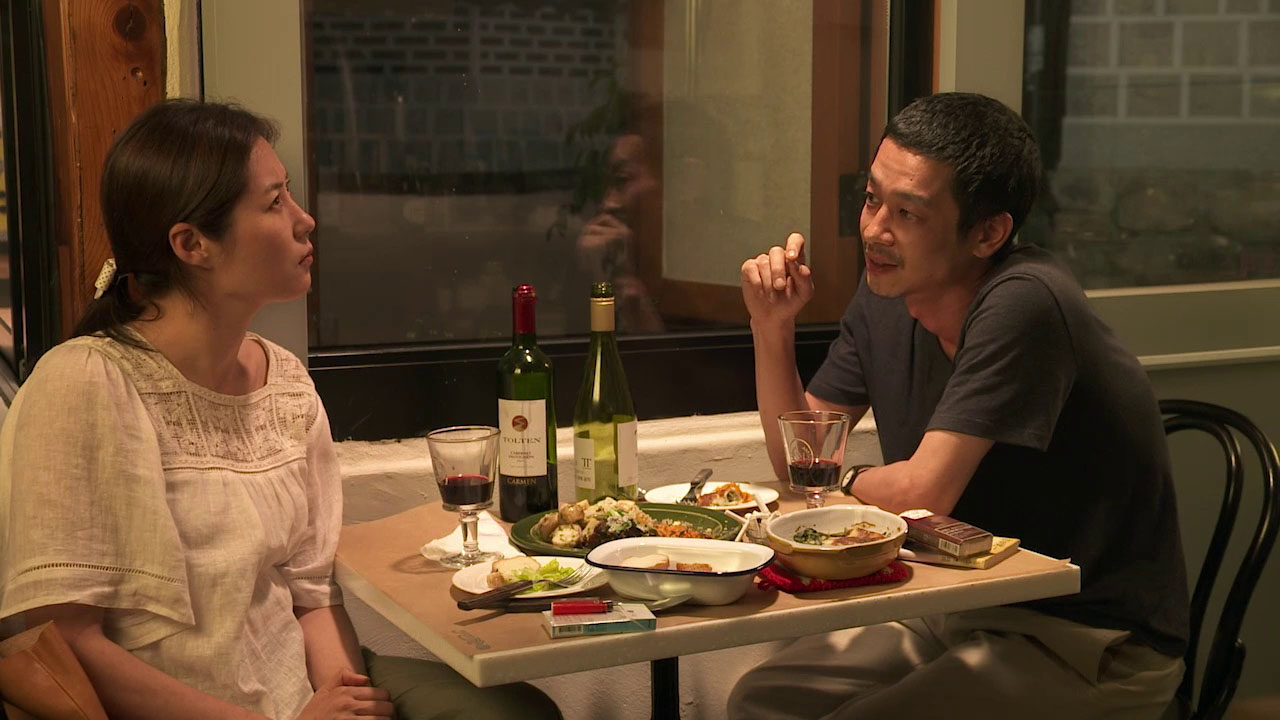
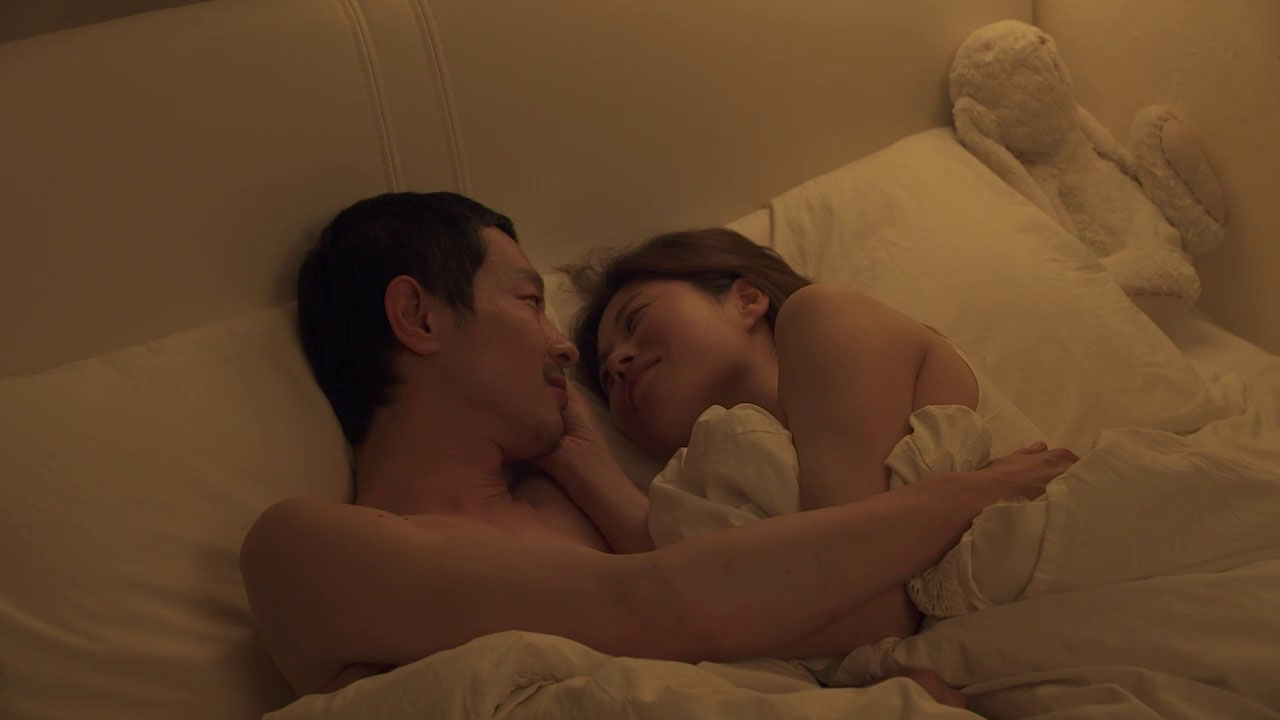
I was finally bullied into watching this by the poster in the Ross front entry… Byington must have visited when this opened (before I moved to town). Story of Max (who carries a magic macguffin suitcase) and friends, jumping forward 5 years every 20 minutes (though the actors barely age). The movie plays like a deadpan, vaguely absurd stand-up comedy act – a funny one, but it’s hard to tell if we’re meant to have any affection for these characters.

Max and Kate:

Max is Keith Poulson (Hermia & Helena, Little Sister) who befriends coworker Nick Offerman and marries coworker Jess Weixler (a Rigby in The Disappearance of Eleanor Rigby). As time goes on, Offerman ends up with Weixler and first Max then his son will date the babysitter Stephanie Hunt. Characters are unceremoniously killed – Weixler’s dad’s post-cancer-diagnosis suicide is played for laughs, and Max, now rich from running a pizza and ice cream franchise with Offerman, has a heart attack while racing a breadstick thief in the cemetery.

Max and Jess:

The director, lead actor, and Max’s ex Kate Lyn Sheil are all Alex Ross Perry associates. Byington’s followup starred Jason Schwartzman and Tunde Adebimpe and I have heard nothing about it. His latest premiered a few months ago at SXSW and I have heard nothing about it either.

My favorite visual joke: wedding singer with a four-man band who all look like the same guy. Are those all the same guy??

Rizov liked it roughly as much as I did:

What it basically comes down to is that I find Byington’s comic fixations — rudeness and morbidity — funny and compelling … It’s smart and sad about death, and the stupid decisions casually made on a day-to-day basis by adrift 20/30somethings who think marriage will give them the stability and rigor they lack otherwise. “You never know what’s good for you,” Offerman says, and he’s right.

D’Angelo hated its guts:

[Max] just drifts through life, responding to decades of minor turmoil with the same vaguely bored sneer … there’s no indication here that Byington’s characters, or Byington himself, gives even half a shit about anything at all. Somebody Up There Likes Me seems smugly pleased with its own detachment, a quality underlined by the cutesy-ironic score contributed by Vampire Weekend’s Chris Baio. (Hope you like tubas.)