I’d heard the basic concept from the DVD box description, that the movie is about a small group who surrogate recently-deceased people to help their families adjust to the loss. That actually turned out to be extremely helpful while watching the movie, which dumps you into the middle of an unexplained situation even more than Dogtooth did.

From D. Kasman’s mixed (but largely disappointed) review:

Alps does not explore why the actors pursue their unreal profession (or passion?), nor how the victims deal with the false replication, nor the differences (or similarities) between ostensibly normal social interactions and those staged by the Alps group. Exploration is cut short in favor of the conceptual impact of the idea: everything serves to film an example of an isolated idea rather than build a cinematic world which contains ideas interacting. These ideas, pitched deadpan, are often very funny – a tone and a result at which Lanthimos clearly excels.

Kasman is right – the movie never pulls together and explains its concept, or explores the wealth of possible meanings and intricacies behind the movie’s netflix summary, or goes in any of the directions that any director given that plot description would travel. Lanthimos lingers on specific details, leaving the story abstract, and the movie begins to spiral into itself, as dialogue and mannerisms leave doubt as to whether any of the four Alps members have true selves (making it possibly a good double-feature with Holy Motors). Or perhaps I didn’t understand the movie at all. But I dug it.

Dancer:

Coach in foreground:

Sad-eyed nurse Aggeliki Papoulia (oldest daughter in Dogtooth and a great reason to watch both films) carries the bulk of the movie, meeting a young girl after a car accident and “replacing” her after her death, finally getting chased out of the house by the dead girl’s parents. Ariane Labed (Marina from Attenberg), is a dancer whose coach won’t let her replace anyone until she performs her routine. Ruthless mustachioed Alps leader Aris Servetalis does a good Bruce Lee impression. Then there’s the coach (Johnny Vekris in his only film, since he apparently died last year), who doesn’t do much.

F. Croce for Slant:

Assigning roles and doling out punishment to the other members of “Alps,” Servetalis’s Mont Blanc alternately suggests a theatrical troupe’s particularly strict director, the pimp in a ring of emotional prostitution, and, most evocatively, a younger version of the father from Dogtooth. Like that earlier film, Alps depicts the deforming effects of repression and substitution, with the avoidance of the reality of a loved one’s death being akin to the avoidance of the world beyond the gates of an isolated house. Where the family unit there was a cloistered horror garden, however, here it becomes an elusive, falsely idealized sanctuary in a world of desolate interactions. It’s no accident that Papoulia plays rebellious protagonists in both films, trying to break out of a home in one and trying to break into a home in the other.

Sample dialogue: “Fuck” “What the fuck” “Shut the fuck up” “Fuuuck”

I still think Betamax would be a catchier and scarier title (though I enjoy saying “I watched V/H/S on DVD”). This is a world where “online” exists, as do digital cameras, even tiny digital HD cameras with mics that hide invisibly in a pair of eyeglasses. So how come the movie opens with a bunch of miscreants filming their dirty deeds on VHS cameras? Since the kids have more than one VHS camera, the movie thinks it can edit as rapidly between angles as it wants (though not as rapidly as the sick-inducing trailer). These miscreants, clearly valued for their experience with analog cassette technology, are then hired to break into an old dude’s house and steal his special VHS tape. Each time a lone kid “finds” the tape (it was in the VCR, dummies) and watches a segment, he winds up missing. Fortunately once we’re through the stupid framing story (by Adam Wingard and Simon Barrett, the duo behind A Horrible Way to Die) there’s less rapid editing in the single-camera stories within.

Unexplained why the camera-glasses sometimes show text reversed:

Amateur Night
Clint wears his videoglasses out to the bar with buddies Shane and Patrick and they pick up a couple girls and go to a hotel. Lisa passes out and the guys reluctantly decide not to rape her, so they aim their attention at large-eyed Lily, who has only ever said “I like you” quietly to Clint all night long. It’s unclear how/if she and Lisa were friends, since Lily turns out to be a hellbeast who kills them all, but not before Clint falls down the stairs and breaks his bones trying to escape. Written/directed by one of the guys who made The Signal

Yay, East Atlanta:

Second Honeymoon
Stupid couple Joe Swanberg and “Stephanie” are on a road trip, taking a vacation video which plays like an actual vacation video. This is a compliment to realism but an insult to cinema. While they sleep, a drifter girl breaks in and films them sleeping, which is honestly creepy. Then more vacation video. Then the girl again, but this time she straight-up kills Joe Swanberg. Turns out the girl (Kate Lyn Sheil of Impolex) and “Stephanie” knew each other, and this was a terrible plot to kill him and escape together. Writer/director Ti West also made The Innkeepers and House of the Devil, and I might be finished watching his movies.

Hotel intruder:

Tuesday The 17th
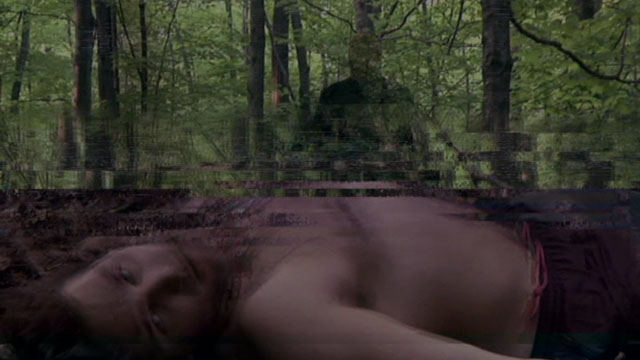
Ooh, a good segment for once, by Glenn McQuaid (I Sell The Dead). Wendy with traumatic past returns to wooded scene of horrible murders with three friends – but they’re not very good friends, and she invited them as bait to the killer, who appears as a red-stocking-headed glitch on her videocamera. “Why can’t I film you?” she asks, but it never explains if she can see him with the camera lowered. The camera also sees dead people, presumably from her last voyage to this spot, making this the only segment that uses the handheld camera for something interesting (the other stories would be no different if their characters had no cameras at all).

Digi-glitch-monster hovers over a victim:

The Sick Thing That Happened to Emily When She Was Younger
Guy witnesses his girlfriend’s haunted house in their nightly video calls. She seems to be going nuts, seeing little people (we see them too) and digging in her arm with knives looking for foreign objects. Turns out the “boyfriend” is setting her up, has implanted a tracking device in her arm and is letting aliens lay eggs in her, or something. Directed by Swanberg, written by Simon Barrett (A Horrible Way to Die).

10/31/98
Another good one, written/directed/starring five guys who walk into a seemingly empty house looking for a halloween party, finally stumbling upon some attic ritual where rednecks have got a girl tied up. After some pretty awesome supernatural stuff happens, they rescue the girl, who proceeds to unleash supernatural stuff upon the survivors (then she gets their car stuck in front of a train). Didn’t recognize any Atlanta scenery, but someone is told to take Spring street.

A prequel to Fear & Loathing In Las Vegas that I was very excited for in 1999, less so in 2011 when it finally came out. Depp does a good job dialing back to an earlier, less insane Hunter S. Thompson impersonation, but this origin story for HST’s career, based on his early (but belatedly-published) novel, doesn’t have much to recommend it besides the pleasure of hanging out with Depp’s HST and a new comic sidekick in Michael Rispoli (Summer of Sam) and a decent comeback for Robinson (Withnail & I).

Aaron Eckhart plays a slick wealthy bad guy (and Depp’s part-time employer), gets to make a nice F&L reference, pointing at the ocean saying he needs someone with the right kind of eyes (or maybe HST just wrote that dialogue twice). Amber Heard (star of The Ward) is Eckhart’s hot wife with a thing for Depp. Giovanni Ribisi isn’t entirely successful as a drunk and dangerous crime correspondent on the newspaper (run by Richard Jenkins with a hairpiece), but he isn’t significantly outclassed by the rest of the film so it works out. Someone uses the term “living wage” – did that exist in the late 1950’s?

Drunken Fantasy scene 1: rum bowling alley

Drunken Fantasy scene 2: Rispoli tongue

Poor French shoeshine guy Marcel, who doesn’t know his wife has terminal cancer, comes across an illegally-immigrated kid from Gabon who escaped from a shipping container. The boy hopes to get to London, but Marcel needs to raise 3000 euros for the smugglers to take him across. Meanwhile the kid’s photo is in the papers (caption: “connections to Al-Qaeda?”) and a police inspector is hot on their trail.

Sounds dreary, but wait! Kaurismaki somehow turns this into a political fantasy, tossing realism aside and assigning all characters extreme benevolence. Tack on a miraculous ending – Marcel’s beloved wife recovers from her cancer – and somehow the darkly ironic A.K. has made the feel-good movie of the year. A perfect example of Katy’s current interest in socially-conscious fiction imagining an idealized future.

Oh yeah, in order to raise the money, Marcel convinces local celebrity Little Bob to hold a “trendy charity concert,” in exchange for ending a dispute between Bob and his wife.

Marcel is Andre Wilms, who apparently played the same character in La Vie de Boheme, and his wife is Kati Outinen, Ophelia in Hamlet Goes Business. Marcel and young Idrissa are helped out by baker Yvette, her mom (Elina Salo – Gertrud in Hamlet Goes Business), Marcel’s fellow shoeshiner “Chang” (actually Vietnamese), and eventually the police inspector himself (Jean-Pierre Darroussin, star of Red Lights). Director Pierre Etaix plays the wife’s doctor. The only irredeemable character, a local meddler who twice tries to get Idrissa arrested, is played by Jean-Pierre Leaud.

Won some prizes with funny names at Cannes but got trounced by The Artist at the Cesars.

M. Sicinski:

Those of us who have been following Kaurismaki’s cinema over the past twenty-five or so years will not be surprised by this vote of confi­dence in the human race. We may immediately recognize un film d’Aki by his patented brand of affective reserve and rumpled formalism – he favors blue and beige foregrounds that hold the light with a warm, painterly glow; tends to limit camera movement; tamps down overt drama from his performers; and envelops this deadpan field of action with a unique musical ambience, chiefly derived from 1950s and ’60s rockabilly. There’s also a fair amount of free-flowing alcohol. But it’s his artistic and empathetic alignment with society’s outcasts that truly defines his cinema. The world of Finland’s highest-profile auteur, not unlike that of Howard Hawks, is one of hard-won faith in basic decency, an unsentimental humanism that can even squeeze in space for love.

Sure sure, I can slightly, vaguely, ever-so-minimally agree with some specific charges of political incorrectness and racial insensitivity I’ve read from online critics who would apparently prefer that Richard Gere make more movies instead of Tarantino. But Django Unchained was so awesome that even Katy loved it. Seems looser and less purposeful at times than his other movies, but that’s hard to say without having seen most of them in a long time.

Bounty Hunter Christoph Waltz (giving just as delicious a performance as in Inglorious Basterds, but this time as a good guy), the only non-racist in the slavery-era American south, frees Jamie “Django” Foxx from slave traders so Foxx can help identify and kill the Brittle Brothers. I figured from the trailer that they’d be more important, but they’re killed off a few scenes later with barely an introduction. Django stays on with Waltz, learning new strategies for killing villainous white men, until they come up with a plan to rescue D’s wife Kerry Washington from the estate of Leonardo DiCaprio. Many monologues follow, and when Leo gets wise to the scam, Waltz kills him (“I couldn’t resist”), leaving turncoat house-slave Samuel L. Jackson (the movie’s most hilarious performance) for Django to finish off. QT cameos as a doomed Australian.

A couple of quotes contradicting anything negative I said in the first paragraph:

Slant:

[Samuel L. Jackson] reveals himself as the film’s true enemy, a totally indoctrinated subordinate whose slave-subject mentality is so deeply inscribed that he acts out his master’s cruelty and viciousness even in his absence. He hints at the more complicated idea that the kind of violence Django trots out with decadent aplomb in the film’s finale is learned from white folks, a notion implied with more subtlety in the relationship between Django and Schultz. In visiting the film’s most protracted, and ultimately fulfilling, scenes of vengeance against a black man, Tarantino stumbled into his most intriguing social-historical corrective: a full-on reconsideration of classically defined algebra of Civil War antagonism, a counterintuitive take on the well-worn rivalry that pitted “brother against brother.”

A. Nayman:

Once again, in this deceptively baggy, ultimately precisely structured movie, the surface effect belies what’s going on underneath. The sight of two black men locked in a battle to the death at the behest of a white overseer is a tip-off to script’s true conflict. The expression of hatred on Jackson’s face as Django rides up to the inevitably named Candieland transcends the jokey Spaghetti Western posturing — it’s genuinely unnerving.

Oh yes it made me cry at least once. Yes I was impressed with the music. Yes some of the acting was really nice, and yes Russell Crowe seemed not to fit in. Same stuff everyone else has said, I’m sure, but two months late.

Hooper is the guy who made The King’s Speech, and has apparently let the big budget and musical numbers fog his memory of how to effectively edit a film. Huge Ackman is the former criminal, pursued unto death by supercop Crowe. Huge’s ex-employee and future oscar-winner Anna Hathaway dies a miserable prostitute, so Huge rescues her little girl Amanda Seyfried from her horrid keepers, welcome comic-relievers Helena Baron Carter and Sacha Bonham Cohen. Seyfried falls in love with Eddie Redmayne, whose doomed compatriots (including some very good young non-movie-stars who make us forget all about Seyfried for a spell) attempt another French Revolution. Huge saves his adopted daughter’s boyfriend, then suddenly dies of old age so they can carry on.

Film Comment:

This movie is by definition hobbled, with no chance of equaling Raymond Bernard’s exquisite and resonant 1934 version of the novel, which unfolded over five luxurious hours. The stylistic elegance and visual coherence of that early French cinema adaptation have been traded in for an all-out sensory assault.

Jim Emerson’s hateful review round-up was pretty hilarious. “The actors are playing to the balcony while the camera (and those wide-angle lenses) push their faces into ours. It’s like Full Metal Jacket: The Musical! with all the parts played by R. Lee Ermey.”

A prologue, long first section, long second section – with only the middle part having sync sound. Bookend segments have spoken narration and certain (probably dubbed/foleyed) sound effects from the scene and seem better/more magical than the talkie half of the movie.

1. In Africa, depressed widower colonialist hurls himself into the crocodile-infested river. “You may run as far as you can, for as long as you like, but you will not escape your heart.”

Ghost of the colonialist’s dead wife:

2. In Lisbon, aging activist Pilar (Teresa Madruga of Silvestre) would seem to be our main character, but the possibly-senile gambling-addicted woman next door takes up much of her attention and curiosity. Aurora isn’t so nice to her maid Santa, is never visited by her children, who support her via a monthly check. Aurora takes a bad turn and sends Pilar to find a man called Ventura (Henrique Espirito Santo, a producer of Doomed Love and Magic Mirror) who arrives too late. After the funeral, he has lunch with Pilar and Santa, begins to tell them his story, after which we never see anyone from the movie’s first half again.

Aurora and Ventura:

3. We spend a year in Mozambique, with month-by-month title cards. Young Aurora (Ana Moreira of Teresa Villaverde’s films) was a famed hunter, a lone wolf who finally married, but soon started an affair with neighbor Ventura (Carloto Cotta, who played Father Dinis’s father as a young man in Mysteries of Lisbon).

Aurora and Ventura:

Their affair gets more passionate and reckless, until finally they run away and she kills the man who discovers them together. She’s dragged back to her husband. Ventura tries to claim that he shot the man, but an anti-colonialist movement takes credit for the murder, so they’re both off the hook – but they never see each other again.

Reverse Shot:

Gomes, even from his earliest shorts (which he’s dubbed musical comedies, though the music is generally piped in rather than sung, the humor dry as a bone, rather than broad) has evinced a willingness to prioritize images over dialogue, songs over the spoken word, and, above all, has maintained a sense of play entirely his own. … Tabu steals its name and chapter titles from the mystical South Pacific feature directed by F.W. Murnau, another filmmaker in thrall to the magic of movies, and produced by Robert Flaherty, the other guiding pole of Gomes’s cinema. That he’s reversed the trajectory of that earlier film, moving from “Paradise Lost” to “Found” suggests that this new Tabu is up to more than just simple homage.

He plays in a band, she listens on the radio, both crying

Slant:

This is a film in which a sullen colonialist transforms into a reptile in a tone-setting prelude. This is a film that answers its hour’s worth of affectingly humdrum urban drama with a lulling, marvelous, deeply dreamy backend. Yet Tabu’s surrealism—like its romance, its comedy, its historicism, its everything—is retained with a light touch. For all its wistfulness, Tabu never feels like a formalist, postmodern, post-cinema put-on. Gomes never feels like he’s trying to pull anything off. And so, in turn, he manages to pull everything off.

Pilar and Santa:

Gomes:

I think I make films to play music. For instance, Tabu starts with Pilar watching a movie. But that sequence was only put at the beginning in the editing room. That story of the explorer and the ghost was like a radio soap that Aurora was doing. I shot her in the studio doing Foley effects (sounds synched to the action) and the sequence was supposed to come in the second part of the film. I didn’t know where, because we didn’t have a script for the second part. I shot many sequences not knowing if they would fit in the film or which part they would fit into. In fact, when Pilar was going to the cinema—and in the script, she went three times, in the film only two—it was intended that you would never see the screen but would hear a song. Maybe this is my emotional link with cinema, that I wanted to materialize it by not showing whatever Pilar is seeing, only portraying it as a song. For me as a viewer of cinema and a listener to music, I wanted to have the same response to the sequence as I would if I were hearing a great song, not being moved by the lyrics but by a more abstract feeling one has in response to music.

A Horrible Movie To Watch

Okay, I’ll try a little harder. Sarah (Amy Seimetz of Joe Swanberg’s Silver Bullets and Alexander the Last) meets a nice guy (Joe Swanberg himself) at an AA meeting. Turns out he’s in a group of serial killer super-fans, and they want revenge on Sarah for turning in her serial killer boyfriend (AJ Bowen from Marietta, murderous son in House of the Devil) – who I think kills them all, having just been released from prison. I dunno, slept through the middle third, sick with the flu and angry at the movie for looking so terrible. At the end of certain shots and scenes, the cameraman appears to get confused then pass out, adding the only stylistically unique element to the movie. I actually came to enjoy those moments, to look forward to them, wondering if one of the two cameramen is narcoleptic or if this is an effect anyone would plan. Wingard (from Alabama) contributed to recent horror anthologies The ABCs of Death and V/H/S.

Joe:

NY Times liked it, calling it “commentary on our willingness to tune out evil for the sake of emotional connection.”

Squeamish British sound engineer Toby Jones arrives in Italy to work on a movie called The Equestrian Vortex, not realizing it’s an extra-bloody horror film. Supposedly he was hired because the film’s director Santini holds him in high regard, but nobody else in the studio could care less, and his requests meet with blank stares and insults, as over the weeks of work he gets more shaken by the company and his work stabbing and snapping vegetables as torture-foley.

Like the 1970’s and 80’s Italian horrors Berberian claims to be recreating (we never see a scrap of footage from the film-in-a-film except its opening titles), this movie cares much more about atmosphere than anything else, and does a great job creating that through image and sound. With Jones playing a foley artist and sound recorder, they knew we’d be paying close attention to the soundtrack, and it’s wonderful. But while the Argento and Fulci movies have overstuffed but ultimately empty stories submerged in their gothic atmosphere, this one mostly dispenses with story and lets its atmosphere do all the talking. In fact, they seem to have forgotten to give the movie an ending. It has a neat build-up, as Toby’s letters from home bleed into his work, a story of a birdnest rampage paralleled in the inner film’s carnage and in editing-room chaos after a wronged actress takes out her frustration upon the audiotapes, but then it peters out after that.

Very nice touch that sound equipment is activated by a black gloved hand in close-up. Shot by Nic Knowland (Institute Benjamenta, Piano Tuner of Earthquakes). I must find Strickland’s earlier feature, a Romanian revenge drama.