Sembene’s third-to-final film, the one before Faat Kiné. His usual feminism is in effect here, but it’s mostly pushed to the background because he has more pressing issues to worry about.

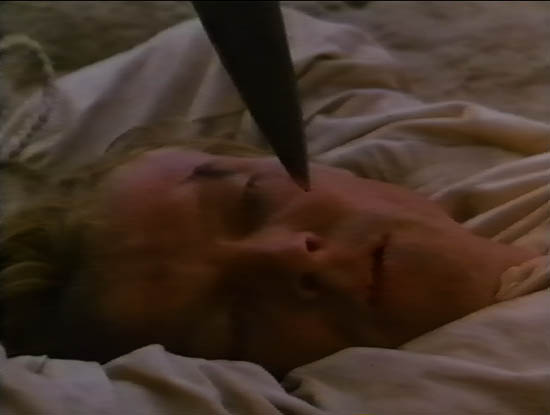
Guelwaar (Thierno Ndiaye, below, also in Karmen Gei) has just died when the movie begins but we meet him in flashback. He has been killed because of his outspoken political beliefs, that it is better for a person or a nation to live poor than to accept handouts. He and his family are Catholic, and when his expatriate son Barthelemy goes to retrieve the body for the funeral, he finds that there has been a mix-up and Guelwaar was buried in a Muslim cemetery. A cop somewhat-assists, but when he finds out Bart lives in France he suggests that Bart appeal to his ambassador instead of asking the local police for help.

image

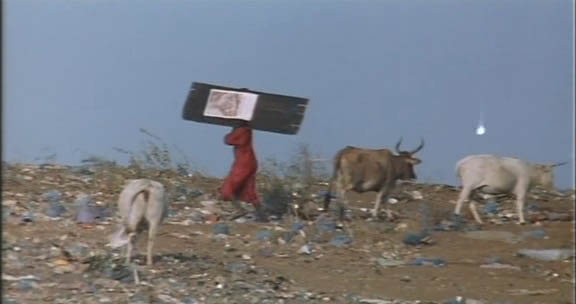
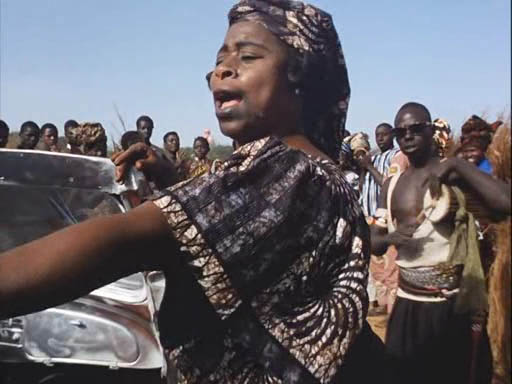
Meanwhile at Guelwaar’s house, the funeral party drags on longer than anyone had anticipated. His widow Nogoy, younger crippled son Aloys, and prostitute daughter (the prime breadwinner of the family) socialize with the guests (who include the daughter’s coworker, actress who played Rama in Xala). When word gets out about the fate of Guelwaar’s body, the Catholic priest and Muslim imam have a showdown, each craving peace but backed by an angry and armed mob of their people. The Muslims only back down when a government man (on whom they depend for food) drives up and convinces them of their burial error. Guelwaar is returned to the Catholics for his funeral, Bart has a newfound patriotism, and on the way out, the Catholics, in solidarity with Guelwaar’s climactic flashback speech (and as an outlet for their pent-up rage) destroy the shipment of food headed for the Muslim town in a passing wagon.

image

Interesting that Guelwaar defends the fact that his family lives off the daughter’s prostitution trade, over his wife’s protests. At least it is work, he argues, and they are not relying on handouts from others. This scene cuts down his noble martyr status by a couple notches. Nobody’s perfect. Also I like that the imam (above) is portrayed as a good man who listens to reason and tries to sway his angry followers to do the same. The only group that is portrayed as irredeemable is the corrupt government officials who silence Guelwaar’s voice that decries the handout system, since they skim a large share from foreign aid money before distributing it to their people, and they’d like to keep it that way.


MAR 20, 2008
————–
Saw on 35mm for the first time. I do not know this movie as well as I think I do… lots of forgotten parts (the town in Iceland buried in ash) and mis-remembered bits. I was grateful to see it projected, but don’t feel that it loses too much on television – gonna keep happily watching the DVD for years to come. If I have a favorite movie right now, this is it.

A new favorite line: “At nightfall the megalopolis breaks down into villages, with its country cemeteries in the shadow of banks, with its stations and temples. Each district of Tokyo once again becomes a tidy ingenuous little town, nestling amongst the skyscrapers.” This is the impression I got from some Japanese movies.

Checked out the DVD again and watched some of the extras. The Chris Darke short didn’t teach me much, just strengthened my belief that nearly all video-art installations consist of too-small TV screens in too-large white rooms full of uncomfortable folding chairs.

DEC 30, 2006
————–
A reminder of the attempted Chris Marker Marathon begun in late August. Showed it off to Jimmy & Dawn.

A movie about memory, images, directing and editing, making pictures, turning life into art and vice versa.

“I will have spent my life trying to understand the function of remembering, which is not the opposite of forgetting, but rather its lining. We do not remember, we rewrite memory much as history is rewritten.”

Explanation for the electronically processed images: “He showed me the clashes of the sixties treated by his synthesizer: pictures that are less deceptive he says—with the conviction of a fanatic—than those you see on television. At least they proclaim themselves to be what they are: images, not the portable and compact form of an already inaccessible reality.”

Owls and cats! Digitally processed images. Tarkovsky’s Stalker. Three children on a road in Iceland. Apocalypse Now. Sacred symbols at Macy’s. Teens dancing in the streets. The same scene in Vertigo that Marker references in La Jetee. Kamikaze. An image. A memory. A glance.

Even better than I remembered, and I remembered it as a masterpiece. Such a good documentary that it may not be a documentary at all. The best travelogue ever.

If this site didn’t already exist, I may have felt compelled to create it myself.

Dawn loved it. Jimmy too, I hope?

The Chris Marker Marathon will continue someday. Got some Rivette to watch first, I think.

A bright-looking city movie about a single family, nice contrast to the dull-colored medium-shot rural Emitai. Rapid escalation of Sembene’s feminist filmmaking that would lead to the glorious Moolaade. Kine at first seems too harsh and rough to be a likeable lead, but after hearing her story and experiencing her kids’ party and meeting her ex-husband, she looks very much like a hero and deserves the happy ending she gets. Cool movie – I’d watch it again.

S. Gadjigo:

Faat Kine is a chic, sexy, and “liberated” woman. She is a forty-year-old single mother, born at the same time as Senegalese independence. From her humble beginning as a gas-station attendant constantly being harassed by male customers, Faat Kine has climbed a ladder reserved for men to become a successful station manager of a multinational oil company. She is financially in control, well-connected in the business world, and adept at manipulating the banking system. Le Credit Lyonnais keeps no secrets from her. When she needs it, she can afford boy-toys. She owns a car and a stylish villa littered with posters of Sembene’s revolutionary icons. She has adopted all the fetishes of the moyenne bourgeoisie, including telecommunication knickknacks, modern appliances, and, best of all, a servant who draws her a warm bath when she comes home from work.

The double success of her children is yet another achievement for Faat Kine, one which stirs memories of her own youth in 1981, “when Sanghor left and handed power to Abdou Diouf.” So, Sembene’s pendulum swings back to the time when Faat Kine was twenty, in her last year of secondary school, just months before her final exam. She had dreamed of becoming a lawyer. But this was not to be. Immaturity, perhaps, and weak social and educational safeguards conspired against her. She was instead seduced by Gaye, her philosophy professor, and left alone pregnant.

The foolishness of the past exacts its brutal price, Sembene reminds us, in the crippled form of Mammy who lives on in the present with Faat Kine, Aby, and Djib. She is Kine’s mother and another of Sembene’s pillars of strength. For once she was expelled from school, Faat Kine’s only protection at home came from her loving but powerless mother. When Kine’s conservative father wanted to kill both his daughter and her newborn, it was Mammy who shielded the children with her body from her husband’s vicious blows.

Crippled Mammy, ambitious Faat Kine, the fatherless Aby: Three generations of women, who have only each other for support in a world shaped by feudal and neo-colonial values, hold the keys to Sembene’s moral. At first to survive, then to succeed, Faat Kine entered a world forbidden to women. By breaking taboos, she unabashedly took control of her life. She faced the world, was rewarded with a degree of financial independence, and moved steadily toward the center of Dakar’s middle-class. What does it mean then, when Sembene lets the pendulum loose once more? Faat Kine becomes pregnant and is abandoned again. Her lover strips her of her savings and their son Djib of his paternity. Apparently, one lesson Kine has yet to learn is that independence can never be a gift. It is hard won.

California Newsreel:

In a film permeated by commercial transactions, Faat Kine exemplifies a model of economic self-reliance tempered with charity; she frugally refuses to take bank loans at usurious rates or accept foreign currencies in clear contrast with African nations’ growing indebtedness to Western banks and lending agencies.

Yet Faat Kine may have become so accustomed to relating to people through money her children fear she has cut herself off from deeper emotional attachments. In Djibril Diop Mambety’s Hyenas, for example, Linguère Ramatou, another businesswoman scorned by male society, retaliates by bribing a village to kill her dishonorable former lover in exchange for an international line of credit. Here, in contrast, Faat Kine decides to marry her male counterpart, Uncle Jean, a widower and businessman who has raised three children on his own.

This will finally be a marriage between equals as the unexpected last shot indicates. Held for a disquietingly long time, it shows only Faat Kine’s feet curled in pleasure. In contrast, to pornography where the woman’s body is fully exposed for the man’s pleasure, here we see only Faat Kine’s anticipated satisfaction. In fact, the audience could be seen as being placed in the unaccustomed position of the provider of that pleasure. This seems like an appropriate ending to a film which, after all, has been a tribute to women who for to long have had to do everything for themselves.

I won’t be very good with details on this one – I was struggling to stay awake. Had no problems with Faat Kine though, which we watched next. Can’t say I liked this very much. Instead of blurrily remembering things about it, below are a bunch of quotes from other people.

One of the soldiers in charge, the commandant, was the main white actor in Black Girl.

image

Harvard:

Sembene’s third film launched his international reputation, reaching an audience far beyond Senegal’s Diola community, to whom he had directly addressed the film. Emitai takes place in the period at the end of the World War II, as West African veterans are returning to their homes in the French colonies. General De Gaulle, the hero of the trench resistance, is now the leader of the newly liberated France, yet forced conscriptions and massacres of Diola villages continue, some of them led by former members of France’s Vichy government. With Emitai, Sembene realized his statement “film should be a school of history.” When the film was released in 1971, it was immediately banned in Senegal, and throughout Africa.

WBAI’s explanation:

Sembene returns to village life in “Emitai.” It is in the early days of WWII and the French Vichy government is rounding up African youth to fight in their war. A village has been occupied by a company of native soldiers who are ordered about by a white Frenchman. Not one given to romanticism, Sembene depicts the lower-ranking African soldiers as passive servants of white rule.

Not satisfied with dragooning young men in a kind of neo-feudal tribute, the French demand rice as well to feed their army. With this demand, the villagers decide they have had enough. Not only is rice necessary for their physical survival, it is their link with their gods. Rice, like the rain that nourishes it, is sacred. To retain their links to the sacred, they hide the harvested rice from the soldiers.

In retaliation, the soldiers force the village women to sit in the brutal sun. They will only be released when the rice is turned over. In order to decide how to save themselves and their people, the village elders convene a series of meetings in a secluded altar to their gods beneath an enormous baobab tree. The gods, including Emitai, the god of thunder, instruct them to make sacrifices. So, in an obviously futile gesture, the elders sacrifice a rooster and then a goat, sprinkling the blood on the earth beneath the tree, after which the carcasses are heaved into a hollow in the trunk. Obviously there is an implied criticism of one aspect of traditional life by Sembene. Animism is no defense against French rifles.

image

From the NY Times:

The villagers don’t exactly need the rice; it is to be used in religious ceremonies, not for sustenance. And the French don’t really need it either. Halfway through the movie, deGaulle replaces Petain, the above-ground battles are ended, and so is the demand for overseas food. But everyone remains inflexible, and the story of “Emitai” continues to a fatal standoff in its bitter conclusion.

Just before the village chief dies—from French rifle wounds — he utterly renounces the gods, wherupon he is gotten up for a marvelous funeral, so he may rest with them in eternity. This juxtaposition is typical of the spirit “Emitai.”

It is a cool, balanced, proportionate spirit, affectionate but unillusioned, and wonderfully suited to the intricacies (and the idiosyncracies) of the subject matter. Sembene does not grab you; he engages you. Much of the time he photographs his action in the middle distance—not for the sake of distance but for the sake of an inclusiveness that keeps surprising you with its ironic sophistication.

“Emitai” isn’t a very complicated movie—in the abstract, little more than a tragic vignette. But for its purposes it is very complete; and considerate of the puzzles faced by its gods, its victims and its killers.

S. Axmaker likes it:

Emitai (1971) remains, to my mind, Sembene’s greatest masterpiece and his most important achievement. His angry attack on colonialism was inspired by the real life resistance of a Diola tribe who stood against the French soldiers that conscripted their men and took their rice during World War II. Sembene tosses out the conventions of western filmmaking and creates a style that arises from the storytelling traditions of rural Senegal. The contemplative pace, performances more ritual than realistic, and formal “call and response” dialogue create a world from the outside in, giving western audiences a culturally unique perspective and African audiences a sense of their own voice.

Congoma-player Marigo hasn’t paid the rent in a few months, so his landlady (the griot from Touki Bouki) has confiscated his instrument until he pays up.
image

With no way to earn a living, Marigo buys a lotto ticket from an optimistic dwarf acquaintance.
image

Marigo has got the winning number… but he pasted the ticket to his front door behind a poster of Yadikoon (“an African robin hood”), so he has to take the whole door to the lottery office.
image

…along the way, dreaming of the rich life…
image

…only to be told that the ticket needs to be detached from the door to be authorized.
image

So Marigo makes a run for the beach and uses the pounding surf to remove the ticket, dancing and dreaming on the rocks, losing his poster but getting the ticket off successfully, screaming ecstatic laughter.
image

I pretty much loved it.

Culturebase.net:
“We have sold our souls cheaply!“, Mambety concludes, though he never described himself as a political director. Yet his films always refer to the economic reality of his country, which is entirely dependent on the World Bank, monetary funds and French economic policy. This is true for his last two films. They were part of a trilogy on “The story of small people.” “Le Franc” and “La petite vendeuse de soleil” are from parables on the lives of people who must ask themselves the same question every morning, namely how to gather the most fundamentally necessary means to survive. The small people in this trilogy are the counterparts to the greed of the hyenas in his longer feature films.”

Filmref.com:
“Mambéty introduces the trenchant idea that the power of the imagination to raise post-colonial African consciousness does not exist in fanciful, but ultimately empty, idle dreams or wistfully dwelling over a lost – and stolen – noble past (a theme that is also articulated in Jean-Marie Téno’s films, as well as Ousmane Sembene’s Borom Sarret), but in a certain wide-eyed innocence and naïve determination that recovery and advancement are still possible with dedicated effort.”

California Newsreel:
“In both films there are conspicuous references to Yadikoon, a semi-legendary figure who in popular memory became a kind of Senegalese Robin Hood, robbing from the rich to give to the poor. In Le Franc, the main character, Marigo has a poster of Yadikoon in his room. Mambety himself named a foundation he established for Dakar’s street children after Yadikoon.”

The only hits I get from “Yadikoon” on google are from articles on these films, so either he’s a Mambety-created character or we are all spelling his name wrong.

Also watched “Echek” again, fun little flick by Adan Jodorowsky:
image

IMDB says it’s “believed to be Africa’s first avant-garde film”. Think it’s the earliest African film I’ve seen period other than the not-so-avant-garde Black Girl & Borom Sarret.

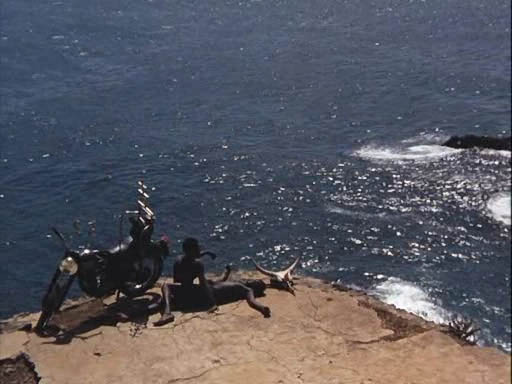
It’s a semi-comic story of horned-motorcycle-drivin’ Mory and his college student girlfriend Anta riding around Dakar, Senegal looking to steal enough money to get them to the paradise that is Paris. After successfully robbing a gay rich dude and unsuccessfully robbing a wrestling match, she boards the boat but he is overcome by nationalistic cow-related panic and runs back into town. There’s a woman “Aunt Oumy”, local griot, yells at them, they imagine returning to town rich and famous, Oumy singing for them. I did kinda like it even though I don’t have much to say about it.

Rosenbaum says “one of the greatest of all African films and almost certainly the most experimental … The title translates as Hyena’s Voyage, and among the things that make this film so interesting stylistically are the fantasy sequences involving the couple’s projected images of themselves in Paris and elsewhere.”

From wikipedia, Mambety “sought to expose the diversity of real life”, and his “editing and narrative style are a confluence of the ancient griotic tradition of tribal storytelling and modern avant-garde techniques. Mambéty was interested in transforming conflicting, mixed elements into a usable African culture, and in his words, reinvent[ing] cinema.”

Shortly before he died, Mambety was asked what he would do next. “I will finish the third part of the trilogy about ordinary people. After that, I will make Malaika, the third part of the trilogy about the power of craziness. The first two were Touki Bouki and Hyènes. Then I will consult God about the state of the world.”

Sex on the beach:
image

Wild child in a tree:
image

Griot in a riot:
image

Fantasy riches:
image

Also watched Episodes from the Life of Jekyll and Hyde by Paul Bush, a few-minute piece using the soundtrack to one (or a few) Jekyll & Hyde movie and ultra-fast-cutting two actors together into some kind of stop-motion nightmare… where the Secret Adventures of Tom Thumb meets Alone, Life Wastes Andy Hardy. Cool.

image

image

Sembene’s fourth feature and his second movie I’ve seen named after a spell/curse.

IMDB: “It is the dawn of Senegal’s independence from France, but as the citizens celebrate in the streets we soon become aware that only the faces have changed. White money still controls the government. One official, Aboucader Beye, known by the title “El Hadji,” takes advantage of some of that money to marry his third wife, to the sorrow and chagrin of his first two wives and the resentment of his nationalist daughter. But he discovers on his wedding night that he has been struck with a “xala,” a curse of impotence. El Hadji goes to comic lengths to find the cause and remove the xala, resulting in a scathing satirical ending.”

Rama the daughter appears in Guelwaar.

image

image

image

image

image

image

Boring movie about two white guys competing to be the first white guys to find the source of the Nile. Richard Burton (Bergin of nothing major) and John Speke (Glen of the last two Resident Evil movies) are on an expedition together in the 1850’s which is badly thwarted by angry Africans. They eventually return, Burton is injured and has to return home early, so Speke gets the glory for discovering the source. The two of ’em fight it out back at home for a while, plan a public debate to settle their stories, but Speke shoots himself on the day of. Burton was later a diplomat, knew a ton of languages, snuck into Mecca and translated “Arabian Nights” and the “Kama Sutra”… interesting guy. Fiona Shaw (H. Swank’s horrible mother in The Black Dahlia) plays his love interest/wife, and Richard Grant (How To Get Ahead In Advertising) plays someone or other.

Burton writing:
image

Speke in trouble:
image

Grant:
image

Watched again, this time on film, and confirmed that it’s one of the greatest movies I’ve seen this year. Fiery badass political in a more artful way than Michael Moore could ever dream, the culmination of Sissako’s filmmaking styles from Waiting For Happiness and Life On Earth merged with a long, deep-seated desire for change. Too bad it’s almost impossible to recommend as good art and entertainment to people not already interested in African cinema… they’ll never believe me. Jimmy liked it too!