A solid movie, somewhat hopeless and dusty and dreary, but nicely told through its visuals and not overly weepy in tone. I give you the oft-quoted official synopsis: “Mocktar, a Nigerien peasant, comes looking for work in Essakane, a dusty gold mine in Northeast Burkina Faso, Africa, where he hopes to forget the past that haunts him. In Essakane, he quickly finds out, the gold rush ended twenty years before, and the inhabitants of this wasteland and strange timelessness manage to exist simply from force of habit. The beautiful Coumba, however, is still courageously struggling to raise her daughter after the death of her family. Mocktar will soon be fighting not only to survive, but also to provide a better future for this mother and her child.”

Opens with a shot of the dusty desert, the mine entrances invisible beneath the dunes, then one by one the miners start appearing from the ground. Closes with the revese of that shot as they go back into the mines. Throughout, when we’re at the entrances to the mines, the camera is always in the same couple of positions, giving a familiarity to the faceless desert. Rasmane Ouedraogo (from Tilai and Moolaadé), recognizable with his short, white beard, is the elder guru miner, who becomes the mine owner at the end when the old owner, a stern but somewhat fair (profit sharing!) fat man, decides to retire, only to be killed for his money on his way out of town. Our hero is kind of a blank, less memorable than the characters and situations around him.

Variety

Salgues’ screenplay is perfectly crafted in the Western tradition, while Crystel Fournier’s striking cinematography connects the film to a broad African vision. Viewers have a lot of time to admire her dazzling desert panoramas, as there is almost no narrative motor to underwrite the visuals. … Mathieu Vanasse and Jean Massicotte’s music track matches the rest of the film in being extremely refined. The French and Canadian post-prod work is top quality. Improbably, all dialogue is in very formal French.

The rarest thing: a smart, funny satire that actually works. Europe is falling into chaos with raging unemployment, while in the “United States of Africa” the people prosper. Immigration is strictly controlled, so our young white protagonist lovers, despite their education and training (teacher and engineer, I think), can’t get meaningful work in Africa. They try it anyway, paying a smuggler to fly them into Africa to take their chances. They’re caught and quite humanely imprisoned in a high-tech facility. She (Pauline: Charlotte Vermeil) takes a job as a domestic servant to Modibo Koudossou (played by the director), a tolerant pro-immigration-reform politician, while he (Olivier: Stéphane Roux, voice of the narrator in Ratatouille) escapes and goes on the run, taken in by a group of poor whites who live in the housing projects.

Meanwhile, Modibo’s rival politician Yokossi (Emile Abossolo M’bo: Ezra, Night On Earth) has got the crooked police chief (Eriq Ebouaney, star of Lumumba, also in Femme Fatale, Kingdom of Heaven, 35 Shots of Rum) gunning for Modibo. Yes, there are crooked cops even in a utopian African film. Modibo doesn’t get to pass his reform bill, but at least he escapes assassination and our lovable white kids help defeat the bad cop. Reunited, Olivier offers Pauline the chance to return home to Europe in shame and poverty with him, but she elects to stay and marry noble Modibo, who has fallen for her, instead. Olivier, though proven good with electronics, was always kind of a douche so this is a happy ending.

Movie is definitely cheap-looking, but not The President Has AIDS-cheap, a respectable made-for-TV-looking cheap. The writing is full of fun satirical tidbits and race-reversal jokes that delighted the High audience. Katy liked it too, and we can’t account for the 4/10 rating on the IMDB…

Torture Money (1937, Harold S. Bucquet)
Caught on TCM’s Oscar Month – this beat out Deep South and Should Wives Marry? for best two-reeler. A cop from the Bunco Squad goes undercover to investigate a ring of scammers who beat a guy up in a back room then fake a car accident complete with paid “witnesses” to fraud insurance companies. The scammers purposely run over a little girl, just in case insurance fraud wasn’t enough of a crime to get our attention. Our officer blends in successfully thanks to his knowledge of 30’s street slang and his ability to fake a hatred of cops. He’s chosen to be the “accident victim” (that’d be the titular torture), manages to contact his men, spring the trap and send the baddies to jail. I don’t recall the character names, so our cop was either George Lynn (I Was a Teenage Frankenstein) or Edwin Maxwell (The Great Moment, His Girl Friday). The director went on to better things (a Katharine Hepburn feature, the Dr. Kilgare series), as did the writer (T-Men, Robinson Crusoe On Mars).


Three half-hour shorts from the 1997 Africa Dreaming series:

Sophia’s Homecoming (Richard Pakleppa, Namibia)
Sophia arrives in town after years in South Africa and finds that her husband, kids and sister aren’t so happy to see her. Turns out the sister and husband are in love… Soph tries to break it up, but when the sister says she’s expecting the husband’s baby, Sophia packs up her kids and returns to S. Africa. Other than a solo dish-destroying kitchen tantrum, there’s surprisingly little screaming and fighting, considering the situation.

Sabriya (Abderrahmane Sissako, Tunisia)
Hot, uninhibited, waterfall-loving foreign woman comes to town and shakes up the home life of a local chess-playing tavern dweller. He falls in love, but I think she leaves town without him at the end… I was too busy staring at the nice visuals and trying to remember scenes from Waiting For Happiness.

So Be It (Joseph Gai Ramaka, Senegal)
Doctor arrives in town (people are always arriving in town in these movies), sees a mute retarded kid who hangs around. Everyone seems to dump on the retarded kid… finally outta nowhere (actually I predicted it, but I was kidding) the townsfolk come with torches to kill the kid. Why? I dunno, but the doctor is right upset. The written description on the box calls it an African Heart of Darkness (although I would prefer an African Heart of Darkness to concern an adventurer from the Congo on a dangerous mission to England to retrieve a countryman who’d encamped in a rural British village up the Thames and established himself as a god among the locals). The box seems to know a lot that I couldn’t figure out from the movies. Maybe I wasn’t paying attention?


Egged On (1926, Charley Bowers)

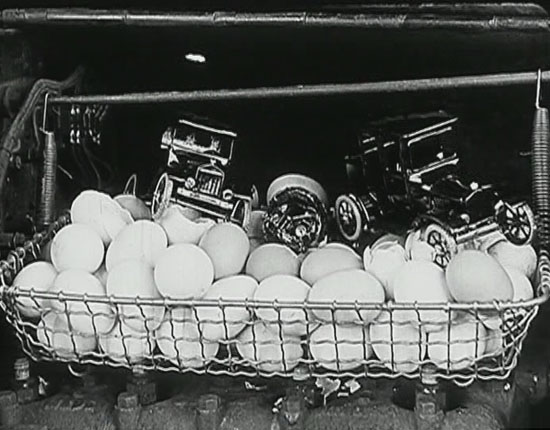
Charley invents an overly-complicated machine in his girlfriend’s parents’ barn which makes eggs unbreakable (rubbery, you open them with scissors) and aims to sell it to the egg-shipping industry. The investors are coming, but Charley has no eggs for the demonstration, so he fails to gather some in various ways. Finally gets an egg from a hen who’s been eating dynamite… test goes well until he hits the egg with a hammer to prove its indestructibility and destroys the whole barn. Worth watching for the scene shown below in which a batch of eggs, incubated by Charley’s car engine, hatch into hundreds of little cars in a massive and delightful stop-motion display.

image

image

He Done His Best (1926, Charley Bowers)
Another one involving eggs, and complicated machinery, overall more entertaining then Egged On. Charley needs his girl’s dad’s consent for marriage, ends up working at his restaurant. Gets dad in union trouble, so invents an automatic server/cook machine (powered by stop-motion, natch). Dad is cheered immensely, girl holds wedding at the restaurant, but she’s marrying some other guy which is supposed to be a funny surprise but is instead kind of an anticlimactic ending after a great movie, a la Chaplin’s One A.M.
image


Azur and Asmar (2006, Michel Ocelot)
Not supposed to be a short, but we ditched after 45 minutes because this was so bad. I can’t even think when’s the last time I walked out on a movie (though I remember itching to leave Sam Raimi’s The Gift). The critically-raved-on animation looked to me like weakly-puppeted low-detail Flash, and the story was going nowhere we couldn’t easily predict, so there seemed no point in staying. As a rule, I don’t put half-seen movies on the website, but I’m making an exception here and I don’t need a reason, nyeah.

Euro/African kids grow up with same mum/caretaker, Euro kid is sent away to become classy, African kid/mum is kicked out of house, sent back to whatever country to become super-rich merchants. Eurokid goes to africa, hides his blue eyes, runs into his mum and a hunchback liar fellow, and sets out to locate the three keys and marry some mythic fairy. Africa stuff is all Eurocentric wide-eyed wonder, and the other kid disappears for huge chunks of the movie, so the idea that we were seeing some kind of African tale faithfully told by a Frenchman went out the window.

Then we snuck into the animated shorts program and caught Varmints (Marc Craste) – wordless depresso-short with very good CGI about a bunny in a polluted Wall-E world trying to use his potted plant in order to get captured by giant floating jellyfish to live in meadowy heaven with the girl he met in the elevator – Gopher Broke (Blur Studios) – slick, commercial-looking animal comedy, unlucky gopher upsetting trucks on their way to the farmer’s market in order to get himself some food – Skhizein (Jeremy Clapin) – guy is hit by an asteroid and finds that his consciousness is some number of centimeters to the side of his body, neat premise but in the end it turns out he is just deranged – and Hot Dog and John and Karen which I’d already seen in The Animation Show 4 but played better with a crowd.

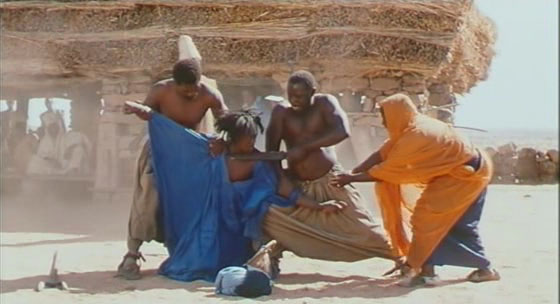
Batrou is a cute student, the privileged daughter of a hardassed military governor/colonel with three wives. His youngest wife is strong-willed and troublesome (aren’t third wives always?) and close to the daughter’s age. The daughter is in love with Ba, and they hangs out with friend Seydou, studying for exams.

I’m not sure exactly what happens with the third-wife plot, or why the boys’ failing their exams helps to launch a student protest against the government (maybe the protest was already in place, and the boys just joined it), but the result is that Ba and Seydou are arrested and sent to hard training camp, where Seydou dies from the stress, and even Batrou is arrested by the unapologetic colonel.

Suddenly we’re back in familiar Cissé territory when Ba’s grandfather hears of his arrest, puts on his tribal garb and heads for the trees to make sacrifices and wish for supernatural assistance in overthrowing the colonel’s evil plans. Walks out of the trees into the colonel’s backyard and threatens him – colonel reponds as we’d expect by shooting grandpa in the back, but the bullets have no effect.

Bulletproof robes are all the ghosts of grandpa’s ancestors can provide, though – when he gets home he finds the house has been burned down and Ba is rumored to have been killed, so grandpa burns his ceremonial outfit and joins the people’s march against tyranny, which shakes up the government enough that the colonel is ordered to release Ba, who’s now free to run off with the colonel’s daughter.

This preceded Yeelen, which featured two of the same actors (the grandfather and the colonel). It lacks much of Yeelen’s striking imagery and unhinged craziness but it’s still a good movie (I liked it more than Xala) and oughtta be more readily available than it is.

N.F. Ukadike: “Ironically, Finye was partly financed by the military government of Mali. Tolerance and maturity prevailing, the government demonstrated that it is capable of listening to constructive criticism.” Kino’s promo copy plays up the romance and compares to Romeo & Juliet, says it “casts a critical eye on both the ancient and modern values.”

M. Dembrow: “In reality, young Malians would have to wait ten years after the making of Finyé for the military regime of Moussa Traoré to crumble. But with this film—and with Yeelen as well—Souleymane Cissé gave them powerful images of hope and resolve.”

Jacob has many kids. His favorite son was killed by animals (bible scholar Katy tells me he’s not really dead) so Jacob is in mourning. King Hamor’s son wants to marry Jacob’s daughter Dina (after kidnapping/raping her), but Jacob’s not responding to requests nor is he acknowledging any of his children. Meanwhile, his brother Esau is lurking with his warriors. Jacob’s sons kill all of Hamor’s people (including Dina’s would-be husband) and there’s gonna be a three-way showdown, but Jacob comes to his senses in time and his clan goes off to Egypt where they’ll presumably find his not-dead son.

image

I also dug the flashback stories in the middle… and Jacob’s climactic nighttime battle with God. There’s lots more that I did not get. Found the movie hard to follow, but I think a passing familiarity with the bible (maybe the book of genesis) would’ve helped some. Was nice to watch anyway, with all the great desert locations, color-coordinated outfits and completely decent actors, a welcome change from the film-fest screeners that have become my constant sorrow.

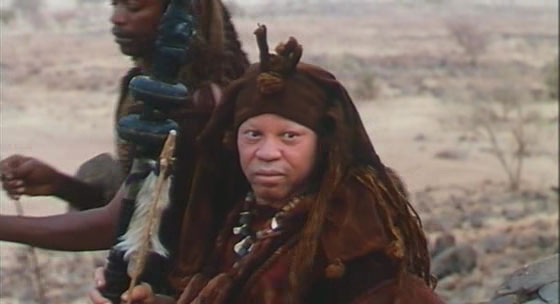
Albino musician Salif Keita, whose music I’m not all that into:
image

Of the lead actors, Salif Keita (Esau) is better known as a musician (he composed for Yeelen), Sotigui Kouyaté (Jacob) and Fatoumata Diawara (Dina) costarred in Sia, the Dream of the Python a couple years later in Burkina Faso, and Balla Moussa Keita (Hamor) appeared in Sissoko’s Guimba the Tyrant and a bunch of Souleymane Cissé films including Yeelen. Hamor is also the guy I would least recognize if I saw him again, unless he was wearing that coiled-white-tube getup.

Jacob:
image

Helpful bit from the distributor: “Based on the book of Genesis, chapters 33-37, the film follows the bitter rivalry between brothers Jacob and Esau and the resulting cycle of violence, with Sissoko mixing relevant allusions to African history and culture into the Biblical tale.”

NY Times called it confused and rambling. “Complicating matters is the involvement of Hamor, the leader of the Canaanities, when his son Sichem abducts Jacob’s daughter Dina (Fatoumata Diawara) and rapes her, then falls in love with her. In the most disturbing scene, a temporary peace is negotiated when Hamor accedes to Jacob’s demand that the Canaanite men be circumcised, and the obedient Canaanites glumly line up to be circumcised by a knife-wielding blacksmith.”

image

Sissoko: “In the Bible, there is a fraternity which does not stop conflict: we love one another and we fight. This is more and more apparent in the world today, in Rwanda, Yugoslavia, and in northern Mali. The same enmities existed amongst the patriarchs of the three great monotheistic religions. … In our farming and herding societies, people reinforce the rivalry between the nomads and farmers: the situation is analogous with that at the beginning of time.”

Movie was written by a French theologist. Sissoko only made one film after this then became Mali’s minister of culture. According to wikipedia, he’s off the government payroll as of late 2007, so maybe there’ll be another film soon.

Katy, here’s the link I told you about.

I passed up seeing The Scarlet Empress in 35mm for this, but it was probably worth it [later note after having finally watched The Scarlet Empress: nope].

Meshes of the Afternoon (1943, Maya Deren)
One of the great poetic movies of the 40’s. Love when she’s climbing the stairs, bouncing off the walls as the camera twists from side to side. Love the multiple Mayas sitting at a table in the same shot (technically impressive, too). Love the movement, the plot (avant-filmmakers take note: an actual plot), the look, that iconic shot of Maya at the window.

Fuses (1967, Carolee Schneemann)
Fairly rapidly-edited shots of director having sex with James Tenney, with other scratched and weathered colored filmstrips superimposed over it. The editing and content are exciting for about ten minutes, but the movie is twenty minutes long, and silent. Girl in front of me tried reading from the reflected light of Tenney’s alarmingly red-tinted penis on the classroom wall, then texted people for a while. I sat wondering why there were so many shots of her cat staring out the window. Maybe it was supposed to be boring, and that was the point. Worth watching on pristine 16mm, glad I saw it, just saying it felt long. Schneemann has few film credits, but they’re in collaboration with Andy Warhol, Yoko Ono and Stan Brakhage. The Brakhage influence can plainly be seen here, and the film process work makes for some wonderful images. This was apparently a reaction to the objectification of women in movies, with Window Water Baby Moving named as an example. The director: “I wanted to see if the experience of what I saw would have any correspondence to what I felt – the intimacy of the lovemaking… And I wanted to put into that materiality of film the energies of the body, so that the film itself dissolves and recombines and is transparent and dense – as one feels during lovemaking.” Won a special jury prize at Cannes.

Reassemblage (1982, Trinh T. Minh-ha)
Black with ambient sound. Then shots of a rural scene in Senegal with silence. More shots with narration. More shots with ambient sound. More narration. Eventually, more black. The sound is rarely commenting directly on the visuals, and even the ambient sound rarely seems to line up. Shots of bare-breasted African women, daily chores, kids (two albinos!), youth playing in the river, and so on, with comments about ethnography. The commentary might make sense written down, but as we heard it, all scattered and edited (the sound editing was pretty poor), it seemed to circle around some points without managing to make any. Got nothing against the film, was fine to hang out in Senegal for a while. L. Thielan: “By disjunctive editing and a probing narration this ‘documentary’ strikingly counterpoints the authoritative stance typical of the National Geographic approach.”

Reassemblage:
image

First Comes Love (1991, Su Friedrich)
Pop music by the Beatles, James Brown, Willie Nelson and more, but someone please get this woman a cross-fader – it’s all so abruptly edited. The songs sometimes work really well with the images, though. Image is of four wedding ceremonies, astoundingly woven together into an ethnographic study of heterosexual marriage ceremony, interrupted by a text crawl of all the countries in which homosexual marriage is prohibited (every country but Denmark). Bell & Zryd: “This simple strategy, which contrasts the lush life of heterosexual ritual with the stark legal and constitutional realities of gay and lesbian relationships, reframes the anthropological text with political rigor.” Rigor isn’t something I look for in a movie, but avant-critics love to proclaim it. What rigor! Anyway, would like very much to see more of her work.

Girlpower (1992, Sadie Benning)
I hear the intro feedback of a Sonic Youth song and all is right in the world. Even though this movie (the shortest of the bunch, I expect) is a half-res crap-quality videotape, the music and narration are clear. About the narration – sounds like either a petulant girl or a woman in performance-art mode… an impressionistic video diary of disaffected youth, comfortable with herself but not with society. Aha, Benning was 30 at the time. Lotta shots of the television. Punk film, but with nicer sound editing than the Friedrich, weird. Short, enjoyed it. Ooh, she’s James Benning’s daughter.

My taunting of Katy for complaining about long movies (“long” > 105 minutes) bit me in the ass today. After an hour delay the movie started, and after 2.5 hours I was the first to moan about how LONG that damned movie was.

The project may have been initiated by the country of Namibia, but it says Burnett wrote and directed, so I’m laying the blame at his feet. So what went wrong? The other Burnett movies I’ve seen centered around small communities, so maybe his style can’t support stretching out to epic scale with ten countries and a hundred characters. Katy points out that Danny Glover had the only character with any depth, and Burnett said in an interview that Glover’s character was fictional, a blending of three or four real people, so maybe Burnett has problems with writing history and his strength is in fictionalization. After the recent reissue of Killer of Sheep, every film critic fell over himself to declare Burnett an American treasure, so maybe the combined weights of feeling like he has to live up to his reputation and deliver a high-quality picture, and feeling like it’s his duty to truthfully deliver the story of Namibia to the rest of the world led to too much compromise.

Plot: Young Sam Nujoma grew up in “South West Africa” (aka Namibia), a country governed by nazi… i mean Germans and occupied by South Africa. Sam always dreamed of a free Namibia. He met some guys who also wanted that, and started a political/guerrilla movement called SWAPO. He went to church and met minister Danny Glover. Then he pissed off to the United Nations and stayed there for twenty years, finally returning as president of his newly-independent nation. Yay!

I didn’t realize that Carl Lumbly (who played grown-up Sam Nujoma in a series of fake beards) was also the easily-manipulated slacker Junior in Burnett’s To Sleep With Anger.

Quoting myself in an email:
Movie feels long, and yet each scene feels too short. Tries to tell the *entire* story of Namibia AND of [Nujoma] without leaving anything out, so it’s an epic and a biopic crammed into 2.5 hours. Script feels like a wikipedia article. And story problems aside, it’s full of traditional epic-sounding music, and traditional cutting and camerawork… doesn’t feel like the idiosyncratic artworks that the other Burnett films I’ve seen (Sheep, Wedding, Anger, the shorts) felt like. Disappointing. BUT it’s got some great shots and some fine acting, and the stories of Namibia and Nujoma are interesting, so it was at least worth sitting through. It’s not total crap (like Amazing Grace), just not the great movie I was hoping for.

À bientôt, j’espère [Be Seeing You] (1968, with Mario Marret)

“Almost 10,000 workers have lost a day’s pay, just like that. It is not a prowess, it’s solidarity and it is something formidable compared to TV games or trash papers. It’s far better, it’s wonderful. It’s normal, it’s the working class… that’s what we must be aware of. What is beautiful is not what is written in the tabloids. It’s what the working class does. It’s to lose 5000 francs to support our sacked mates, and to contribute today again to make up for their lost pay. If only this was advertised and spread. Isn’t that culture? I want to tell management we’ll win thanks to the solidarity they know nothing about. We’ll get you. We’re not mad at those who think wrongly they are the boss, but we’ll get those who own capital. It has to be, it’s natural, and we’ll be seeing you.”

Unfortunately this does not seem like an intricate film which will grow deeper in meaning with repeat viewings – just on-the-spot reporting, interviews with striking factory workers who calmly explain what’s wrong with factory conditions and the effects (both actual and hopeful) of their strike. The only good speech is the one quoted above, at the very end. Movie was a letdown considering the great strike movies I’ve seen lately, including Harlan County USA just last week… but this wasn’t aiming to be similar to that film, or to The Battle of Chile, just small-scale reporting of a single event, leading (hopefully, but not actually) to a revolution of working-class-created films.

image

image


2084 (1984)

Filmmakers are asked to commemorate the hundredth anniversary of the 1884 start of trade unionism in France. “They were rather at a loss, so they had this idea of simply jumping ahead a century… afraid of defining the state of the movement today.” Their software and studies predict three possible futures, color-coded.

The Grey Alternative: a never-ending crisis. “When it takes all your energy just to stay afloat, there’s not much imagination left for creating a future.” An alternative with the possibility of “a social or nuclear explosion”, “a fearful society huddled in its blankets of false security, staking its hopes on a precarious balance that is forever in jeopardy. Here the union is at best a powerful protective organization” to “safeguard your job, keep you as comfortable as possible… A union like that doesn’t bother with changing the world.” “Union ritual becomes… nothing but congresses, meetings, demos, slogans. What a drag.”

The Black Alternative: “it could be fascism, it could be stalinism… it’s not easy to forsee a world where the technical developments replace ideology… The appropriation of this technology: who is to benefit from it, who should control its development, was the overriding question of the late 20th century, its real challenge. Because we didn’t understand in time what was really at stake, it was left to a new type of leader to govern the future: the techno-totalitarians.” It forsees “violent workers revolts [in] the 80’s and 90’s and their repression.” This leads to a Wall-E utopia. “At home you get more images than your eyes can absorb and more information than your memory can stock… Anger too belongs to a bygone age. The state is a well-oiled feeding machine and the union nothing more than the engineer who keeps it working, the one who detects the little glitches, little breakdowns, and who can’t even imagine that the machine can serve some other purpose. In fact, of ‘union’, only the name remains. Trade unionism passed away with the dawn of the year 2000” because of infighting.

The Blue Alternative: a tentative hope. “before our eyes, technology is beginning to prove itself a fantastic tool for changing the world, and this transformation includes the struggle against hunger, against suffering, the struggle against ignorance and against prejudice. It is still a struggle, but in the context of the 21st century, not the 19th.”
image

“The 20th century hasn’t even existed. It was nothing but a long, painful transition from barbarism to civilization. In the 1980’s those who still felt angry about poverty, about the injustice of industrial societies were right. Those who felt there was hope for change were right too. The part unions played was to bridge the gap between this anger and this hope. They were the instrument of a new struggle, a place where imaginations could meet and create new solidarities, where people could… learn how to make good use of their differences, and how to win control of their days.”

The film proclaims that it has been “talking less about what has been done already than about what remains to be done. Nothing is programmed yet. The three alternatives are open to us.” “We’ve just got one century left.”

Definitely had to watch this a second time to make sense of it because of the rapid-fire low-key narration and the bizarre images (mostly of film students in a lab combing through 20th century film images), which I would focus on and lose the train of thought of the narration. They don’t exactly work together most of the time. It’s a great commentary though, and a strong little film.

image


Remembrance of Things to Come (2001, with Yannick Bellon)

Excellent movie by two 80-year-old artists celebrating the photography of Yannick’s mother Denise Bellon. Tells stories through Denise’s photographs of France and surrounding countries (including colonized north Africa) and of her friends the Surrealists, first in the pre-war 30’s, then the lead-up to WWII, and briefly post-war (incl. a surrealist reunion photo). Nothing afterwards, though Denise lived until 1999 – makes for a short, focused movie. Electro-sounds and female narration by the Sans Soleil crew of Michel Krasna and Alexandra Stewart.

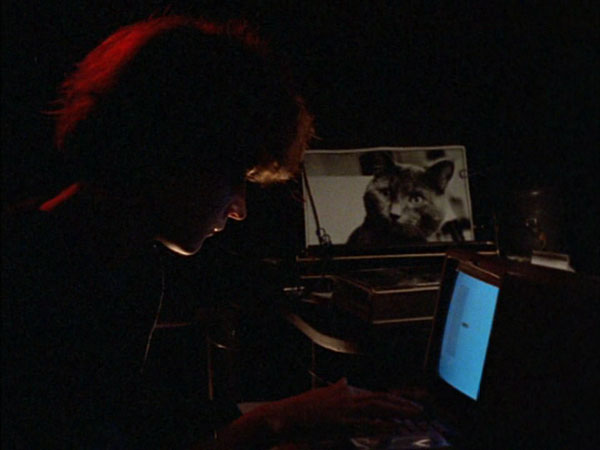
“Each of her photographs shows a past yet deciphers a future.” This is the kind of movie I’d been waiting for while sorting through Marker’s lesser-known 70’s stuff – poetic commentary weaving history and art around the images. Don’t know how the collaboration with Yannick Bellon worked, but this feels very much like a Marker movie, and a great one at that. There are cats, of course (see below), and the second mention I’ve seen him make of the 1952 Olympics.

From what Acquarello writes about this, you’d think he was talking about Sans Soleil: “It is in this analytical deconstruction between the integral art of composing an image and the cognitive assignment of significance behind the captured image that filmmakers Chris Marker and Yannick Bellon create a compelling exposition on the processing and (subconscious) self-actualization of human memory.”

Movie opens on Dali’s Rainy Taxi, which I saw in Spain.

image

image

The Bellon sisters:
image

Auguste Lumiere:
image

image

The Pont-Neuf, which I recognized from Lovers on the Bridge:
image

The commentary on this part, about scrap metal used to fuel the war effort, is one of Marker’s finest:
image


Puisqu’on vous dit que c’est possible [We Maintain It Is Possible] (1973)

“We can now point out that the government preferred to surrender to multinationals rather than grant anything to the workers. That’s what we can say for now.” [via megaphone]

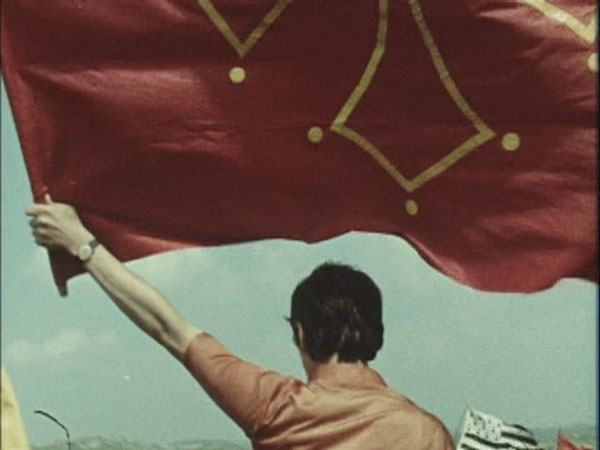
Movie about worker occupation of a factory in 1973, with an intro saying the movie was shot by “Scopecolor”, edited by Marker, and is the sole responsibility of those involved – the strike participants’ way of distancing themselves from the film, perhaps. A watch factory called Lip is to be shut down, then bought out, then restructured with massive layoffs, and the workers decide not to accept this, to take the factory and sell the watches themselves. Negotiations don’t go well (the workers have all sorts of demands, the owner simply says it’s not profitable so he’s shutting it down) then the police evacuate the building and demonstrations hit the streets.

Has much more interesting editing than À bientôt, j’espère but that’s not saying much. Still, for the most part, video interviews and a few photographs for a while, then footage from inside the factory, nothing exciting to watch. I mean, all praise to Mr. Medvedkin, and I agree that cinema can have many useful purposes, but personally I’ve seen an unusually high number of movies about worker strikes, so forgive me if I yawn when this one’s narrator goes on about how exciting are union meetings.

“The outrage lies in labor exploitation and the alienation that capitalism inflicts on workers.” says a speaker during a convincing speech – which is exactly the point here. Rich factory-owners aren’t going to freely hand their factories over to the workers, and the government isn’t going to allow one group to occupy another group’s buildings against the owner’s will, so the only way to win is the change the system, to reform capitalism. It happened, however briefly, in Chile, but the watchmakers at Lip failed to overthrow the French capitalist system.
image

image


Set Theory (1985)

An ugly slideshow done entirely in HyperStudio, accompanied strangely enough by string music by Russian composer Alfred Schnittke instead of the electronic sounds Marker is fond of using. The story goes: Noah is on his ark wondering how to sort out all these animals, when two wise owls come by and teach him set theory. “Eureka,” cries Noah, who now understands all manners of mathematics through understanding set theory. Since it uses French intertitles instead of spoken narration, I transcribed the titles and ran ’em through google translator to make a subtitle track with helpful program Media Subtitler. The movie itself was only halfway worth the effort – it seems a very minor work (though more amusing than À bientôt, j’espère) – but it was fun to play around with. Some of the clip-art and dialogue is actually pretty cute – a tiger being confused with a house cat due to faulty classification and taken home is portrayed using an oversized tiger in a bathtub, with E. Munch’s “The Scream” in the foreground.


image

image

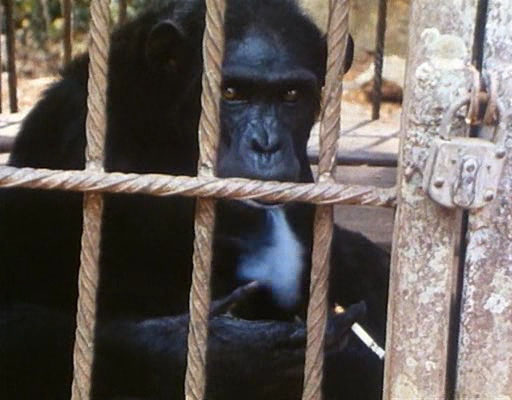
Not very Herzogian – the great man doesn’t interject any commentary of his own, letting his narrator (journalist Michael Goldsmith) do all the leading and interviewing, and not cutting away when Goldsmith follows up interview subjects’ stories of being imprisoned and tortured for years by order of Central African Republic dictator Jean-Bédel Bokassa with Goldsmith’s own oft-repeated story (“you know, I was imprisoned for a month myself”). Gives the feeling that it is the journalist’s film and Herzog is a director-for-hire, which is probably not true. The movie does, after all, end with a caged monkey smoking a cigarette, which isn’t a typical way to end a journalistic interview-doc. And it opens with Herzog himself reading a letter from Goldsmith over beautiful, otherworldly shots of migrating crabs. It’s just the bulk of the film in between those animal bookends that seems kind of typical.

Bokassa, fallen dictator:
image

Bokassa himself seems sadly typical – a military leader of an African country who took over the government, becoming more corrupt, horrible and bizarre as his rule progressed. We talk with a couple of his (many) wives and some kids, including one who was involved in a fraud/mistaken-identity comedy which led to her having a sister with the same name who got married on the same day as her.

image

Goldsmith survived torture and imprisonment in Central Africa, and returned safely from Liberia (where he had gone missing at the time of this film’s completion), only to die of a hemorrhage in late ’90, shortly before the film premiered.

Fascinating movie. I think Katy liked it too, though we were both a bit upset after she vetoed my triple-feature short-doc selection at the last damned minute.

image