Uncle Ali (2000, Cheick Oumar Sissoko)
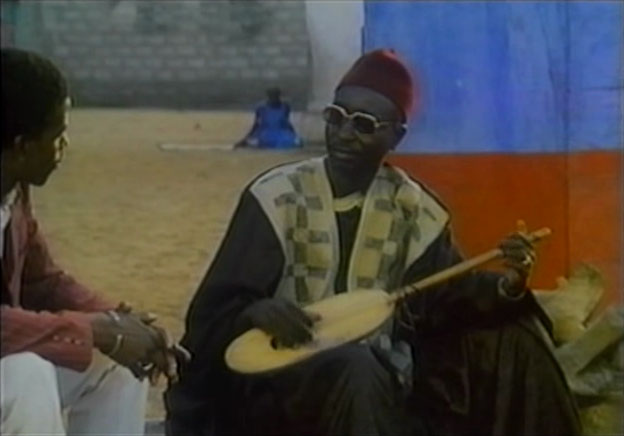
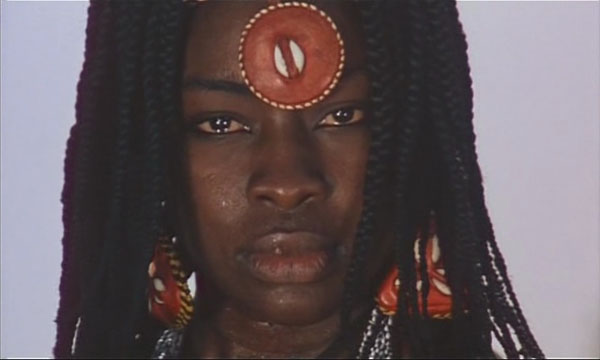
Cheikh’s uncle is super sick from AIDS, comes to live with his family after the uncle’s neighbors boot him from his apartment. Cheikh learns a bit about STDs, prejudice and love. The kid is Alioune Ndiaye of The Price of Forgiveness and Uncle Ali is Guelwaar himself, Thierno Ndiaye (also of Karmen Gei and Africa Paradis).

The Heart of the Matter (2004, Mahamat-Saleh Haroun)
It’s all monologue voiceover, and the voice acting isn’t the best. Actually all these “Scenarios from Africa” shorts online have been dubbed into English. I also checked out a Sissako (Good Reasons) and an Idrissa Ouedraogo (The Shop) from this series and none are interesting at all except as educational tools. Anyway, this one stars the mute girl from Haroun’s Abouna. It’s twice as long as the others, so I figured it’d have time to develop into more of an actual movie than a flimsy PSA, but no luck.

I’m Here (2010, Spike Jonze)
Where did this half-hour love story come from? Maybe Spike felt the need to create something personal after working on Where The Wild Things Are for years of his life. Awkward, traditional boy robot falls in love with rule-breaking girl robot. The twist comes when she keep losing limbs and he gives her his own to replace them, until finally she’s in a wheelchair, and he’s nothing but a head. Played at Sundance – somehow supposed to be an ad for a vodka company, but I didn’t see that.

Letter From Hong Kong (2010, Jimmy Lo)
Comes complete with deleted scenes of food, family and kitties. I liked the camera on the spinning table. Don’t think I’ve ever seen a movie where the cameraman sneezes before.

Just a couple weeks after we heard about a Kenyan sci-fi short making the festival rounds, there’s a free screening of the same director’s first feature here at the Carter Center. What luck! We didn’t quite get the full experience because the video subtitles were turned off, so we missed the Arabic conversations between lead security guy Abu (Ken Ambani) and his suicide-bomber Somali friend Fareed (Abubakar Mwenda). But they looked thoughtful and intense.

It’s a high-quality picture, with good camerawork, editing, lighting, etc., and good storytelling, jumping back and forth in time without calling attention to itself. Better than most of the Atlanta Film Festival flicks I’ve seen – surprising for such an under-the-radar debut African feature, but I guess it won two major awards at the Pan-African Film Festival just last month and swept the African Academy Awards (I didn’t know there was such a thing). Good soundtrack by Eric Wainaina, a huge music star in Kenya.

The mother of young Tamani (Corrine Onyango) dies in the 1998 U.S. Embassy bombing in Nairobi, but her important businessman father never tells Tamani, just says mom is missing. So when T. is older and back in town (she keeps getting sent to the States for something or other) she renews the search for her mom, eventually meeting Abu (whose wife is a fan of T.’s red-heart-adorned artwork), who finds out that her mom died in the blast. Tamani is understandably mad at her father for lying, but they work things out.

More interesting than the business between Tamani and her father (especially since the father, presumably played by Godfrey Odhiambo since that’s the only other name listed on IMDB, is the only not-so-good actor of the group) is between her and Abu (in the present) and Abu and Fareed (in flashback). Abu doesn’t display your stereotypical tortured guilt/anger, but talks calmly about missing his friend and trying to forgive him – a tough thing to say to a survivor of the bombing. Abu makes a good point that if he can forgive Fareed then surely Tamani can forgive her dad for never coming clean. Maybe dad made a foolish move, but he was just trying to be protective. Katy liked it, too.

CA Newsreel has blurbs by Jonathan Demme and Charles Burnett, so this was seen when it came out even if it hasn’t been seen since. “Saaraba presents an unsparing indictment of a corrupt older generation intoxicated with Western consumerism and of alienated urban youth addicted to drugs, sex and millenarian politics.”

Good looking movie, with more traditionally beautiful shots than in countryman Ousmane Sembene’s 1970’s movies (I haven’t seen his only 80’s film yet). At the time we were watching it, I thought I liked it pretty well. Katy was glad to be watching African movies again. We could both follow the story without any problems. But a couple days later we realized neither of us could remember anything about it. Saaraba had vanished! Now, a couple weeks later, my blogging task is hopeless. If not for Jonathan Demme’s pull-quote and this amazing screen-shot I took, the movie may cease to exist.

image

Well that’s not completely true. I can tell you it opens with our hero Tamsir returning to Dakar after years spent abroad, determined to live a proper African existence and reject the West. He has a pothead friend and likes a girl named Lissa. She’s promised by her parents to marry a fat man (“the MP”), but things go sour when Tamsir knocks her up. Either her dad or his dad needs to perform a sacrifice to save the herd (really don’t remember this part). T’s dad dies at some point. Demba, the cool dude shown above, spends the whole movie trying to fix his motorcycle so he can ride away to Saaraba (paradise), but I think he rides into a ditch and gets killed… or does he kill Tamsir’s dad? No, I am almost sure Demba dies.

image

The writer/director’s only listed film. Some of the crew was German. IMDB lists no acting credits, but I looked some of them up and found a couple Sembene crossovers: Elhadj Abdoulaye Seck of Xala and Omar Seck of Guelwaar. The American University, whatever that is, says this was the director’s thesis film.

Precautions Against Fanatics (1969, Werner Herzog)
“Have you ever seen a dishonest man with a chest like this?”
Said to Werner’s cameraman by a one-armed man in a suit: “What are you doing here? Go away!” It’s not clear who is supposed to be here where they’re filming, in the training area of a horse racetrack. Some guy is repeating himself and karate-chopping flat stones. This cannot actually be happening! It is all pretty wonderful, a parody of a behind-the-scenes documentary. Made in between Signs of Life and Even Dwarfs Started Small, both of which I need to catch some day.
image

Organism (1975, Hilary Harris)
Time-lapse footage and readings from biological textbooks portray a large city (New York, of course) as a living organism. The dated 70’s sound design is unfortunate but otherwise it’s completely wonderful. Makes me wish I had a classroom of kids to show it to. He worked on this for years, inventing a time-lapse camera in the 60’s for the purpose. Bits from Scott MacDonald “As late as 1975, Harris apparently felt that time-lapsing imagery was unusual and high-tech enough to justify his frequent use of science-fictionish electronic sounds as an accompaniment. … Hilary Harris shot some of the New York City traffic shots used in Koyaanisqatsi, though apparently Reggio didn’t see Organism until after his film was well under way.”
image

L’Opéra-mouffe (1958, Agnes Varda)
Somehow I missed this during Varda Month – one of her earliest shorts hidden amongst the copious features on a Criterion DVD. Varda films either herself or another pregnant nude women, then goes on a rampage through the marketplace, mostly capturing the faces of people shopping there, with interludes featuring actors (incl. Varda regular Dorothée Blank, as nude here as she is in Cleo) clowning around. Sections highlight public drunkenness, anxiety and affection. I want to say this is my favorite of her shorts so far, but then I remember they’re all so good. Delightfully scored by a not-yet-famous Georges Delerue.
image

“I was pregnant. I felt the contradiction of expecting a child, being full of hope, and circulating in this world of poor, drunken people without hope, who seemed so unhappy. I felt tenderness toward them, especially the elderly. I imagined them as babies, when their mothers kissed their tummies.”
image

Silent Snow, Secret Snow (1966, Gene Kearney)
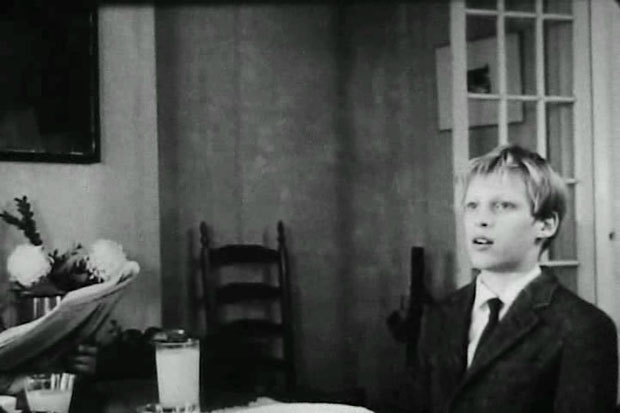
A boy named Paul starts to obsess over snow, allowing the snow in his mind to filter him from reality. Creepy and well shot. Later remade as a Night Gallery episode with Orson Welles narrating. Makes me think of the Handsome Family song “Don’t Be Scared,” with its line “when Paul thinks of snow, soft winds blow ’round his head,” except it’s one of their very few comforting, happy songs and the movie is anything but.
image

Une histoire d’eau (1961, Truffaut & Godard)
A girl wakes up and the whole town is flooded from melting snow. She meets a guy (a young Jean-Claude Brialy) who offers to drive her to Paris before nightfall. Music is weird – gentle flute or horns punctuated with bursts of percussion. Ooh, a Duchess of Langeais reference… in fact there are a ton of references in her quick monologue narration, which ends with spoken credits.
image

The Forgotten Faces (1960, Peter Watkins)
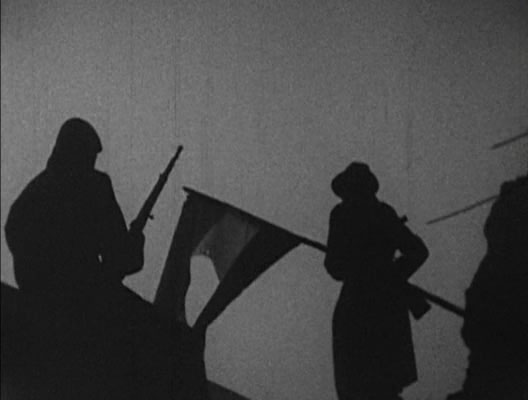
Revolution in Budapest. Nice reconstruction, convincingly documentary-like – where’d Watkins get all those guns? No sync sound, a TV-sounding narrator. One part, the reading of a communist speech turns briefly into a dramatic propaganda montage – don’t see that happen much in Watkins’ films.
image

image

The Perfect Human (1967, Jorgen Leth)
“Today I experienced something I hope to understand in a few days.”
image

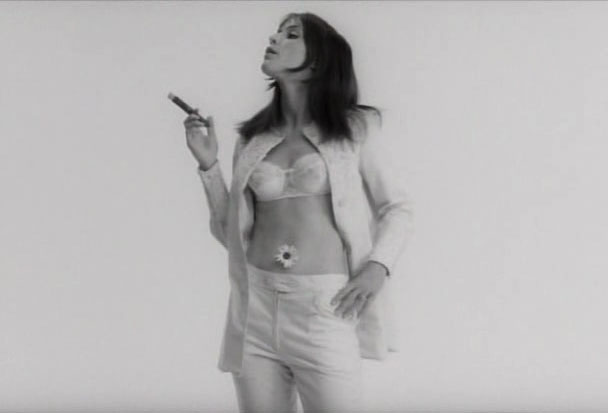
I like the British narrator. “What does he want? Why does he move like that? How does he move like that? Look at him. Look at him now. And now. Look at him all the time.” There’s no diegetic sound, but if this was dubbed in a studio, why does there have to be so much tape hiss? A fake documentary and a stark white delight, with slow zooms in and out, gentle string music, and a general sense of serious absurdity. Only saw, what, a third of this in The Five Obstructions.
image

Les Maître fous (1955, Jean Rouch)
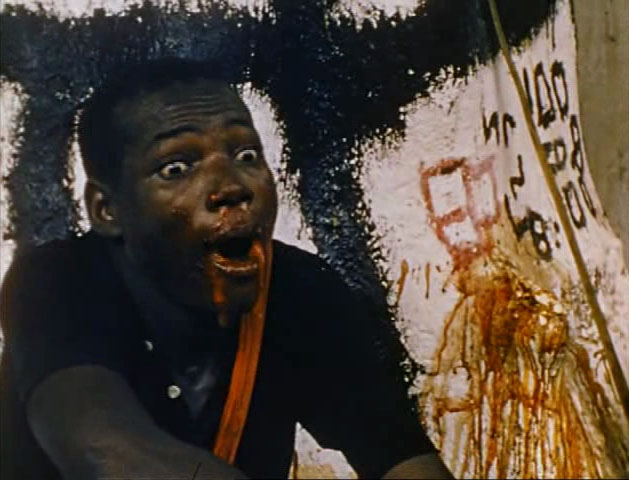
Document of a group in Ghana called the Hauka doing something involving wooden toy guns, red ribbons, chicken sacrifice, dog-blood-drinkin’ and having lurchy foaming-at-the-mouth fits. I’m not ever quite sure, because the French narration has been auto-subtitled by google – whatever they’re doing, the subs call it “having.” After they’ve had, the film crew catches up with them at their day jobs, not freaked-out cultists anymore, just working hard, smiling at the camera. This is one African film that Katy didn’t want to watch, because Rouch is an exoticizing anthropologist. So what’s going on that this film makes the best-ever lists? A Rouch tribute page says he popularized direct cinema/cinema verite, that he was known for rethinking ethnography, and a documentary surrealism (sounds like Jean Painleve). Ian Mundell says the film “drew plaudits from the Nouvelle Vague, in particular from Jean-Luc Godard. They liked the fact that Rouch’s fiction emerged from an encounter between the actor (professional or non-professional) and the camera, and his willingness to break the rules of cinema.” Paul Stoller says Rouch crisscrossed “the boundaries between documentary and fiction, observer and participant,” but I take it that’s more about his later films, which I’m thinking I would like better. So it’s seeming like this film gets awarded because it’s one of the most-seen of his films and because of its influence, not because it’s Rouch’s best work.
image

Nicky’s Film (1971, Abel Ferrara)
A mysteriously silent possibly gangster-related 6-minute film. I can’t imagine even a Ferrara scholar gets much out of this.

The Hold Up (1972, Abel Ferrara)
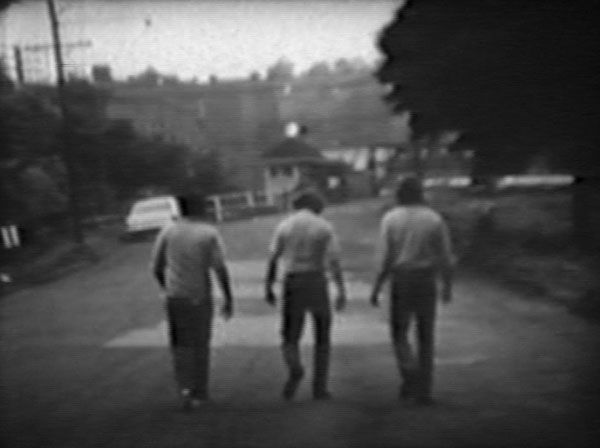
Super-8 production made when Abel was 21, seven years before Driller Killer. A few minutes in, I realized it’d be much better with the director commentary turned on. “And away we go. Wait, it’s the other way. Which way is she looking?” Um, some guys get fired from factory jobs, hold up a gas station, get caught. The song “Working on a Building” is heard.
image

Both this and Genesis required all my concentration to figure out who was who and what was happening.

A girl and her dad:
image

Magic man Mambi has a daughter Jangine, and he promises her in marriage to the son of powerful leader Guimba. Twenty years later she is beautiful and Guimba’s son is a perverted dwarf, so she wants to marry a hot dude instead. So Guimba, a scary, easily-angered man who hides from sunlight, drives her father and all hot dudes from the village and demands she marry the son as planned.

image

But the son doesn’t want to marry Jangine – he prefers his women more full-figured. This is fine with Guimba – he’ll let the son marry his large mistress while Guimba takes the girl for himself. The father sends some magic boogedy into town, Guimba kills his son then exposes himself to capture and ridicule by the townsfolk, and presumably kills himself.

image

Jangine would star in Moolaade (Katy recognized her; I didn’t). The griot appeared in Bamako, and the daughter’s father has been in everything: Finye, Yeelen and Genesis among them. We liked it alright – Katy says it was more confusing than Genesis, because at least she’d read the book of Genesis and seen Joseph and the Amazing Technicolor Dreamcoat but with Guimba we had no frame of reference.

image

R. Ames in his African Filmmaking book:

Sissoko turned away from the basically realistic approach of his first two features with Guimba The Tyrant. Already, in Finzan, Sissoko had drawn on the popular Malian koteba theatrical tradition in the portrayal of Bala, the village idiot. Now in Guimba he moved further in the use of African oral traditions to shape the whole film – creating a narrative full of abrupt shifts in time and place and unexpected digressions – the shift in style typified by the appearance of a griot at the beginning and end of the film, introducing the tale and commenting on its aftermath. The inset story, which focuses squarely on tyrnny and the need to oppose it, has obvious contemporary relevance, as many commentators have noticed, to the overthrow of the Malian dictator Moussa Toure in 1991. But the film is shaped as a fable mixing elements of farce and the supernatural and with constant shifts in mood and direction. It chronicles the rule of Guimba and his dwarf son Jangine, putting emphasis on their brutality, on the constant praise-singing of their eloquent but two-faced griot, and also on their ludicrous sexual desires: Jangine rejects the beautiful Kani, to whom he was betrothed as a child, in favor of her more than amply proportioned mother, Meya. The exile of Meya’s upright husband by Guimba, who covets Kani for himself, trigers the ruler’s eventual downfall, chronicled in an often confusing sequence of confrontations played out in splendidly evocative costumes within the visually impressive setting of Djenne, one of Mali’s ancient Saharan trading centres. As Sissoko has rightly said, Guimba “opens the door to audiences for understanding our history through our cinema. Obviously, some aspects will seem odd or not readily comprehensible, but the door to dreaming and discovery is open to those who wish to enter it.”

image

A government paperwork wonk named Wikus is given the task of going door-to-door in the South African slums and telling all the aliens from another planet they are to be relocated. When he discovers one alien (and his young son) who has been reassembling their technology underground in order to retake control of their mothership, Wikus accidentally exposes himself to a chemical that transmogrifies him into an alien. Kickass action involving disintegration weapons and armored body suits follow. Weird, thrilling, completely unique movie – influences seem to be Cloverfield (handheld camerawork + action fx) and The Fly (Katy would not enjoy the Wikus-to-alien transformation).

The director on Peter Jackson’s involvement:

There’s no way I could have gotten this film made as what I wanted to make, without his involvement. So it’s much more than just saying, “Go and do what you want.” It’s “Can I put a guy in the movie who’s never acted before, but I think he can carry the lead role?” There’s no way that would have happened if he wasn’t producing it. So he said “Yes.” And then, “Can they keep South African accents? And they’re thick accents.” “Yes.”

See, used to be I’d go to the video store and rent anything that looked interesting, and I’d come home with wild, awesome, insane movies. But one Tetsuo The Iron Man and a pile of Richard Kern films later, I start to get wary of the weird stuff. It seems the few weird, random films I rent these days are crappy movies trying too hard for cult success (Sukiyaki Western Django, Tokyo Gore Police). Eventually I get this crazy idea that I should seek out good movies instead of bad ones, and become obsessed with lists of great and important films and magazines like Cinema Scope. So imagine my surprise when C.S. did an article on Craig Baldwin, one of those purveyors of cult-reaching found-footage hyper-weirdness peppering the video shelves. Bug had been a C.S. recommendation and that wasn’t so bad, so I finally overcame my angry memories of Baldwin’s Negativland documentary Sonic Outlaws and I rented this.

And wow is it a mindblowing pile of awesomeness. Footage from ALL sources (godzilla/molemen/cartoons, star trek scenes played as news footage, actual news footage superimposed with sci-fi business) combine to form a tell-all exposé of aliens from planet Quetzalcoatl who landed on earth in the year 1000 and live underground for centuries, waking after nuclear bomb tests to affect global climate change and politics in South and Central America and the U.S., leading to annihilation of the planet in the future year of 1999.

Movie is a wild, hilarious masterpiece of montage, with the nutty stuff woven into actual history, then 45 minutes in, after I thought it had just ended, it refocuses on Africa and becomes kind of dull. Turns out this was the short RocketKitKongoKit (1986), with no opening title so I didn’t know what was happening. Story is more news reporting with less fanciful writing, with stuff on Mobutu (evil ruler of Zaire/Congo) and others I already can’t remember, and I think there was stuff about Germany in there. Loved the conspiratorial half-whisper of the narrator in the first film, so the dull, accented narrator of this one lost interest in comparison.

Next up on the DVD: Wild Gunman (1978), apparently featuring scenes from a dragon’s-lair live-action cowboy video game, but I guess they didn’t have laserdisc players in ’78. Clever montage of advertisements, cowboy shows, repeated bits back and forth (not quite Martin Arnold-obsessive, just for fun). All three movies are divided into numbered sections… the last one used reverse-images of a girl holding up numbers and this one’s got film countdown leader. Playful and fun, brings back the energy the middle film lost.

Internet says Baldwin is a Bruce Conner devotee – no surprise there.

Video distributor says:

Baldwin’s “pseudo-pseudo-documentary” presents a factual chronicle of US intervention in Latin America in the form of the ultimate far-right conspiracy theory, combining covert action, environmental catastrophe, space aliens, cattle mutilations, killer bees, religious prophecy, doomsday diatribes, and just about every other crackpot theory broadcast through the dentures of the modern paranoiac… a truly perverse vision of American imperialism.

T. Maloney in Senses of Cinema:

On the surface RocketKitKongoKit is the true story of a German rocket firm leasing land in the Congo (then called “Saire” under Mobutu’s reign), for testing rockets. The larger implications, that of Europe’s colonial attitude towards Africa in the 1960s and the exploitation of its people for a program the Europeans didn’t want in their own backyard, is not an entirely inaccurate one. History is, of course, highly malleable, and interpretations of any event can continue for decades – especially with relatively recent and well-documented events. The direct links between the ESA’s rocket program and deteriorating conditions in Africa are made more forcefully than would a more conservative historian, and the information is presented with the authority and integrity the documentary form affords.

and on Trib 99:

Organised into 99 chapters, each with a terrifying title screaming out in full screen capital letters, (9) the structure of the film invokes both conspiracy theories and biblical texts. And yet a great deal of the narration in Tribulation describes a readily verifiable history of American intervention in Central America from the 1960s through the 1980s. It is mixed in with vampires, voodoo and killer robots, but it is there.

Tarsem’s previous movie The Cell had a crappy story and bad acting wrapped around a handful of intensely cool but disconnected imagery. This one has a simple but decent story and good acting, with about half the movie being intensely cool imagery, finely intertwined with the rest of the plot. A quantum leap forward!

The gimmick of not having a gimmick (no digital effects, etc) was distracting as hell. We were always “what country do you think that is” or “THAT isn’t a real place is it” or “aha, that’s GOT to be a digital effect” or “is the little girl acting or not, she seems so natural.” From online trivia we learn it’s a remake of a 1981 Bulgarian film and the little girl was often improvising.

Movie itself is a wonder. In Princess Bride’s framing story, grandpa Peter Falk is reading a great, classic storybook, so the bulk movie has to be great and classic, and it lives up – but in The Fall we have an unreliable narrator, suicidal, heartbroken, wasted on morphine, making it up as he goes along. In a sense this makes the story more unpredictable, but it’s also a huge cop-out because if the writing is poor you can say “oh it’s supposed to be poor, didn’t you get that?” And it is kinda poor. Our hero the masked bandit with his lost love and archnemesis kinda fizzles, and his side characters Luigi (“explosives expert” who only uses explosives once, suicidally at the very end), The Ex-Slave and The Indian just make poses and look beautiful against the exotic scenery, getting shown up by the problem-solving Charles Darwin and his pet monkey. So it doesn’t sound too good and it’s probably not, but if you’re gonna throw out images this nice, I’ll let your thin plot slide. Carried over from The Cell we’ve still got some nightmarish imagery too. When their guide The Mystic is captured, being chopped to death with an axe (barely offscreen), crying and repeating the safe word “googly googly”, small birds flying out of his mouth, that’s a thing that gets stuck terribly in my head while I’m trying to sleep.

Movie ends with a montage of Keaton and Chaplin stunt scenes, half of which I recognized, in a belated homage to stunt men (our hero is one, ended up in the hospital with the little girl by falling badly off a bridge). Weird. Nobody I’ve heard of in the cast, which makes sense. If you’re shooting a self-financed movie over four years in 20+ countries, you’re not gonna get many recognizable actors to sign up. However, Lee Pace (our storytelling hero) is now starring in Pushing Daisies.

Firstly, the “Ceddo” are the outsider townspeople. Took me half the movie to figure that one out. The town is converting to muslim, and the local imam is becoming more powerful than the king. A small group of traditionalist men kidnap the princess to protest the forced religious conversion. Meanwhile, a white christian missionary is looking for followers but is not doing so well.

While the king and imam disagree over how to proceed and the imam’s men plot to overthrow the throne, three younger men – the king’s potential successors and the princess’s potential husbands, depending which rules you follow – aim to rescue the princess, bringing guns to a bow-and-arrow party. Biram is kind of a compromise choice between mirror-wearing king-loyalist Saxewar and committed muslim Fall, but Biram is easily killed by an arrow. Saxewar goes next, dies stabbed through the throat by the kidnapper. Fall becomes suspicious of the imam and renounces his position, and finally the imam carries through his threat of deposing the king (who dies offscreen) and has the lead kidnapper killed, freeing the princess. She marches right back into town, grabs a rifle and blows away the imam herself. Damn, Sembene was good with endings.

image

Much of the story revolves around slavery. A white trader is in town accepting slaves in exchange for wine and guns, so Ceddo are trading members of their own families for guns to fight the muslims. One reason people are converting to islam in the first place is because law prohibits children who are born muslim to become slaves, so if young adults convert, they might still become slaves but their children will be born free. The christian missionary has no such promise, and at most manages to collect one follower, or at least a curious onlooker to the white man’s sermon. This leads to a wonderful dream sequence, a large modern (as opposed to the no-specific-year historical period of the rest of the film) crowd is gathered as this new guy reads a memorial service for the white priest, seen in a coffin… dreams of a successor, unfulfilled, as the christian is killed unceremoniously later in the movie.

image

Watched this from a very good print with strong color rented from recently-folded New Yorker Films – we were warned that this may be the last screening of this particular film for a long time. This was made two years after Xala – seems that this is the turning-point film for me in Sembene’s career, since I’ve enjoyed this one and everything after it (Guelwaar, Faat Kiné, Moolaadé) more than everything before it (Xala, Emitai, Black Girl). Can’t put my finger on why I like the later ones more… better color, stronger characters, easier-to-follow narratives? I don’t know why I like movies, but this one was damn amazing. We’ll see how unseen early film Mandabi and late Camp de Thiaroye hold up.

The princess appeared 20+ years later in Faat Kiné, and Prince Biram played an interpreter in Coup de torchon

We were always looking for the camera’s reflection in Saxewar’s mirror:
image

From the valuable article by J. Leahy at Senses of Cinema:

Sembène goes so far as to articulate something completely ignored in the discourse of the male protagonists of the village’s internal war: the desire of this strong, silent, beautiful young woman. This is revealed in what I read as a subjective flashforward to a possible future, similar to that of the priest. It is characteristic of the complexity of Sembène’s analysis of the interaction between the individual, history and traditional practice that this shows her married to her kidnapper and finding happiness in the role of a traditional wife serving her husband. Others have read this as flashback to their first encounter. Even if this is so, the moment remains equally evocative in terms of the possibilities it suggests.