Katy said let’s start holding theme months again – perhaps Westerns Month, or Robert Altman Month. To delay making a decision, I played a Robert Altman Western. She said it wasn’t bad, but please no more movies like that, so Westerns it shall be.

Foolish me, I actually thought this wouldn’t be so Altmanesque. He made it right after MASH, but I’ve seen Images from the following year, so I’d convinced myself that he didn’t pick up the ensemble overlapping-dialogue thing again until ’75 with Nashville, making a few movies with a distinguishable soundtrack there in between. But no, this one was extremely ensembley and each noisy scene seemed to have been recorded with a room mic placed a couple rooms over. Katy points out that it may have exploded Western conventions in ’71, but now that they’ve been exploded for so long, we don’t see this as a very daring experiment, just a mushmouthed dialogue-heavy flick full of Leonard Cohen songs with a great chase/shootout ending.

McCabe:

Another disappointment: when Julie Christie finally showed up I was expecting a force of nature a la Joan Crawford in Johnny Guitar, but she doesn’t do much more than build a bath house and take over the whoring at Beatty’s new pub. As an article in The Guardian points out, our protagonists are “nothing like as confident as they would have us believe.” Recognized Shelley Duvall in a pretty small role as a mail-order bride and Michael “Tanner” Murphy as a businessman who fails to negotiate with Beatty over the sale of his land, leading to a snowy hide-and-seek shootout throughout the town, Murphy replaced by a gang of thugs who do not negotiate. I’m slowly learning my Carradines – a fresh-faced Keith (star of Fuller’s Street of No Return) played a doomed vacationing cowboy.

Mrs. Miller:

Mostly I liked the look, the feel, the light, the editing and pace. I wouldn’t say it had a documentary feel, but it felt like the scenes were happening on their own and the cameras were struggling to keep up (*). Has a good reputation these days, voted one of the greatest-ever westerns by some group or another. At the time, Christie lost her oscar to Jane Fonda, for something called Klute, and Vilmos Zsigmond’s hazy cinematography was only honored at the Baftas, where he was also nominated for Images.

(*) I thought that was a pretty neat thing I’d thought/written there about the movie, but when I went looking for articles I found that everyone else had thought it already. For instance, C. Taylor for Salon:

Mrs. Miller (Julie Christie), is a hard-headed madam with dreams of her own, the ones emanating from her opium pipe. The movie feels as delicate, as lulling, as Mrs. Miller’s drug-induced visions, and yet the life it shows us, the town and its people, are so real and sturdy we seem to have stumbled on them. The life the movie shows us is already being lived by the time we turn up. And everything we encounter evolves naturally — the setting, the characters, the story and most of all the mood.

A. Danks for Senses of Cinema:

McCabe and Mrs. Miller follows the coordinates of the most rudimentary of westerns; full of archetypal and cliched characters and situations such as the loner/stranger who shakes up a frontier town and the whore-with-the-heart-of-gold. But these classical or archetypal elements are undermined by the film’s opaque view of its characters, its foregrounding of atmosphere and place (including the ‘atmosphere’ of place, weather), and a technique which captures characters (both their bodies and voices) within pictorial tableaux that emphasise their relativity to the unfolding drama. In this respect, parts of, and indeed images within McCabe and Mrs. Miller resemble a painting by the sixteenth century artist Pieter Bruegel; broken up into interlocking tableaux and brought up to date (i.e. into cinema) by the deployment of favourite Altman devices like the zoom, the pan and multi-tracked sound – these devices serving to distance the events and characters from the viewer while opening up the frame, and the relationship between frames, to the scrutiny of the spectator.

I don’t know why I didn’t get L’Atalante upon first viewing. Maybe ’twas the low-grade VHS tape I rented, or maybe I was drowsy or impatient, but now I see it’s almost as beautiful and twisted a love story as Sunrise.

Provincial girl marries a barge captain passing through town then finds that spending life on the boat with his two assistants is less excitingly romantic than she’d imagined. Tension mounts between the captain and the gruff-looking but tender Jules leading the girl to flee the ship to see Paris on her own. But she doesn’t fare well and the captain goes into a depression, so Jules goes and finds her for a tearful reunion finale.

Not the fault of the video, I guess, because many shots were out of focus on the 35mm print. Must’ve been rough to do so much location shooting in 1934. So many other gorgeous shots and ideas scattered throughout that it’s easy to overlook technical shortcomings. Movie holds a poetic, dreamy state throughout, and the ending seems deserved despite the captain being kinda unlikeable most of the time.

Jean Dasté got small roles in Jean Renoir films, and many years later, larger roles in Francois Truffaut films. He was also the sympathetic teacher in Zero For Conduct.
image

Dita Parlo appeared in Grand Illusion and didn’t do much acting after the 30’s.
image

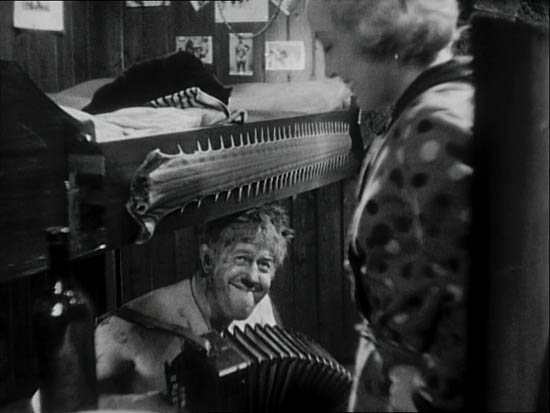
Michel Simon was more well-known, starring in The Two of Us, Rene Clair’s Faust, Port of Shadows and at least three by Renoir. Jacques Rivette did a 100-minute Cinéastes de notre temps with him in ’66.
image

Cats are thrown at people from offscreen, an obvious influence on Dario Argento.
image

Happy ending:
image

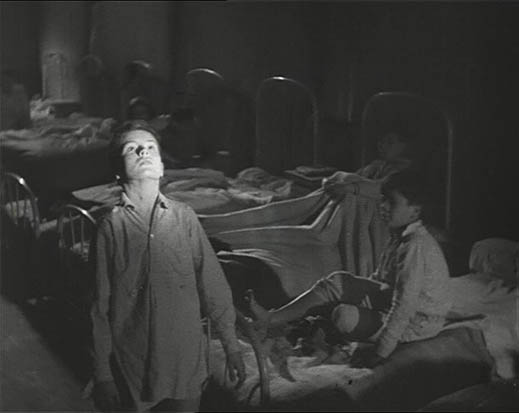
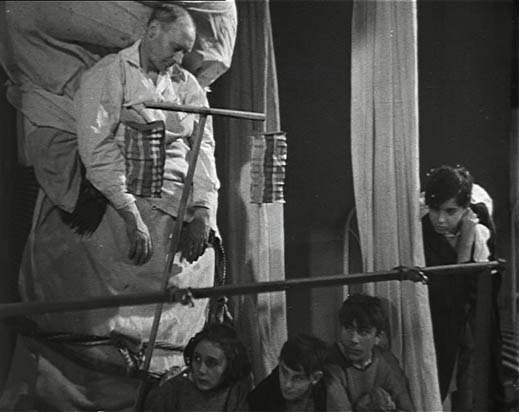
Zero For Conduct, by contrast, was less anarchic hilarity and slightly more tedious than I remembered it. Still a fun boarding school romp with good characters (the dwarf headmaster, the head-standing supervisor played by Dasté who is on the kids’ side from the start) and great portrayal of repressive school life, friendships and rivalries and minor (and in the end, major) rebellions.

image

image

I watched the above two at Emory on 35mm last November but delayed posting this until now because I wanted to go through the rest of the Artificial Eye DVD.

I dug the Cinéastes de notre temps episode by Jacques Rozier (new-wave filmmaker with Adieu Philippine, also shot some of the stuff on the Contempt DVD and the Cinéastes episode on Bunuel excerpted on the Viridiana DVD). 90 minutes of Vigo stories and interviews with the three L’Atalante leads thirty years later. Michel Simon looks the same, and Dita Parlo is very recognizable when she smiles. Now that I know what Jean Daste looked like in the mid-60’s, I’ll look out for him in The War Is Over. Didn’t realize that Jean Vigo knew Jean Painleve… and Painleve has an indirect connection to Oskar Fischinger.

Not much to say about the two shorts. The Jean Taris doc has some cool photography, but I wouldn’t say it’s worth watching over and over. The Nice doc is more creative, has lots of cool photography, and is definitely worth watching over and over.

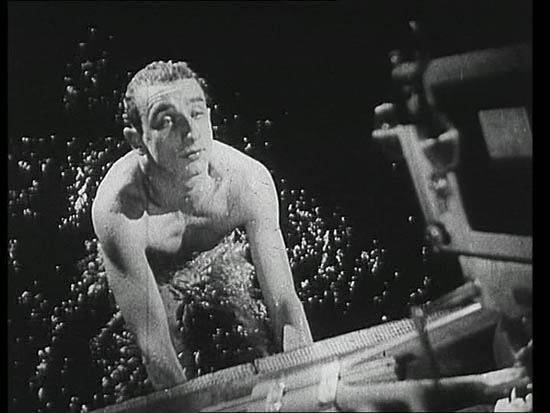
Jean Taris, swimming champion:
image

À propos de Nice
image

Silent World by Jacques Cousteau and Louis Malle beat it for the golden palm at cannes, but it took the “human document” award. The film print said “grand prix” but it doesn’t even look like that award was handed out in ’56. The print also calls Ray “Roy”, but those two seem interchangeable by the IMDB. Supposed to be India’s Rashomon, the one that brought Indian film to the world’s attention.

Daunting to watch a movie known for 50 years as a masterpiece… well-illustrated when I walked into the room early and saw a bunch of freshman watching the end of Citizen Kane.

Oooh, my fourth 50’s film in a week. This came out less than a decade after Bicycle Thief, its inspiration, and the year after Senso, La Strada, Seven Samurai and Saga of Anatahan.

Ray’s first film, with great music by then-unknown Ravi Shankar. Rich drama, very moving and awesomely shot. I kind of expected to be underwhelmed, but I loved it (probably more than the film students around me who sighed a lot and started fidgeting and text-messaging towards the end) and maybe even cried a little. Some of the students did too, so there’s hope for them.

Little Apu is born to overburdened mom, underemployed dad, always-in-trouble sister and elderly aunt. Sis’s friend is getting married. Apu goes to school. Dad gets work with the landlord but isn’t paid for months. Sis steals a necklace. Mom fights with aunt while trying to make sure kids are fed and staying out of trouble. One horribly powerful fight scene when, after the necklace dispute, mom drags sis out of the yard by her hair, collapses against the inside of the door while through the wall we can see Sis crying on the other side.

image

The scene is edited and scored with such force, seems like it couldn’t be the work of a first-time film director working before his country even had a proper film industry. Anyway, Sis gets sick and dies right before father comes home from the big city (he’s barely in the film) bearing money and gifts. Death scene (during a horrid rain storm) is at least double what the hair-pull fight scene was, with the music peaking into the scream that we never hear from the mother. In the finale, the family is moving to a new town to start again, Apu finds the necklace and throws it in a lake.

Movie feels like a masterpiece despite my pedestrian plot description.

When looking for screenshots I found this scene that wasn’t in the print we watched. The parents have a rare conversation about their lives and bring up moving out of town for the first time.
image

Ray: “The cinematic material dictated a style to me, a very slow rhythm determined by nature, the landscape, the country. The script had to retain some of the rambling quality of the novel because that in itself contained a clue to the authenticity: life in a poor Bengali village does ramble.”

Ray in ’82: “All artists owe a debt to innovators and profit by such innovation. Godard gave me the courage to dispense largely with fades and dissolves, Truffaut to use the freeze.”

Truffaut walking out in ’56: “I don’t want to see a film about Indian peasants.”

Apu:
image

His sister in the rain, celebrating a short-lived freedom:
image

Outcast auntie:
image

Sad parents:
image

Update, Jan 2010: Katy liked it, but says she saw the sister’s death coming.

“Help me. Rats are eating me.”

Rose (not shown here because I didn’t think to get screenshots until after she’d died) lives in a spooky “New York” apartment building above a rare book store run by cat-hater Kazanian. She reads his book about The Three Mothers (which is not such a rare book since he has a few copies in stock). Bumbles around the basement, drops her keys into an underwater room with a portrait of a Mother and some floaty dead bodies, then recovers from that only to be stabbed in the neck.

Kazanian hating on some cats:
image

How to die in this movie, in three steps:
1. a hand injury
2. (optional) animal attack
3. stabbed in the neck

Rose’s mustachioed brother Mark is in Rome studying music with his buddy Sara, when he gets a mysterious letter from Rose referencing the Three Mothers book.

Mustachioed Mark, seen here whispering into a hole:
image

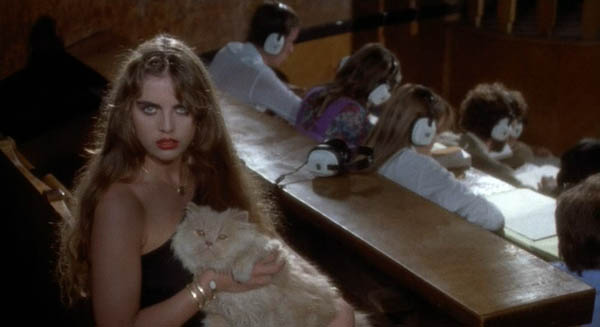
Mark runs off, freaked out by a cat lady who appears in class, so snooping Sara reads the letter.

Cat Lady, seen here in music class:
image

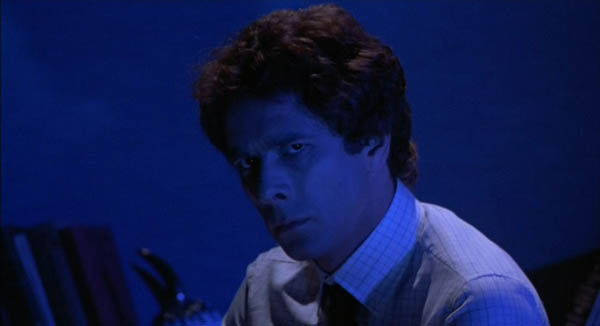
Sara picks up a copy of the not-at-all-rare book in Rome, and stumbles immediately upon another of the three evil buildings that the book mentions. She runs away from an evil alchemist and befriends a man in the elevator who soon gets stabbed in the neck.

Sara’s elevator buddy, seen here under a heavy blue filter:
image

A monster catches Sara and dispatches her with a broken window to the neck. I am not kidding.

Snooping Sara shortly before getting her stupid self stabbed:
image

Mark goes to “New York” to find his sister, meets her hot neighbor Elise. Elise helps get him caught up on the mystery, then she gets tormented by having stagehands throw cats at her from off-camera, and stabbed to death.

Elise on the set of INFERNO:
image

Also in the apartment are an evil nurse who wheels around an evil old man, a nondescript woman (not shown), and a loyal butler.

Mark hassles poor Kazanian, who is later tormented by cats in his bookstore. Kazanian loads the cats into a bag, takes it to the river to drown them, falls down and is nibbled by rats before being stabbed in the neck. His own fault, really.

Back at the mysterious apartment building, the butler is probably evil (aren’t they always?) but I don’t remember for sure… anyway, his eyes are gouged out, breaking the knife-to-the-neck rule set forth by INFERNO in order to keep the “an eye must always be gouged out” general law of Italian horror.

Butler near a birdcage:
image

If the butler isn’t the mastermind behind all this evil, it must be the old man, who lives like Phantom of the Paradise in the cellar with his listening devices and his robot microphone.

Phantom of “New York”:
image

Wrong again! It’s the nurse who wheels him about! I think the movie is saying that she’s one of the Three Mothers and that she is very evil, but I’m not sure how far her evil extends, or if it’s even dangerous to people who don’t live in this apartment or attend music class or hate cats. But oh my god, when Mark goes downstairs to face her, the movie’s theme song plays with lyrics sung in Latin, and that is great.

One Evil Mother:
image

The nondescript woman sets the place accidentally on fire (it’s an “inferno”, if you will), and the Mother is either delighted or horrified by this, hard to tell since at this point she is wearing a rubber skeleton mask, but anyway she throws her hands in the air and Mustache Mark escapes, the end.

My favorite part of the whole affair is the interview on the DVD, where a weary-looking Argento talks about what a difficult and personal film this was, and how he and assistant director Lamberto Bava (dir. DEMONS and DEVIL FISH) and his father Mario Bava (dir. Black Sunday and Diabolik) struggled over this effects shot where a woman dramatically crashes through a mirror and comes out wearing a fakey skeleton costume. Yep, it took the three greatest minds of Italian horror to come up with that one. If only they could’ve got Lucio Fulci (Zombi 2, The Beyond) and Umberto Lenzi (Cannibal Ferox) to make her a better rubber suit.

The underwater bit isn’t bad, which is the same thing I said about Zombi 2. Maybe the Italians should make a whole horror movie underwater.

At least I was so busy marvelling at the silliness of the whole thing that I didn’t notice the dubbing.

Implications of this movie:
– women (or maybe actors in general) are just set dressings to be put in pretty poses and then threatened and stabbed.
– there is something evil, and it’s been around forever, and it is easily defeated by unknowing incompetents, though honestly it’s better off being left alone since it’s not much of a threat to anyone.
– alchemists are scary, cats are evil, architecture is evil

I think Eyes Wide Shut was based on this movie. The atmosphere and pacing, the camera zooms, the drowsily agitated characters, the fake New York, the singing in Latin… it all adds up.

Total Film mag and the They Shoot Pictures List call this one of the best horror movies of the ’80’s, but those people are tripping.

This is a semi-sequel to Suspiria, and Dario Argento’s brand new film Mother of Tears is a sequel to this one starring his daughter Asia (as a woman in trouble) and Udo Kier. Mustache Mark never amounted to much… Rose appeared in Puppet Master and Watchers II… Sara was in something with Marcello Mastroianni and Tom Berenger… Elise has been in all the big Italian horrors and will appear in Mother of Tears… the nurse was in The Beyond… Sara’s blue-tinted friend dubbed the title character in the Italian release of V For Vendetta… the old wheelchair man appeared in The Seventh Victim in 1943… and Kazanian was the husband in Last Year at Marienbad!