I read about this when researching Ashes of Time and wasn’t sure I believed it existed… but whattaya know, the video store has it on DVD. And in crystal-clear quality with good subtitles, versus my blurry, half-assed copy of Ashes of Time. How’s that for justice? Oh well, Ashes gets a sparking theatrical reissue with a blu-ray disc to follow, so I guess time heals.

If you’d run these two movies back-to-back I wouldn’t have even suspected they’re both based on the same novel. Yeah, I’d be aware that most of the same actors are here, and some character names are the same, and both movies have borderline-incomprehensible plots, but the only person who seems vaguely similar is Jacky Cheung’s beggar king. This was exec-produced by Wong Kar-Wai, with great fight choreography by Sammo Hung, and shot at the same time as Ashes. Of course, this came out a year earlier because of Wong’s legendary slowness. And it was a bigger hit, because of Wong’s legendary artiness.

It’s actually a good movie… I enjoyed it more than Katy was enjoying Smart People in the other room. Some of the jokes are funny, some of the action is awesome, color is bright, editing is controlled and coherent, and it never drags. Everyone seems dubbed, though. It’s stupid as hell, but in a fun way. I’m not gonna try too hard to get the plot details straight, but here’s an actor/character spread to match the one I did for Ashes:

Tony “Tony 1” Leung Chiu Wai held his title as “the saddest of all actors” for three days, before it was revoked. This screen shot should indicate why. Here he’s an unexplained evil dude who chases the princess to obtain the royal seal and usurp the throne. It doesn’t go well… despite his very powerful toad-style kung fu, he’s beaten to hell (in self-defense) by Jacky Cheung and defeated at the palace by the combined forces of the good guys, so he decides he’s a giant duck and happily joins the cave monsters. Tony 1 has probably got the most complicated story and the most screen time, and he does a great job, really, as an evil goofball warrior. His name is Ouyang Feng (Leslie’s role in Ashes).
image

Veronica Yip is Tony 1’s evil partner. I don’t know where she goes between the first few scenes and the last few.
image

Brigitte Lin is the princess being chased by those two. Everybody humors her one kung fu attack, which is powerful but lacks any accuracy. She’s poisoned at the end, but that turns out to be nothing. She was engaged to Prince Duan, but that also turns out to be nothing.
image

Leslie Cheung is Yaoshi, a kung fu master chosen to protect the princess. He has a mark of three sixes on his chest, which for some reason doesn’t make him the devil, but rather Tony 2’s one true love. He is sweet on Suqiu, who is the only girl he’d ever seen until the princess comes along. He’s playing the role Tony 2 did in Ashes.
image

Joey Wang is Suqiu, Leslie’s sweetheart who fears losing him so follows him and the princess. I think she gets him back in the finale, from the way they’re fighting together. Joey was supposed to be in Ashes of Time, but when she couldn’t do re-shoots, was replaced by Charlie Yeung, another girl with a boy’s name.
image

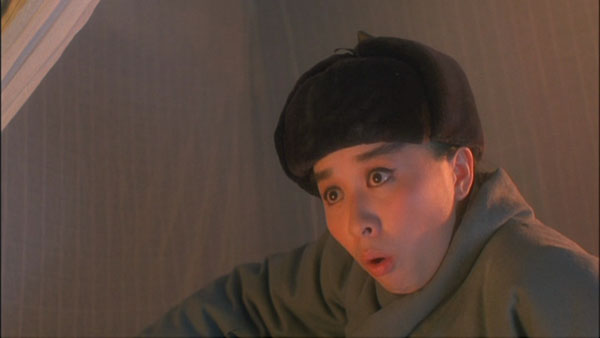
Carina Lau is Zhou Botong – she’s actually playing a male monk, not ambiguous like Brigitte in Ashes. When her master is killed by a magical boot discarded by Tony 1, she thinks it’s Leslie’s fault, and follows them parallel to Suqiu to take revenge. Movie ends with her dreaming of her master returning to requite her love – weird.
image

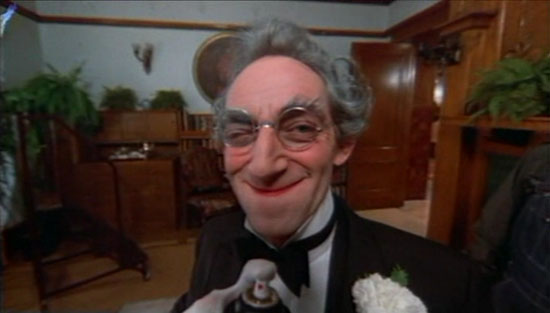
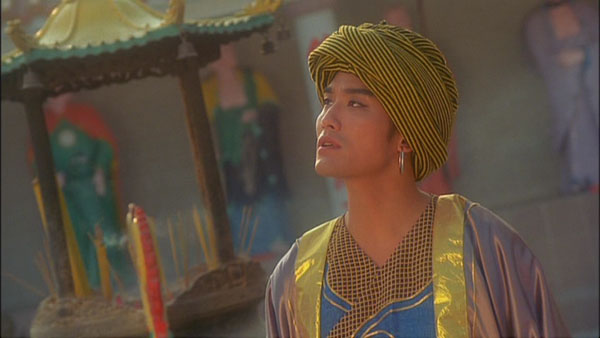
Tony “Tony 2” Leung Ka Fai is Duan, a lame but extremely powerful guy who speaks English in his first scene. He’s engaged to the princess, but wanting to be immortal, he goes looking for his immortal true love. When he finds Leslie and tricks him into saying “I love you” three times (there is cross-dressing involved, and a floating disembodied head), Tony 2 ascends to heaven, returning in the finale to kick Tony 1’s ass.
image

Jacky Cheung is Hong Qi the beggar king, cousin of Suqiu who wants desperately to marry her. She won’t marry him so he decides to die instead, tries to get every passing kung-fu master to kill him, but he’s too powerful and ends up hurting them instead. Funny that the only happy guy in Ashes should end up playing a suicidal version of the same character in the comic parody.
image

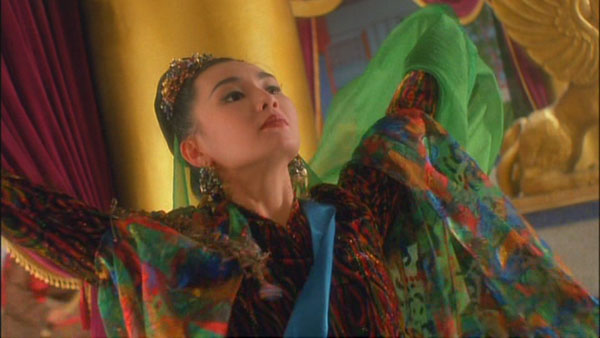
Maggie Cheung barely appears in this, just like she barely appears in Ashes and 2046. Maybe it’s an in-joke, or maybe it’s because IMDB lists twelve other 1993 movies she acted in (not including 1994’s Ashes). She is a sorceress who gives the evil duo some malfunctioning equipment (magic flying boots and invincible killer bees) and shows up in the finale to help kick ass.
image

Director Lau made some Stephen Chow movies and another Wong Kar-Wai parody (Chinese Odyssey 2002), again produced by Wong himself.

Excerpts from DVDTalk’s review:

written by no one apparently (there is no credited screenplay)… Lau and his cast appear to have never met a silly joke they haven’t liked, even resorting to Three Stooges-style eye pokes and rubber gorilla suits… I was never entirely sure who was after what mystical book or royal seal, nor could I always tell who hated whom and why… everyone gets chased by the vengeance seeking, chubby homosexual Zho Botong (2046’s Carina Lau playing a man). Most of the characters change allegiances at least once, several do so while hallucinating… Really, it’s the fights that are the best part of Eagle Shooting Heroes, when the movie can take a break from the headache-inducing script (or lack thereof) and show off a little… Eagle Shooting Heroes was shot by the awesome Peter Pau (Crouching Tiger, The Promise), which only adds to the incredible roster of talent that threw standards to the wind and made this goofball adventure. It makes it all the more of a waste that Wong Kar-Wai didn’t hire a real comedy writer to whip the material into shape. All of his people are ready to totally go for it, just what “it” is seems to confuse them all.

Great presentation of a not-so-great movie. Nobody ever called episode six of Red Heroine the best-ever silent martial-arts serial from China, but today it is the only surviving silent martial-arts serial from China, and therefore an important fragment of popular film history. The Devil’s Music Ensemble are touring it around the country, providing much better music than it deserves. Not that it’s a particularly bad movie, it’s just a standard piece of fluff to which nobody would give a second thought if it didn’t have to stand alone to represent an entire lost genre of Chinese film. So the D.M.E. is to be highly praised for their work and for enhancing our knowledge of film history, but the movie itself, well, it is what it is.

image

What it is: a 90-minute self-contained revenge drama, the prequel to the prequel to the prequel to Kill Bill. Army invades, girl’s grandmother is killed and girl is kidnapped to become the general’s wife, but before that can happen, crazy-bearded White Monkey kicks the general’s ass and rescues her. Three years later the same thing is happening (minus the dead grandmother) to a new girl, a friend of the old girl’s “brothercousin” (so sayeth the awesome intertitles). Old girl reappears flying through the air (to great applause from the packed Emory crowd) as Red Heroine. She kicks the ass of the general and his hilarious bucktoothed assistant/bodyguard, and rescues the girl whom she suggests should marry her brothercousin. There’s minimal action, all shot wide, and no definite references to the other episodes of the series (maybe White Monkey was in them?).

IMDB’s details are muddled on this film and director, so this is from Kung Fu Cinema Dot Com:

Director Wen Yimin, who can also be seen in a supporting role as a young scholar in RED HEROINE, was a Manchurian who was born in Beijing in 1890. His work for the Youlian studio, which included helming the HEROIC SONS AND DAUGHTERS series (1927-1931) and at least two of the RED HEROINE films (1929-1930), established him as one of China’s first genre directors. In 1934, he moved to the Unique studio, an early venture by the Shaw brothers, who would go on to dominate the Hong Kong film industry decades later. In 1936, Wen co-directed a film, MADAME LAI, with future mogul Shaw Run-me. Wen permanently moved to Hong Kong after the war, where he sometimes worked under the Cantonese version of his name, Man Yat-man.

He is frequently credited as an assistant director to the prolific leftist filmmaker Zhu Shilin. Another frequent collaborator was director Ren Yizhi, daughter of Shanghai pioneer Ren Pengnian. He continued to appear in supporting roles in a number of mid-century dramas and action/adventure films. In 1965, he moved to Taiwan, and worked as an actor there until his retirement. He died in 1978.

Incredible movie that I feel terrible for not having seen in theaters. So many wide shots with super-fine detail of masses of people or rock or industrial waste, and that detail is wasted on my ridiculously outdated 480-line interlaced TV screen. Affordable hi-def can not arrive quickly enough.

Watched this right after Derrida, and it seems they had some of the same intentions with the music in the two films (Derrida had music by Ryuichi Sakamoto, who scored Tony Takitani and various De Palma films, and won an oscar for The Last Emperor), but I loved the music far better in this one (music by first-timer Dan Driscoll, so that shows what I know). As for the image, well it’s unquestionably great, and fascinating. The filmmakers follow photographer Edward Burtynsky, who shoots monumental landscapes that have been formed by human interaction – factories, strip mines, the Three Gorges dam. Unlike 99% of documentaries about artists, the rest of the film is just as nice as the photographs, as the filmmakers have an eye for composition and are more interested in learning about the subject matter of the photographs than asking the photographer dumb questions about his art. Political and conservation issues are obviously brought up, given the scale of manmade environmental change visible in the film, but we don’t spend too much time debating those with talking-head experts – movie is mostly content to show us the landscapes (in places that most people never see – not exactly hot tourist spots) and let us see for ourselves. The result is a constantly surprising and gorgeous work, which I will gladly watch again when we can get a higher-res copy.

Katy was disappointed because she thought this was the movie about the guy who shoots whole bunches of naked people (that would be Naked States and Naked World, both about photographer Spencer Tunick). But she liked it anyway, just not as much as I did.

1982: the year of Blade Runner, White Dog, Poltergeist, The Thing, Gandhi, Britannia Hospital, Fitzcarraldo, Fanny & Alexander, Tron, the Sting version of Brimstone & Treacle… and this, the legendary Worst Kurt Vonnegut Adaptation Ever. From young hotshot Steven Paul, one of the producers of Doomsday, and I know I just said I wouldn’t waste my time watching anything created by anyone involved with Doomsday, but the Vonnegut connection combined with this movie’s reputation for being one of the worst comedies of the 80’s forced me to watch it out of morbid curiosity.

Laurel and Hardy? The book was dedicated to them.
image

Opens with narration by Orson Welles, surely giving even less effort than he did as the voice of the planet in Transformers: The Movie. You can immediately tell that the movie has no comic sense whatsoever. It looks cheap despite the big-name cast, and every “joke” is dead on delivery. The comedy is mostly people falling down, moving fast, talking funny (slapstick, I guess) and it’s badly staged… for instance, the twins are giant-sized, but only when convenient.

I don’t think Vonnegut was as mean-spirited towards the Chinese. And of course, Noriyuki “Pat” Morita is not of Chinese descent, but better him than Mickey Rooney I suppose. He plays the shrunken thumb-sized ambassador, a reference only understood by readers of the book since it’s unexplained during the movie. Other bits from the book are also rethought and bungled, and the twins are from SPACE now (and return to space in the ridiculous ending). All traces of Vonnegut’s trademark sadness and humanity are lost, unless you consider the sadness of the cast and the releasing studio and the audience. Rogue Cinema points out that the movie’s cast (Khan, Feldman, even Welles) and poster and title (and renaming the doctor “Frankenstein”) aimed to make audiences think that this would be a Mel Brooks Close Encounters parody. That particular advertising lie is probably the most well-thought-out part of the whole film.

Lewis!
image

Khan!
image

Madeline Khan and Jerry Lewis double-star as both the super-genius twins and their rich, detached parents. Marty Feldman is the butler in the twins’ secluded home. John Abbott plays a guy with a cool beard and Samuel FULLER is the colonel at the Military School For Screwed-Up Boys.

Feldman!
image

Fuller!
image

One of the last films of Jim Backus (Mr. Howell on Gilligan’s Island, voice of Mr. Magoo), John Abbott, Marty Feldman, and even Jerry Lewis (had starring roles in 6-7 more movies, most of them bad) but Jerry recovered in time to make Arizona Dream. Yes, Slapstick was a mega-career-killer, destroying the respectability of everyone involved! It ruined cinematographer Anthony Richmond, who previously shot the beautiful Man Who Fell To Earth and Bad Timing but went on to shoot Dane Cook movies and Dumb & Dumber 2. And – little known fact – it contributed to the death of Orson Welles and was directly responsible for his never completing Big Brass Ring, The Dreamers or Other Side of the Wind. Orson’s female co-narrator’s career was so thoroughly demolished that the internet has no record of who she was. But on the bright side, the movie helped launch the film career of Pat Morita, who would star in The Karate Kid two years later.

Morita! (he’s the one not looking at the camera)
image

Music by Michel Legrand and a song with lyrics by Vonnegut were edited out of the movie after the original release – why?? Assistant-directed by Michel’s son Benjamin Legrand, ending his short career as assistant-director (begun the year before on Rivette’s Merry-Go-Round).

Everybody wants prosthetic foreheads on their real heads? The incest scene doesn’t go very far, because we need a “PG” rating.
image

Released around the same time as Scorsese’s awesome King of Comedy, also with Jerry Lewis, though I think this was shot first and shelved for a while. Gene Siskel calls it “shockingly bad” and Ebert calls it offensive but makes a point of not blaming Vonnegut or Lewis. I heard one detectable Jerry joke: “You know, do as the romans do… when in rome, that is – I had it backwards” (it’s all in the delivery). There’s an occasional passionate line-read by Madeline or Jerry, the occasional animated bit of action, but mostly the movie moves mechanically from one laborious scene to the next, a simple motion illustration of a screenplay written by a guy who knows a guy who talked to a guy who once read the Vonnegut novel (which wasn’t one of KV’s best stories to begin with). I would looove to say that Fuller, Lewis and Feldman were excellent and the movie was slightly worth watching, but they weren’t and it wasn’t. I’m not in any hurry to rewatch Breakfast of Champions to decide whether this one is worse, but I think it probably is.

Close Encounters of the Dumb Kind:
image

image

Marker’s third movie, the one he made right before “Letter From Siberia”.

image

Nice to have a fast-paced English voiceover so I can actually tell what is being said, unlike with the washed-out subtitles of “letter from siberia” and “description of a struggle”.

Movie is short, poetic and comical. We reeeally needs a nice dvd set of these travelogues to go with the great current releases of “Sans Soleil.”

image
“this isn’t an absent-minded surgeon; it’s a townsman protecting himself against the dust

The narrator remarks that dust, germs and flies are the enemies of the revolution, so there may still be capitalists in China, but there are no more flies. Catherine Lupton: “This remark neatly commends the energy put into overcoming problems, while taking ironic note of the obstacles that may have been overlooked in the rush to cleanliness. This hint of light-hearted subversion wholly escaped the selection committee for the Berlin Film Festival of 1957, who refused to screen Sunday In Peking unless the comment about the vanquished flies and a number of other remarks deemed to be Communist propaganda were removed.”

image
“shops covered with characters as if they were huge boxes of tea”

Nice line: “the harsh price of the picturesque”… and history remembers “legendary wars that still resound through the peking opera house today.” Images and writing about the past and future, history meeting present day, the nature of time.

image
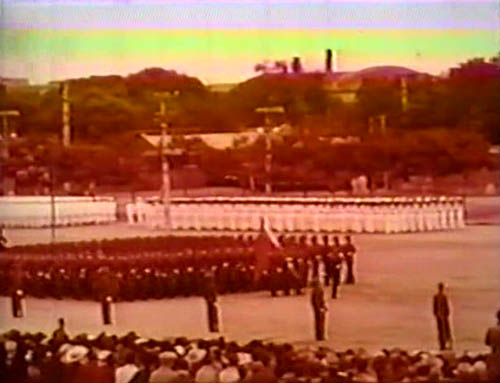
“the chinese people celebrating their bastille day, their day of revolution”

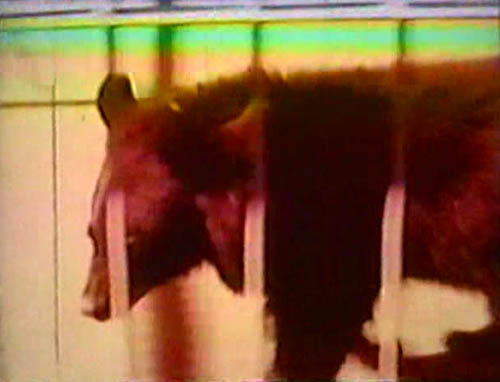
I don’t remember any owls, and cats were (entirely?) restricted to the title cards, but there was a Siberia-reminiscent bear:
image

These movies are all still good, worth watching for enjoyment, not just as academic exercise to probe Chris Marker’s beginnings in film. Wish they’d get a little more attention.

image

Senses of Cinema:

In describing Peking/Beijing, Chris Marker understands that, no matter how sincere his intentions may be he will never be more than an outside observer to this or any other culture he visits. Rather than ignore or disguise this problem, he runs with it. Literal performances and cultural displays are made the dominant subject of Dimanche รก Pekin’s assembled footage. Gymnasts, dancers, shadow puppets, acrobats all feature to such a degree that, if the film was the viewer’s first exposure to Chinese culture, they could begin to imagine a kind of circus-nation, one in which performance was as common a means of communication as writing or speaking.

Blood: Disliked from the start, showing a neglected round-bellied child walking stupidly around some animals, hitting them, unsupervised, an animal herself. Movie explores the problem of AIDS in China, how it is widespread and misunderstood. Uses the ol’ “look how sad everything is, feel sorry for us” effect… more a mission than a movie.

Sari: the excised fourth Iraq Fragment (and seems shorter than the others), also about AIDS. The kid in this one is human, with thoughts and feelings, expressed in voiceover like the rest of the Fragments, as his mother runs the bureaucratic gauntlet trying to get him treatment.

I think in both situations the kids got the disease through blood transfusions… sad that’s still happening anywhere in this decade.

The third of Zhang’s extreme action epics. More colors than you can shake a sceptre at. Maybe a step down to in quality and emotional impact from Flying Daggers level back to Hero level.

Katy liked it a bit.

Emperor Chow Yun-Fat is poisoning his wife Gong Li because she is sleeping with her stepson, the crown prince. His mom, thought to be dead, is really now the wife of the royal chemist, exiled from the kingdom, with a young daughter who is also sleeping (whoops) with the crown prince (Ye Liu, who played the awesome Snow Wolf in The Promise). Gong Li’s two sons are handsomely bearded Jie (Jay Chow, singer, of Initial D), loyal enough to his mom to betray his dad for her, and ignored prince Cheng, who wants to get in on the action. Chow sits around being kingly most of the time, with only a few good enraged moments, and Gong Li gets to act out all manner of desperation, rage, sadness, sickness and everything else.