A tiny film for Rivette, near the end of his career, with his old collaborators. Centers around two people – Jane Birkin (not as great as she was in La Belle Noiseuse) and Sergio Castellitto (greater than he was in Va Savoir) – who meet at a tiny circus, near the end of its life.

From the commentary: “One of the things that attracts Vittorio to the circus troupe is his sense that they have no director. He sees an opportunity, a possible role for himself.”

The first scene is magic: Jane is broken down on the road en route to re-joining the circus after many years away (due to the on-stage death of her boyfriend) when non-circus-performer Sergio, acting more like he belongs in the circus than anybody, stops and fixes her car, with no dialogue at all. After that, Sergio remains somewhat magical, but Jane’s story becomes something more scripted and typically movie-like than usually found in a Rivette film. Apparently it’s all full of interesting metaphors, and after reading Sam’s comments I’m sure I should give it another shot, but it didn’t strike me as hard as Don’t Touch the Axe, or practically any of his others, for that matter. It’s not like I understood his intentions in making Joan the Maid or the symbolic meaning behind Va Savoir, but I loved them nonetheless, and this one lacked that immediate power. It was, however, his funniest movie since Le Pont du Nord (not counting Up, Down, Fragile, which I haven’t seen), and that’s more than I can say for Rohmer’s final film, to which Sam admiringly compared this.

Anyway, I enjoyed the movie, just not as much as I expected to. Some great non-naturalistic lighting, some good awkward stage scenes (a bizarre clown bit that revolves around broken dishes), and my second favorite moment after the wordless open, Jane Birkin walking the tightrope, first towards the camera with the tightrope at bottom of frame, so we can see she’s truly performing the stunt, then it pans up slightly as she turns around, so she walks back with the rope itself out of the shot, the titular mountain (the French title is roughly 36 views of Saint Loup Peak) in the distance.

A tumbling act vaults in different styles according to their costumes (hockey players, military parade). Magicians one-up each other. The audience participates. We go backstage and into the lobby. Tati mimes at different sports (badminton, soccer, fishing)…

image

Not a documentary of a circus performance but a film (make that a video, one of the first video-shot features, after 200 Motels) with a circus performance in it. Doesn’t look like an existing, functioning circus but a soundstage with paid extras for audience members, complete with choreographed “backstage” scenes. Amused me as well as any real circus (and more than Fellini’s The Clowns). Video quality on my copy was below average, but the editing (and lack of talking heads/announcers/titles) differentiates it from, say, a period PBS special on a circus, and the pacing would confirm Tati as director, rather than simply performer, even if his name wasn’t there in the credits. Whole thing has an attractive draw to it… I liked it better than I thought I should, can’t say just why.

image

Rosenbaum has a good theory: “[a] gag is more likely to make us smile than laugh; but the cumulative effect of dozens of such underplayed gags is to make reality itself seem both slightly off-kilter and alive with comic possibilities–every moment brims with potential gags that often require an audience’s alert participation in order to be noticed at all.” He has written a long, perceptive article which makes me want to watch this again immediately.

Don’t know why I assumed this was not a good movie. I’d seen screen captures from the DVD (some of the same ones I’ve got below) and somehow I still thought it was possible to make a bad movie using those images. It is not. This was astounding.

image

In a daring but successful shout-out to Feuillade, the story (set in 1910 or 20) is ridiculous. Plot threads do not weave together as in a tapestry of grand design. Each scene seems to have been thought up after the last one was finished filming. This is not a weakness, but adds to the movie’s dreamlike effect.

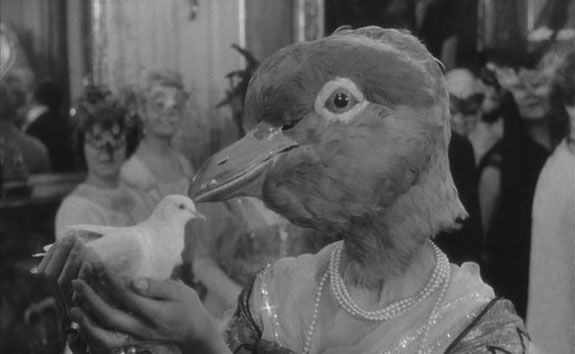
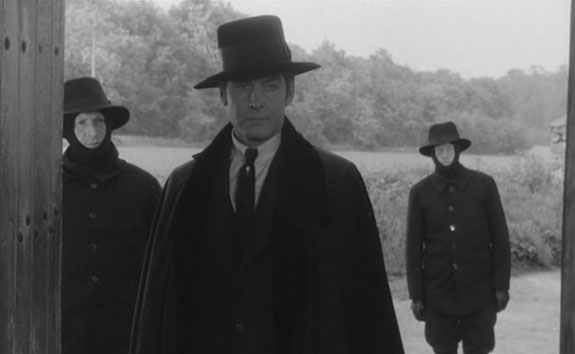
Master criminal Judex’s evil plans aren’t very broad-ranging in this story. He’s stalking rich guy Favraux acting as his servant, sends a letter demanding Favraux surrender half his fortune or he will die the next night. Next night at the costume ball (seen above), Favraux does die.

But he’s not dead! Imprisoned by Judex!

image

Daughter Jacqueline is left alone in the house!

image

She is easy prey for Marie, the swinding ex-governess of the house who returns to steal Favraux’s valuable papers and kidnaps Jac. when she interferes.

image

But Jac. is rescued by Judex’s dogs!

image

There’s a private eye named Cocantin (seen below reading Fantomas), originally hired by Favraux, and somehow still involved.

image

Can he stop Marie?!? Who can??

image

Judex!

image

Ha, not really. Marie has captured Jac again, has her tied up atop a building along with Marie’s accomplice, a man who found his long-lost father earlier after Favraux tried to have the father killed, but that’s another story. Highlight of the movie here, Cocantin is wondering how to get atop that building when a circus caravan rolls past. Why, it’s the circus of his old friend Daisy, an acrobat who easily climbs the building!

image

Rooftop fight! Marie grabs the gutter! Will she fall??

image

Yes!

image

I think the only actor I knew was Edith Scob as Jacqueline – just saw her as Mary in The Milky Way. Sylva Koscina (Daisy) was in some MST3K-approved Hercules films. Francine Bergé (Marie) was later in Mr. Klein, Rivette’s The Nun and Roger Vadim’s La Ronde remake. Channing Pollock (Judex) was a magician with only a few other film roles. René Génin (Pierre Kerjean) had appeared in Renoir and Carné films in the 30’s. This movie was co-written by Feuillade’s grandson, heh.

G. Gardner with Senses of Cinema:

Franju sought in particular to recapture Feuillade’s sense of documentary and his playfulness. He reproduced with as much exactitude as possible the costumes and settings which Feuillade filmed in scrupulous detail. Feuillade’s street-scapes are now an invaluable documentary record, but Franju also paid particular attention to reproducing the elaborate interior designs and furnishings of the day, resulting in settings of quite extraordinary detail and clutter. Franju also sought, despite the playfulness, to avoid any camp satire of these elements by over-emphasis or any special attention being paid to them.

In the title role, Franju pulled off his most brilliant coup by casting the master prestidigator of his day, near godlike in his handsomeness, Channing Pollock. Pollock’s skills as a magician were employed to produce a dazzling array of apparent magical occurrences involving, most particularly, disappearing doves, a plot device that Feuillade uses to enable the regular rescue of the heroine and others by Judex. Franju’s Judex is a far livelier, less sombre, more inventive and more mysterious character than that of Feuillade.

IMDB: “What do an elderly topiary gardener, a retired lion tamer, a man fascinated by mole rats, and a cutting-edge robotics designer have in common?” That’s what I set to find out while watching this very fun, good-looking and well-edited movie. Katy got tired an hour in, liked it for the most part but didn’t enjoy my connection-drawing game.

Dave was a lion trainer who traveled with the circus. He seems ambivalent about his career, not talking it up as a great time with his beloved lions or an exhilarating and rewarding experience, mostly going over the reasons for first wanting to be involved (he idolized and eventually worked with Clyde Beatty, animal trainer and entertainer who once co-starred with Mickey Spillane in a weird-sounding mystery called Ring of Fear) and the procedures and dangers involved.

George is an elderly gardener who creates, trims and maintains the topiary sculptures in one estate garden. You get the feeling there used to be one old woman who oversaw the garden, and now there’s nobody, that he’s gardening for himself on someone else’s land. Unlike Dave, who is helping train newcomers, George has nobody following in his footsteps, and dislikes other gardeners’ methods (using electric hedge trimmers, for example).

Raymond studies and “wrangles” insects, and has become a specialist in the naked mole-rat, a mammal that exhibits insect-like behavior. He sets up a museum installation to put their society on display, and talks about their activity and relationships.

Rodney is a robot scientist trying to innovate robotic movement and behavior by putting together bunches of small robots or processes which try to solve common tasks, instead of attempting to control them with one larger intelligent system.

There are plenty of ways to link these four guys and their jobs/interests, not a large hidden theme which is the One True Key to unlocking the film. They all work with non-human life forms, trying to study and control behavior. Some offer insights into human behavior through the lens of their subjects. All but Dave work with arrays of smaller beings (robots/leaves/rats) which work together towards large tasks (or forms). I had more but I’ve forgotten half of them… IMDB commenters mention themes of growth and development, consciousness and death, or the guys as representative of different concepts of god’s existence.

I loved the editing, the music (by Caleb Sampson, who killed himself the following year), the use of stock footage (such as old Clyde Beatty films) instead of the Mr. Death re-enactments, the pacing. The movie’s got heart… these guys are really involved in what they’re doing, care about it, and each is able to express himself and his subject in an engaging, philosophic way. It’s not the connections and differences between these guys which are interesting in themselves, it’s the way Morris encourages the viewer to discover them. Wonderful.

The premiere title of my personally-curated Obscure Movie Sundays monthly film screening programme was well-attended (five persons), the viewers anxious to view what my own invitation tantalizingly called “a 1977 surreal sci-fi comedy from Czechoslovakia. Set in the futuristic 1990’s, the plot involves identical twins and nazis with time machines. An obscure cult classic!” The movie lives up to the letter of that description, but wasn’t as wacky-enjoyable as it would sound. Still an affable, somewhat cheap-looking light comedy with a really good ending.

Rocket scientist Jan has an evil rocket scientist twin brother, who chokes to death on a roll at the start of the film. Jan is hot for his brother’s fiancee (an attractive girl from a family of circus performers), so Jan pretends to be his brother (barely mourned at all, so you’d think he’s a pretty crappy brother even though the two lived together) and goes to work – not knowing that this was the day the deceased brother was to participate in an evil plot to travel back in time to 1944, the turning point of WWII, and deliver a briefcase-sized atomic bomb to Adolf Hitler so the nazis would win the war. Things get fouled up royally, both in the 1990’s “present” and in 1941 (where they accidentally end up, right after Pearl Harbor, instead of ’44 like they’d planned) but finally Jan straightens everything out (easy to do when you’ve got a time machine at your disposal) and has the baddies imprisoned before they can meddle in the past. How to solve the problem of his dead brother? Jan travels back to moments after the brother’s choking accident, incinerates the body and inserts himself in its place. Result: two happy Jans are living together, one of them engaged to the evil twin’s attractive fiancee.

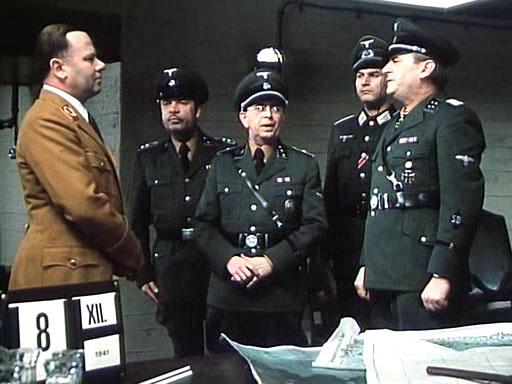
The bunch of baddies (right) in ’41:
image

I thought it was a funny movie, but I was the only one laughing – the others found it a little tedious. Too bad. Delightful inventions of the “future”: time travel exists but is only used for tourism, dishwashing detergent dissolves the dishes instead of bothering to clean them, and a stun-ray gun turns people to green statues (they’ll recover just fine in a few minutes, unless someone tries to move them and accidentally breaks off a limb or two). Also, the A-bomb has been miniaturized to fit in a light briefcase and the military has stopped using such weaponry, so it can only be found in museums. That’s a pretty short time window (from 1977 to 1990) from weapon advancement and miniaturization to obsolescence and declassification. Or you’d think they’d disarm the bomb they put in the museum.

My Two Jans:
image

The movie’s writer (I Killed Einstein, Gentlemen and What Would You Say To Some Spinach?), the composer (Three Nuts For Cinderella) and the director (no other movies with funny titles) all died in the last decade. Three of this film’s lead actors also appeared in What Would You Say To Some Spinach?, which came out two weeks before I was born – will have to seek that one out. The actor who played Hitler died in ’84.
image

I was gonna go on about similarities between Gordon/Mamet’s Edmond and Freaks, but I guess that doesn’t make much sense.

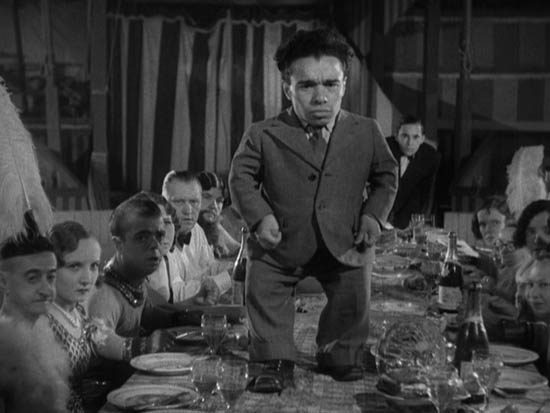
Katy is hung up on how the freaks turned the wicked trapeze artist into a chicken lady, but it is a “horror” movie, so we’ll just say the Human Torso has transformative magical powers.

image

Wallace Ford (Phroso the clown) was in tons more movies, incl. Anthony Mann’s Man From Laramie and Hitchcock’s Spellbound.
Good-girl beauty Leila Hyams was in Buster Keaton’s Spite Marriage, Browning’s 13th Chair, Leo McCarey’s Ruggles of Red Gap, then she never acted after 1936.

Evil trapeze girl Olga Baclanova was in The Docks of New York and not many sound films because she moved to Broadway for a decade before retiring.
Hercules Henry Victor got huge in the 40’s playing evil nazis in every Hollywood movie that would take him before dying of a brain tumor in ’45.

image

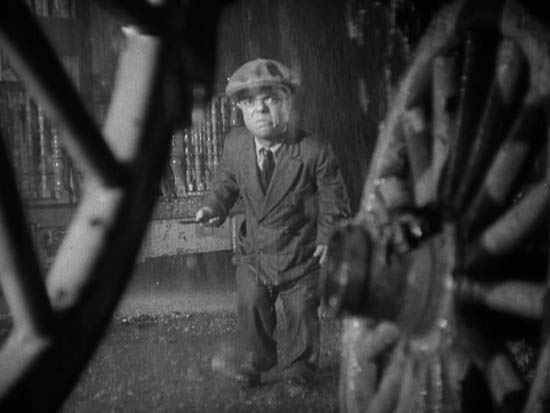
Short couple Hans and Frieda were actually siblings. He was in Browning’s Unholy Three and both of them were munchkins in The Wizard of Oz.

image

Those twins actually were conjoined.
The human torso was sixty-one when the film was made!

One of the greatest weird movies everywhere. Rob Zombie loves it.

image

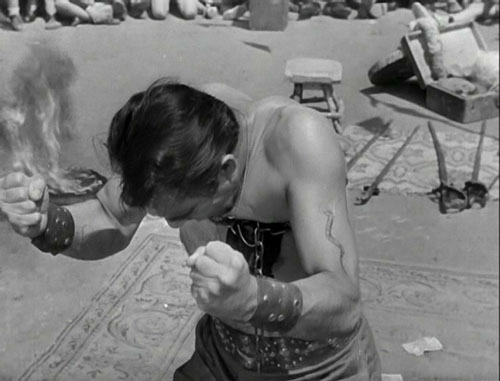
Circus strongman Anthony Quinn pops into poor village, visits poor family, mentions that their oldest girl has died, and skips off with the next-oldest, the simpleminded and very facially-expressive Giulietta Masina. She eventually learns to be useful in the act, but he never warms up to her, disappearing all night with whores and the like. Guy robs a convent and kills the clown she likes, then leaves her to die on her own, and carries on for years with his lame chain-busting bit. Not one of those “tough guy with the heart of gold” stories then.

La Strada 1

Not as dismal as I’ve made it sound above, but still pretty dismal. Very watchably dismal though, whenever Giulietta Masina is onscreen, which is almost always. Mixes Fellini’s clown obsession with his bummer realist stuff very successfully. To think that I was afraid of this movie after seeing La Dolce Vita. Wonder if Katy would’ve enjoyed it.

La Strada 2