“Popular unity against the criminal bourgeoisie!”
image

Other street protest chants:
“Bourgeois shit, the street belongs to the left!”
“We need an iron hand!” (?!)

I alternately see this referred to as an epic 1979 movie, a long two-parter with a third-part postscript, or three separate movies. I guess they were presented theatrically in different ways in different countries. The 2/1 split seems right to me, as I’ll explain.

Part one drops me into the middle of an election in March 1973, which I didn’t understand until towards the end of the movie. I wondered why nobody was saying Salvador Allende’s name – turns out it was a senate election, and either the pro-Allende party lost, or they just did not gain enough seats in congress to prevent the opposition from holding a majority. So for the rest of Allende’s short reign as president, the country’s senate is mostly against him, undermining his authority. Movie is on the street, taking opinions from everyone, kind of slow at the start since I don’t know what’s happening, but excitement is in the air, and things straighten out soon enough. Cameraman is terrific, patient but curious, always looking for the best thing to shoot even if it means wandering off the person talking. I can’t believe the sound guy can keep up with him, but he does.

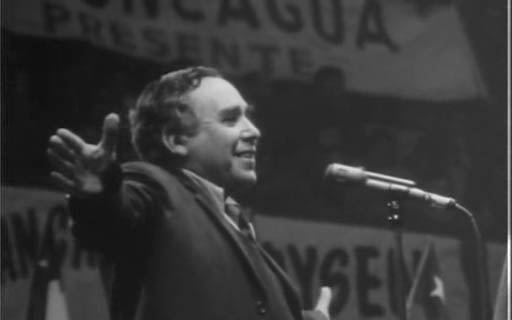
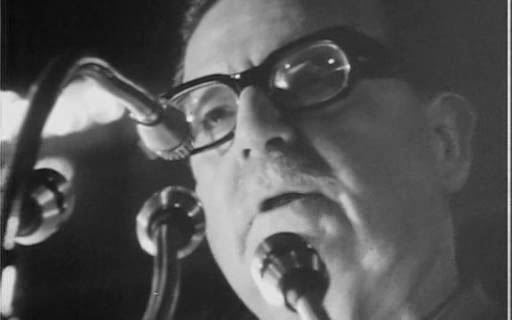
Salvador Allende:
image

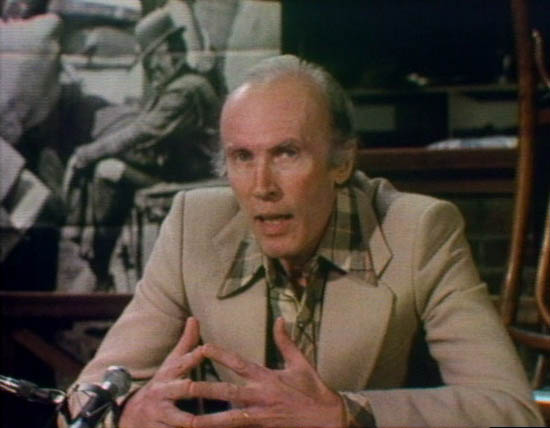
A politician:
image

image

image

Part two picks up right where the first one ends, with an attempted military coup on June 29 1973, and part two ends Sept. 11 1973 with the successful coup that killed Allende and instated General Pinochet as ruler. In between those dates, Guzmán covers everything that happens in the whole country, it seems, with access to the marches, the debates, worker meetings, everything but the secretive military that turns against its country (with help and provocation, it turns out, from the U.S. government). This is by far my favorite of the three parts, and could easily work as a standalone movie… I see the Film Forum in NYC thought so as well. The events themselves, a democratic country swerving communist then falling military-dictatorship, is the best movie material you could hope for and Guzmán and his crew make the best of it, watching from ground zero as history is made, producing one of the best docs I’ve ever seen.

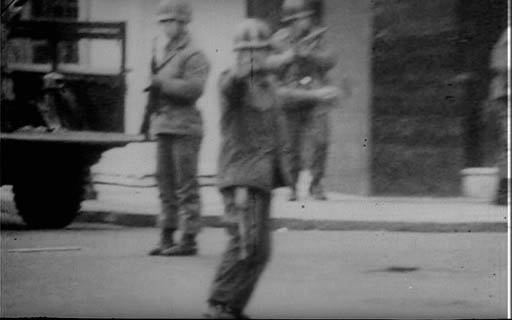
Military man who shot and killed Argentine cameraman Leonard Hendrickson at the end of part one:
image

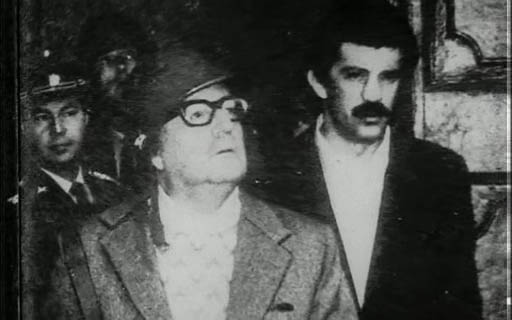
Salvador Allende, file photo:
image

Bombing of the presidential palace:
image

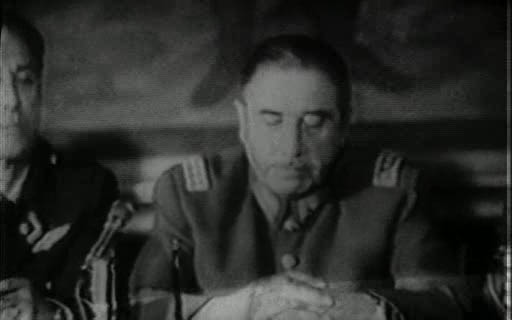
Pinochet addressing the nation on TV:
image

Military rule:
image

Pinochet: “After three years of support for the Marxist cancer we have been given a disaster that is economic, moral and social, that could not continue to be tolerated by the sacred interests of the mother country.” (or something like that – I think it’s all amateur-translated)

Guzmán: “From the 11th of September, all resources of the Chilean army are mobilized to repress the popular movement with the compacency of the North American government. The first armed resistance offered by some industrial cords, agricultural populations and student centers are squashed quickly in unequal fight. Thousands of people are killed and the main sport fields become concentration camps. The longest democracy in the history of Latin America ceases to exist.”

I don’t exactly wish I’d skipped part 3, but it would’ve made a nice recap six months later instead of watching it right after 1 and 2. Filmmaking in Chile wasn’t easy during Pinochet’s rule, since Pinochet was killing and imprisoning everyone who disagreed with him, including the cameraman of Battle of Chile (to whom the completed work was dedicated), so Guzmán backs up and shows further details of the workers’ movements during Allende’s presidency, not again mentioning Pinochet or the violence. The many worker meetings and the creation of multi-factory blocs and the attempted attack on Allende’s credibility by the “Christian Democrats” (his primary opposition) via a U.S.-funded transportation strike had all been covered in the previous films, but now we see them in greater depth… “depth” meaning lots of guys with sideburns talking into microphones at meetings. Since I’m not personally interested in creating a communist worker’s paradise in my own neighborhood, part three wasn’t of much use to me, but I’ll bet it’s exactly what Chris Marker was hoping for when he helped fund Guzmán’s efforts to document what was happening in the country. Marker’s own angry reaction to the coup is documented in his short Embassy, which I’ll have to watch again now that it’s on a new, clean DVD.

The transportation strike:
image

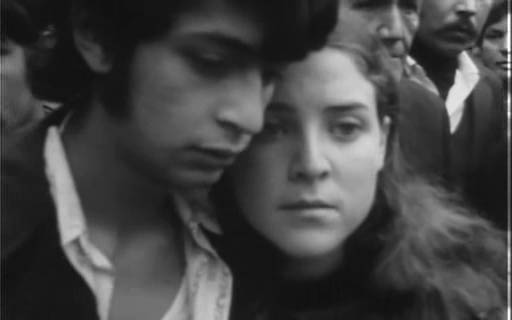
The people:
image

The sideburns:
image

The revolution:
image

Not as audacious as La Soufrière nor as profound as Grizzly Man or moving as Little Dieter Needs To Fly, but has its measured share of audacity, profundity and… moving… ness. Motion? Werner goes to Antarctica to look at things, interview people, and express his contempt for it all. He finds some stuff to love, and there’s some gorgeous, wondrous underwater photography (non-Herzog-directed) by Henry Kaiser – THE Henry Kaiser, guitarist friend of Fred Frith – who also did the music. For above-ground shooting Werner brought along his Rescue Dawn/Little Dieter cinematographer Peter Zeitlinger.

We get the obvious “ice is melting and we are all doomed” bits, and shots of penguins, and interviews with the philosophers and scientists who live (either temporarily or not) in the ugly US base city of McMurdo. Touristy reaction scenes and the training sessions given to visitors before they’re allowed to leave the base. Then there are more typically Herzog moments. He comments on the commercialization of the south pole, the end of human discovery over the planet, signs we leave behind for future generations and visiting aliens. He cuts off some interviews, giving his own postscripts and summaries and arguments in their place (interrupts one woman flatly saying “her story goes on forever”). It’s a cool movie and a nice addition to Herzog’s philosophical travelogue cinema of human behavior on the edge, probably not destined to be a classic Great Film. Was very happy to see it on the big screen, and it was a nice breather among all the avant-garde shorts. Katy was a little disappointed with her first Werner Herzog experience, then I think after I told her she’d already seen a Herzog film and it was Nosferatu: Phantom of the Night, she liked Encounters a little more by comparison.

Edit, one week later:
I unexpectedly got to see this again, in the theater in Nashville when Phantom Love was postponed. The festival guy described it as an “experimental documentary”, and that got most of the packed theater to walk out right there. A few more left immediately after the subtitled berry-mashing chant that opens the picture, and more shuffled out gradually until around the 1920’s there was only me and the two other people who stayed till the end. Movie makes me extremely happy, glad I saw it again. Was on video, though, so not real different from my home viewing, only larger.

——–
Apr 14:
I was nervous about this one, and wouldn’t have rushed to watch it if not for the Hidden in Plain Sight connection. On one hand, it made top-ten lists last year and was featured on the front cover of Cinema Scope, a magazine that hardly ever steers me wrong. On the other hand, it’s an hour-long narration-less tour of gravesites, which sounds less than exciting.

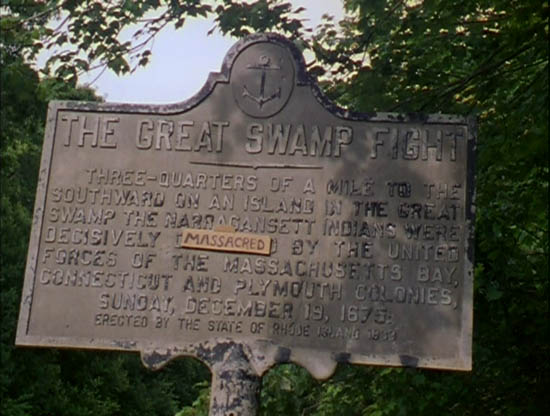
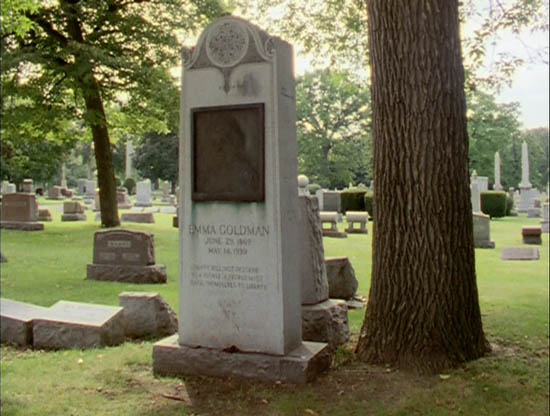
Cinema Scope was right. A moving, beautiful film which I now want to show to everybody I know. Peaceful and contemplative, with shots of trees and fields to break up the reading of gravestones and historial markers. The graves include people I know of (Frederick Douglass, Malcolm X, Emma Goldman, Paul Robeson), people I SHOULD know but don’t know very well (Mother Jones, Sacco & Vanzetti), people whose social relevance is explained by the text on the markers (the founder of the first all-female labor union) and people and events I was inspired to look up on wikipedia (Philip Berrigan: a pioneering Vietnam War protester, Lucretia Mott: women’s rights advocate in the 1800’s, The Ludlow Massacre, when the Colorado National Guard murdered the children of striking mine workers in 1914).

image

Felt good to watch, moving and energizing, not morbid despite the cemetery locales and mentions of massacres and executions. Shows these past people & events, triumphs and defeats, from today’s perspective, mostly a natural perspective with no living humans in the shot, but sometimes an Exxon will be seen across the street from a cemetery, cars will be whizzing by a historical sign, a marker will be located in the parking lot of a PetCo (!). Closes with some recent protest footage with lively editing. The struggle continues.

CScope: “In addition to forging a radical remapping of the American terrain, Gianvito’s film provides its audience with the rare opportunity to pay our respects by proxy.”

image

JG: After September 11, 2001, “I found myself re-reading stretches of Howard Zinn’s A People’s History of the United States, re-encountering some measure of what is admirable in this country’s past, the words and deeds of so many, known and unknown, who contributed to the historical struggle for a more just and egalitarian society. In time the idea took root to pay homage to this significant history, as well as to this book which continues to mean so much to so many of us, and by so doing, the hope was to draw sustenance from the sacrifices and efforts of those who came before us. Profit Motive and the Whispering Wind was intended to be a small poem to this progessive past.”

World premiere of this doc, which will double-feature with Profit Motive and the Whispering Wind at Tribeca in a couple weeks, so I watched Profit Motive on video then ran out to see this one in the theater. Unfortunately, Hidden In Plain Sight was also on video, and looked considerably worse projected in the theater than Profit Motive looked on DVD on my laptop. Shot in 16mm and video (you can sometimes see interlacing, especially at the end), then the whole thing thrown into an ugly low-grade digital video mash. If this bothered the director (in attendance), he didn’t mention it, nor did he mention how the music seemed to skip every couple of seconds, so I have to assume these things were intentional. It’s a movie about looking and seeing. Street, somewhat pretentiously (and comparing himself to Godard and Vertov along the way) wants to teach us new ways to look at city scapes. Leaving the theater I was very happy that my city was full of natural light and color, non-interlaced, without any of the dull ambient music (seemingly ripped from last night’s “experimental” shorts) that plagued Hidden.

Street visits Dakar, Santiago, Marseilles and Hanoi, stands on street corners and films stuff. Just whatever. Then there’ll be some black and an intertitle with a quote or an organizational header, then more street corners. Sometimes sync sound, sometimes sound from elsewhere or ambient music or silence. I was content to be bored for the hour, but Street lost some goodwill when he talked some crap about how he enjoyed seeing San Francisco disfigured by the 1989 earthquake… then lost more when he tried to make a point about tourists seeing a wide view of the city, and locals seeing more narrowly, observing finer details. It’s actually a fine point, but he is a tourist, and his street-corner tourist-gaze is far from a local’s view of the city. Shooting stuff that tourists aren’t expected to shoot (walls, locals walking around, more walls) does not make one a local and I resent his attempt to educate the audience and show us “unique perspectives” via banal images. Gianvito’s Profit Motive (or Marker’s Sans Soleil, or Vertov’s Man with the Movie Camera, or Akerman’s From the Other Side) this ain’t.

“Cinema is the ultimate pervert art. It doesn’t give you what you desire; it tells you what to desire.”

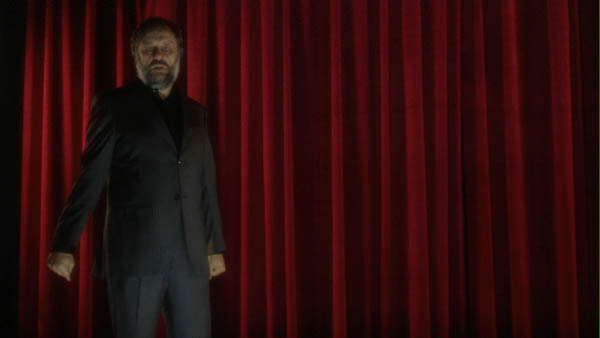
With his focus on the “traumatic dimension of the voice… which distorts reality”, I must believe that narrator Slavoj Zizek, with his heavily accented voice, is watching and interpreting slightly different versions of these movies than the ones I have seen. After all, I watch films and he watches “fillums”.

image

A few bits: the three levels of Norman Bates’s house representing the id / ego / superego… the power of the voice represented by Dr. Mabuse… “Music is potentially always a threat”… a look at the intersecting fantasies in Blue Velvet, and the related horror themes of Blue Velvet and Mulholland Drive.

Calls a scene in The Piano Teacher “the most depressive sexual act in the entire history of cinema.” To think I once showed that movie to my girlfriend’s parents!

Wish Katy had finished watching this with me, could’ve helped defend my position on David Lynch movies. And for stupid cinephiles like myself, who love Lynch movies (and The Piano Teacher, and Eyes Wide Shut, and Blue) but get lost in their images and atmosphere without thinking too hard about their psychological implications, he handily explains the stories and characters from a psych point-of-view.

“I think that flowers should be forbidden to children.”

The movie might teach the rewards of closely analyzing a few great movies instead of trying to watch every potentially great movie. This is a lesson I will not be following. Maybe one day…

I feel so vindicated that he picks Alien Resurrection as a film worth discussing. When oh when will that gem get its due? Only the second of the series (after the Ridley Scott original) to count as a horror film, plus it’s good sci-fi and an innovative sequel/reboot that hasn’t been matched since (well, maybe those Chucky movies).

“All modern films are ultimately films about the possibility or impossibility to make a film.”

He compares Cecil B. DeMille to the Wizard of Oz to the mystery man in Lost Highway.

“In order to understand today’s world, we need cinema, literally. It’s only in cinema that we get that crucial dimension which we are not ready to confront in our reality. If you are looking for what is in reality more real than reality itself, look into the cinematic fiction.”

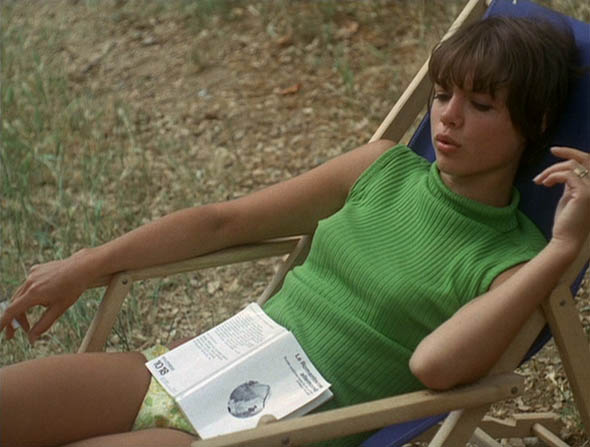
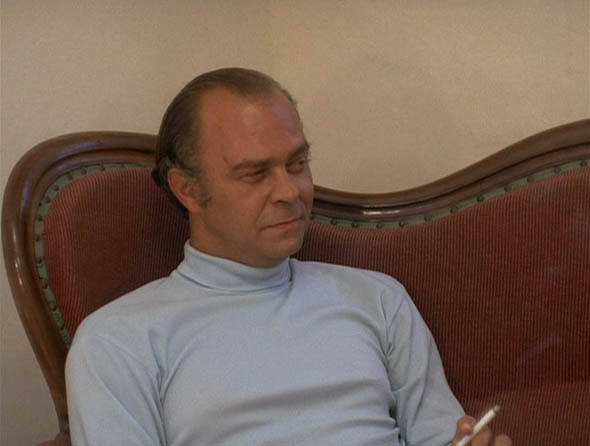
Made and released before My Night at Maud’s, but it’s part four of the Moral Tales. I made a moral decision to watch the films according to their numbering in the DVD box set, and not in the order they were made.

It’d be almost Antonioni-esque without the voiceover. Hardly anything actually happens, but Adrien always keeps us filled in on what he’s thinking. I considered disliking the movie for a while, a movie about idle rich young artists having self-conscious affairs, but it turns out Adrien and Haydée aren’t rich (only idle and leeching off their rich friend) and never manage to have an affair. I ended up liking it.

image

Buff 30ish Adrien comes to the beach to take his “first vacation in ten years” prior to an art opening, hopes to sit around with buddy Daniel and do absolutely nothing, not even think (they read so they don’t have to think). 21-yr-old Haydée is also at the house sleeping with a different guy every night. We don’t get much insight into Daniel – he’s the third wheel here – but Adrien and Haydée are both trying to find themselves, define their own moral codes, playing off each other and never quite getting together. At the end, Adrien pulls a standard Moral Tales move. Chances are good that he’s got Haydée for the night, but he leaves her in the middle of the road, deciding that sleeping with her would be against his character, and books a flight for London to see the girl he’s with (briefly) at the start of the film.

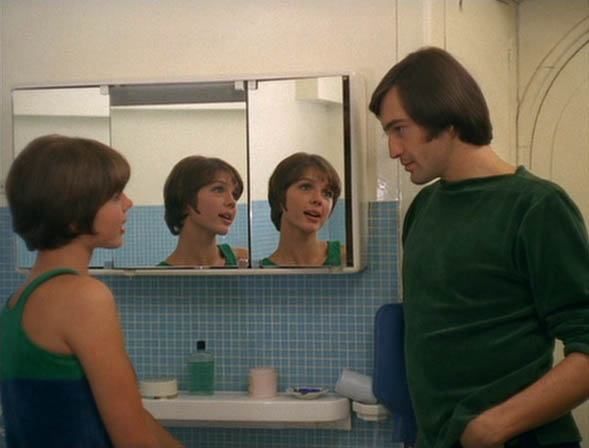
Leisurely-paced movie, but never slow or dull. Differently structured than the other films, with a few-minute prologue for each character before the main section of the movie begins. Rohmer and his cameraman would be happy to just stare at Haydée all day – her entire prologue is shots of her barely-clad body. Apparently that’s what defines her character.

image

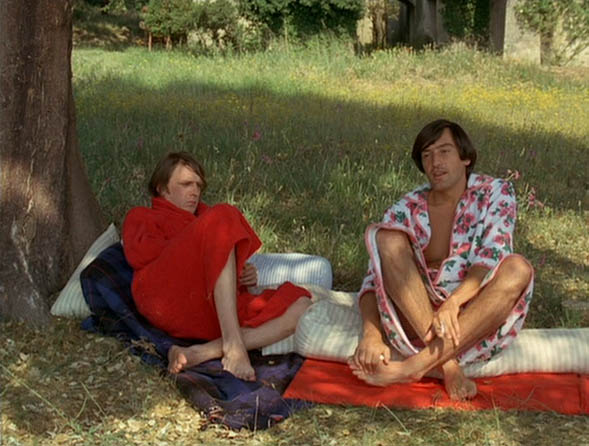
Have I mentioned that it is in color? Guess that’s another good reason to watch it fourth instead of third. Nice, rich color, too. Much of the look is in the bleached grays and browns and blues of the beach and the plain interior of their villa, so what colors we get in clothing and city life and an antique vase all stand out. Adrien and Daniel wear some hilarious clothes throughout (see above). Must be a 60’s artist thing.

Adrien was Patrick Bauchau, had a smallish part in Suzanne’s Career, later in American stuff like The Rapture and Panic Room. Haydée was Haydée Politoff, immediately turned to Spanish and Italian horror movies, had a small part in Love in the Afternoon, and mostly quit acting after that. Daniel was Daniel Pommereulle, appeared in Godard’s Weekend the same year, then two by Philippe Garrel.

image

from V. Canby’s NYT review:

Much of the comedy in La Collectionneuse, as in Rohmer’s later films, is provided by the otherwise aware hero’s elegant self-deceptions about his own motives, followed by his dimly seen perceptions of what could be another truth. In this context, it is a momentous event (and, comparatively speaking, momentously funny) when Adrien begins to have doubts about the affair of Haydée and Daniel. “I couldn’t be sure,” he tells himself with complete seriousness, “that their complicity was entirely for my benefit.”

There is a certain chilliness and lack of spontaneity to all of the performances, especially Bauchau’s, which, I suspect, has as much to do with the tiny scope of the film as to the actor’s talents. My Night at Maud’s and Claire’s Knee suggest living worlds outside the films’ rarefied milieus, whereas La Collectionneuse exists in splendid, arrogant isolation. Adrien is tiresome. Daniel is enigmatic, and Haydée is sweet, and great to look at, but, after a while, sadly commonplace.

A note of interest to local film buffs: the Seymour Hertzberg who is listed in the credits (he plays Sam, the American art collector whom Adrien solicits), is the nom d’écran of Eugene Archer, a former New York Times film reviewer who, I’m told, has absolutely no intention of acting again. He is an excellent reviewer.

“Seymour Hertzberg”:
image

From P. Lopate’s Criterion essay:

Haydée is not the most articulate young woman, though she says just enough to cast doubt on the men’s interpretations. There will be other Rohmer films that take us deep into the psyches of women; this one does not, but it gives us a very daring, precise portrait of the misogynistic, entitled, self-loathing psyches of men. And unlike, say, most Woody Allen movies, it does not let the rationalizing male character off the hook. Rohmer explicitly warned us, in an interview: “You should never think of me as an apologist for my male character, even (or especially) when he is being his own apologist. On the contrary, the men in my films are not meant to be particularly sympathetic characters.”

From an appreciation in The Guardian:

Drama, for Rohmer, is made up of a number of frequently small incidents which culminate in an inevitable denouement. There are many kinds of film-making but Rohmer’s would be very difficult to beat within the confines of his chosen metier.

A Modern Coed, 1966

image

“People used to say girls went to college only to land a husband. Though today’s coed might find a husband, she isn’t necessarily looking.”

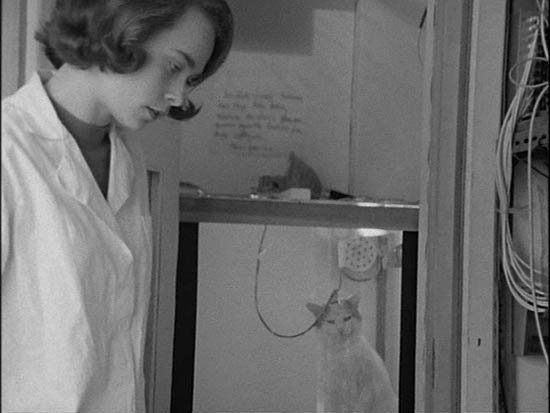
Just a short doc to tell the world that there are female college students, and some of them even study science. Its main reason to exist today is to document mid-60’s Paris hairstyles. Narrated by Vidal from Maud’s.

Foreground: our coed. Background: a cat with a hat in a box.
image

Rohmer on La Collectionneuse in 1977:
“It’s the only film I made that followed the era’s fashion. Audiences loved the new fashions, the long hair, the blue jeans. Then there was Haydée, whom audiences adored. Marcel Carné signed her for his next film right after that.”

He speaks proudly of a conversation scene in the 1976’s The Marquise of O, calling it “tiresome and static” but saying nobody else would have dared film it as written.

“This is a problem that concerns me. In the past, I was drawn by the way people spoke. I’m deeply interested in language. Currently, I find a kind of sloppiness has crept into the French language and I don’t like it very much. I like colloquial language, but today, especially as it’s used in intellectual circles, I find little of interest in it. … That said, I also believe characters in film should speak naturally. I’m getting around this currently by shooting films set in the past. When I return to contemporary films, I don’t know what my position will be. Perhaps by then language will have evolved further. Today’s spoken language is so extremely impoverished that it doesn’t inspire me. You find the same dialogue in every film now.”

image

One of those documentaries that I don’t think I should be celebrating because it seems deceptive, hiding facts in order to heighten the drama… but on the other hand – a classic video game competition with scores pursued over a period of years and the players not even competing at the same time – this is drama that needs heightening. What they’ve done is made an awesome, exciting movie with equal parts pathos and comedy, and a portrait of two really interesting guys, hot-sauce mogul Billy Mitchell and science teacher Steve Wiebe (and one really awful guy who the camera mostly avoids). A simple, boring premise, but somehow pulled off sooo entertainingly. I wanted to clap and cheer but I was alone in my room and Katy would think I was weird.

“Human beings will always betray you. You can only trust the numbers.”

Well-chosen images (sometimes picked for more comic effect than illustration) keep the thing entertaining while it lectures us. Good use of stock footage and music (incl. Yo La Tengo’s “return to hot chicken” and “nowhere near”).

image

PART 1

Post-Depression-and-WWII expansion of American gov’t in order to “control the economy and protect society from the dangerous self-interest at the heart of capitalism.”

Friedrich Von Hayek predicts tyranical outcome from gov’t planning and control of society, says everyone pursuing their own individual self-interest should lead to social order.

Intro of game theory and cold war strategy.

John Nash enhances Hayek’s theory, shows that “rational pursuit of self-interest” leads to a happy equilibrium, but after Nash was locked away to treat his schizophrenia, his coworkers tried to adapt his theories. Nash one of the few theorists and politicians who comes off looking kinda good at the end, saying that he was wrong and that his theories were mis-used.

RD Laing investigates schizophrenia, discovers a treatment (getting affected people the hell away from their horrible families) and a related scary fact, that sane people can be sent to an asylum and believed to be mad. Develops system to quantify personality disorders and remove subjectivity from diagnosis.

James Buchanan argues that politicians’ working for what they call “the public interest” is deceptive, greatly influences Margaret Thatcher. Sets up number-based productivity targets for health-care employees to “free” them based on Nash’s simplified vision of purely selfish individuals.

PART 2

John Major sets out to harness the individualism of public servants through liberating paradigm of the free market via performance targets.

Greenspan and Clinton’s economic advisor tell Clinton that his programs won’t work, needs to move to market-driven society and government.

“Freedom was redefined to mean nothing more than the ability of individuals to get whatever they wanted.”

When he talks about misinterpretations leading to this market-driven society, John Carpenter’s sinister “Halloween” theme kicks in… nice.

An anthropologist actually named Napoleon did a bizarre observational experiment which “proved” that game theory can be applied to the genetic level, that humans, like other animals, are self-interested machines.

“With the rise of this machine model of human beings a new idea of how to change society began to emerge, not through politics any longer but by adjusting how well the individual machines function” and into “a new form of order and control” in the form of imagined new mental disorders and treatments such as prozac. And the drugs turned them into simpler beings, closer to the machine model.

Meanwhile, performance targets weren’t working, corporate crime was huge, and class division was greatly increasing.

PART 3

Overview of how these simplified machine models of human behavior and other stupid theories led to increasingly bad policy decisions in England and the US, into an intro to Isaiah Berlin. I thought I kept notes during this one, even remember spelling out “Isaiah Berlin” but I can’t find them. So here’s wikipedia:

“Berlin is best known for his essay Two Concepts of Liberty, delivered in 1958 … at Oxford. He defined negative liberty as the absence of constraints on, or interference with, agents’ possible action. Greater “negative freedom” meant fewer restrictions on possible action. Berlin associated positive liberty with the idea of self-mastery, or the capacity to determine oneself, to be in control of one’s destiny. While Berlin granted that both concepts of liberty represent valid human ideals, as a matter of history the positive concept of liberty has proven particularly susceptible to political abuse.”

Tony Blair tried at least, sending Berlin a letter asking for advice, but Berlin was on his death bed and never responded. Bunch of sadness ensues, and the movie’s ray of hope for humanity’s future only appears in the final sentences. I will have to watch this part again.

Overall a helluva terrific movie. I want to see it again and I want everyone everywhere to see it also. Katy even almost watched it with me.

Addendum JAN 2011:
Watched again with Katy and I was thrilled that she loved it also. We talked about how damned clever, well-researched and respectful of its audience it seems to be, and how all other documentaries seem lessened in its wake.

An awesome little movie that my memory is already threatening to lose since I watched it right in between two Japanese mind-fucks, Glory to the Filmmaker and Sukiyaki Western Django. This is an English-language documentary by a French filmmaker about two British couples who raised each other’s children after a mix-up at the hospital. One mother knew it, or at least strongly suspected, and constantly fussed over what should be done, tried desperately to stay in contact with the other family, wrote letters to George Bernard Shaw, and so on. Other mother was unconvinced that there was a problem and just carried on. Unexpected end result is that one of the girls grew up twice loved as the other.

Excellent, interesting movie… well-considered storytelling with tons of cool framing tricks and window/mirror effects. All of the people involved gamely play themselves, relaying events and participating in recreations. Listening to them talk, you wouldn’t think these to be the kind of people to go along with a comic sort of retelling of their painful pasts for a foreign camera crew, but thankfully they did. A quirky sort of movie, but in a good way. Each member of the camera crew was shown during the closing credits – I think that’s a first for me.