I guess I’ll count this as a movie, even though it’s just footage from Planet Earth, which we’re gonna catch soon on video. We watched the U.S. version narrated by a coddling James “Earth” Jones. The UK version is reportedly more environmentally to-the-point, sort of how our cigarette packs say “cigs are known to the state of california to contribute to cancerous growth of the blah” and UK packs say “these will kill you.” Anyway, animals are pretty cute and wonderful, so we liked this a whole lot.
Tag: documentary
Man On Wire (2008, James Marsh)
Marsh, director of Wisconsin Death Trip, weaves stock footage (shot by the participants), current interviews and re-enactments to show how Philippe Petit and associates snuck to the top of both Twin Towers one night in ’74 and shot a line across their roofs for Petit to walk and dance upon. Pretty unbelievable stuff, kinda sad and inspiring. I flashed back to Maddin’s comments on lost buildings of his youth in My Winnipeg as much as I paid attention to the screen.
I wanted a lock-groove Michael Nyman score to propel the movie into a screaming intensity, but that never happened. Recognized a few other music pieces, which I suppose were “In The Hall Of The Mountain King”, “A Fifth of Beethoven” and Erik Satie.
David Edelstein: “It goes without saying — and happily, Man on Wire doesn’t say it — that all this took place in a more naive time, that the notion of foreigners with fake IDs slipping past guards into the Twin Towers has a different meaning now. So does the prospect of falling from the top.”
Eadweard Muybridge, Zoopraxographer (1974, Thom Andersen)
“He was the first and only zoopraxographer.”

Hour-long doc about the man who invented a form of motion photography (the famous series of tripwire-triggered photos of horses running), spending half his career as a successful still photographer, and the other half capturing and studying human and animal motion with his zoopraxiscope.
Visually, the movie is mostly composed of Muybridge’s work, nicely assembled and presented, including moving reproductions of his motion series. Voiceover tells us his story (memorable detail: he was acquitted for murdering his wife’s lover in 1875).
For his location still photography Muybridge (pronounced “Edward Mybridge” – people added extra letters to seem fancy back then) travelled with a “darkroom wagon”, foreshadowing Medvedkin’s cinetrain.
Muybridge photographed the effects of the Great San Francisco Earthquake… but not the one in 1906 – this is from October 1868!

Muybridge died in 1904, having seen the birth of Edison’s cameras and Lumiere’s cinema which shuttled his own inventions to the sidelines. It would be 90 more years before The Matrix would combine Edison’s motion photography with Muybridge’s circular camera arrays to create the bullet-time effect. Muybridge’s photographs of San Francisco are valued as a record of the city before it was leveled by the Even Greater Earthquake of 1906.
Movie is narrated by two-time Cannes best-actor-winner (and future Blue Velvet crooner) Dean Stockwell. Editor Morgan Fisher went on to make that movie I read about which is composed of all insert shots, and the same year, director Andersen made the stock-footage masterpiece Los Angeles Plays Itself. All Movie Guide says this film took ten years to make, and J. Rosenbaum calls it “one of the best essay films ever made on a cinematic subject.”
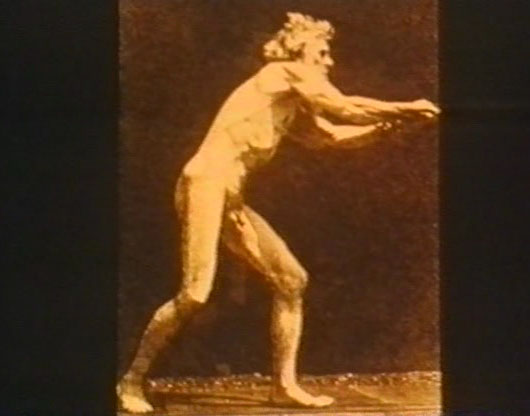
Muybridge self-portrait:

Runnin’ Down a Dream (2007, Peter Bogdanovich)
I.
Movie opens exactly how I would’ve opened a Tom Petty movie, with a concert performance of “You Wreck Me”. And this is a four-hour movie, a four-HOUR movie, so I thought we’d have some breathing room and could afford the four minutes to hear the whole song uncut, set the stage for your epic Tom Petty documentary by letting us hear a whole Tom Petty song, just so we know what exactly we’re celebrating here. But P.Bog goes the obvious talking-heads documentary route instead, cutting into the song so people like Eddie Vedder, Stevie Nicks, Dave Grohl and Johnny Depp can tell us that they love Tom Petty and his music so much. Damn, almost had something there. I guess P.Bog doesn’t want people tuning in and thinking it’s gonna be a straight-up concert, but still, I hope in the next four hours he finds time to play one song, just one song all the way through without voiceover. Can you celebrate a musician without actually playing any of his songs?
We may not get to hear a song uninterrupted, but we can enjoy watching Johnny Depp talk without any bothersome on-screen text saying “Johnny Depp”. But I didn’t recognize half the people who spoke, so if he doesn’t eventually start with the text, I’ll just never know.
But look at me complain. It’s an enjoyable show so far, talking ’bout Petty’s early obsession with rock music and his meeting Mike Campbell and Benmont Tench and early days in Mudcrutch. All songs I’ve heard before from the box set with nice home-movie footage to go with it.
II.
Tom drives to L.A. to find a record deal, gets a few of those, Mudcrutch breaks up because the studio wants Tom more than the rest of the band, and the Heartbreakers are quickly formed to replace it. Their record producer wrongly assumes that they mean the name Heartbreakers ironically. Tom is shot in arty black-and-white.
III.
First two Heartbreakers albums are out. There was all of one sentence about the second album being more difficult than the first before they cut to people raving about it. Some good live footage, some talk about drug use. And finally, one entire TV performance of a song with no cuts or voiceovers. Hoorah! A “required monthly test” on my tape cut out one talky segment. The band was initially popular in Britain before they caught on in the U.S.. Someone’s trying to convince us that Tom Petty was part of the Talking Heads/Sex Pistols rebel new-wave/punk movement, since the Heartbreakers’ roots-rock was out of fashion on the radio, replaced by bloated dinosaur rock and disco. I guess it’s a workable theory but I want to hear David Byrne’s opinion first.
IV.
Third album was a big deal. Jimmy Iovine shows up and tells us that third albums are always big deals. Petty found out he was being dicked around by his record company and he sued them… big unprecendented event, led to settlement giving Tom more control and royalties from his music and the eventual release of “Damn The Torpedoes,” feat Refugee, Even The Losers and Don’t Do Me Like That. Movie plays nearly the whole album over the story.
V.
Some pressure for the fourth album, “Hard Promises”, another great one, feat. Insider and A Woman In Love. Very nice segment on The Waiting that starts with Petty singing it acoustic, cuts into music video / studio version, then after an interview piece closes out the song with Eddie Vedder on vocals during a live performance. We lost a bass player (no hard feelings), gained a new one (Howie Epstein), won another fight with the record company (over album pricing), dealt with Stevie Nicks, and played the great Stop Dragging My Heart Around. First time diving into Tom’s angry youth, his abusive father (plenty of hard feelings) and sweet mother who died during the recording of this album after long illness. Iovine presents his theory: missing mother + abusive father = rock star. Towards the end of 1982 I drove back to work blasting Insider with the windows open. Man, it’s only 1982… how long can P.Bog keep this up? Did he ever watch the whole thing at once?
VI.
Next album “Long After Dark” (the one with “You Got Lucky”) isn’t as good as it might’ve been. Producer Jimmy Iovine is blamed for his involvement. Next album “Southern Accents” (feat. Eurythmics-penned “Don’t Come Around Here No More”) isn’t as good as it might’ve been. Producer Jimmy Iovine is blamed for his lack of involvement. We get a full pretty-recent concert performance of the song “Southern Accents”, and a brief description of the drug-fueled two year period around the Accents album leading to Tom’s smashing his left hand into a wall. P.Bog uses an innovative cutting style during this segment, and intimate camera work reminiscent of his film “Texasville”. Haaaa I’m just kidding, it’s the same ol’ interview stuff. I turned it off after a black screen announcing the end of part one. I hope part two is on my videotape!
VII.
The album: “Let Me Up (I’ve Had Enough)” feat. Bob-Dylan-co-penned “Jammin’ Me”. Here in part two, Petty’s rock cred and history firmly established, we take an immediate P.Bog-style veer towards talking about all Tom’s Famous Friends. Tom and his group back up Dylan (who hadn’t played with a band since The Band), hang out with ex-Beatles and Jeff Lynne and Otis Redding and finally form the Traveling Wilburys, marking the point when Tom went from rebel-rocker to a guy whose records my mom would buy. I haven’t seen The Last Waltz but mentions of The Band got me wondering if this is P.Bog’s answer to that movie, a big rock statement blending his two main talents of reminiscing about the old days and namechecking famous friends. Oh but I shouldn’t be mean to P.Bog, don’t really know much about him.
VIII.
Wilburys record comes out and is a huge hit, then Roy Orbison dies so that doesn’t go any further. Tom alienates the band by making a solo-ish record in “Full Moon Fever,” but it’s the biggest hit of his career and the Heartbreakers play the songs live and they don’t seem so bitter anymore.
IX.
Tom continues to alienate the band, this time with the help of Jeff Lynne, “Into The Great Wide Open” producer who likes to record the band members one at a time instead of all together like they are used to doing. New drummer joins during “Wildflower” sessions and is asked to stay permanently when old drummer finally quits. They hang out with Roger McGuinn, Johnny Depp, Dave Grohl, Faye Dunaway. “Greatest Hits” sells ten million copies after Tom is finished grumbling about it. The band gets a little happier. I’m starting to be thankful that the movie is so long. It’s been nine lunch hours so far I’ve gotten to hang out and listen to Tom Petty stories, and I always feel like playing some Petty albums when I get back to work.
X.
I didn’t think I’d end up criticizing a four-hour doc for its omissions, but when it acts like it’s telling the whole story, those omissions seem serious enough to mention. Firstly, they didn’t mention the Petty/Heartbreakers soundtrack to She’s The One. I can see not wanting to spend a lot of time on it, but they could at least mention it in passing… it’s a great album. More importantly, Tom’s cameo as the mayor of Bridge City in the post-apocalyptic epic The Postman went unmentioned. “I heard of you, man… YOU’RE famous.” On the bright side, the band is back together. On the less bright side, nobody seems totally happy with “Echo”, least of all Tom, who was going through a divorce at the time of recording. Back up with a new wife and a hall of fame induction for “The Last DJ”, currently the Heartbreakers’ most recent album and a very good one. And then back down again as bassist Howie Epstein dies from drugs and is replaced in the band by original bassist Ron Blair. Oh, and the band backed up Johnny Cash on “American Recordings”, something else to be proud of.
XI.
Oh augh, the summary chapter. Would that the VCR chewed up my tape sometime between last time and this one. Tom is proud of “Highway Companion” but has nothing new to say about it. There’s some more concert and video footage, but mostly this is where we throw all the clips of people saying nice things about each other to leave us feeling good about ourselves and Tom and rock ‘n roll. Might work better if you’ve been spacing on the movie for four hours and gone through a couple six packs, but as a standalone episode it’s tedious. So I’ll keep my last words to a minimum: good flick, good tunes.
The Battle of Chile (1975-78, Patricio Guzmán)
“Popular unity against the criminal bourgeoisie!”

Other street protest chants:
“Bourgeois shit, the street belongs to the left!”
“We need an iron hand!” (?!)
I alternately see this referred to as an epic 1979 movie, a long two-parter with a third-part postscript, or three separate movies. I guess they were presented theatrically in different ways in different countries. The 2/1 split seems right to me, as I’ll explain.
Part one drops me into the middle of an election in March 1973, which I didn’t understand until towards the end of the movie. I wondered why nobody was saying Salvador Allende’s name – turns out it was a senate election, and either the pro-Allende party lost, or they just did not gain enough seats in congress to prevent the opposition from holding a majority. So for the rest of Allende’s short reign as president, the country’s senate is mostly against him, undermining his authority. Movie is on the street, taking opinions from everyone, kind of slow at the start since I don’t know what’s happening, but excitement is in the air, and things straighten out soon enough. Cameraman is terrific, patient but curious, always looking for the best thing to shoot even if it means wandering off the person talking. I can’t believe the sound guy can keep up with him, but he does.
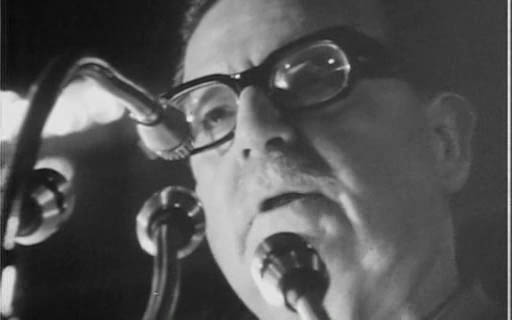
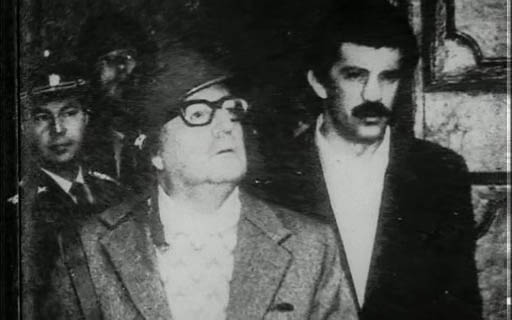
Salvador Allende:

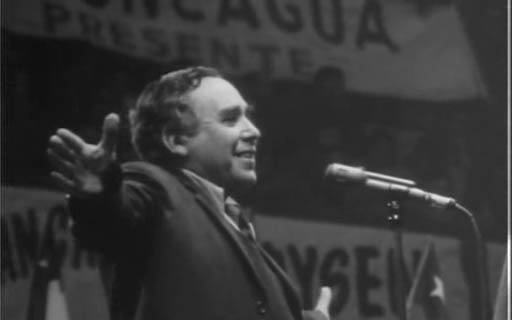
A politician:


Part two picks up right where the first one ends, with an attempted military coup on June 29 1973, and part two ends Sept. 11 1973 with the successful coup that killed Allende and instated General Pinochet as ruler. In between those dates, Guzmán covers everything that happens in the whole country, it seems, with access to the marches, the debates, worker meetings, everything but the secretive military that turns against its country (with help and provocation, it turns out, from the U.S. government). This is by far my favorite of the three parts, and could easily work as a standalone movie… I see the Film Forum in NYC thought so as well. The events themselves, a democratic country swerving communist then falling military-dictatorship, is the best movie material you could hope for and Guzmán and his crew make the best of it, watching from ground zero as history is made, producing one of the best docs I’ve ever seen.
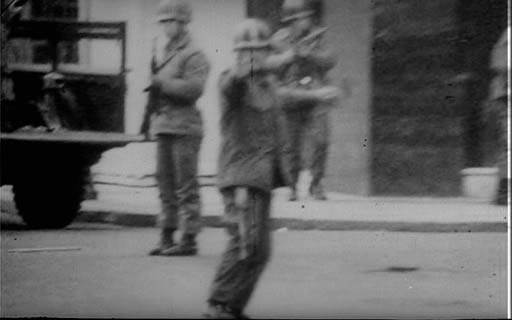
Military man who shot and killed Argentine cameraman Leonard Hendrickson at the end of part one:

Salvador Allende, file photo:

Bombing of the presidential palace:

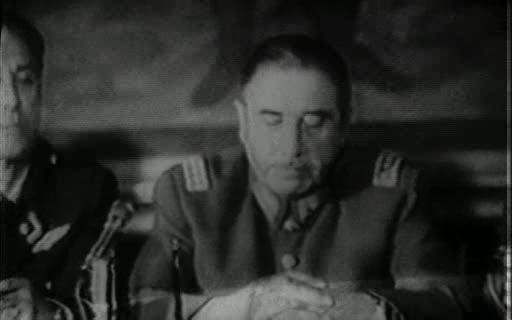
Pinochet addressing the nation on TV:

Military rule:

Pinochet: “After three years of support for the Marxist cancer we have been given a disaster that is economic, moral and social, that could not continue to be tolerated by the sacred interests of the mother country.” (or something like that – I think it’s all amateur-translated)
Guzmán: “From the 11th of September, all resources of the Chilean army are mobilized to repress the popular movement with the compacency of the North American government. The first armed resistance offered by some industrial cords, agricultural populations and student centers are squashed quickly in unequal fight. Thousands of people are killed and the main sport fields become concentration camps. The longest democracy in the history of Latin America ceases to exist.”
I don’t exactly wish I’d skipped part 3, but it would’ve made a nice recap six months later instead of watching it right after 1 and 2. Filmmaking in Chile wasn’t easy during Pinochet’s rule, since Pinochet was killing and imprisoning everyone who disagreed with him, including the cameraman of Battle of Chile (to whom the completed work was dedicated), so Guzmán backs up and shows further details of the workers’ movements during Allende’s presidency, not again mentioning Pinochet or the violence. The many worker meetings and the creation of multi-factory blocs and the attempted attack on Allende’s credibility by the “Christian Democrats” (his primary opposition) via a U.S.-funded transportation strike had all been covered in the previous films, but now we see them in greater depth… “depth” meaning lots of guys with sideburns talking into microphones at meetings. Since I’m not personally interested in creating a communist worker’s paradise in my own neighborhood, part three wasn’t of much use to me, but I’ll bet it’s exactly what Chris Marker was hoping for when he helped fund Guzmán’s efforts to document what was happening in the country. Marker’s own angry reaction to the coup is documented in his short Embassy, which I’ll have to watch again now that it’s on a new, clean DVD.
The transportation strike:

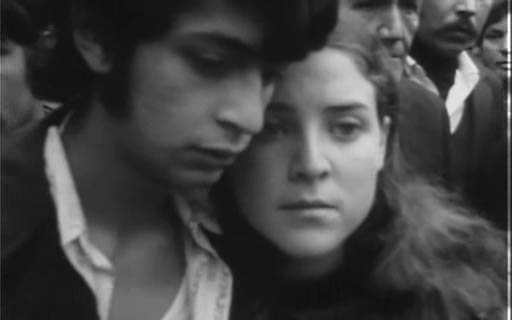
The people:

The sideburns:

The revolution:

Encounters at the End of the World (2007, Werner Herzog)
Not as audacious as La Soufrière nor as profound as Grizzly Man or moving as Little Dieter Needs To Fly, but has its measured share of audacity, profundity and… moving… ness. Motion? Werner goes to Antarctica to look at things, interview people, and express his contempt for it all. He finds some stuff to love, and there’s some gorgeous, wondrous underwater photography (non-Herzog-directed) by Henry Kaiser – THE Henry Kaiser, guitarist friend of Fred Frith – who also did the music. For above-ground shooting Werner brought along his Rescue Dawn/Little Dieter cinematographer Peter Zeitlinger.
We get the obvious “ice is melting and we are all doomed” bits, and shots of penguins, and interviews with the philosophers and scientists who live (either temporarily or not) in the ugly US base city of McMurdo. Touristy reaction scenes and the training sessions given to visitors before they’re allowed to leave the base. Then there are more typically Herzog moments. He comments on the commercialization of the south pole, the end of human discovery over the planet, signs we leave behind for future generations and visiting aliens. He cuts off some interviews, giving his own postscripts and summaries and arguments in their place (interrupts one woman flatly saying “her story goes on forever”). It’s a cool movie and a nice addition to Herzog’s philosophical travelogue cinema of human behavior on the edge, probably not destined to be a classic Great Film. Was very happy to see it on the big screen, and it was a nice breather among all the avant-garde shorts. Katy was a little disappointed with her first Werner Herzog experience, then I think after I told her she’d already seen a Herzog film and it was Nosferatu: Phantom of the Night, she liked Encounters a little more by comparison.
Profit Motive and the Whispering Wind (2007, John Gianvito)
Edit, one week later:
I unexpectedly got to see this again, in the theater in Nashville when Phantom Love was postponed. The festival guy described it as an “experimental documentary”, and that got most of the packed theater to walk out right there. A few more left immediately after the subtitled berry-mashing chant that opens the picture, and more shuffled out gradually until around the 1920’s there was only me and the two other people who stayed till the end. Movie makes me extremely happy, glad I saw it again. Was on video, though, so not real different from my home viewing, only larger.
——–
Apr 14:
I was nervous about this one, and wouldn’t have rushed to watch it if not for the Hidden in Plain Sight connection. On one hand, it made top-ten lists last year and was featured on the front cover of Cinema Scope, a magazine that hardly ever steers me wrong. On the other hand, it’s an hour-long narration-less tour of gravesites, which sounds less than exciting.
Cinema Scope was right. A moving, beautiful film which I now want to show to everybody I know. Peaceful and contemplative, with shots of trees and fields to break up the reading of gravestones and historial markers. The graves include people I know of (Frederick Douglass, Malcolm X, Emma Goldman, Paul Robeson), people I SHOULD know but don’t know very well (Mother Jones, Sacco & Vanzetti), people whose social relevance is explained by the text on the markers (the founder of the first all-female labor union) and people and events I was inspired to look up on wikipedia (Philip Berrigan: a pioneering Vietnam War protester, Lucretia Mott: women’s rights advocate in the 1800’s, The Ludlow Massacre, when the Colorado National Guard murdered the children of striking mine workers in 1914).

Felt good to watch, moving and energizing, not morbid despite the cemetery locales and mentions of massacres and executions. Shows these past people & events, triumphs and defeats, from today’s perspective, mostly a natural perspective with no living humans in the shot, but sometimes an Exxon will be seen across the street from a cemetery, cars will be whizzing by a historical sign, a marker will be located in the parking lot of a PetCo (!). Closes with some recent protest footage with lively editing. The struggle continues.
CScope: “In addition to forging a radical remapping of the American terrain, Gianvito’s film provides its audience with the rare opportunity to pay our respects by proxy.”

JG: After September 11, 2001, “I found myself re-reading stretches of Howard Zinn’s A People’s History of the United States, re-encountering some measure of what is admirable in this country’s past, the words and deeds of so many, known and unknown, who contributed to the historical struggle for a more just and egalitarian society. In time the idea took root to pay homage to this significant history, as well as to this book which continues to mean so much to so many of us, and by so doing, the hope was to draw sustenance from the sacrifices and efforts of those who came before us. Profit Motive and the Whispering Wind was intended to be a small poem to this progessive past.”
Hidden In Plain Sight (2008, Mark Street)
World premiere of this doc, which will double-feature with Profit Motive and the Whispering Wind at Tribeca in a couple weeks, so I watched Profit Motive on video then ran out to see this one in the theater. Unfortunately, Hidden In Plain Sight was also on video, and looked considerably worse projected in the theater than Profit Motive looked on DVD on my laptop. Shot in 16mm and video (you can sometimes see interlacing, especially at the end), then the whole thing thrown into an ugly low-grade digital video mash. If this bothered the director (in attendance), he didn’t mention it, nor did he mention how the music seemed to skip every couple of seconds, so I have to assume these things were intentional. It’s a movie about looking and seeing. Street, somewhat pretentiously (and comparing himself to Godard and Vertov along the way) wants to teach us new ways to look at city scapes. Leaving the theater I was very happy that my city was full of natural light and color, non-interlaced, without any of the dull ambient music (seemingly ripped from last night’s “experimental” shorts) that plagued Hidden.
Street visits Dakar, Santiago, Marseilles and Hanoi, stands on street corners and films stuff. Just whatever. Then there’ll be some black and an intertitle with a quote or an organizational header, then more street corners. Sometimes sync sound, sometimes sound from elsewhere or ambient music or silence. I was content to be bored for the hour, but Street lost some goodwill when he talked some crap about how he enjoyed seeing San Francisco disfigured by the 1989 earthquake… then lost more when he tried to make a point about tourists seeing a wide view of the city, and locals seeing more narrowly, observing finer details. It’s actually a fine point, but he is a tourist, and his street-corner tourist-gaze is far from a local’s view of the city. Shooting stuff that tourists aren’t expected to shoot (walls, locals walking around, more walls) does not make one a local and I resent his attempt to educate the audience and show us “unique perspectives” via banal images. Gianvito’s Profit Motive (or Marker’s Sans Soleil, or Vertov’s Man with the Movie Camera, or Akerman’s From the Other Side) this ain’t.
The Pervert’s Guide To Cinema (2006, Sophie Fiennes)
“Cinema is the ultimate pervert art. It doesn’t give you what you desire; it tells you what to desire.”
With his focus on the “traumatic dimension of the voice… which distorts reality”, I must believe that narrator Slavoj Zizek, with his heavily accented voice, is watching and interpreting slightly different versions of these movies than the ones I have seen. After all, I watch films and he watches “fillums”.

A few bits: the three levels of Norman Bates’s house representing the id / ego / superego… the power of the voice represented by Dr. Mabuse… “Music is potentially always a threat”… a look at the intersecting fantasies in Blue Velvet, and the related horror themes of Blue Velvet and Mulholland Drive.
Calls a scene in The Piano Teacher “the most depressive sexual act in the entire history of cinema.” To think I once showed that movie to my girlfriend’s parents!
Wish Katy had finished watching this with me, could’ve helped defend my position on David Lynch movies. And for stupid cinephiles like myself, who love Lynch movies (and The Piano Teacher, and Eyes Wide Shut, and Blue) but get lost in their images and atmosphere without thinking too hard about their psychological implications, he handily explains the stories and characters from a psych point-of-view.
“I think that flowers should be forbidden to children.”
The movie might teach the rewards of closely analyzing a few great movies instead of trying to watch every potentially great movie. This is a lesson I will not be following. Maybe one day…
I feel so vindicated that he picks Alien Resurrection as a film worth discussing. When oh when will that gem get its due? Only the second of the series (after the Ridley Scott original) to count as a horror film, plus it’s good sci-fi and an innovative sequel/reboot that hasn’t been matched since (well, maybe those Chucky movies).
“All modern films are ultimately films about the possibility or impossibility to make a film.”
He compares Cecil B. DeMille to the Wizard of Oz to the mystery man in Lost Highway.
“In order to understand today’s world, we need cinema, literally. It’s only in cinema that we get that crucial dimension which we are not ready to confront in our reality. If you are looking for what is in reality more real than reality itself, look into the cinematic fiction.”