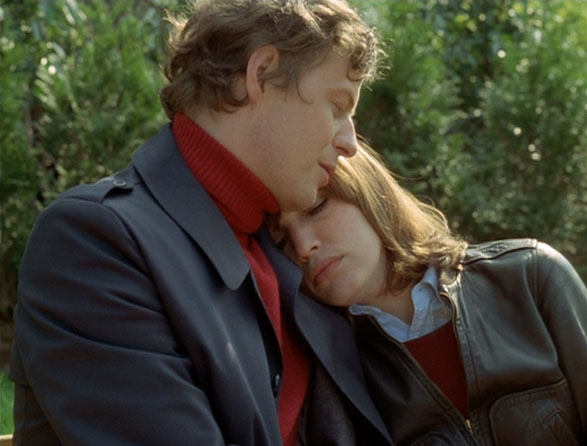
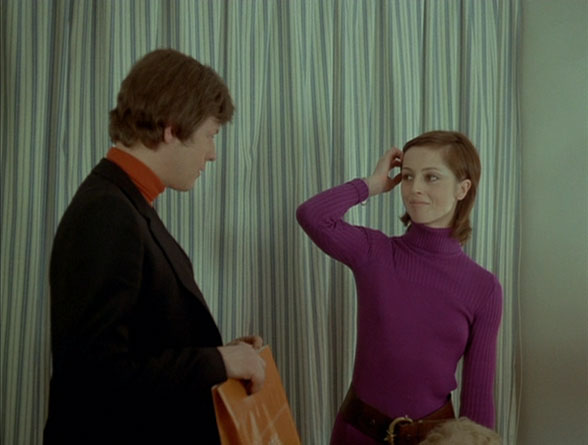
Finally out on video, I got to watch this seven years after seeing Out 1 in theaters.

Rosenbaum calls the two films “radically different,” but to me, it often felt simply like a shorter version of Out 1. Of course, having seen the longer version, I can’t help noticing major differences. The two theater groups’ rehearsal footage is almost entirely gone. Renaud’s disappearance with Quentin’s money is obliquely shown, and the ensuing city-wide hunt for him is even more obliquely included, in the form of black-and-white stills from those scenes inserted between regular scenes, accompanied by a low buzzing noise. There are other appearances of stills, some from deleted scenes from the longer version, sometimes callbacks or flash-forwards to scenes within Spectre.

Admittedly the 13 group felt like a much bigger deal in Spectre, more of a central conspiracy to the film, and I was able to follow the relationships and stories of offscreen characters Pierre and Igor much better, but I can’t tell if they’re really more sharply in focus in Spectre than Out 1, or if during Out 1 itself I was too busy trying to keep the many onscreen characters straight to follow much Igor drama. But looking through articles I quoted in my original Out 1 writeup, Rosenbaum said Out 1 was shaped by “the successive building and shattering of utopian dreams” and Lim says it “devotes its second half to fracture and dissolution,” and that theme and structure didn’t feel as true of Spectre.

The buzzing stills interrupt and fragment primary scenes, and there appears to be more cross-cutting between scenes than in the long version. Conversations sometimes cut off in the middle and never return. The stills appear in greater frequency at times, and disappear for long stretches at others – for instance, when Thomas first visits Sarah at the beach house and convinces her to return to Paris, the whole scene with its long shots plays out without interruption. Sometimes the editing is telling different stories than the dialogue – when Rohmer’s Balzac scholar says “secret societies,” it cuts to the Prometheus group, not returning to Rohmer for a long while.

Obade is far, an 8-hour drive southeast from Paris

Rivette:

They aren’t single frames, but simply production stills. When we tried a shorter version, our first montage ran five and a half hours. Then to make a commercially feasible length, we used the stills to tighten the editing, much the way that Jean-Luc uses titles more and more in his films, as in La Chinoise. Every time there was an editing problem he had recourse to a title. But finally we spent more time on these photos than on anything else, because there were a priori so many possibilities. We wanted the relation between the film and the stills to be neither too close nor too distant, so it was very difficult to find just the right solution. Then we added the sound to the stills. They didn’t work without sound, because the silences interrupted either noises that were very loud or others that were just murmurs. Silence didn’t produce the effect we wanted. I wanted something purely artificial: what we have is just a meaningless frequency, as if produced by a machine, which interrupts the fiction — sometimes sending messages to it, sometimes in relation to what we’ve already seen or are going to see, and sometimes with no relation at all. Because there are stills from scenes, especially toward the end, which don’t appear in the body of the film and are frankly quite incomprehensible.

Hand-off:
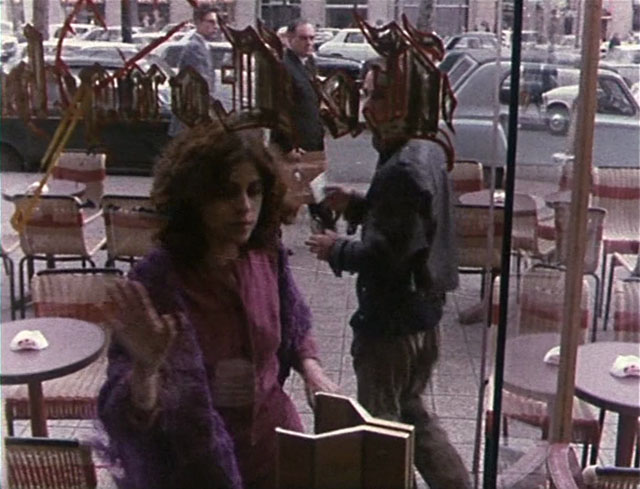
At the halfway point, after Colin, Frederique and Emilie/Pauline just appeared in the same scene, it lets loose with a whole montage of the buzzy stills. When Rivette says “there is a moment, one single shot even, in which almost all the fictions intersect, as if all these lines had to pass through a ring. This shot we put squarely in the middle: it comes just before the intermission,” is this the scene he means? There was no intermission in the DVD version, but it seems likely.

Ten of the 13: Thomas, Lili, Sarah, Pauline, Lucie (legal advisor), Warok, Etienne (chess player), The Ethnologist, Igor (never seen), Pierre (never seen). Four more whom I suspect: Elaine (because she discusses Lili’s disappearance with Lucie), Marie (because she gives Colin the letters), Iris (because Pauline speaks freely about Igor and her blackmail plot in front of her) and Georges (unseen character I mentioned in my Out 1 writeup, though I can’t recall who he is).
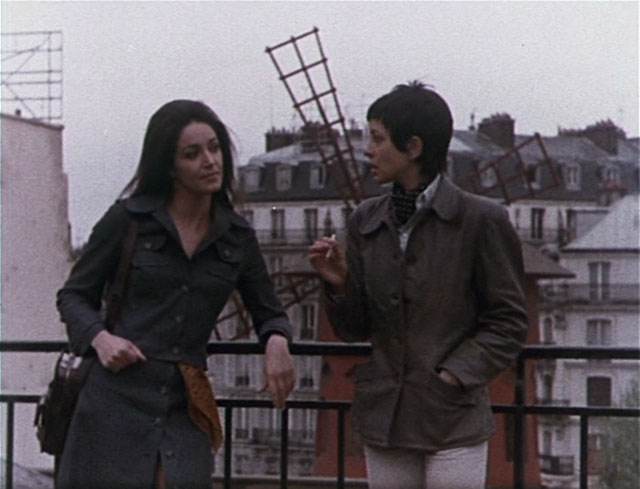
But let’s not read too much into the conspiracy. Rivette again:

In Out, I was already more careful, because the idea of the “thirteen” came rather late. For a long time we thought that the characters might never meet; perhaps there would be five or six completely different stories. We just didn’t know. Still, I had the idea that something should bring them together, and so it was Histoire des treize. But it was just a mechanism. In Paris and, even more, in Out, I don’t take the whole idea of the search for meaning seriously. It was a convenience to bring about the meetings, but it didn’t work with either film, because they were taken to be films about a search. I tried and failed to make people understand, as the film progressed, that this search led to nothing: at the end of Paris, we discover that the Organization doesn’t exist; and the more Out progresses, the more evident it becomes that this new organization of the thirteen which appeared to have been formed never really existed. There had only been a few vague conversations between completely idealistic characters without any real social or political roots. In each case there was a first part where we assembled a story of a search, and a second part where little by little we wiped it out… When I decided to use Histoire des treize, it was as a critique of Paris, which tried to show more clearly the vanity of this kind of utopian group, hoping to dominate society. It begins by being fascinating and tempting, but in the course of the film comes to be seen as futile.

equipage equipage equipage equipage equipage equipage equipage:

“Listen baby, I’m not Marlon. Marlon is on the waterfront.”

Lili and Pauline are somehow connected in running the shop (which advertises Bob Dylan bootlegs for sale in the window), and Sarah sneaks in and out. I thought Sarah was hanging out in the basement, but when they knock out Lorenzo’s man and drag him downstairs, it doesn’t look like much of a place to spend time. Lili is later said to have stolen a million francs and disappeared – but from Lorenzo or from the cases full of important-looking papers beneath the shop, I’m not positive.

Both theater groups begin with “rehearsals” that seem more like acting warm-up activities, then into vague explorations of theme and character. Each group gets a shot in the arm from the entry of a new member – Sarah to Prometheus and Renaud to Thebes. But Renaud’s ideas don’t work for Lili, and she begins to retreat from the group. In the end, both groups have dissolved because their most recent members have left, followed soon by leaders Lili and Thomas to Obade.

More important differences in the ending: Thomas doesn’t have his beachside breakdown, and Frederique doesn’t die (not sure that she even meets Renaud).

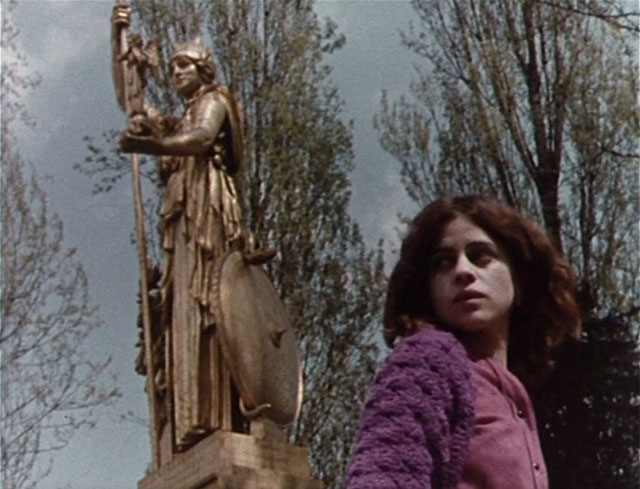
Shortly before Pauline’s lover Igor reappears (in the form of a phone call to the beach house), this maybe-strangely-translated conversation – Lili: “Why do you imagine Igor’s in a room here?” Pauline: “Imagine someone is a half, or a full year trapped in a house. No one notices. In the basement, on the floor, in a room.” Lili: “But this is a dream.” Then they agree to search the house for him, but there’s one section to which nobody has the key, and later when the key mysteriously appears, Pauline searches the unoccupied rooms beyond, staring into the infinite mirror. I find this piece of the film interesting since Bulle Ogier (Pauline) would appear in Rivette’s next film as a ghost trapped within a dream house.

Rosenbaum: “The coded messages Leaud intercepts are significantly different in the two films.” Different how? Also: “Much as Thomas Pynchon in Gravity’s Rainbow bears witness to mid-century paranoia by turning imaginary plots into real ones and vice versa, Rivette has a chilling way of both suggesting explanations and dispersing them in this monumental, maddening epic.”

Rivette:

There are some sequences which I think are failures, but after a certain number of hours, the whole idea of success and failure ceases to have any significance. Some things that I couldn’t use in Spectre are all right in the longer version. The whole actor-spectator relationship is totally different in Out, because there the actors are much more actors than characters. There are many more scenes where the sense of improvisation is much stronger, even to the point of admitting lapses, hesitations, and repetitions. There are some of these in Spectre, but relatively few, because we treated it much more as a fiction about certain characters. In the longer version, the dramatic events are a lot more distant from each other, and between them are long undramatic stretches… contrary to what most people believe, one doesn’t learn any more in the long version than in the short one.

On the meaning of the opening title “Paris and its double”:

I wanted the two titles to indicate that the film was shot in April and May 1970 – that, for me, is the important thing, since there are many allusions in the dialogue to that period. It should be evident that the group of thirteen individuals had probably met and talked for some time until May 1968, when everything changed and they probably disbanded.

David Thomson:

Out 1: Spectre begins as nothing more than scenes from Parisian life; only as time goes by do we realize that there is a plot — perhaps playful, perhaps sinister — that implicates not just the thirteen characters (including Léaud, as the mystery’s self-styled detective), but maybe everyone, everywhere. Real life may be nothing but an enormous yarn someone somewhere is spinning.

Castello Cavalcanti (2013, Wes Anderson)

Cute – Schwartzmann is a racecar driver who happens to crash in his ancestral village then decides to slow down and hang out for a while.

Aningaaq (2013, Jonas Cuaron)

The other side of a radio conversation Sandra Bullock has in Gravity, with a man in the icy wilderness who doesn’t understand her. It’s fun as a companion short but gets all its emotional weight from the Gravity recall.

Stephane Mallarme (1968, Eric Rohmer)

A visit with a typical pretentious french poet. Or I can’t tell if he’s pretentious since the spoken interview is translated but his written poetry excerpts are not. It’s all starting to seem odd, when the “documentary” short ends and the credits tell me Jean-Marie Robain (of Melville’s Le Silence de la Mer) played the poet, who died in 1898.

“In a society without cohesion, without stability, it’s impossible to create stable, definitive art.”

Weed (1996, Fatih Akin)

A corny-assed comedy starring Akin with Counting Crows hair, who tries to impress his new dance-club friends by claiming he has amazing weed at home, which he does not. So in order not to get killed once the lie has spun out of control, he brings them weeds from the garden, which they smoke and find to be amazing, because potheads have no standards I guess.

A strangely excellent movie – beautifully shot and performed. It’s very straightforward, plot-wise. The central mystery is set up in the first scene (taking place at Cafe Exposition, populated by extras filling each other in on backstory), and the movie spends the rest of its runtime dropping hints as to the solution to the central mystery, until finally even people like me, who don’t try to guess the endings to movies, know very well what’s going to happen. The NY Times considered it obvious enough to reveal the answer outright in their original review. But somehow that didn’t keep me from loving the movie, more than Perceval to be sure. One complaint: the title made Katy think of the Marquis de Sade, and made me think of The Story of O – so the movie should have been far sexier than it was.

The story was written in the early 1800’s and set in Germany, so of course Rohmer makes a German film that looks like it is happening in the early 1800’s, with a Barry Lyndon level of attention to light and costume. The Marquise (Edith Clever of a couple Hans-Jurgen Syberberg movies) is rescued from Russian marauders by their commander Bruno Ganz (not long before starring in Herzog’s Nosferatu). She is given sleeping pills after her ordeal, and the family is ever grateful to Ganz. Thing is, he’s now strangely, hurriedly insistent on marrying the Marquise, and she soon realizes she is pregnant.

Bruno makes an awesome entrance:

It becomes increasingly obvious to the viewer that Ganz knocked her up while she slept from the pills and is trying to run damage control, but this never occurs to the Marquise or her family until he admits it in the final scene. Instead, her mother tries to pin it on faithful servant Leopardo, while her father shuts his ears and bans her from setting foot in the house again.

Rohmer himself stands distractingly against the wall:

A super talky movie, of course, but possibly my favorite so far of Rohmer’s. Intertitles and fade outs at the end of scenes provide what little stylization is allowed into the movie. It’s funny to me that in the last line of the movie the marquise calls Bruno an angel – he and the actor playing her brother (Otto Sander) would later co-star as angels in Wings of Desire and Faraway So Close.

I didn’t expect this from the most naturalistic of the French new wavers. It’s a period musical adaptation of an epic poem – that part seems up Rohmer’s alley – but he uses spare, symbolic sets (anticipating the digital backdrops of The Lady and the Duke) and has the actors read their character’s dialogue and accompanying narration, speaking along with their actions so as not to break up the verses. The source poem is incomplete, so the story trails off at the end, but not before a momentum-killing passion play with our lead character as Jesus on the cross. It’s quirky and unique, and I liked the story somewhat, but didn’t warm up to the simple lead character or the renaissance music. As far as French movies set in weirdly artificial castles starring Andre Dussolier go, I prefer La Vie est un roman.

Young Andre Dussolier with Perceval:

Perceval (Fabrice Luchini, who’d recently starred in Immoral Tales) takes advice given him VERY seriously, listening first to his mother, then a “worthy man” he meets on his travels. But he is dumb as hell, and sometimes misinterprets the intent of the advice, firstly when he barges into a knight’s tent, steals some food and molests the woman inside. I’m not sure what advice led to that. Later he’s told that it’s better to stay silent than say stupid stuff, so in the enchanted castle of the Fisher King, he doesn’t ask about the miraculous bleeding spear and glowing bowl he sees, and so is cursed for his lack of humility, and spends five years wandering godlessly through the wilderness while his mother dies alone back home. As with many ancient texts, the story takes logical leaps that I don’t follow.

Magic woman with awesome hair who delivers the Fisher King curse:

Perceval Christ:

Elsewhere, Perceval falls for a woman named Blanchefleur (Arielle Dombasle, who made an impression as the goofy wheelchair woman in La Belle Captive), defends her castle and promises to marry her. He gets respect from King Arthur and starts sending his defeated enemies to the King for punishment instead of finishing them off. Then the movie leaves Perceval for a long while, following Arthurian knight Gawain (Dussolier) on a quest to clear his name from some murderous accusation, with a stop on the way to win a jousting contest on behalf of a rich girl. I love that the same choir of musical servants (including Pascale Ogier of Le Pont du Nord, in her first role) appears in every location. I also love the look of the film, and a weird scene involving cartoon geese.

There’s Pascale on the right:

Perceval with Blanchefleur:

Rosenbaum:

a medieval musical that feels a bit like a western … The merit of Rohmer’s realism in Perceval is that it brings something otherwise dead and forgotten to life – not because Rohmer’s imagination is especially rich but because he sees no alternative to his literalism, even if it makes some audiences laugh in disbelief.

Astree loves Celadon and vice versa, with the kind of suicide-pact love that mainly exists among 17-year-olds in tragi-romantic plays. His parents don’t approve so the young lovers make a public show of dating other people… but Astree believes the show, feels betrayed and tells Celadon to piss off, so he goes and drowns himself in the river. Not quite dead, he’s rescued by nymph Galathée and her gang. Gal wants hunky Cel for herself but he escapes and hides away in the forest, eating berries, refusing to approach his beloved because, after all, she ordered him away. Meanwhile, Astree and Cel’s brother alternate (“he must be dead!” “he must be alive!”).

I guess I see the Rohmer moral theme at work here. Cel loves his girl so he must remain faithful to her and do as she says, staying away even if she doesn’t know he’s alive. But as Jimmy said, breaking into a giggling fit after hearing Celadon echo his simple emotions for the thousandth time, “he’s SO dumb!” It’s hard to disagree… they are all so dumb, and the movie is so straightforward and simple that it gets frustrating. Some nice imagery though, I thought (Katy said it looked made-for-public-television). Best not to get into the ending, in which Celadon pretends (not convincingly) to be a girl in order to get closer to his beloved.

Astree is Stephanie Crayencour and Celadon is Andy Gillet, neither of whom have shown up elsewhere yet. Jocelyn Quivrin who played Celadon’s brother died in a car crash two months ago. Nominated for the golden lion in Venice along with six movies I’ve loved (and also Sukiyaki Western Django) but they all lost to Lust, Caution, which I thought didn’t get good reviews.

M.J. Anderson:

Adapting Honoré d’Urfé’s novel of 5th century Gaul life, The Romance of Astree and Celadon claims to reproduce less the period depicted than its 17th century readers’ imagination of the earlier period. Commensurate with this goal, the director features canvases painted in the seventeenth century, a castle built well after the novel’s setting and importantly a grafting of the Christian faith onto the Druid-themed source material.

“You’ll be your own downfall.”

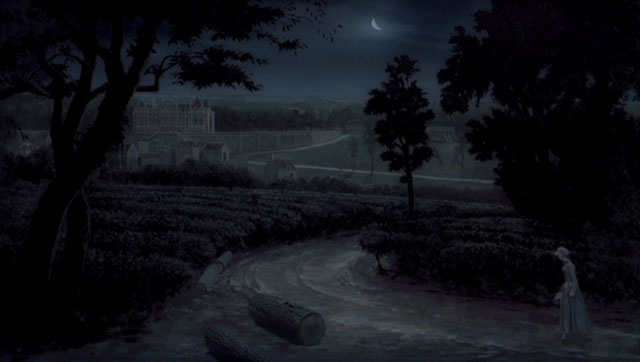
The Lady of the title is Grace Elliott, a Brit in France during the 1789-93 French Revolution. Actually the French title is L’anglaise et la duc but Grace is Scottish, claiming English nationality for simplicity when it’s suddenly very dangerous to be a French aristocrat in France. The movie’s intertitles and much dialogue are taken directly from her diaries.

image

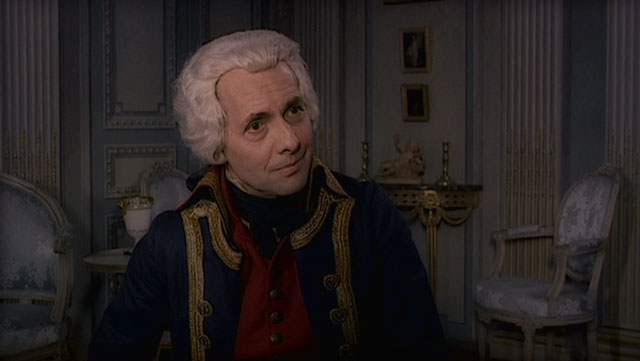
The Duke is one of my favorite Jean-Pierre Jeunet actors, but I didn’t recognize anyone else. Star Lucy Russell has failed to break into the Hollywood mainstream (landing such roles as “female restaurant guest” and “classy shopper #3” in recent big films). Ach, I missed Alain Libolt (Renaud in Out 1) as the Duke of Biron.

Renaud plus 30 years:
image

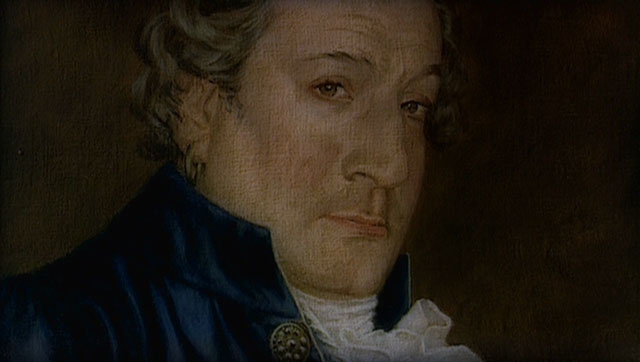
Grace is pure aristocracy, the very target of the revolution, and her sympathies lie with her friends whom she sees being rounded up and killed by the brutish masses. Steadfast in her devotions (though lying to stay alive), she’s contrasted with her friend the Duke, who changes with the times and ends up voting for the execution of the king. Plays like one of Rohmer’s Moral Tales only with more action, more heads on stakes, and more awesome digital backdrops of period Paris standing in for the usual stifling production design and avoidance of outdoor shots (except by filmmakers with Scorsese-budgets). Slant, in fact, called it an “economical antidote to the bloated costume drama.” Grace tries to negotiate the changing world without compromising her belief in the class system, while the Duke either adapts his morals or never had any to begin with. The main thing this movie has over the other Rohmers I’ve seen is historical interest… I delighted in the details of the revolution, about which I know very little. I thought the movie rather anti-revolution, which seems shockingly out of fashion, and one “Grunes” confirms that this was a problem:

Rohmer pitches the action from Elliott’s perspective, with which his own Roman Catholic penchant for order prompts him to identify—hence, the controversy the film engendered in France. Thus the street mobs are unwashed, grisly, barbaric, obscene; poor Louis XVI!

image

It’s hard to know what to make of the movie’s politics. There’s also a long scene where she successfully hides a Marquis from the police. We don’t get to know the guy very well, but he’s not made out as a man who deserves to die, so bravo, I guess. When Grace is finally arrested and held for two days for possession of a letter from an Englishman, the letter ironically turns out to praise the French revolution to the heavens. These examples and the duality in the title make it seem relatively even-handed, despite being adapted from Grace’s own horrified writings.

Duke Jean-Claude Dreyfus:
image

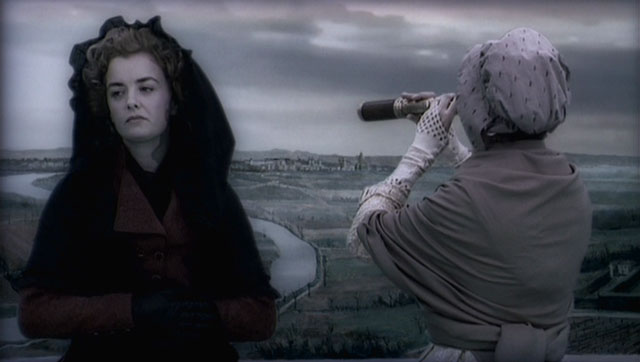
Watched this the night the director died. It got mentions on decade-end lists, with some screenshots that got stuck in my head (like the one below, peering into a painting with a telescope), so I’d planned to watch it soon anyway. I didn’t hear much when it came out, probably because of the timing (sept-oct, 2001). Beaten out for its only two César nominations by Amelie and Brotherhood of the Wolf.

image

NY Times:

The moral dilemmas that Grace and the Duke face are diagrammed, in Mr. Rohmer’s inimitable fashion, with equal measures of clarity and complexity. The director manages to evade both the stuffy antiquarianism and the pandering anachronism that subvert so many cinematic attempts at historical inquiry. His characters are neither costumed moderns, just like us only with better furniture, nor quaint curiosities whose odd customs we observe with smug condescension. They seem at once entirely real and utterly of their time. And the time itself feels not so much reconstructed as witnessed.

image

I’ll close by outright stealing an entire blog post by from Glenn Kenny, only because I want to always be able to find this Rohmer quote.

My films, you say, are literary: The things I say could be said in a novel. Yes, but what do I say? My characters’ discourse is not necessarily my film’s discourse.

There is certainly literary material in my tales, a preestablished novelistic plot that could be developed in writing and that is, in fact, sometimes developed in the form of a commentary. But neither the text of these commentaries, nor that of my dialogues, is my film: Rather, they are things that I film, just like the landscapes, faces, behavior, and gestures. And if you say that speech is an impure element, I no longer agree with you. Like images, it is a part of the life I film.

What I say, I do not say with words. I do not say it with images, either, with all due respect to partisans of pure cinema, who would speak with images as a deaf-mute does with his hands. After all, I do not say, I show. I show people who move and speak. That is all I know how to do, but that is my true subject. The rest, I agree, is literature.
—From “Letter to a critic [concerning my Contes moraux]”

Fred has a decent life with his wife, who is expecting a second baby, when old friend (actually an old friend’s ex) Chloe resurfaces and they start meeting in the afternoons. Fred lunches with Chloe, then goes shopping with her, then kisses her, then sees her naked, then almost sleeps with her but runs back to his wife for a tearful finale.

Fred & Chloe:
image

Progressions from the previous films:
– Fred is married with two kids, so stakes are higher
– We meet the wife and get to know her more than we’ve gotten to know the other “chosen girls”, again raising the stakes.
– a dream sequence wherein Fred meets the girls from the other movies on the street while wearing a magical crystal
– At the end, Rohmer beautifully shows us (below) Fred’s decision to cut it off with Chloe and return to his wife instead of having Fred explain it to us in voiceover.

image

Felt self-conscious watching this with Katy, who didn’t like it. Overly-talky French films with protagonists who have crappy ideas about women should apparently be watched alone, cuz I felt fine watching the five other talky entries with cad protagonists in this series.

As Fred, Bernard Verley is the guy I just saw playing Jesus in The Milky Way (he’s very different here, and not just because he has no beard and is not playing Jesus). Fred has better hair and a better personality than any guy since My Night at Maud’s. Zouzou (Chloe) appeared in a 1977 Edgardo Cozarinsky revolution comedy with Dennis Hopper. Guy who plays Fred’s business partner Gerard was in Stolen Kisses and Bed & Board. Fred’s wife, unfortunately, was in nothing else of note.

Fred’s wife is def. more attractive than Chloe:
image

“What Rohmer gets better than anybody else, I think, is the way in which we justify ourselves, the way we talk ourselves into such silly and demeaning but human interactions with people, that we can justify just about anything. He’s one of the great justifiers. He loves to watch these men squirm their way along through life.” – Neil LaBute, director of the Wicker Man remake. It’s actually a very nice interview, a ten minute appreciation of Rohmer’s cinema.

The famous shot:
image

Fred with a dream-sequence girl… is that Haydée?
image

also: Veronique and Her Dunce from 1958, before the Moral Tales. Shot by Charles Bitsch, who did Le Coup du berger and Paris nous appartient for Rivette. Veronique shows up to tutor a kid who isn’t too good at math or composition and likes to ask questions. Then she goes home. That’s really it! Not exactly The 400 Blows here, or even Le Coup du berger, but it’s a likeable little sketch. Veronique would return the next year in Charlotte et Veronique written by Rohmer and directed by Godard – it’s on the A Woman is a Woman DVD. As for this short, I liked the tile floor, and am glad they showed it so often.

Veronique before meeting her dunce:
image

When the movie began, I immediately noticed Jean-Claude Brialy’s hair. Who is this guy? I’ve seen him in earlier films (Paris Belongs To Us, A Woman is a Woman and Le Beau Serge) and a later film (Phantom of Liberty) but I can’t remember him. I think he might be the guy on the right in my middle screenshot of Le Coup du berger but without the beard and the hair it is impossible to tell. That hair… so distracting. Laying on the couch, I alternated between taking in the luxurious outdoor camerawork and watching Brialy’s hair. The birds fought on me for the first ten minutes before Our Bird settled on the couch in front of my head and New Bird camped on my shoulder with his tail right in my eye. So I thought about the birds, and Brialy’s hair, and the sunlight in the film, then I realized that a half hour had passed and I still wasn’t paying attention to the dialogue.

Brialy & Laura:
image

So maybe not the ideal screening of Claire’s Knee… or maybe it was! Either way, I got the feeling that I liked the previous two movies better, despite expectations that this would be the masterpiece of the Six Moral Tales. Seems like the Tales are wearing themselves thin. Guy in picturesque location with distant girlfriend flirts with young girls but ultimately stays with his girlfriend… it’s La Collectionneuse again.

Claire:
image

This time the guy is bushy Brialy, spending the month before he gets married in his old home town (I think), possibly to sell the family home, though we never see him do anything productive. His co-conspirator (see also: Vidal in My Night at Maud’s) is an Italian writer with a distracting accent, Aurora. Brialy flirts first with big-haired 16-yr-old Laura, then with her (slightly older?) step-sister Claire, whose knee we don’t see until towards the end of the picture. Laura is happy to lightly play around and talk with Brialy but they both know there’s nothing serious, then he is briefly tempted by Claire, tries to break her up with her boyfriend, then comforts her when they are stranded in the rain together by rubbing the titular knee. He goes home to his fiancee, thinking himself a dark stranger who changed these two young girls’ lives, but Laura hardly seems to notice him in the last few days, and Claire is back with her boy two minutes after Brialy has left. Even if the rest of the story was nothing special, I liked this ending, which gives more of an inner life to the female characters than previous entries have done.

(R-L): Sad Claire, her knee, Brialy:
image

Beautifully shot by master of light Nestor Almendros the same year he did Bed & Board and The Wild Child for Truffaut. Hardly any of the actors besides Brialy had been in any films before, but most would appear in later Rohmer films from time to time. This won best film from both the U.S. and French critics societies, but lost a best-foreign Golden Globe (with fellow loser The Conformist) to an Israeli movie that isn’t out on video (which itself lost the best-foreign Oscar to The Garden of Finzi-Continis).

image

My (comparatively) negative feelings about this one extend to the DVD extras, too. First we’ve got a nothing TV interview with the cast, where we learn that Brialy has been Rohmer’s friend for a long time, and the girls somewhat enjoyed working on the film, and everyone is miffed that Rohmer won’t appear on the show himself. Then there’s The Curve by Edwige Shakti, a short based on a basic scenario by Rohmer. Shekti herself stars as the usually topless girlfriend of an art-obsessed young man. She challenges his remarks that he was drawn to her because she reminded him of different specific artworks. It’s a cute enough short, but its appeal lies more in watching the director’s breasts than in the uninteresting 30fps video work or the consciously Rohmer-talky dialogue.

The Curve:
image

Made and released before My Night at Maud’s, but it’s part four of the Moral Tales. I made a moral decision to watch the films according to their numbering in the DVD box set, and not in the order they were made.

It’d be almost Antonioni-esque without the voiceover. Hardly anything actually happens, but Adrien always keeps us filled in on what he’s thinking. I considered disliking the movie for a while, a movie about idle rich young artists having self-conscious affairs, but it turns out Adrien and Haydée aren’t rich (only idle and leeching off their rich friend) and never manage to have an affair. I ended up liking it.

image

Buff 30ish Adrien comes to the beach to take his “first vacation in ten years” prior to an art opening, hopes to sit around with buddy Daniel and do absolutely nothing, not even think (they read so they don’t have to think). 21-yr-old Haydée is also at the house sleeping with a different guy every night. We don’t get much insight into Daniel – he’s the third wheel here – but Adrien and Haydée are both trying to find themselves, define their own moral codes, playing off each other and never quite getting together. At the end, Adrien pulls a standard Moral Tales move. Chances are good that he’s got Haydée for the night, but he leaves her in the middle of the road, deciding that sleeping with her would be against his character, and books a flight for London to see the girl he’s with (briefly) at the start of the film.

Leisurely-paced movie, but never slow or dull. Differently structured than the other films, with a few-minute prologue for each character before the main section of the movie begins. Rohmer and his cameraman would be happy to just stare at Haydée all day – her entire prologue is shots of her barely-clad body. Apparently that’s what defines her character.

image

Have I mentioned that it is in color? Guess that’s another good reason to watch it fourth instead of third. Nice, rich color, too. Much of the look is in the bleached grays and browns and blues of the beach and the plain interior of their villa, so what colors we get in clothing and city life and an antique vase all stand out. Adrien and Daniel wear some hilarious clothes throughout (see above). Must be a 60’s artist thing.

Adrien was Patrick Bauchau, had a smallish part in Suzanne’s Career, later in American stuff like The Rapture and Panic Room. Haydée was Haydée Politoff, immediately turned to Spanish and Italian horror movies, had a small part in Love in the Afternoon, and mostly quit acting after that. Daniel was Daniel Pommereulle, appeared in Godard’s Weekend the same year, then two by Philippe Garrel.

image

from V. Canby’s NYT review:

Much of the comedy in La Collectionneuse, as in Rohmer’s later films, is provided by the otherwise aware hero’s elegant self-deceptions about his own motives, followed by his dimly seen perceptions of what could be another truth. In this context, it is a momentous event (and, comparatively speaking, momentously funny) when Adrien begins to have doubts about the affair of Haydée and Daniel. “I couldn’t be sure,” he tells himself with complete seriousness, “that their complicity was entirely for my benefit.”

There is a certain chilliness and lack of spontaneity to all of the performances, especially Bauchau’s, which, I suspect, has as much to do with the tiny scope of the film as to the actor’s talents. My Night at Maud’s and Claire’s Knee suggest living worlds outside the films’ rarefied milieus, whereas La Collectionneuse exists in splendid, arrogant isolation. Adrien is tiresome. Daniel is enigmatic, and Haydée is sweet, and great to look at, but, after a while, sadly commonplace.

A note of interest to local film buffs: the Seymour Hertzberg who is listed in the credits (he plays Sam, the American art collector whom Adrien solicits), is the nom d’écran of Eugene Archer, a former New York Times film reviewer who, I’m told, has absolutely no intention of acting again. He is an excellent reviewer.

“Seymour Hertzberg”:
image

From P. Lopate’s Criterion essay:

Haydée is not the most articulate young woman, though she says just enough to cast doubt on the men’s interpretations. There will be other Rohmer films that take us deep into the psyches of women; this one does not, but it gives us a very daring, precise portrait of the misogynistic, entitled, self-loathing psyches of men. And unlike, say, most Woody Allen movies, it does not let the rationalizing male character off the hook. Rohmer explicitly warned us, in an interview: “You should never think of me as an apologist for my male character, even (or especially) when he is being his own apologist. On the contrary, the men in my films are not meant to be particularly sympathetic characters.”

From an appreciation in The Guardian:

Drama, for Rohmer, is made up of a number of frequently small incidents which culminate in an inevitable denouement. There are many kinds of film-making but Rohmer’s would be very difficult to beat within the confines of his chosen metier.

A Modern Coed, 1966

image

“People used to say girls went to college only to land a husband. Though today’s coed might find a husband, she isn’t necessarily looking.”

Just a short doc to tell the world that there are female college students, and some of them even study science. Its main reason to exist today is to document mid-60’s Paris hairstyles. Narrated by Vidal from Maud’s.

Foreground: our coed. Background: a cat with a hat in a box.
image

Rohmer on La Collectionneuse in 1977:
“It’s the only film I made that followed the era’s fashion. Audiences loved the new fashions, the long hair, the blue jeans. Then there was Haydée, whom audiences adored. Marcel Carné signed her for his next film right after that.”

He speaks proudly of a conversation scene in the 1976’s The Marquise of O, calling it “tiresome and static” but saying nobody else would have dared film it as written.

“This is a problem that concerns me. In the past, I was drawn by the way people spoke. I’m deeply interested in language. Currently, I find a kind of sloppiness has crept into the French language and I don’t like it very much. I like colloquial language, but today, especially as it’s used in intellectual circles, I find little of interest in it. … That said, I also believe characters in film should speak naturally. I’m getting around this currently by shooting films set in the past. When I return to contemporary films, I don’t know what my position will be. Perhaps by then language will have evolved further. Today’s spoken language is so extremely impoverished that it doesn’t inspire me. You find the same dialogue in every film now.”

image