Rewatched for the first time since theaters.

I’ve been reading the Adam Nayman book on the Coens:

Nothing in the film is “original” except for the reconfiguration of elements, which is why the opening citation is more honest than it seems and, in its way, a signifier not of smarminess but of humility. The nod to The Odyssey admits that any artist in the Western tradition owes some currency of debt to Homer, and that to mount any story about homecoming is to reconnect with the roots of storytelling itself – to return to the primal scene.

Nayman:

“If it’s not new and it never grows old, it’s a folk song,” quips the hero of Inside Llewyn Davis, which is O Brother, Where Art Thou?‘s spiritual sequel. Taken together, the two films clarify the Coens’ relationship to a musical genre founded on familiarity. For filmmakers perpetually interested in circles and circularity, the cyclical proliferation and popularity of folk and bluegrass standards – songs largely without cited authors, passed down and performed by different singers through the generations – serves as a potent analogue to their thematic preoccupations.
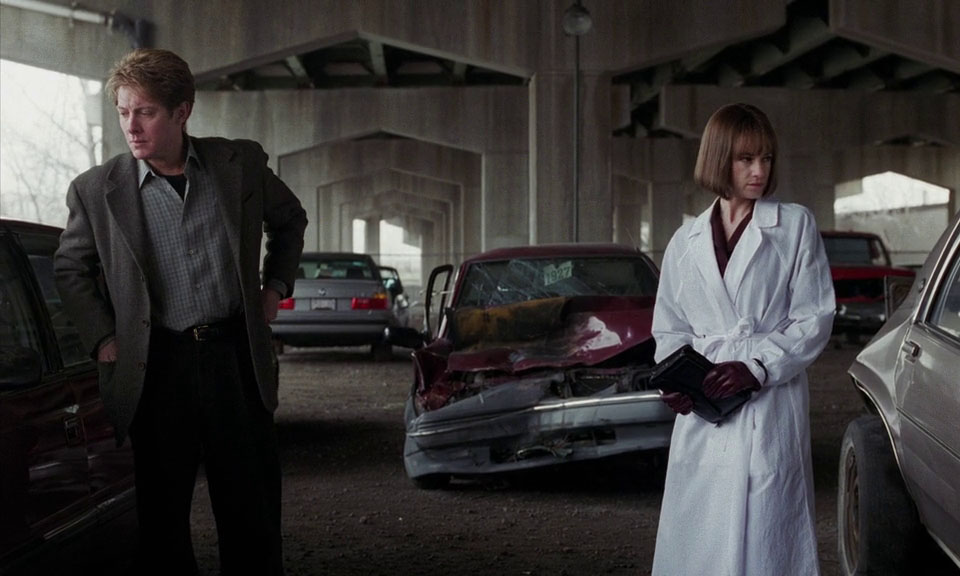
Practically double-featured this with Exotica, another mid-90’s Canadian Elias Koteas sex thriller. James Spader is a commercial producer banging his camera girl, while his wife Deborah Kara Unger (great in this) gets with some guy in an aircraft hangar – 3 sexual encounters in the movie’s first 6 minutes. After Spader kills Holly Hunter’s husband in a head-on collision, she’s pretty cool about it, making out with him when he gives her a ride, leading to another crash. All this sexual/mechanical energy attracts primo perv Vaughan (Koteas). “Vaughn makes everything look like a crime, doesn’t he?”

Thank god there were enough degenerates in Canada to bring this project to life. A movie where everyone limps, and I’m struggling to think of any two characters who didn’t end up fucking each other. As in Naked Lunch, Cronenberg took scenes from another book (The Atrocity Exhibition) and used the author’s real name as a character. It won a prize at Cannes at least, and I just recently watched Crash’s cannesmate Three Lives.

Cronenberg on political correctness: “I think as soon as you allow politics of any kind into your movie, you’re doomed as an artist.”

Good things: Holly Hunter, the backstage insult-humor camaraderie of the comedians.

Bad things: Mac laptops don’t make the startup sound when you’re simply waking them from sleep/screensaver mode. The sound guy on this film must be a Windows loyalist.

Watched at the Grand, which lost some business over their bad picture, broken air conditioner, condescending staff, sound bleed, slow lines and stupid lobby signage – next weekend I went to the Alamo.

Habitual thief marries cop, they steal baby, then every other character in the movie (his boss, his prison buddies, the Lone Biker of the Apocalypse) try to steal him back.

Some similarities to the later Wild at Heart: Nic Cage, wide-open Western locations, amour fou, people exploding. Is it just me, or is there an Evil Dead reference in the low, traveling camera move when Mrs. Arizona discovers her missing son? And the movie has a similar ending (hazy dream of a child-filled future) to 25th Hour.

Haven’t seen Holly Hunter since The Incredibles (and haven’t seen her since O Brother). Her last movie before starring in this was Swing Shift. Tex Cobb (Police Academy 4) is the Lone Biker, a bounty hunter seemingly summoned by Cage’s nightmares. Sam McMurray (a cop in C.H.U.D.) is Cage’s boss who gets punched (and thus fires Cage) for suggesting a wife-swap, then schemes to steal the stolen tyke for wife Frances McDormand. John Goodman and William Forsythe (of the Steve Gutterberg version of The Man Who Wasn’t There) are brothers who break out of prison (then in the epilogue, back into prison) assuming Cage will join them on some heists. And Trey Wilson (a baddie in Twins who died soon after) is Nathan Arizona, father of the quints, who proves to be a decent fellow at the end.