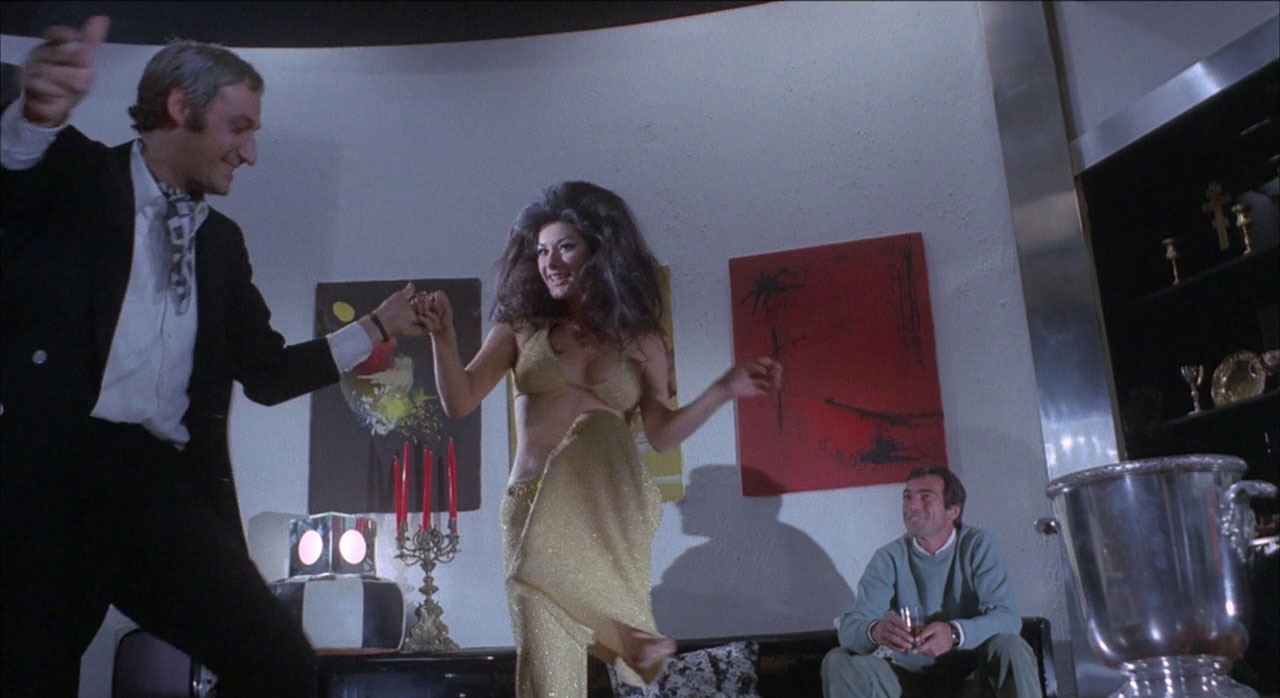
Every Shocktober you’ve gotta watch one of those illogical Italian movies with crazy use of zooms and focus and repetitive editing. Londoner “Jane” (Five Dolls star Edwige Fenech) sees murder everywhere since her miscarriage, husband “Richard” (her costar from Martino’s Strange Vice of Mrs Wardh) wants her to take her blue pills and make sweet love to him and not go to therapy. But Jane is being stalked by the blue-eyed man from her murder dreams. After he tries to kill her with an axe, neighbor May takes Jane to a group she says can help: a rapey clown cult of pale-faced people watching a guy with Freddy fingernails do animal sacrifices.

“You’ve crossed the limits of reality.” Everyone starts dying – Richard pitchforks Blue Eyes (Ivan Rassimov of Schock) then shoots his wife’s sister Barbara for trying to seduce him, the cult kills Richard, etc. Even the tidy explanatory ending doesn’t make sense, which is perfect.

Overenthusiastic girl imposes herself on a shabby traveling variety show – this is Lily: Carla Del Poggio, who worked with every 1940’s Italian director I’ve heard of, plus G.W. Pabst, who apparently enjoyed a late Italian phase. She gets hired against the wishes of star Giulietta Masina, and hijacks the show, enjoying her new popularity but getting too big for her britches almost immediately.

We end up following the little-mustached company leader Checco: Peppino De Filippo would pair up with comic star Toto for a series of comedies (including a Fellini parody) and also appear in the cool-sounding Atrocious Tales of Love and Death with Mastroianni and Piccoli. On the street after the company’s destruction, Checco meets a sharpshooter, an American trumpeter and a Brazilian singer, and recruits them to start a new show. But Masina has her own solo gig, and Lily is too ambitious, joins another company behind his back.

Codirector Lattuada made forty-some movies including the Criterion-coronated Mafioso. It’s not clear whether this Fellini debut is the half in 8½ since he co-directed, or if the half was a short film, and I’m not looking it up since I’m not a numerically-oriented film viewer. Very good visual drama, too bad the sound was synched by fifth graders.

Remarkable-looking movie with time-slippage editing. I think the Coens were taking style notes. Hopefully they took better plot notes than me – I wrote “a surreal kinda movie,” probably because it was late and I lost track of story details. Pretty gay and horny, overall. For all they didn’t care about sound sync, the Italians know good music (notably, the action moving from Italy to France doesn’t fix the sync). Brilliant cinematography by Vittorio Storaro (The Last Emperor, One From the Heart), but this only got a writing nomination(?), losing to The French Connection(??).

Trintignant is a handsome, remorseless fascist assassin who had a traumatic youth. He takes a mission to murder an old friend, he and his wife (Stefania Sandrelli, the wimpy guy’s mom in Jamón, Jamón) get into a love triangle with the friend’s daughter Dominique Sanda (who’d reunite with Sandrelli in 1900), then he betrays pretty much everyone except his wife.

Mike D’Angelo on lboxd:

I’m something of a Sorrentino apologist, but rewatching The Conformist made me realize that he’s too often wedding maximalist formalism to equally emphatic performances, hat-on-a-hat-style; here, Trintignant’s opaque stillness is at disarming odds with all the canted angles, expressionistic colors and triumphalist architecture, and it’s the contrast that conveys meaning.

Trint’s dad, in a marble nuthouse:

Getting to this movie due to its placement in the latest Sight & Sound lists. Made in between L’Avventura and L’Eclisse, this time Monica Vitti isn’t the protagonist but a third-party temptation. Main couple is Marcello Mastroianni (a few years after White Nights and Big Deal) and Jeanne Moreau (the year before Jules & Jim). Ennui at a party, ends with him on top of her in a golf course sand trap, neither still in love with the other. Won Berlin’s golden bear vs. Godard, Kurosawa – and vs. Bernhard Wicki, who acts in this as the couple’s dying friend. Richard Brody’s Criterion article is very good.

There is nothing like wordless low-light cave exploration video to put me to sleep, so despite the 93 minute runtime this took a few attempts.

It’s certainly Frammartino-ish, re-enacting a 1961 spelunking expedition but without any explanatory dialogue, and giving equal weight to the kids playing ball and the solitary death of a shepherd on the surface. Lovely ending, the last explorer in camp drawing a map of the cave hears ghost echoes of the dead old man calling his animals as the fog rolls in.

Optimistic after Argento’s Four Flies, I jumped ahead a decade to a film that I supposedly watched back in the 90’s but don’t remember at all except for the doberman scene. Editing and dialogue and acting all bad (I switched a couple times, settled on the English version), but lighting good, and that’s all you need.

Black-gloved killer vs. the lighting:

Anthony Franciosa plays an American in Italy (in Across 110th Street he played an Italian in America), a famous author on a book tour, whose acquaintances keep ending up dead. It’s a nonsensical murder mystery with at least three black-gloved killers, including the author, who then dies in a freak modern art accident. Fortunately, John Saxon is here (with a hat on!) to save the movie, the only guy onscreen having any fun. Saxon eventually gets stabbed, the sole survivor being the author’s secretary Daria Nicolodi. Other victims include the detectives, combative audience member Mirella D’Angelo (Caligula), the author’s ex, and Lara Wendel of Ghosthouse as the girl chased by dobermans.

Saxon, with hat:

Some cool camerawork, including a scene where the camera climbs the walls of an apartment building, a precursor to that Massive Attack video. The cool 1970’s synth soundtracks have devolved into 1980’s synth-rock by the Suspiria gang. Commentary guys Jones & Newman say it’s Argento’s most 80’s movie, and influenced by Possession. They supposedly love the film, and spend half their time making fun of it… I switched to McDonagh’s commentary, which was immediately better, but has too much narration. Didn’t stick around for an explanation of why Argento has his stand-in author draw attention to the sexism in his own movies.

Incredible scene:

An island murder mystery, so soon before Glass Onion comes out. Good lighting and fashion, the camera getting up in everyone’s business with help of a zoom lens, music going as big as possible… poor acting and dialogue and logic and dubbing.

The Professor has a secret formula, three other guys want him to sell it to them, then everybody starts turning up dead and being sent to the meat locker. The Professor (who also played a professor in Devil Fish) dies, of course, his widow Trudy scheming with Bad Hair Jack, then they shoot each other over the precious microfilm. I lost track of how the island-prowling loner girl was related to anyone else – played by the daughter who hung out with dangerous hippies in A Lizard in a Woman’s Skin – but she survives and gets all the money.

Why does this open with an Ethan Hawke personal intro, between the production logos and the title? The movie’s broad motivations are obscure, and I don’t buy many of its details. The music has Dead Man guitar improv vibes, and if it’d cut out those military marching band beats it might be truly great (the music, not the movie). Some kind of a cyber military thriller, mainly shot in ugly nighttime handheld digital. Pandemic-era: kissing through masks, smartphone in a freezer, disinfectant sprayed on $100 bills, a computer gets shot during a skype call. One Hawke zooms around Rome holding out his camera like it’s a gun (“shoot it so they believe it”), his revolutionary imprisoned Hawke Brother seems Nick Nolte-inspired.

Trauma drama in which a high schooler dies in a diving accident. I’d always been curious about this one for winning the Palme d’Or over Mulholland Drive, The Piano Teacher, Va Savoir, et al. Quality movie, mostly about the performances and the coping. Dad is a psychiatrist, catches abuse from his patients then abruptly quits the business. Eventually the family latches onto a girl who knew their son briefly, tries to befriend her and help her out, go on a spontaneous road trip together. It’s unusual to hear an Eno/Roedelius/Moebius song in a movie. Mia Madre feels like a superior remake, but this was good.