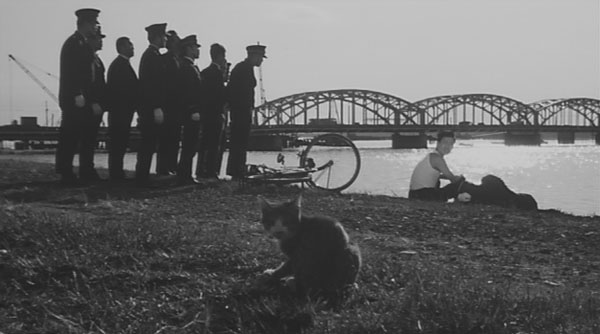
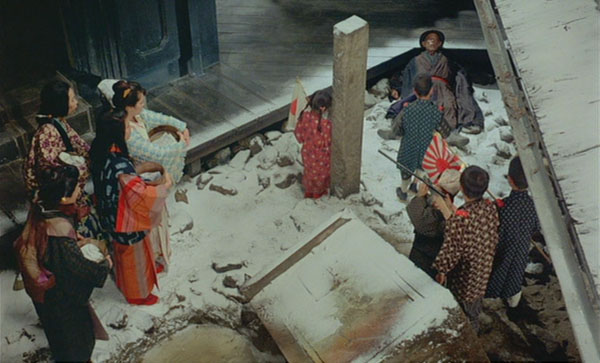
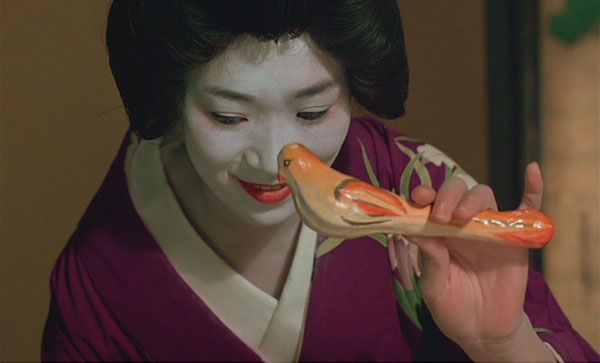
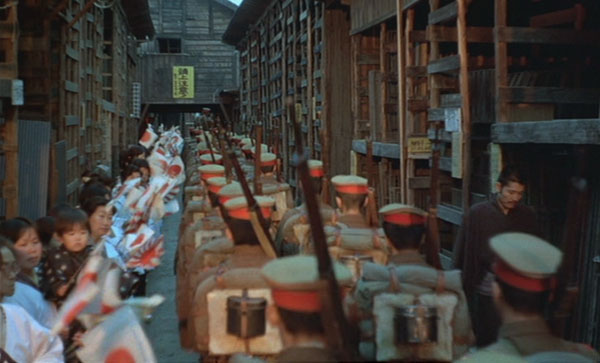
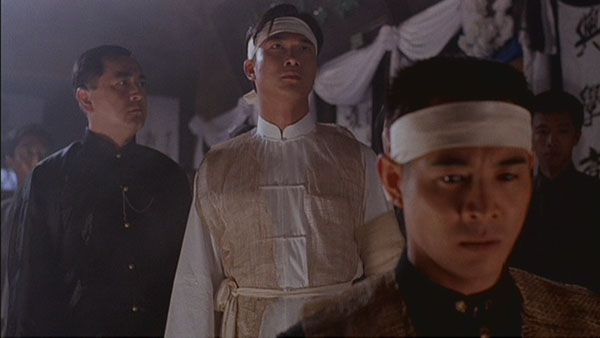
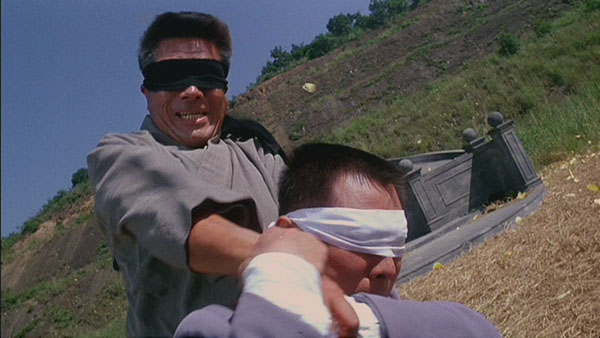
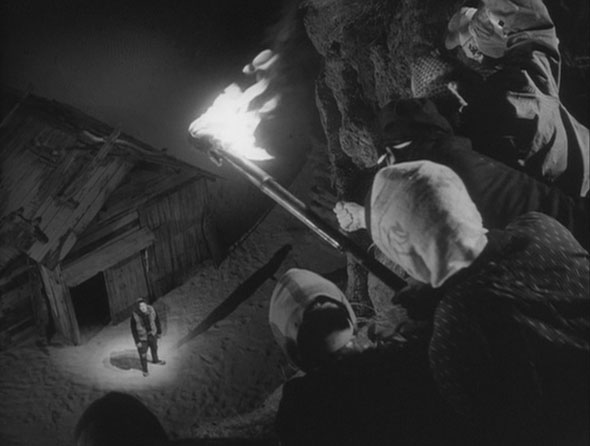
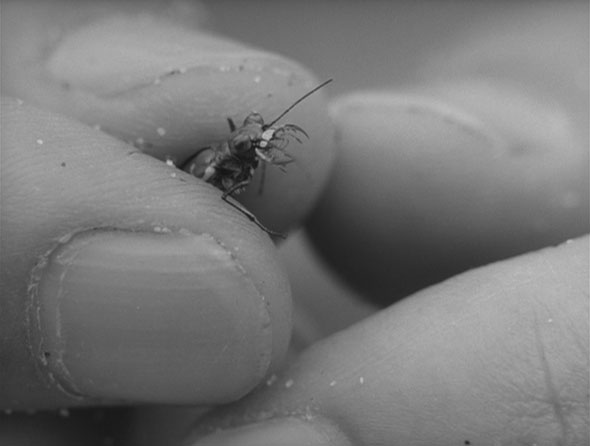
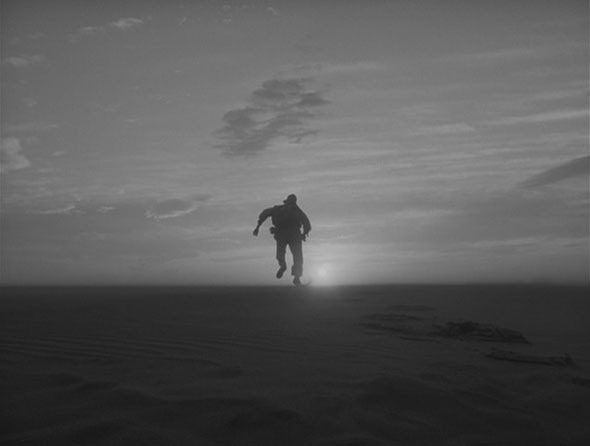
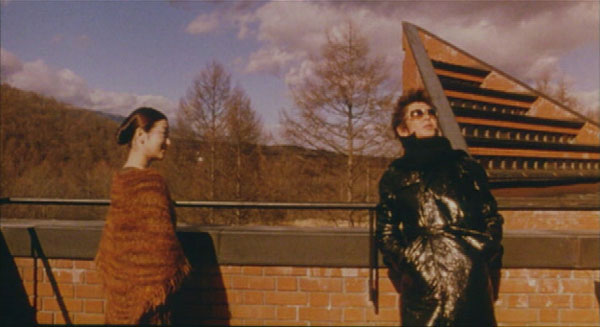
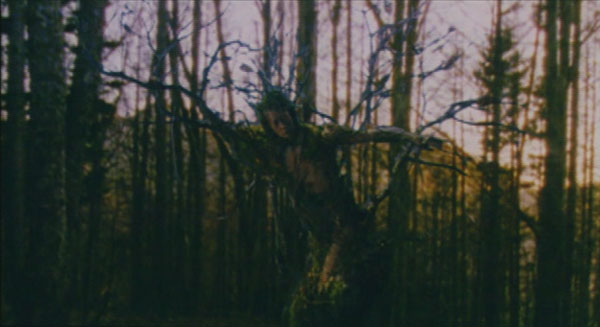
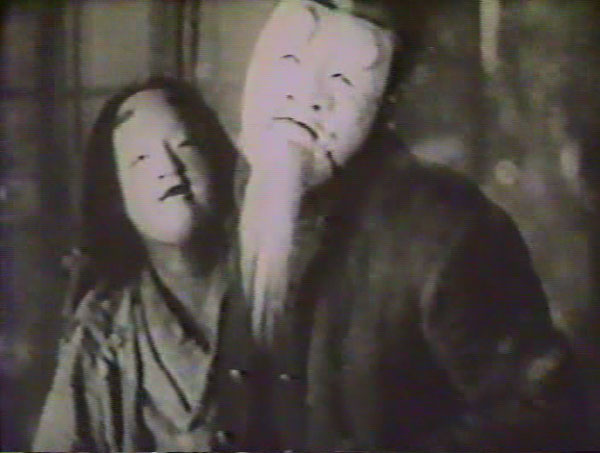
Oh man, I don’t know what happened plot-wise, but clearly (dimly) we’d have an expressionist madhouse classic to beat Cabinet of Dr. Caligari on our hands here if we had a better print copy.

image

No intertitles, and I guess I was paying more attention to images and technique than trying to puzzle through the story, so even the one-line IMDB plot-blurb “a man takes a job at an asylum with hopes of freeing his imprisoned wife” is news to me. I thought he might have always worked there, maybe he imagines she’s his wife, but he’s either hallucinating – crazy enough to be at the asylum, but gentle enough to be given menial jobs – or maybe he becomes mad from hanging out there too long, or perhaps the ending is a dream… so either Caligari or Shock Corridor.

image

Watched it with Superchunk’s score playing on the stereo. Now Superchunk are heroes of mine, but they wouldn’t be my first choice to score a bonkers dream-logic silent film… worked pretty well, but maybe next time I’ll cook up a mix CD for the occasion.

Based on a short story by Yasunari Kawabata, who has other titles with interesting names to his credit and film adaptations by Naruse, Shimizu, and Kon Ichikawa.

Kinugasa made Gate of Hell, which I think I’ve heard of, and some 100 other films. I hope somebody has looked into this.

An IMDB user: “the film makes use of every single film technique available at the time: multiple exposures and out of focus subjective point of view, tilted camera angles, fast and slow motion, expressionist lighting and superimpositions among others.” V. Petric via Midnight Eye: “These devices… are used not for their own sake but to convey complex psychological content without the aid of titles.”

Silents Are Golden has a plot description: “An elderly man, a former sailor, works voluntarily at odd jobs in a lunatic asylum where his wife is confined after having attempted to drown her baby son in a fit of madness many years ago.”

Excerpts from M. Lewinsky’s well-informed interview on Midnight Eye:

The strongest direct influence was certainly Murnau’s Last Laugh. There was much debate in Japanese film magazines about this film – it was released in Kyoto in January and in Tokyo in mid-April 1926 (A Page of Madness was shot in May 1926) – and its having no intertitles. In a published enquiry “My Favourite Film”, Kinugasa chose Last Laugh saying he had seen it five times. If you compare the two films you will find many elements and images from the German film used in A Page of Madness, but transformed and integrated in a different structure.

The comparison with Dr. Caligari is quite pointless I think. This German film from 1919, despite being popular in Japan, is too different in its mood and making, and its treatment of madness has nothing in common with A Page of Madness.

There are many instances in A Page of Madness where the film relies on benshi narration to furnish crucial information. Without narration, without dialogue, the film at times is nearly incomprehensible.

Three half-hour Tokyo-set films by three famous non-Japanese filmmakers. I didn’t read the reviews very closely but I gather that some viewers thought the Michel Gondry segment about a struggling couple moving into the city and the Bong Joon-ho segment about socially-dysfunctional residents of an earthquake-prone Tokyo were pretty good and the Leos Carax segment about a sewer-dwelling monster was awful, and some viewers agreed that the Gondry and Bong were pretty good but thought the Carax was brilliant. A fan of Carax’s Lovers on the Bridge, I assumed I’d fall into the latter group, but I wound up finding the whole experience somewhat unsatisfying. By the time I finished watching six previews and an overlong ad for the film festival through an allergy-induced headache I was ready to go home already. Then the movies themselves, a far cry from Paris, je t’aime, seemed awfully down on their host city, and the whole thing was kind of a bummer (and a digital-video-looking bummer at that).

Gondry’s bit featured a wannabe-filmmaker come to the city with his first film, which turns out to be terrible, and his girlfriend (Ayako Fujitani of the Gamera trilogy) who feels like nobody notices her. There’s fanciful talk of dreams and ghosts, and in the end she turns into a piece of furniture, a wooden chair. She’s picked up by a musician, and finally finds happiness – to be of use.

After this portrait of selfish men in an inhospitable city, Carax dives right in with a sewer-dwelling monster (Denis Lavant, of Lovers on the Bridge and Chaplin in Mister Lonely) named Merde walking the street shoving and groping people and being a general nuisance. It’s all jolly and hilarious until he finds a cache of grenades in an underground cave, and on his next rampage he blows up a bunch of people and is arrested for murder. Now we get an achingly prolonged trial where the monster is represented by a lookalike (but more posh) lawyer (Jean-François Balmer of films by Ruiz, Chabrol, Akerman), who speaks our guy’s mythic language of grunts, whines and head-slaps. It’s all over-silly and over-serious at the same time, and I don’t know what to think when the unrepentant Lavant is hung at the end.

Bong tries to restore some whimsy to the proceedings with Shaking Tokyo. His story of a shut-in (Teruyuki Kagawa, in Serpent’s Path a decade ago, starring in the new Tokyo Sonata) is at least the most Japanese of the three stories, the reclusive “hikikomori” being a recent phenomenon of that country – as far as I’m concerned, the other two movies could be set in any major city. Due to an earthquake, our guy accidentally makes eye contact with another person for the first time in a decade, and that person is substitute pizza-delivery girl Yû Aoi, who has button-like tattoos representing different emotions – when one is pushed it determines how she feels. The next day, she decides to shut herself away in her room, along with seemingly everyone else in the city, while our guy steels himself and goes outside to search for her, leading to a cutey happy ending when he presses her LOVE button. The “earthquake changes everything” conceit reminded me of Chan-Wook Park’s short Judgement, and the empty city reminded me of Pulse.

Bong: “I had an image of the people of Tokyo as oddly repressed, defensively lonely… I think I had a desire to wake them up, shake up and liberate such people. That’s where the title, Shaking Tokyo came from and how the motif of the earthquake also came about.”

I guess I’m liking the three movies better now that I’m thinking about them, but at the time they didn’t seem to be working together and I wasn’t sure what the movie’s point was. I’m sure it’ll be like Eros or Three Extremes, where the omnibus concept disappears in time and I start to think of ’em as decent individual shorts.

Sometimes I rent something because it looks like a stupid good time, and sometimes I’m very wrong and it turns out to be just painfully awful. This one would look, from the screenshots, to be at least more exciting than Sukiyaki Western Django, but it is not.

image

Ruka (above, girl with the needles in Audition) works for the cops. Inexplicably, she’s the only one who can defeat the “engineers”, berserker killers with fleshy Cronenbergian keys in their heads. She meets the original/lead engineer (Itsuji Itao of Negative Happy Chain Saw Edge, unless that’s actually an alternate title for this movie) who killed her father long ago as a hired assassin when her dad was leading some kind of union, but it turns out the cops are corrupt and wanted her dad killed so she teams up with the engineer and takes down the cops after becoming part-engineer herself (below).

image

But the plot ain’t what the movie is about. It’s about limbs being chopped off and the endless watery blood sprays that follow. Seems to steal parts of Hostel and Hellraiser in addition to the Cronenberg works. I found the movie to be headachy crap, with music that made it sound like an advertisement. Tried to compensate for its MPD Psycho-like video look with a constantly moving handicam, achieving the worst of both worlds. Wasn’t even worth watching for cool fight scenes, since the fight scenes were not cool.

Itsuji Itao:
image

The director started as a makeup/effects artist, and it shows, since that’s all he seems to care about here. He is joined by a writer of Uzumaki. Apparently, irritating teen-girl-obsessed director Sion Sono was here as an actor somewhere. and Tak Sakaguchi (star of Versus) and Takashi Shimizu (director of Ju-on/Grudge and Marebito) also appeared, I don’t know where or when.

image

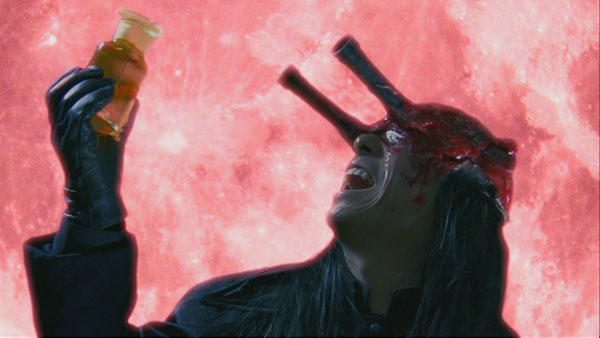
The full title (one of my all-time favorites) is Godzilla, Mothra, King Ghidorah: Giant Monsters All-Out Attack!

Sparkling print (because it’s never screened anywhere) of the English dubbed version. Dubbing is always humorous, but it was less hilarious here than in For A Few Dollars More. Maybe that’s because the dialogue here was too worthless to worry about lip-sync… 90 minutes of soapy garbage surrounding an awesome 15-minute monster movie.

imag3

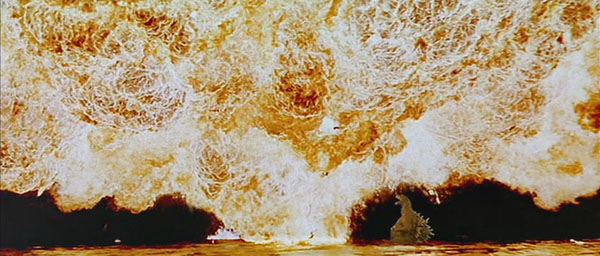
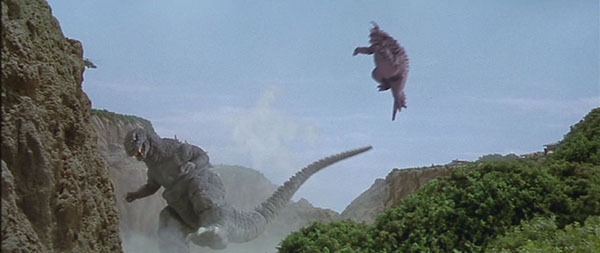
Forgetting about the garbage (it involved a disreputable docudrama production company somehow having handy all the equipment necessary to do wireless live reporting, a possible love triangle dropped early due to disinterest, a spooky old man/ghost who tells everyone about the spirits of dead soldiers trapped in some guardian stones, and somebody’s dad driving a research sub into Godzilla’s mouth to explode his insides), Godzilla is back and is fucking pissed. Reborn as a purely evil human-extermination machine with milky-white eyes and atomic breath, he easily stomps a friendly-looking burrowing Barugon halfway through the movie.

Big G. unleashes the mighty tail-flip upon Barugon:
imag3

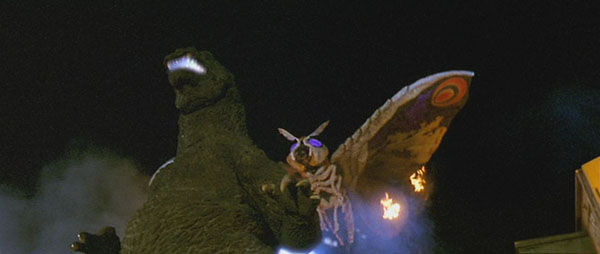
This awakens the other two guardian monsters, honestly-not-all-that-powerful Mothra and three-headed dragon Ghidorah, who head to Tokyo for the big showdown. Ghidorah’s knocked cold, then Mothra is incinerated while trying to sneak up behind G. (who sometimes seems to be toying with his opponents).

Mothra sneak-attack:
imag3

But gold-sparkly Mothra-dust descends upon Ghidorah, turning him dramatically into the golden, winged KING Ghidorah, to the cheers and applause of the sold-out Plaza Theater. King G. bullies Godzilla underwater for a bit, finally eats atomic ray, and just when all hope seems lost for humanity, that girl’s dad does his thing with the submarine.

Triumphant rebirth of Ghidorah:
imag3

Yuri, our reporter heroine, appeared in Ju-on:Grudge 2, and her boss – is that the long-haired guy? – was in Godzilla 2000, the terrible Final Wars, and Evil Dead Traps 2 & 3. The ghostly old fella is a 60’s Godzilla veteran, also appearing in King Kong Strikes Again and Farewell to the Ark. Our director made the fully-decent 1990’s Gamera trilogy, a supernatural teen live-anime thriller series called Death Note, and a pyrokinesis horror called Cross Fire which I’ve had for seven years on VHS but never watched. His D.P. shot the non-Kaneko-affiliated Mechagodzilla follow-up feature, and Tsukamoto’s Hiruko The Goblin. And the guys in the monster suits all did motion-capture acting for the Metal Gear Solid video games.

My first mid-30’s silent film. Chaplin’s Modern Times doesn’t count, and the Russian Happiness was two years earlier. Japan still had union narrators in theaters, so their cinema stayed silent longer than most.

Traveling actor Kihachi brings his troupe to the town where his ex-girl and illegitimate son live. K. has made himself scarce, sending money whenever he can, so the boy (Shinkichi, now 20) could grow up without the burden of a no-good father, and whenever Kihachi’s in town he stays with the mother and sees the boy.

Kihachi’s current woman in the troupe suspects something is up, finds out the story through bribery and sets up younger girl Otoki to go after the boss’s son. The two fall in love, and Kihachi tries to break it up, leading to the revelation that he is Shinkichi’s father. Meanwhile, constant rain means the troupe can’t perform, and finally they’re out of work long enough to have to sell off their stuff and break up. After an emotional climax, the young lovers stay behind, and Kihachi and his girl make up at the train station, heading off to form a new troupe.

Great movie, slow-building, ends up as emotional and true-feeling as the other Ozus I’ve seen. I ought to watch at least one per year. They are refreshing. Kihachi somehow stays sympathetic even though he hits everyone in the movie at some point. That’s just how he communicates, I suppose. Definitely different kinds of families here than in Tokyo Story or Equinox Flower.

This was something like Ozu’s thirtieth movie, and it’s said to be the beginning of his mature style. It’s an uncredited remake of Hollywood’s oscar-winning part-talkie The Barker from 1928, which was also remade twice in Hollywood (with Clara Bow in ’33 and Betty Grable in ’45).

Half these actors had been in Ozu’s Passing Fancy the year before. The kid had later roles in Kon Ichikawa and Seijun Suzuki movies, and his father appeared in Ozu’s own 1959 color remake Floating Weeds. Maybe Katy will watch that with me next year – Masters of Cinema’s N. Wrigley calls it the most beautiful Ozu film.

I had to interrupt this movie the first night I watched it, and I finished it the next night. In between, I was at Acapella and picked up the book on K.K. by Jerry White and flipped to the back, where he calls this movie an utter failure of storytelling. I didn’t read any more, wanted no spoilers, but I hope White at least found something to like about this one, if not the story, because I liked it quite a lot, and thought it was better than Kurosawa’s follow-up Retribution.

Starring Miki Nakatani of the Ring series and Chaos, title star of Memories of Matsuko
image

It’s similar to Retribution… a ghost-revenge story with only a few characters set in old, run-down buildings with sudden shocks and supernatural occurrences in broad daylight. Atmosphere and cinematography (by the same guy as Retribution) are ace. Movie is horror, but it doesn’t seem to know that it’s horror. As with all of Kurosawa’s movies, the genre cliches aren’t there, the music and camera and lighting and characters don’t do what you’d expect. They do get panicked and frightened, but they’ll also walk knowingly into danger and stare at the ghosts, looking slightly sad or tired, not necessarily afraid. Very cool movie, not one of Kurosawa’s very best but it’s got me looking forward to Tokyo Sonata again.

At right, Reiko’s book editor Hidetoshi Nishijima, star of License to Live, Bug House and Kitano’s Dolls
image

The story is a little baffling, but KK also wrote Charisma, so baffling ain’t unusual. Reiko’s editor gets her a quiet place in the country where she can write her next book. She meets her neighbor Yoshioka, a university professor with a 1000-year-old mummy (which moves by itself occasionally) in his room. The professor isn’t sure if this is the same mummy that was dug up 80 years ago, but he watches a time-lapse film of that previous mummy just to confuse us a little more. We’re not sure if he’s dangerous or just a crappy professor, but he seems nice enough to Reiko.

The anthropologist is Etsushi Toyokawa of The Great Yokai War and Boiling Point
image

Besides the mummy moving about, Reiko is being haunted by the ghost of a young girl. Graves are dug, bodies are carried around, a foggy pier is discovered, Reiko is vomiting black mud (this was happening before she even moved into the house) and somehow Reiko gets her book written. Her editor shows up and terrorizes her for no clear purpose until it turns out he rented the same place to a previous writer (the young ghost-girl) and murdered her. Reiko would be next but the cops bust him just in time. She burns her book and Yoshioka burns the mummy. Then they go for a walk to the foggy pier, where the ghost knocks Yoshioka into the swampy water for some reason!

Spooky loft
image

The ghost/girl isn’t in every scene, she’s just somehow in all of my captures
image

I’d heard this was a sequel to Suicide Circle, so I assumed it was a horror movie. A natural assumption, since Suicide Circle is very much a horror movie. But by no means is this a horror movie, nor is it any good at all, and it is almost three hours long, which means I could have watched two short, good horror movies instead of this one. Tragedy!

Lots of steadicam, with the low-budget video look of MPD Psycho. First hour is a bunch of teen girl crap, with Noriko getting tired of her family and wishing she was as accepted in real life as she is online, where her screen name is Mitsuko. The online community is related to the Suicide Circle cult (it’s the website with the colored dots), but besides a couple flashbacks to the intro train scene of that movie, some “Desert” posters on a wall and some dodgy explanations at the end by a group member, there’s no real mention of the events of the other movie. Instead, we are presented with a wholly different view on Sion Sono’s ideas of group and individual identity, life and death, and the social problems of modern Japan. Maybe it’s deep if you think about it long enough, but it doesn’t make for a very interesting movie, with its amateurish cinematography, excessive length and dull repetitive voiceovers about the boring family problems of teen girls.

Happier times. But WERE they really happy? Are the kids smiling? ARE THEY?
image

So, right, Noriko/Mitsuko runs away and meets her online buddy Ueno Station 54 (named after a locker full of junk she found). That’s #54, as in the 54 kids who jumped from the train station… you can look for explanations all day long, but it’s not gonna solve anything. Noriko’s sister Yuka runs away a few months later, changes her name to Yoko, and the sisters meet up in the city. With US54 they work for a family-rental business pretending to be family members of lonely people for an hourly fee. Meanwhile, their real parents are crazy with grief over their disappeared daughters, and after a year the mother kills herself so the father (Ken Mitsuishi of The Pillow Book, Chaos, Eureka, Audition, Invisible Waves) starts combing their rooms for clues and finally comes to the city to find them.

Death is no big thing in Japan
image

All is well in the family rental business. Sometimes a client kills a “family member”, as above, but there’s Kumiko/US54 on the left taking his money as if nothing special has happened. The dad gets a friend to help, moves all his stuff from the old house and sets up a new place just like it, then gets the three girls to come over, climactically bursts out of a closet and… stands there like a damned fool. Um, some cult dudes show up and pummel the friend, but dad kills ’em all with a knife. Finally the girls somewhat snap out of it, and go oh yeah it’s our dad. I think Noriko runs away again at the end. I’m probably forgetting something, but whatever.

Separated by sun
image

Hints:
– the suicides kept going after the last movie ended… they did not stop with Dessert’s final performance.
– “What about the suicide club – it’s the result of Kumiko’s grudge, right?”
– “The world is the suicide club, with far more suicides than our circle.”
– “Being close to death gives living value”
– Dad is told by a club dude at a diner: “Feel the desert. Survive the desert. That’s your role.” Get it – Desert? Dessert? Get it?? Phthhhht!

What, no floss?
image

If this was better lit you’d see “Kiyoshi Kurosawa wuz here” on the windowframe
image

“Are you connected to yourself?”

Watching for the second time (and reviewing the plot on wikipedia), I abandoned the thought that the plot would make any sense or come together in the end (the writer/director is apparently a poet, so that explains that) and enjoyed it for what it is, a bloody and effective horror movie. Movie features high-school kids dying en masse as a muddled critique of society, which I guess is why it gets compared to Battle Royale. What with the unexplainable deaths around the country, mysterious websites and themes of interconnection, I’d say it’s more similar to Pulse.

The wiki does a good job on plot, so I’ll make this quick. Pop group Dessert (aka Dessart, Desert) has annoying hit song. Backstage at their concerts, fans who are connected to themselves have patches of skin shaved off and mailed to the police, then a few days later the fans kill themselves. Female internet informant The Bat is kidnapped by flamboyant male “suicide club” leader Genesis, but I’m not sure that either of them have anything to do with anything. The cops fail to figure anything out, but a girl named Mitsuko does. At the end, instead of throwing herself under a train, she enigmatically steps aboard it, smiling at a cop, as Des(s)aert announces their final performance.

left: Ryo Ishibashi, star of Miike’s Audition, also in Big Bang Love, Kitano’s Brother, and that Masters of Horror called Dream Cruise. right: Kimiko Yo of Hou’s Café Lumière
image

Akaji Maro’s distinctive face has appeared in movies by Miike, Beat Takeshi and Seijun Suzuki, as well as the Maiku Hama trilogy and he is Ichi the Killer’s (the actor’s) dad.
image

Masatoshi Nagase is Mike Hama, also in The Hidden Blade, Pistol Opera and Mystery Train.
image

skinbag:
image

sega genesis:
image

Tonight we will be Liveblogging the Japanese horror movie House!

2 Minutes In: Already I have seen editing tricks I have never seen in a movie before (maybe because they are a bad idea), an animated opening title sequence, continuity problems, poor (or poorly translated) dialogue, and music that emphatically does not fit the action. Only 85 minutes to go!

image

10 Minutes In: Cruising the IMDB… director has made forty movies since House. This is kind of like when I discovered Takashi Miike with Ichi the Killer and realized there are FORTY more things like this somewhere in the world. Only this is much stupider. Woman who plays the grandmother (below) used to be in Imamura and Mizoguchi films, and now she’s in this.

image

20 Minutes In: Holy crap is this music ever awful. So far I am not buying that this is a horror movie. If there’s any “horror” here, it’ll be extremely goofy and everyone will turn out okay (and best friends) in the end. The visual style, editing and sound mixing are all crazed. Wipes and irises all over. And there’s cat tossing!

30 Minutes In: Definitely not a horror. I feel ripped off.

image

40 Minutes In: yep, the goofy horror has begun… but it’s SO goofy it puts Sleepaway Camp to shame. It puts The Great Yokai War to shame! This one might out-goof even Princess Raccoon!

Dead fat girl’s head, mistaken for a watermelon, flies through the air and bites another girl on the butt in front of crazy-fake backdrop:
image

50 Minutes In: I wonder if Sam Raimi might’ve seen this before making Evil Dead 2. Hmmm, and I just found an unauthorized pseudo-sequel to Evil Dead 2 from Italy called House 3/Ghosthouse. So one could rename ED2 “House 2” and form a whole new trilogy. Then we can use the American House IV to finish it off… fitting, since there was no actual House 3 in that series.

image

60 Minutes In: Movie gets tiring after a while. It’s still super goofy, I’ll give it that… not quick bursts of stylistic flourishes – they are ever-present. Must have taken an age to make, with all the insert shots and models and effects and editing nonsense going on. There was some nice piano music earlier but now it’s back to the ol’ spastic theme song. Should we be seeing nude high school girls? Is that okay?

image

70 Minutes In: They just found some sort of leather-bound book of the dead, giving credence to my sequel theories. Also, a piano just ate someone. Maybe we can replace House IV with Death Bed: The Bed That Eats. Hmmm, blood spraying out of a hole in the wall and filling the room… definitely Evil Dead 2-ish. One girl you can tell is the smart one, because she wears glasses, has her hair in no-nonsense ponytails, and knows what to do when they find a book (she reads it).

image

80+ Minutes In: I think the movie just ended, but there’s another 15 minutes on the file. Oh good, here’s a music video. Are they burning the girl’s stepmom’s head? Some voiceover craaaap about the nature of love, then illustrated credits, which I always appreciate.

image

Whew, so what was that? Some kinda teen comedy horror, I suppose. There’s an intro bit where a girl is sad that her dad is remarrying, then she tries going to camp but camp is cancelled. So she and her camp friends go off to her gramma’s house instead. But gramma is an evil witch who gains power from killing children in hilarious ways. I’m not sure who is still alive at the end because I was sleepy, but apparently the stepmom shows up at gramma’s house there, and I think maybe the main girl takes control of the witch activities and something bad happens to gramma. Whoa, I made 221 screenshots… hold on and I’ll sift through them looking for plot clues. No, it’s no clearer. But needless to say, I highly recommend this movie.

image

The director is still alive and working, but the executive producer, Tomoyuki Tanaka, creator of Godzilla?? Dead, dead, dead.