More miserable, miserable misery from the ol’ misery-monger Mizoguchi. I never like his movies, then I keep hearing they’re masterpieces so I watch another. This one and Ugetsu are universally acclaimed, and while I liked ’em better than Street of Shame and Life of Oharu, I can’t say I really liked ’em. So, laying off the Mizoguchi for a while after this.

Isn’t life torture? Sister Kyôko Kagawa was big-time, starring in movies for Akira Kurosawa and Mikio Naruse. Her mom played the wife in Equinox Flower.
image

Near Fukuoka in south of Japan in the 1100’s, this government guy who we never see is unpopular with the higher-ups because he actually wants to help people, so he’s banished to the other side of the country. His wife Tamaki packs up the kids (Zushio and his little sister Anju) to follow, and together they set off on a wonderful adventure! No just kidding, after the kids are kidnapped and sold into slavery, the wife becomes a prostitute, eventually goes blind and never sees her husband or daughter again.

Tha Bailiff:
image

Mostly focuses on the son Zushio. As a boy he learns his dad’s humanistic ways, but in the slave camp he gives in to authority, becoming a tormentor of his fellow slaves under the rule of Spiky-bearded badman Sansho. Finally he repents, takes a chance to escape (stays with ex-slave Taro, now a priest, who used to be in Zushio’s position), promising he’d be back for his sister. Z goes to Kyoto to appeal to the law, finds sympathy among men who knew his father, and they make Z a governor. He goes down and challenges Sanso’s authority, ordering all slaves freed. When Z says, “My mother and sister will be delighted. Now I can make a happy life for them,” those of us who’ve seen other Mizoguchi movies know what’s coming… he discovers his sister has drowned herself rather than face torture by the guards asking where her brother had gone (as if he’d even told her). Meanwhile mom has been living blind by the sea for years, her song “Isn’t Life Torture” about her kidnapped children spreading throughout the land, so now, having been fired from his post for trying to be nice to people, he manages to track her down and they hug each other and cry.

Zushio and the mad monk:
image

Sistercide:
image

Movie jumps back and forth in time, pretty unusual. The music, hailed on the DVD commentary for being authentic, is either tuneless twanging on a single guitar string or tuneless piercing flute.

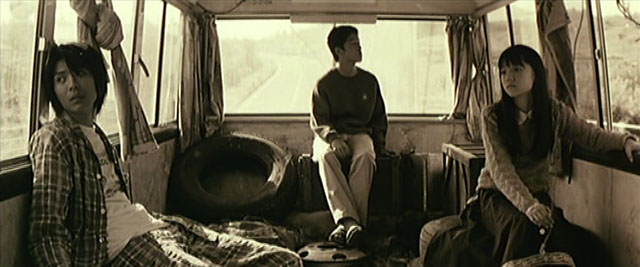
Shot by the cinematographer of Loft and Retribution. Classy, austere-looking locked-down long shots hiding behind shelves and banisters made me think this is Kurosawa’s prestige pic, hence the jury prize at Cannes and the great reviews. Closest in tone to his Bright Future, which is also the last movie of Kurosawa’s which played here theatrically, but with no sign of the crazy left turns, the never-answered questions that make his other films so maddeningly mysterious. One thing that makes this easily fit in with the rest of his movies, though, is the theme of people not connecting or communicating, not really knowing each other or themselves, as Japan crumbles around them. Kurosawa doesn’t seem like a very happy guy – but this film has a happy ending, probably his most hopeful one ever.

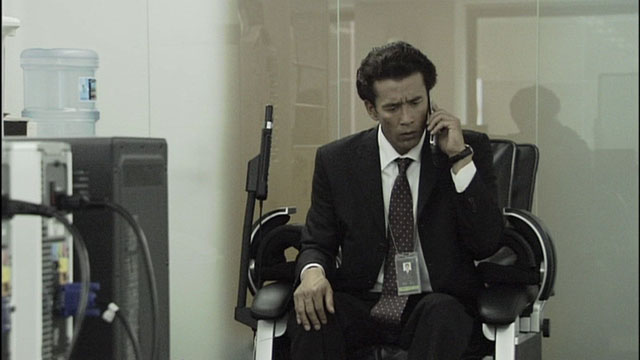
I recognized star Teruyuki Kagawa but couldn’t think which of K.K.’s movies he’d been in – turns out he’s the main dude in the earthquake/agoraphobia section of Tokyo! and the sheriff in Sukiyaki Western Django. Sasaki-san is a middle manager type, and when the company is reorganizing with layoffs, his boss asks him what skills he has, so he can be used elsewhere in the company. He gets up and starts packing. Much of the movie manages this balance between deadpan humor and realistic tragi-drama.

image

Back home to older son Takashi (Yû Koyanagi of Crows Zero), an absentee teen fuckup who decides to join the U.S. military, younger son Kenji who only wants to take piano lessons, and wife/mother Megumi who quietly tolerates all of this (and suspects her husband’s job problems) without getting any breaks or chances to express herself. Dad forbids Kenji from learning piano and gets increasingly obstinate about it, fearing a breakdown of his parental authority, so the boy takes lessons in secret. Sasaki waits in line regularly at the employment agency, hangs out at the mall, and eats lunch from a homeless/unemployed trailer every day with his laid-off buddy who has become an expert at living off his severance pay and lying to his wife.

image

As time passes, the movie gets harsher. Megumi has nightmares of her oldest son returning home shellshocked (the only dream/fantasy scene in the film), Sasaki takes a demeaning job as a janitor and when he finds out about Kenji’s piano lessons he knocks the kid down the stairs sending him to the hospital. One day K.K.’s favorite actor Kôji Yakusho (star of Charisma, Cure, Doppelganger, Retribution), a depressed ex-locksmith who decides crime is the answer to his life problems, breaks into their home and kidnaps Megumi. He’s a crappy kidnapper, but he offers her a temporary escape – she meets her husband and learns about the janitor job, then spends the rest of the day enjoying her freedom from family with the kidnapper.

image

In the morning it looks like he’s drowned himself. Returning home are the wife (who slept in a shack on the beach), her husband (who slept in the gutter, knocked down by a car while running from the mall) and Kenji (who slept in jail). Flash-forward, dad seems content at his job, mom is getting letters from Takashi, and Kenji rocks his piano recital. And thank god, because I was going to be angry at the movie if it had ended ten minutes earlier.
image

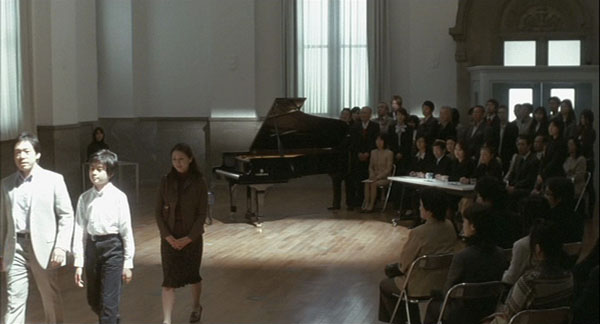
Good ones from Cinema Scope: “The outline of Kurosawa’s design is as powerful as some of the particulars within are slightly uncertain.” and on the ending as the parents proudly walk Kenji away from the piano, “Years from now, when someone goes looking for the cinematic moment that most fully embodied this troubled stretch of history, they will undoubtedly settle on this forcefully ambiguous gesture.”

Greencine: “Kurosawa’s framing is always a bit cluttered and claustrophobic, and his willingness to sit and watch for a little too long makes it seem like violent disaster is always just on the verge of breaking out. And then suddenly it does and all hell breaks out.”

Tom Mes, who should know:

Anyone familiar with Kurosawa’s body of work will know that it is often the very real ills of society and its people that give his films their power and their chill: the balding middle-aged man muttering to himself while waiting for his dry-cleaning in Cure, the lack of eye contact in dialogue scenes in Pulse, or the way a husband and wife brush reason aside in Séance. … Tokyo Sonata contains many examples of simple, mundane incidents – family dinners, job interviews, scenes from a mall and walks in the park – but they are charged with a power to distress that is unparalleled even in Kurosawa’s oeuvre. … The world has finally caught up with the films of Kiyoshi Kurosawa, and it’s a horrifying, frightening sight to behold. Tokyo Sonata would be unbearable if it weren’t the director’s masterpiece.

Kurosawa:

This film will portray a very ordinary family in modern Japan. I start from a point where lies, suspicion and a complete breakdown of communication have already established themselves within the family. Without a doubt, this is ‘modern’ and this is also ‘Japan.’ However, I would like to show a glimmer of hope in the end. Can I do that? Even if I could do so, would that be something that can save a conventional family? I just do not know. Since I do not know, I have a strong desire to make this film.

“Will they lead the same sorry lives that we have?”

image

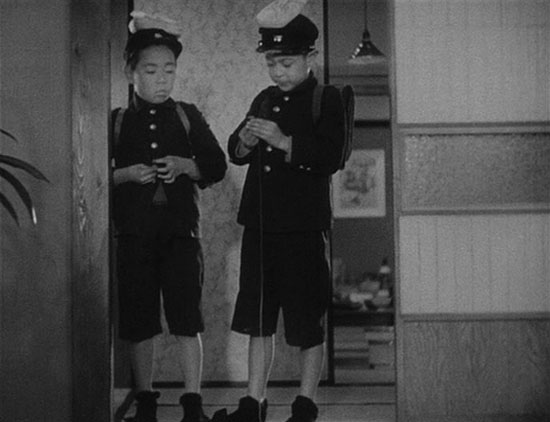
The Eclipse box set title is “Three Family Comedies” but I’d forgotten that Ozu even made comedies until the opening titles played over a drawing of a kid holding his crotch. Then my realization “oh, this will be a zany comedy featuring kids doing dirty stuff” turned out to be off base. Sure, kids are the protagonists, and it features some comedy, but it all leads to the quote above (spoken by the kids’ father) which belongs firmly in drama territory.

image

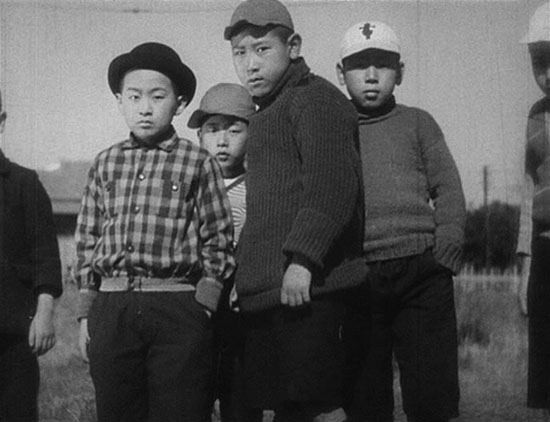
Dad’s got a new job so he moves the family close to work. Actually he moves ’em into the suburb where his boss lives, and it comes out later that dad is kind of a suck-up. The kids are intimidated by a pretty mild gang from their school until they learn to use their wooden shoes as weapons and they dominate the group. It’s kinda like the beginning of 2001: A Space Odyssey but with Japanese schoolchildren instead of apes.

image

Most of the movie seems to be this low-key power struggle with the kids which includes searching for sparrow eggs to eat raw (to prove strength) and trying to get an ‘E’ (for ‘excellent’) in calligraphy at school. A scene at the boss’s house is the turning point. Everyone is watching the boss’s home movies in which our kids’ dad is making funny faces and cracking everyone up – everyone but his kids who are ashamed that their father is playing the fool. The older boy (Ryoichi) goes home, calls dad a yellowbelly and trashes the house until he gets spanked. Moods improve later and the movie ends with the kids relatively cheery again and getting along with the boss’s son (who dresses like Oddjob).

image

One scene I didn’t get: the bully kids find a valuable coin, pool their money to make change, then hand over the change to a policeman and walk away bummed out. What happened?

image

A scene in dad’s office where the camera follows a contagious yawn made me yawn too. Yes, there is camera movement in an Ozu film. Movie is obsessed with trains and streetcars too – there’s one passing behind the action whenever possible.

image

Apparently Ozu’s Good Morning nearly thirty years later was a semi-remake.

TCM:

I Was Born, But…, which Ozu developed from his own story, is a social satire of comic delights and melancholy resignation to the innocence lost as the boys face up to the compromises that await them. The film won first prize at the Kinema Jumpo awards – the first of six such prizes he would eventually win – and is regarded as Ozu’s first genuine masterpiece.

Michael Koresky:

“I started to make a film about children and ended up with a film about grown-ups,” said Ozu, speaking to the film’s dark side. Because of this, Shochiku didn’t know what to do with the picture, even delaying its release for two months. This potent mix of comedy and pathos within the domestic space would, of course, continue to dominate Ozu’s oeuvre in the coming decades—and while the age disparity between the generations would grow smaller, the resentment gap would grow even wider.

Ah, I was right when I watched Scars of the Sun and assumed that it wasn’t Miike’s primary focus of 2006. This movie (AKA 4.6 Billion Years of Love) is where all the innovation went. After all, the man himself called this his masterpiece.

Opens with a clapboard, a guy reading poetry about light and the past and the five senses, an older fellow telling a kid about homoerotic rites of manhood, then suddenly Masanobu Ando is doing a frenetic dance against a white background. Later there are intertitles, crazy sets, unusual CGI, and an animated segment of someone frying on the electric fence.

image

Masanobu Ando also starred in Kids Return, played a villain in Battle Royale:
image

Once you unlock the story from all the craziness, it’s about two guys sent to prison together – tattooed tough-guy Kazuki (Ando) and weak, sensitive, gay Ariyoshi. K likes A and looks after him, but doesn’t quite warm to his sexual affections. Both are frustrated, yearning for escape (symbolized by their long conversation in an imaginary outdoor field in front of a pyramid and a space shuttle).

Ryuhei Matsuda (Ariyoshi) is the guy on the poster of Oshima’s Gohatto and the star of Nightmare Detective:
image

At the end it turns into a whodunit, as Ariyoshi is suspected of strangling Kazuki to death. He’s caught in the act, and tells everyone he did it but nobody believes him capable so the investigation continues.

Warden Takatsu is Ryo Ishibashi, star of Audition, recently seen in Suicide Circle:
image

But it’s not the kind of whodunit where the audience participates and could possibly guess the culprit. We’re just left to wonder “Did Ariyoshi kill him, and how?” because the other inmates don’t get much to say until after the investigation is underway. I figured Kazuki could’ve let A. kill him, a la In the Realm of the Senses, but no – it was giant Tsuchiya who works in the infirmary and regularly summons A.’s co-worker from laundry duty for sexual liasons. Even Tsuchiya didn’t think he could take Kazuki – he attacked him as a way to commit suicide, and when K. let himself die, T. took his own life a couple days (hours?) later.

image

Sounds like kind of a sad story, but the filmmaking is so invigorating there’s no time to be bummed out.

D. Kalat from TCM (?):

For a film whose premise is a homoerotic romance set in a prison, Miike has studiously avoided the obvious, the cheap, and the cliché. The prison itself is not so much a set as an abstraction—the architect appears to have run out of ink and paper before he got around to designing the usual attributes of a prison: cells, bars, walls.

image

Tom Mes:

There is a lot of meditation in Big Bang Love, Juvenile A too. It’s perhaps one of Miike’s most meditative films ever. Oddly, on the one hand, because it was produced by Hisao Maki, responsible for Silver, Family and several other of the most thick-headed turkeys in Miike’s career. Not so oddly, on the other, because it was scripted by the great Masa Nakamura, writer of Dead or Alive 2, The Bird People in China, Young Thugs: Nostalgia and several other of the very finest films in that same career. The big bang of the title is also the clash between the two furthest extremes in Miike’s filmography and the spectacle of its scattering stardust is one to behold.

Yes, but is it any good? This is a Takashi Miike film. It will make you wonder, curse, marvel, tremble, scratch your head, grow bored, and awaken rudely. Celebrate it.

Opens with the title “Are you for or against the abolition of the death penalty?”

image

Movie gets straight to the point. After reading Tony Rayns say about In the Realm of the Senses that “there is no thing as the Oshima style,” I thought I’d check out one of his earlier films and see for myself. Sure enough, this has nothing in common with it or with Empire of Passion – it’s bonkers in its own particular way.

Oshima in 1964: “An artist does not build his work on one single theme, any more than a man lives his life according to only one idea. Foolish critics, however, want to think that works have just one theme running through them. Then when they find something that contradicts that one theme, they immediately say that they don’t understand the work. Our work has nothing to do with these foolish critics. We want to put into it everything we are thinking and experiencing now; if we didn’t, creative work would have no meaning for us.”

image

R., a rapist and murderer, is hung but seems unhurt. Since his body won’t die, they rule him demented – but now he can’t be killed because a demented man can’t realize his guilt and understand punishment. The surly chaplain says they can’t even pray for him because last rites have already been administered. R. seems to have amnesia, so the men in the room (prison officials, doctor and so on) act out his crimes to jog his memory. They tell him his history, convince him he is Korean, awaken his mind and memory in order to kill him again.

image

They get really into their re-enactments – the education minister (above) imagines that he has actually killed a girl on the roof of a building and the others think him hysterical – then one by one they begin to see the dead girl – then she’s not dead at all, rises up and starts to talk with R, says she’s his sister. The men are upset because R never had a sister, but that falls by the wayside, and eventually she and R are lying on the floor apparently naked under a sheet while the men all argue and cry and hallucinate around them. It’s that kind of movie. With its loooong shots and loose, imprecise framing, single location and shouty characters, it could’ve easily been done as a play.

Akiko Koyama, an Oshima regular, as the mysterious Korean woman:
image

Oshima 1964: “Unless you see people living in their own country, their true identity escapes you. The tragedy thus grows clear; the Japanese and Koreans have superficial and uncertain views of each other, and cannot see things in their true light.”

1968: “Death By Hanging had as its starting point the events set in motion by the criminal Ri Chin’u, perpetrator of the Komatsugawa High School incident. In my opinion, Ri Chin’u was the most intelligent and sensitive youth produced by postwar Japan, as demonstrated by the collection of Ri’s letter edited by Boku Junan, “Punishment, Death and Love.” Ri’s prose ought to be included in high school textbooks. Ri, however, committed a crime and was sentenced to death. I had been thinking of devoting a work to Ri ever since he committed his crime in 1958. … We created R, a character who did not die after execution.”

1974: “In ancient times, revolutions began with the destruction of prisons. No, history called the uprisings that were strong enough to destroy the prisons “revolutions.”

R (left) with the priest played by Toshiro Ishido, the writer of Oshima’s Night and Fog in Japan:
image

“Death only has meaning if we know it is coming.”

“I don’t want to be killed by an abstraction.”

image

Recommended listening: That Man Will Not Hang by McLusky

“If you strangle me, don’t stop midway. It’s too painful afterward.”

image

Kichi runs an inn, makes explicit advances on one of his workers. They begin passionate secret, explicit, OH-so-explicit sexual affair. Eventually he leaves his wife, the girl (Sada) and he move in together having continual sex, the sex gets more dangerous and starts involving knives and choking, and finally he lets her strangle him to death.

I liked Empire of Passion so I thought I’d like Oshima’s celebrated, scandalous arthouse porno even more, but was surprised not to. It’s got less cinematic flair than Passion, and less of a story too. I hate to say it, but all that sex gets boring after a while. Okay I take it back – there’s interesting stuff in here… some cool high shots (see below), a wildly fucked dream sequence where the woman grabs a naked six-year-old’s penis and won’t let go, a geisha gang rape, and some political business (nationalism on the streets, an army march – this is the year before the bombing of Shanghai) completely ignored by our sheltered protagonists, making me think this is a predecessor to Bertolucci’s The Dreamers.

image

Finally, a ridiculous closing voiceover tells us this happened in 1936 and she was arrested a few days later. I thought this was wedged in by the producers, but in his excellent commentary, Tony Rayns tells us that’s Oshima’s own voice.

There’s more weirdness involving an egg, pubic hair consumption, fantasies of Sada killing Kichi’s wife, and a quirky dancing man. The girl has a scorpion tattoo on her ear – Tony didn’t tell us the relevance of that, so perhaps it has no relevance, because Tony knows all. The two have a fake marriage ceremony at an inn (not his inn, this is after they’ve run away) which leads to the geisha gang-rape and the quirky dancing man (below). I am already out of things to say… it’s a pretty simple movie for something so controversial.

image

Produced by Wakamatsu Koji (United Red Army), produced and suggested by Anatole Dauman (Hiroshima mon amour, Masculin Féminin, some Walerian Borowczyk features, Fruits of Passion, La Belle captive, Wings of Desire and Marker’s Level Five – wow).

Original title was Empire of the Senses. I assume the Mekons song Empire of the Senseless, with its lyrics about censorship, is referencing that. Oshima’s chosen Japanese title Ai no corrida (translated: Love’s Bullfight) looks to me like Spanish for Hey! No Running.

image

Tony Rayns:
“Oshima sees himself as standing apart from the consensus. For him, anybody who breaks the bounds of convention, anyone who dares to think for him or herself is in some sense an admirable figure,… hence an overall focus, I think, on the figure of the outlaw in many of his films.”

Most of the people in the film are women, including all the voyeurs (and there are many voyeurs). At the very beginning, a woman tries to initiate some lesbian sex with our hero and is rejected outright. Tony tells us these things explicitly delineate Senses from standard porn films.

image

More Tony:
“No two Oshima films look alike – there is no thing as the Oshima style.”

The geishas all falling upon each other as Sada has painful menstrual sex is “not a realistic detail.”

image

Girl who played Sada appeared the next year in a Kinji Fukasaku film with Sonny Chiba, otherwise not too many acting roles, while Kichi became a fairly successful actor. Typical. Although he was also a known actor before this, while she was just starting out in movies (previously in Terayama Shuji’s theater group). The actor playing an old tramp (glimped in the top screenshot) played the father in Kaneto Shindô’s Naked Island. Oshima didn’t finish his l’amour fou trilogy, and only made three more features and a couple documentaries over the next twenty years.

“Men don’t have to tell women everything.”

I love Jet Li but I think he’s been in about two good movies since the mid-90’s, so thought it was time to rent some of his early good stuff. Thought this was just okay though – an action flick given importance by tying in some historical drama. From the director of King of Beggars, Royal Tramp and The Medallion, but not as goofily comedic as those (and fortunately not as drab and dry as Jet Li’s Fearless either). This could still afford to be more fun, but I think it had a political point which I mostly missed.

image

Jet is Chen Zhen, disciple of a respected Shanghai fighting school gone to Japan to study. This is the mid-30’s and China is occupied by Japan, so when Jet starts the film by kicking the asses of thirty Japanese dudes who belittled his country, you know what direction the movie is going. Turns out his master was killed at home by a new school of rude Japanese guys so Jet returns home (followed belatedly by his Japanese girlfriend; you see Jet is beyond racism and just wants everyone to get along).

So Jet teams up with the master’s son and new clan leader Ting’en (Siu-hou Chin of Twin Warriors and the Mr. Vampire series) and cool-headed elder guy Uncle Nong (Paul Chun of Peking Opera Blues, played a king in Royal Tramp II). They talk peace and strategy, challenge some guys to some fights, and so on.

Uncle Nong, Ting’en, Jet:
image

Hmmmm, I’m thinking… okay, Jet kicks the ass of the guy who killed his master and figures out that the school’s chef poisoned the master to make him lose the match. A Japanese general kills the guy who Jet beat and takes control of the other school. Somehow involved is this guy Fumio Funakoshi (Yasuaki Kurata, also of Fist of Hero, Fist of Vengeance, Fists for Revenge and Fist of Unicorn) who challenges Jet to a blind match, which ends in a draw then Fumio respectfully bugs off. The general is not so graceful about losing, pulls a sword forcing Jet to fight back – with his belt! – and kill the guy.

image

There was also some racism business, a thing about a brothel girl who Ting’en hangs out with, a court case, and Jet pulling boxing moves in the middle of his kung-fu fights. At the end, Jet is “executed” by the Japanese, but really he’s secretly shuttled out of town with his girl. Some extremely cheesy parts – if this is better than Fearless, it’s not an awful lot better. Filmmaking seemed pretty standard, with too much editing but some good fight choreography by Yuen Woo-ping, who himself directed a Brigitte Lin movie and a Michelle Yeoh movie the same year. After Black Mask (1996) he’d start bouncing back and forth to Hollywood to help with Matrix sequels and Tarantino flicks.

image

Movie is apparently considered one of the greatest martial arts films ever (I preferred Royal Tramp) and contains references to Bruce Lee’s Fist of Fury.

Two years after The Face of Another and Pitfall, and seven years after I first fell asleep trying to watch it, I finally make it to/through Woman in the Dunes. I know that sentence makes moviewatching seem like a chore, but this was one I’ve been really looking forward to – a movie I knew I would totally love, so it might as well be saved for a special occasion, like staying home from work unable to sleep from painful poison ivy.

image

This was made in between the other two, and shares their shining, silvery black-and-white cinematography. An entomologist is allowed to stay at a woman’s house in a sand pit but is not allowed to leave. He rages against his situation, declares the sand illogical, tries to escape through cleverness and trickery, and finally (over months, years) resigns himself to it, living with her and helping to fill buckets with sand to be sold by the villagers for building material.

image

At first he doesn’t trust the woman, then he wants to help her get out, then the villagers gather around the edge of the hole offering him favors if he’ll have sex with her in front of them, and finally they’re an acting married couple, and she’s being lifted out of the hole with pregnancy complications, leaving him a chance to escape which he doesn’t take.

image

Funny enough, the same week I watched this, Criterion put out a Japanese movie from a year earlier called Insect Woman, a title this film could’ve stolen.

image

James Quandt’s essay points out the common theme of breaks in identity from Pitfall and Face of Another – the teacher gives up his life of collecting, identifying and documenting and accepts his captive life in the desert. And hey, Quandt saw the same parallel images of sand-flecked bodies between this and Hiroshima mon amour that I was noticing – good for us.

image

The man, Eiji Okada, is the same actor from Hiroshima mon amour, which is probably why that occurred to me. He later appeared in The Face of Another, Crazed Fruit, Samurai Spy, and in the last year of his life, Stairway to the Distant Past. I’m not sure who the dune woman, Kyôko Kishida, played in Ozu’s An Autumn Afternoon, but she also starred in Manji which I’d like to see.

image

image

Reasonably paced at 70 minutes. This was part of some made-for-TV or direct-to-video series of Maiku Hama stories. I think there are 12, written/directed by the likes of Alex Cox (Repo Man) and Tetsuya Nakashima (Kamikaze Girls), but this is the only one I can find…

image

I’ve had Aoyama’s critically-acclaimed, award-winning Eureka for years, but instead of finally watching it, I rented this. I’ll try not to judge him too harshly by it. Apparently shot or once presented on film (can see dirt on the print and reel-change marks), Facets proudly presents us a letterboxed, non-anamorphic, hard-subtitled, interlaced video with poor color. Thanks for that, Facets.

Mike travels to a retreat in the woods to retrieve a rich man’s daughter who has this weird idea that she’s free to marry whoever she wants. He gets slightly mixed up in the tree-worshipping new-ageyness of the place and intimidated by the woman in charge, but hey, it all turns out fine in the end.

image

I wasn’t exactly looking for a slam-bang action flick, given the slow strangeness of the last two movies in the series, but I don’t think watching Mike pad around getting in touch with his inner self is exciting enough to justify watching this. Mike is the same actor as before, Masatoshi Nagase (additionally of The Hidden Blade and Suicide Circle), and we know he can be funny, so I’m blaming the D.O.A. humor in this one on Aoyama. Kyoka Suzuki (above left) of Bullet Ballet and Zebraman plays the mysterious camp leader.

image