Esther Williams musical, feat. Apple Blossom Time, the Chiquita Banana song, Easy To Love (three times! And Esther’s in a whole separate movie called Easy To Love) and of course Inka Dinka Doo, since Jimmy Durante plays star swimmer Esther’s agent/”family friend”/wannabe-love-interest. Another wannabe: her greying boss Gordon (Dick Simmons), whom she almost marries at the end when actual love interest Dick (singer Johnny Johnston) is found to be engaged after Dick’s meddling opera-star dad Lauritz Melchior (the movie’s bad, but you can’t hold that against Lauritz) announces Dick’s engagement to another girl (soap star Mary Stuart, only in one scene). Despite this setback, Dick wins over Esther’s gramma (May Whitty, society rose gardener in Mrs. Miniver) and though I have no particular love for Dick, I’m glad Esther ends up with the only person in the movie within 25 years of her own age (besides bandleader Xavier Cugat – wouldn’t it have been great if she ended up with him instead?).
Tag: musical
All That Jazz (1979, Bob Fosse)
A singing, dancing musical fantasy taking place in the mind of a lead character confined to a hospital bed, who doubles the filmmaker’s own hospital illness/fantasies. But enough about The Singing Detective…
Bob Fosse ended up in hospital trying to obsessively re-edit his film Lenny while launching his musical Chicago, and Fosse’s stand-in Roy Scheider (the guy in Jaws whom I disliked less than Richard Dreyfuss) is in a similar fix, plus he’s juggling too many drugs and women, including ex-wife Leland Palmer (that’s the actress’s real name, also of Ken Russell’s Valentino) and dream-girl Jessica Lange. Inspired by 8 1/2, Scheider always surrounded by women in his profession and home life.
Lost the big oscars to Kramer vs. Kramer and Apocalypse Now, but still won a bunch, including editing, which it deserved. Most impressive part of the movie is the dance scenes, which include the camera and editing as part of the dance.
N. Murray:
Joe’s great curse is that he knows everything can be improved with more time and effort — himself included. More than once in the movie, he shows his work to someone who’s exasperated with him for all the time he’s taking and all the money he’s spending, and in each case, they shake their heads, annoyed to have to admit that all his fussing has made the finished product more brilliant. A skeptic might say this is Fosse congratulating himself, but it’s really more of an explanation. It’s impossible to create something as lasting as All That Jazz without doing a lot of personal and collateral damage.
Frozen (2013, Disney)
First movie watched since moving to Nebraska!
A movie with no baddies. Cursed ice-princess loses control of her snowy powers and hurts her little sister, then years later as hormonal ice-queen she dooms the whole town to endless winter and runs off. Little sister gathers hunky ice salesman and magic comic snowman (with the voice of Elder Cunningham) to set things right. There is singing.
Inside Llewyn Davis (2013, The Coens)
Oscar Isaac (Carey Mulligan’s loser husband in Drive) is a folk singer who gets by on his earnest music and pity over the suicide of his ex-partner, not on his abilities to make or keep friends or smoothly adapt to change. He sleeps at fellow folkies Jean & Jim’s place (cutie couple Justin Timberlake and Carey Mulligan) or arts patrons The Gorfeins. Llewyn may have gotten Jean pregnant, and he accidentally receives (then loses) the Gorfeins’ cat. He’s running out of career options and hastily plans a last-ditch trip to Chicago in the company of sullen actor Garrett Hedlund and grotesque blues man John Goodman, to (unsuccessfully) audition at a major club.
R. Brody: “The symbolic aspect of this sidebar is clear. The jazzman is a hardened cynic with a wound, a habit—and a career; the young actor is a self-deluding purist trapped in humiliating servitude; and for Davis, both options appear unbearable.”
Interesting how the end of Llewyn Davis is similar/opposite to the end of The Grandmaster. In Grandmaster, Ip Man has suffered and ended up alone, but we see a young guy who is obviously Bruce Lee, and the movie is telling us that Ip’s legacy and teachings will live on gloriously. In the Coen movie, Llewyn has suffered and ended up alone getting his ass kicked in an alley, but we see a young guy who is obviously Bob Dylan, and the movie is telling us Llewyn has run out of time, than his whole genre is about to be transformed and move on without him.
B. Ebiri:
The film fades to black, and the Dylan song, victorious, plays over the end credits. Somewhere along the way, you figure Dylan has been on his own, significantly luckier trajectory – maybe like the Incredible Journey that Ulysses the cat must have been on. But we didn’t see that journey. We saw the other journey — the one with some loser named Llewyn and a nameless, wounded cat. In many ways, that’s the journey the rest of us are also on.
M. Koresky:
It ought to be rather clear by now that the Coens’ body of work constitutes the closest we have to a consistent existential American cinema. This helps explain that sense of detachment in their films, often misread as condescension. Theirs is admittedly not an open-arms type of filmmaking, but no one could accuse Inside Llewyn Davis, at once their warmest and most fragile film, of treating its complicated, imperfect protagonist with disdain. From its opening shot, the camera caresses Llewyn (Oscar Isaac), who enters from frame right to meet a microphone in wait.
An American In Paris (1951, Vincente Minnelli)
We’ve got three guys who live in the same building over a cafe: painter Jerry (Gene Kelly), pianist Adam (Oscar Levant of The Band Wagon and The Barkleys of Broadway) and semi-rich guy Henri (French singer Georges Guetary). Each has a backstory, love and career aspirations, but only one is Gene Kelly so we don’t spend much time with the other guys.
The ladies: Leslie Caron (whom I recently saw in Surreal Estate) has a killer introduction via musical dream sequence. After Gene acts stalkerish towards her (as we know from watching classic movies, this is the correct approach) she starts to fall in love with him, but whoops, she’s due to marry Henri who once saved her from nazis. Rich, overconfident Nina Foch picks up Gene as his sponsor, then starts to act possessive.
So Gene and his two women take up most of the plot, but surprisingly Oscar gets a long dream sequence of his own, where he plays a dramatic piano piece conducted and accompanied and viewed by other Oscar Levants (someone has been watching Keaton’s The Playhouse). At the end Gene finds out about the whole nazi thing and grudgingly lets his girl go, then proceeds to dream himself a massive, astounding ballet (IMDB confirms Gene was a big Red Shoes fan). Sometime during the ballet Leslie must’ve had a heart-to-heart with Henri, because he brings her back to Gene at the end, leaving one happy couple, two broken-hearted rich people, and one lonely, out-of-work Oscar Levant. Then one assumes Nina pulls her sponsorship so Gene never gets his art show, and the couple lives off Leslie’s perfume-counter pay in their tiny apartment.
Written by major songwriter Alan Jay Lerner (My Fair Lady) and directed by Minnelli between The Pirate and The Band Wagon. The songs have a rocky start with the unintelligible By Strauss, then Gene’s got a great routine for I Got Rhythm but there are children interfering with the song. Finally Gene and George get in a nice version of ‘S Wonderful halfway through. Oh and Gene and Oscar sing one in the apartments where Gene dances in a doorway. But really it’s all about the three dream sequences.
J. McElhaney in Senses of Cinema:
Chris Marker has stated that when he, Alain Resnais and Ghislain Cloquet were in London in 1952 filming Les Statues meurent aussi they began every day by attending a 10am screening of An American in Paris. An American in Paris: a film which, apart from a few second-unit shots, recreates Paris entirely on Hollywood soundstages and the back lot; Les Statues meurent aussi: a documentary short on what happens to African art when it is exhibited in museums where it loses its relationship to the folk culture from which it sprang and as a result becomes lifeless, part of the “botany of death that we call culture.” In a larger sense, the short is also about the nature of art and what it (along with science and religion) means to us in our fight against death, becoming the “instrument of a desire to seize the world.” There are, of course, many ways for an artist to seize the world and consequently many ways for the artists we sometimes call filmmakers to do so as well, through the most rigorous of documentaries to the most stylised of musicals. Marker does not go into detail as to what it was he and his collaborators got out of this daily ritual of watching An American in Paris except to note the “lightness” that they felt watching the film. Consequently it may have been nothing more than a refuge from the seriousness of the work on their own obviously very serious film. But let us suppose for a moment that what these three French filmmakers saw in the faux French world of An American in Paris was a cinematic universe parallel rather than antithetical to their own, one equally possessed with a desire to seize the world and equally concerned with its own version of the “truth” but paradoxically articulating it within the realm of artifice. In the midst of a review of Francis Ford Coppola’s musical One from the Heart Serge Daney describes Coppola as working within the Minnellian idea “that a good illusionist does not ‘break’ the illusion, but constantly multiplies it, ad infinitum. The truth of a mask is not the face but an excess in the mask .. Two minuses make a plus. Two falsehoods make a truth”
Les Misérables (2012, Tom Hooper)
Oh yes it made me cry at least once. Yes I was impressed with the music. Yes some of the acting was really nice, and yes Russell Crowe seemed not to fit in. Same stuff everyone else has said, I’m sure, but two months late.
Hooper is the guy who made The King’s Speech, and has apparently let the big budget and musical numbers fog his memory of how to effectively edit a film. Huge Ackman is the former criminal, pursued unto death by supercop Crowe. Huge’s ex-employee and future oscar-winner Anna Hathaway dies a miserable prostitute, so Huge rescues her little girl Amanda Seyfried from her horrid keepers, welcome comic-relievers Helena Baron Carter and Sacha Bonham Cohen. Seyfried falls in love with Eddie Redmayne, whose doomed compatriots (including some very good young non-movie-stars who make us forget all about Seyfried for a spell) attempt another French Revolution. Huge saves his adopted daughter’s boyfriend, then suddenly dies of old age so they can carry on.
Film Comment:
This movie is by definition hobbled, with no chance of equaling Raymond Bernard’s exquisite and resonant 1934 version of the novel, which unfolded over five luxurious hours. The stylistic elegance and visual coherence of that early French cinema adaptation have been traded in for an all-out sensory assault.
Jim Emerson’s hateful review round-up was pretty hilarious. “The actors are playing to the balcony while the camera (and those wide-angle lenses) push their faces into ours. It’s like Full Metal Jacket: The Musical! with all the parts played by R. Lee Ermey.”
Up, Down, Fragile (1995, Jacques Rivette)
Weird and delightful movie with a Gang of Four/Va Savoir feel, but more so, made with the usual suspects: Pascal Bonitzer and Christine Laurent on script and Nicole Lubtchansky editing, plus Christophe Pollock (Class Relations, In Praise of Love) shooting.
We follow three women: Louise (Marianne Denicourt of La Belle Noiseuse), Ninon (Nathalie Richard, “Madame” in Never Let Me Go, also Irma Vep), and Ida (Laurence Côte of Gang of Four). Louise just got out of a hosiptal of some sort and inherited a house from her aunt. Ninon has short blonde hair, works in moped delivery. An hour in, both of them have met Roland (Andre Marcon, king in Joan the Maid), a slightly mysterious (but not too mysterious – he runs a business making theater sets down the street) stalker who knew Louise’s dead aunt and has knowledge of a secret club (of course he does). But the club really exists, and seems honestly sinister, and I’m impressed that Rivette has finally given in to his secret-society teases (though come to think of it, the one in Don’t Touch The Axe was pretty effective), but then it turns out to be kind of a joke. Meanwhile Ida just creeps about, or sits at her library job trying to remember the title of a song in her head.
A girl (Louise) and a gun:

Intrigue: Louise has a stalker, actually a bodyguard named Lucien (Bruno Todeschini, thief of Va Savoir) hired by her dad. Ninon steals cash from work and gets away with it, though her coworker who was manning the register gets fired. Roland has secret papers proving that Louise’s dad is a crook. There seems to be a lot of wordplay that isn’t translating in the subtitles. And halfway through, the movie becomes a musical!
Ninon and Louise find something to dance about:

The girls visit a nightclub called Backstage, where Vivre Sa Vie star Anna Karina is a singer (and Ninon is an electrifying dancer). It’s here that Louise gets pulled into the secret club, where she is chosen to kill another member, then given a gun filled with blanks. Bodyguard Lucien is falling for Louise, Ninon is involved with Roland, and Ida has a weird connection with Anna Karina – I’m afraid I missed the point of Ida’s role besides the joy of watching Laurence Côte. Actually that might have been the point of the entire film.

Adrian Martin on the first musical number: “Haut bas fragile is about the dream of everyday life metamorphosing – via only the slightest nudges of stylisation – into the idealised realm of art, and specifically popular-musical art. Rivette’s films, with their obsessive walkers and mannered talkers, have frequently circled this moment of ignition, but here he goes all the way: love expresses itself in ironic, playful postures and swooning falls.”

J. Rosenbaum:
All three actresses created their own characters – a procedure Rivette also followed in Out 1 and Celine and Julie Go Boating. And just as Jean-Pierre Léaud and Juliet Berto are solitaires in Out 1 and Julie is one in Celine and Julie before she meets Celine, Ida in Up Down Fragile might be described as someone who’d like to be in a musical but can’t because she doesn’t yet know who she is. The adopted daughter of provincial parents whose letters she doesn’t answer, she’s obsessed with fantasies about who her real mother might be and with tracking down a song from her early childhood, of which she remembers only fragments. (Eventually her obsession leads to a meeting with Sarah, a cabaret singer, played by Anna Karina, whom we’ve already seen in scenes with Ninon and Louise.) Narratively and musically, Ida’s in a perpetual state of becoming – the only creature to whom she’s attached is a cat. Meanwhile the other lines in the fugue are the processes by which Ninon and Louise acquire romance and friendship and thereby work their way into musical numbers, all of them various kinds of duets.
A rare director cameo:

June 2024: Watched again in HD. Some points I’d forgotten: Ida is sad that she doesn’t know who her parents are, and Roland is trying to hide the fact that Louise’s dad is a scumbag.
Lately… Nathalie Richard became a Michael Haneke regular, then a Bertrand Mandico regular, costarring in his new Conann movie… Marianne Denicourt was in a bunch by Claude Lelouch and an Agatha Christie miniseries by the Martyrs guy… Laurence Côte was just in a Virginie Efira identical twins melodrama that played Cannes… and we’re still mad at André Marcon for leaving Isabelle Huppert in Things to Come.

Lisztomania (1975, Ken Russell)
I’d heard that Criterion will be releasing this, hopefully as a precursor to the uncut The Devils, and since I so enjoyed Tommy, I thought I’d check it out. But I got my wires crossed – Criterion is putting out Quadrophenia, the other post-Tommy, Who-related feature, not Lisztomania. Their loss! My loss too, I guess, since I probably would’ve rented this again just to hear what the commentary track would say about things like this:
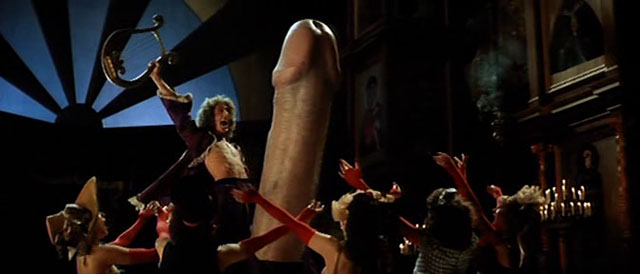
Oh but wait, my DVD does have a commentary track by a sleepy Ken Russell, who rouses himself to tell us spectacularly obvious things about once per minute – I didn’t play through very much of it.
Train vs. Piano:
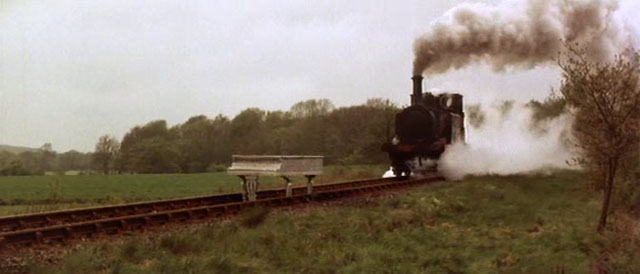
Roger Daltrey brings his boyish energy from Tommy straight into this, as enthusiastic womanizer and rock-star pianist Franz Liszt. He throws parties, hold concerts, flees from sword-wielding husbands, and generally ignores his own wife (Fiona Lewis of The Fury and Innerspace) and children. When his daughter Cosima marries his rival Richard Wagner (I already know how Russell feels about Wagner), Liszt must travel to Wagner’s castle (in a loopy Dracula parody scene) and prevent them from creating a nazi superman.
Vampiric Wagner:

Bored Liszt at home with wife:

In the middle of the film, Liszt goes to Russia and stays with Princess Carolyn (Sara Kestelman of Zardoz) in her penis-decorated palace, leading to a fantastic, cock-filled chorus-girl number. I don’t know why exactly, but Liszt joins the church (under Pope Ringo Starr) sometime later. This is what leads him to fight Wagner (Paul Nicholas, Tommy‘s sadistic cousin Kevin), who is defeated but resurrected as a Frankenstein Siegfried Hitler, who guns down Jews while Liszt’s daughter kills her dad with voodoo. But murdered Liszt returns to Earth from heaven in an angel-winged rocketship, gunning down FrankenWagner, achieving peace at last. All of this really happens. This movie is amazing.
Hitler/Wagner with electric-guitar machine-gun alongside Cosima and Superman-caped children brigade wearing Weezer/Wagner t-shirts:
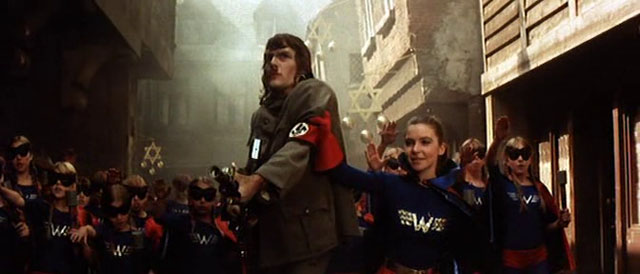
Liszt with Piano Flamethrower:

Russell: “My film isn’t biography. It comes from things I feel when I listen to the music of Wagner and Liszt, and when I think about their lives.”
The Princess:

Senses of Cinema: “By Russell’s account, producer David Puttnam interfered with the project, insisting on more pop art and less context, and also adding the painfully stupid hoedown music to the opening scene.” They also point out visual references to Eisenstein’s Ivan the Terrible in the Russian scenes.
Sun Valley Serenade (1941, H. Bruce Humberstone)
An attempted Christmas Movie with no real Christmas scenes. The story is just a pathetic thing to hang musical setpieces on, but they’re good ones, so we forgive it. A band’s pianist (ordinary John Payne) agrees to adopt an orphan as a publicity stunt but ends up with extremely smiley teenage norwegian girl Sonja Henie (who was nearly 30 when this was filmed). Supposedly he is dating the group’s new singer Lynn Bari (pin-up runner-up to Betty Grable), but his adopted daughter aims to marry him and succeeds at the end (ew).
Glenn Miller:

Payne and group – dig those shadows:

The good parts: Dorothy Dandridge sings “Chattanooga Choo-Choo” with two amazing dancers (the Nicholas Brothers) who do the splits a lot. Former Olympian Sonja Henie does some figure-skating, including an impressive-looking bit on reflective black ice. And (Katy’s favorite band leader) Glenn Miller’s orchestra gets to perform three full songs without any annoying plot interruptions. The photography on these is very good, always varying the view with some curious angles and sharp shadows. We’ll try to forget one musical number, “The Kiss Polka.”
Dandridge and Nicholas Bros:


This was Glenn Miller’s first big film, followed by Orchestra Wives the following year (also featuring the Nicholas Brothers – must watch this), followed by a fatal plane crash. Henie’s star was beginning to fall after a string of late-30’s hits. Upcoming comedian Milton Berle plays the band’s manager. Humberstone (heh) made some fifty movies, culminating in some Gordon Scott Tarzan flicks before he crept away to television.
