Watched again, this time on film, and confirmed that it’s one of the greatest movies I’ve seen this year. Fiery badass political in a more artful way than Michael Moore could ever dream, the culmination of Sissako’s filmmaking styles from Waiting For Happiness and Life On Earth merged with a long, deep-seated desire for change. Too bad it’s almost impossible to recommend as good art and entertainment to people not already interested in African cinema… they’ll never believe me. Jimmy liked it too!
Tag: politics
Sicko (2007, Michael Moore)
More consistently on-topic than any previous Moore video/film project, and even more of an illustrated essay than Fahrenheit 9/11 was.
Kinda made me cry a little. Katy liked it, too.
The War Tapes (2006, Deborah Scranton)
Harsh, harsh film. Three soldiers (Zack, Mike and Steve) get cameras to take on their tour in Iraq, filming daily activity and keeping sort of video journals. Meanwhile, camera crew in U.S. interviews their family, loved ones, and records their safe return home at the end. Tightly edited together to give an excellent, horrifying look at the war.
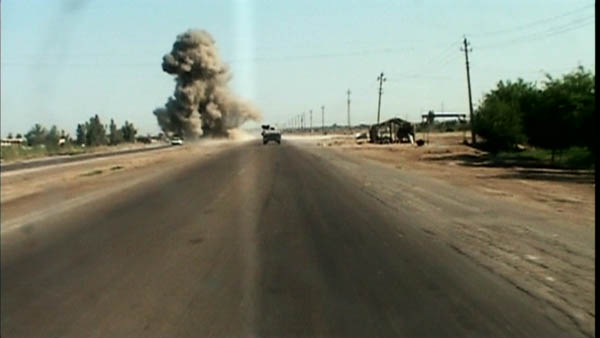
Cameras can be helmet-mounted or gun-mounted, giving a disturbingly video-game-like feel to the fighting (and there IS fighting). We see IEDs go off, civilians get hurt, US soldiers get hurt, dead rebels, grieving families. Brings home the reality of things I’d only vaguely read/heard about that are still going on (this was shot 2004). Very glad I watched, even if I felt terrible throughout.
Zach is from Lebanon, speaks Arabic, is one of the few US soldiers who can communicate with the locals, until he gets tired of having to repeat the company line to them. Mike is a pro-war go-get-em guy who signed up because of 9/11 and ended up disgusted by the experience, back at his difficult job at home. Steve is a lightweight joker reading The Nation, goes through a lot in Iraq, comes home probably with post-traumatic disorders, all a ball of bottled rage. These guys have gone to war and been messed up by it. They’re worse off, both countries are worse off. A real-life horror movie.
An IED going off:
Night-Vision Zack:

My Country My Country (2006, Laura Poitras)
“Secularism won’t give us our rights. America is secular but its democracy hasn’t achieved justice.”
All movies start with the ending now. This starts with the ending.
Documentary portrait of an Iraqi father running for political office, unsuccessfully. His (friend’s?) son gets kidnapped for ransom towards the end of the movie, safely returned, seems unconnected to the election. A muddled film giving a muddled look into the muddled political world of a muddled country. Would’ve maybe been valuable if The War Tapes hadn’t blown it away a few minutes later.
Enjoy the forced subtitles:


Movies I Watched In Kenya (Jan. 2007)
Black Book (2006, Paul Verhoeven)
Nice, twisty little nazi suspense drama. Watched on the plane, a little drowsy, so IMDB will help remember the plot details: “When the hiding place of the beautiful Jewish singer Rachel Steinn is destroyed by a stray bomb, she decides with a group of other Jews to cross the Biesbosch to the already liberated south of the Netherlands. However, their boat is intercepted by a German patrol and all the refugees are massacred. Only Rachel survives. She joins the resistance, and under the alias Ellis de Vries manages to get friendly with the German SS officer Müntze. He is very taken with her and offers her a job. Meanwhile, the resistance devise a plan to free a group of imprisoned resistance fighters with Ellis’ help. The plan is betrayed and fails miserably. Both the Resistance and the Germans blame her. She goes into hiding once more, with Müntze in tow. Together they wait for the war to end. Liberation does not bring Ellis freedom; not even when she manages to expose the real traitor. ‘Every survivor is guilty in some way.'” Edit April ’07: saw again in theaters – a real interesting movie. I definitely like it, glad Verhoeven is directing his talents away from stuff like The Hollow Man these days. Awesome final shot, with Rachel living in Israel, having moved from one besieged state to another. I don’t think Jimmy or George liked it much.
Jackass Number Two (2006, Jeff Tremaine)
Watched in the plane right after Black Book, when everyone around us was going to sleep. KLM didn’t censor it as far as I know. Completely awesome, hilarious movie. A masterpiece in its own way. Katy says I laughed too much/loud and annoyed my fellow passengers. Most other people watched that Kevin Costner movie with Ashton Kutcher for some reason.
Badlands (1973, Terrence Malick)
After a few days at the World Social Forum, finally one evening Katy and I were both awake enough to sit through a movie. I suggested Badlands, which we both ended up enjoying. Sheen kills Spacek’s father (Warren Oates) and they go on a little shooting spree before getting captured. Another quiet and beautiful movie by Terrence Malick. EDIT: JUNE 2007: after reading a great Adrian Martin article in Rouge, I realized that Malick is the only director I’ve seen whose EVERY film I would consider great… Charles Laughton excepted.
My Migrant Soul (2004, Yasmine Kabir)
On the last day at the Forum, I found the movie tent. Watched this half hour doc about a guy from Bangladesh who got a job in Malaysia in order to send money home to his family. But the guy who sends him gives him a forged passport, and he gets hard work for short periods of time, then sits idle the rest of his weeks, unable to find other work or complain to anyone without a legitimate ID, finally gets sick and dies. Sad.
Words on Water (2003, Sanjay Kak)
They’re building dams in India that destroy small towns, I guess. I fell asleep in the first ten minutes, then left the movie to wander the Forum and listen to the drumming, so I can’t tell you much more than that. Got back just before the credits when some protestors from the village are being arrested. Sad.
7 Islands and a Metro (2006, Madhusree Dutta)
I was drowsy and it didn’t make a strong impression. Some overlong shots (because the longer you hold a shot, the artsier it becomes) and some disconnected stories about Mumbai/Bombay. The director came out and said the movie reflects how people from all over got together to form this big city, and now the city is splintering into smaller communities again, without a firm focus or center (which of course reminded me of Atlanta), and told many stories of displacement, of trying to make a home in an overcrowded metropolis. I was disappointed that so many of the stories were made-up, and some of the actors were really overdoing it, as if in a soap opera. Decent enough movie I guess. Sad.
Early in the Morning (2006, Gahité Fofana)
The next day we went to the Alliance Francaise, checked out an excellent photo exhibit and saw some free movies. This one retells the true story about two kids from Mali who froze to death in the landing gear of a plane to Europe, having written a letter to Europe’s heads of state explaining that they’ve got it bad in Guinea and need some help. A well done movie, underplayed, not sensationalistic, quietly calling attention to the country’s problems without setting up some overbearing horror of war. The kids don’t even experience the war firsthand, so we don’t see it either, just hear about it in a single scene. Sad.
Bamako (2006, Abderrahmane Sissako)
Next up at the French Alliance was this awesome movie, which we wanted to see all week and surprisingly made it out to. Good thing the Alliance was walking distance from our hotel. A (mock?) trial is being held in the center of town and broadcast on the radio, with the people of Africa (Mali in particular) versus the European powers (the IMF and World Bank). A plea for debt forgiveness, for Africa to maintain its identity and stop to think how it wants to deal with foreign countries without getting exploited. Meanwhile small-town life carries on around the trial, the central story being about a family with a husband who can’t work, a wife who sings at a nightclub and their sick child. Wonderfully and humorously shot, with strange collisions of culture and a much talked-about bit where a TV movie starring Danny Glover suddenly takes over the screen. Must see again.
Garden State (2004, Zach Braff)
Katy watched on our last night in Nairobi, after the safari. I was just listening to the dialogue and music, and finally watched the second half with her. It’s an easy movie to make fun of after the fact, but while it’s playing, it’s very convincing.
Fighting Elegy (1966, Seijun Suzuki)
An action/comedy from Suzuki! Extreeeeme sexual tension leads Kiroku (lead actor from Tattooed Life) to join a fight club, and finally form his own gang and have huge fights with other groups of kids. IMDB guy says “a satire of the militaristic attitude that eventually lead Japan into WWII”. Wonderful. Watched this and 39 Steps on the portable DVD player on the flight home.
The 39 Steps (1935, Alfred Hitchcock)
Watched twice in a row, the second time with commentary. Robert Donat, a very capable leading man, gets caught up in a plot to smuggle government defense secrets out of the country when a woman he meets at a show is murdered in his apartment. He runs all over, never believed or trusted, Hitchcock’s original “wrong man”, predicting North By Northwest in structure and the final theater scene of the Man Who Knew Too Much remake during the great ending when, about to be captured again, he shouts to Mr. Memory onstage “what are the 39 steps”, revealing the plot to everyone. Very easy to watch… one of the better Hitchcocks I’ve seen, even if completely unbelievable.
The Royal Tenenbaums (2001, Wes Anderson)
For some reason, I thought about this one during the whole safari. Is it the boar’s head that Royal rehangs on the wall? I don’t know, but I was itching to see this again, and watched it as soon as we got home. One of my favorite movies ever.
The Lion King (1994, Allers & Minkoff)
Of course we thought about this one too, and watched it the next night. Didn’t finish it, though. Best not to.
The Leopard (1963, Luchino Visconti)
Here’s my email to Jimmy the next day.
———–
Time vs. The Leopard (or Burt’s Eyebrows: The Movie)
So it completely slipped my mind that I hate Italian movies, and I went to see The Leopard last night.
An IMDB reviewer says “To anyone interested in serious concerns, cinematically expressed with grace and intelligence, I would urge you to see this splendid film.”
Serious concerns? Concerns about what? About being serious? The movie is serious about being serious. It seems serious about the people of Sicily, about its sense of history and its future, and about our lead man Burt and his serious eyebrows and sideburns.
In the past few weeks I’ve watched movies by Bela Tarr, Wong Kar-Wai, and Luis Bunuel, plus The Double Life of Veronique and The Fountain. Been using all of those to think about how the movies present time, how they stretch time and contract time and enhance it and make it stop and start. It’s one of the main things movies do that other art forms don’t. It’s hard to change your sense of time with a play, with a painting.
The clock in White Hall to the left of the movie screen is stopped dead, and I liked to look over at it during The Leopard as if to confirm that the movie was frozen in a moment, that it was not progressing, that it had barely started and it was nowhere near the end. A great movie seems to fly by… I want to start it right up again after it ends, but then I notice the real time on the VCR clock, and remember that in real time, in my real day, two hours have gone by and I can’t play it again and I probably should be cleaning the office or going to bed. The Leopard left me with no such illusions. I felt the full force of all one hundred and eighty minutes… plus more minutes! The movie was even longer than it actually was! I feared that Visconti was filming new scenes while we watched, that the movie was looping itself, that the elderly couple behind me would not live to see the credits!
Nice restored print with very strong color. Good low-light and natural-light photography. The movie is a painting, with a painting’s sense of time. It wants to be looked at, but it does not propel you forward. Maybe people want this, to be slowed down, frozen in time focusing deeply on Burt Lancaster’s eyebrows and sideburns (an obsession of mine while the film was in progress), but I’m not so sure. I heard heavy sighs from the crowd, a few people left, at least one fell asleep, and some started talking and wandering around when one of them got a leg cramp. On my way out I walked past a couple discussing how the final dance sequence seemed way too long.
Was this done on purpose? As Prince Burt Fabrizio Lancaster is aging, thinking back on his life, thinking about the changes in Italy, watching the old power structure of which he is a part slowly decline, are we supposed to feel his sense of the moment stretching to the breaking point? Did the director know that the final dance sequence is way too long? Was he rudely extending the scene to force us into Burt’s mindset, to show us that from Burt’s age and position, this dressy ball is tiring and meaningless?
Sometimes when I notice that a movie is using longer-than-usual shots, I try counting shots to see just how long they are. At one point in The Leopard, I think they were running around five to six seconds on average, but it’s actually hard to count seconds in Leopard-time, which is more agonizingly slow than real time. When watching Werckmeister Harmonies (which I haven’t finished yet), I counted only eleven shots (plus or minus a couple) in the first forty minutes. And those forty minutes fly by! Bela Tarr expresses time in a mysterious and alluring way. Luchino Visconti (and Fellini, and Pasolini, and possibly Rossellini but probably not De Sica or Leone) expresses time in the most leaden way possible. I’m surprised that Visconti ever built up the energy to start filming. I’m sure, though, that he never stopped filming The Leopard, that the studio took what he’d shot so far and edited it into a movie. IMDB says he died 13 years after the movie’s release. There must be 13 years worth of deleted scenes, of sequel, of continuing ballroom dances and palaces in disrepair and golden harvest fields by moonlight, of candlelit interiors and Sicilian cityscapes at dusk, all sitting in a chest in Casa Visconti, waiting to be discovered by anyone bored enough to venture there. The ten thousand minute director’s cut!
Other notable things about the movie: Frenchman Alain Delon (of Le Samourai and L’Eclisse) as young rebel Tancredi… a DeNiro-looking priest who is omnipresent in the first half of the movie and strangely missing from the second half… all the young soldiers look like Cary Elwes… some pretty women (the prettiest of whom starred in Fellini’s 8 1/2 the same year)… and of course the lousy dubbing and sound design and the interruptive, full-of-itself Nino Rota score (Italians don’t seem to think that sound is an important part of a movie).
At the end of the movie, Burt Lancaster is old, he’s tired and he’s crying. And so am I. I drove straight home and trimmed my eyebrows.
Dr. Strangelove (1964, Stanley Kubrick)
Not much left to say about Dr. Strangelove, since I’ve nearly memorized it by now.
Groovy font on the titles.

George C. Scott is actually better than Peter Sellers in this movie.

Why We Fight (2005, Eugene Jarecki)
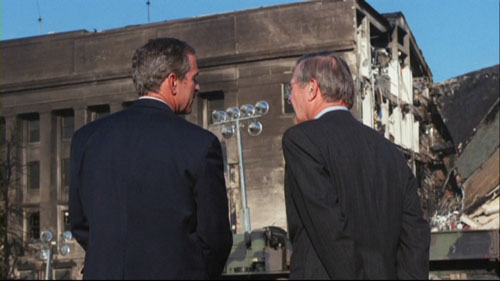
Not a good movie to watch when depressed, obviously. Patiently explains why the Iraq war and all the other countries we’ve had military dealings with since WWII are symptoms of the “unwarranted influence” of “the military-industrial complex” that Dwight Eisenhower warned against in January 1961.
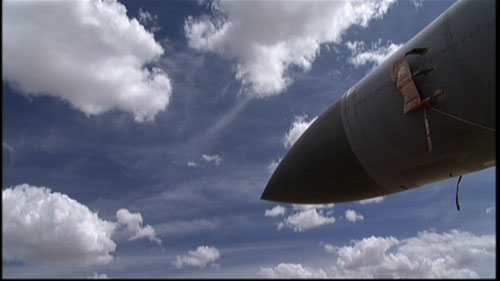
GW Bush and Cheney and Halliburton whatever. Saddam Hussein whatever. 9/11 whatever. A man whose son was killed and wrote to ask his name be written on a bomb dropped in Iraq. A woman who works at a bomb factory. Eisenhower’s descendants talking about Eisenhower. We’re all gonna die. Too bad I watched this, cuz now I can’t see Al Gore’s “An Undeniable Truth” without fucking killing myself.
Punishment Park (1971, Peter Watkins)
In The Future, political dissidents in the USA are given a choice between long jail sentences or four days at “punishment park”, a desert training ground for law enforcement officials. If they can reach a target before the cops catch them, they’re free… if caught, they go to jail anyway.
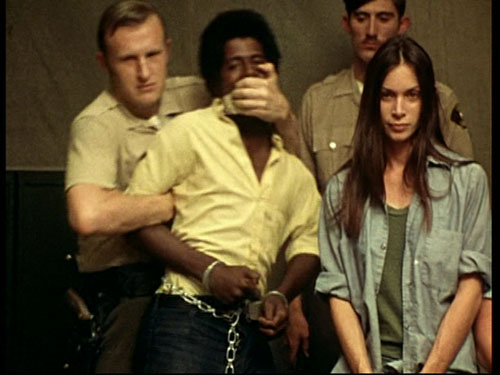
Movie has two settings… one group at punishment park, and the tribunal for the next group to be sent… flips back and forth between them. The group in “court” (a tent with card tables) is modeled on Abbie Hoffman and the Chicago Seven, with one member ending up bound and gagged. Someone in the group at the park manages to kill a guard, and after that, it’s vengeance time… the whole group is gunned down as they are caught, with the camera crew first standing by, then trying ineffectively to help.
Not as interesting as The Gladiators, I think, but a lot more straightforward. Can’t decide if I really liked it. Covers a lot of facets of 60’s radicalism, the straight world’s reaction to it, and the direction the country was going politically. Useful as an alternate-history lesson, maybe.