Lance Henriksen is sent by a corporate board of sinister white men to date and impregnate Barbara, who is afraid of her own eight year old daughter Katy, who caused an explosion to win Atlanta a basketball game. But first: bald children, wicked clouds, John Huston in an Obi-Wan robe and an unhappy-looking Franco “Django” Nero, who I found out from the closing credits was supposed to be Jesus Christ and whose opening narration sounds an awful lot like Star Wars with the names replaced by Bible characters. This all sounds nuts, and it is – a lost classic of cheesy/weirdo horror cinema revived by Drafthouse Films.

Unhappy Jesus:

After the bonkers intro it’s back to the family scene, which is playing out like We Need To Talk About Katy. Soon Katy shoots her mom (Joanne Nail of Switchblade Sisters and Full Moon High), who is then confined to a wheelchair and hires Shelley Winters (of Bloody Mama and Tentacles) as a housekeeper who might be working for God/Huston. Shelley affects nothing in the household besides bugging everyone by singing “mammy’s little baby loves shortnin’ bread” and saying things like “A great philosopher said that our characters are our fates. And some scientists now believe that planets somehow understand this.”
Shelley introduces herself and her finches:

Huston (the same year he made Wise Blood) is God, who works in mysterious ways, allows Katy to kill the Atlanta cop (The Big Heat and Experiment In Terror star Glenn Ford) investigating her mom’s shooting, then after many scenes standing on Atlanta roofs frowning at the sky (and after playing Pong on a projection screen with Katy) he finally kills her and Lance with a flock of pigeons.
Playin’ Pong with God:

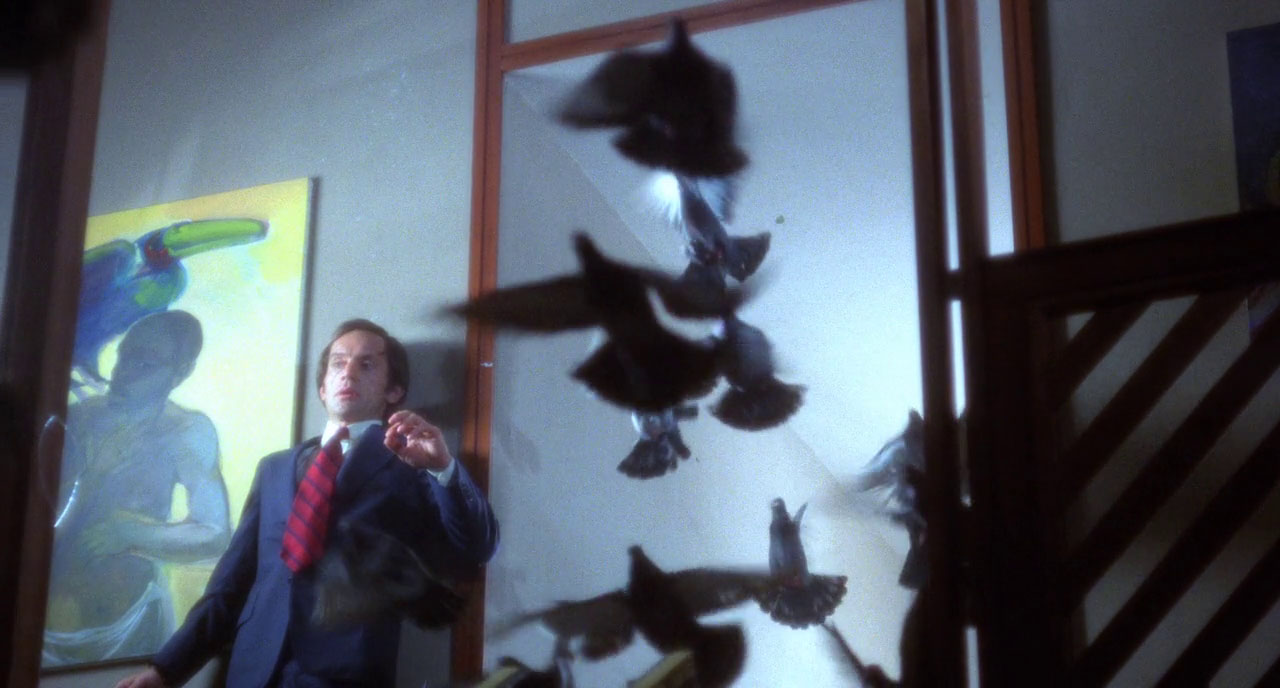
Huston looks surprised at what he’s done:

Have I mentioned that Katy’s Satan-Falcon kills a cop by messing with the street lights?

Or that between Pong and the pigeons, there’s a Lady From Shanghai funhouse scene?

Lance was just off The Omen 2, which this movie is ripping off. We’ve also got Sam Peckinpah (who I just saw in Invasion of the Body Snatchers) playing Barbara’s ex, and the leader of Lance’s white-man cabal is Mel Ferrer (of two unrelated films both called Eaten Alive). Director Paradisi had bit roles in some Fellini films, also made a movie called Spaghetti House, and cowriter Ovidio Assontis also produced Pirahna 2: The Spawning, as his IMDB bio mentions proudly. And have I mentioned this was shot in Atlanta?


