We’ve been watching bird movies. Here’s a final roundup.


Alone Among Birds (1971, Janusz Kidawa)

Ornithologist Jerzy Noskiewicz lives on a nature preserve on a West Polish lake, watching and tagging the local and migrating birds. Beautiful and very birdy short, divided into chapters, with big doom music.


Ptaki (1963, Kazimierz Karabasz)

Much more bird-appropriate music here, with light guitars and woodwinds. Doc of a homing pigeon competition – the pigeons are trucked away from their starting point then fly back and get ranked on speed. After the birds’ release the movie flies back home itself, showing a birds-eye view via aircraft. All their legbands are removed by the judges, so how does any breeder get their own bird back?


Ptak (1968, Ryszard Czekala)

Opens with a beautiful animated bird made of free-floating triangles before following a lumpy crosshatch man with weird fingers who runs the public toilets. The man is in trouble with the government, and either the toilet job is his punishment or he’s paying the fine with toilet money. He frees the bird in the end. I didn’t get it. I saw Czekala’s The Roll-Call a few years ago, and he’s kind of a depressing dude.


Birds (1968, Frans Zwartjes)

Trix is bobbing a toy bird on a string, but every five seconds the camera flash-edits to her bare legs instead, and back, and again, until despite the film’s short five-minute runtime, even Trix gets tired and goes to sleep.


Los Pajaritos (1974, Antonio Mercero)

Air pollution montage then a bunch of dead birds, oh no. Royally costumed dude trades his getup for one of the last living birds, a woman with finely sculpted hair gets the only other bird in town, and they both lose their birds and give chase to recover, until they meet up at the park with two birds, making plans to flee the city. A silly dystopia, everything over-punctuated – I guessed it was by the Telephone Box guy pretty easily. Her bird chase is fun, using ever-larger chase vehicles, recruiting everyone she sees to help, and apparently having a grand time. Both leads also appeared in Luis García Berlanga’s Placido.


Birds (2012, Gabriel Abrantes)

Meeting scene in a Haitian forest with halting dialogue. Second movie of my Birds series where someone’s spouse is transformed into an animal – this time a goat. Good closeup of a buzzard, then into town where everyone is jumping and shouting in full bird costumes. Meta-conversation accusing Abrantes of using “shitty theory.” Maybe it’s an arthouse/festfilm parody, I dunno.


Bird Karma (2018, William Salazar)

Short, snappy and cartoony, produced by Dreamworks. Water bird has all the fish he can eat, but goes after the magic golden rainbow fish. Salazar worked on this year’s oscar short winner The Boy, the Mole, the Fox and the Horse.

The Emperor’s Nightingale (1949, Jiri Trnka)

Live-action, a pent-up litle kid prevented from going outside or ever having fun gets a mechanical bird, then has a fever dream that all his toys come to stop-mo life. He proceeds to imagine that the emperor of China feels the same way, lives in a house of riches but never gets to have any real experiences. When the emp hears of the existence of nightingales, he demands one. The most accurate part of the story is when the emp gets into birds, so at his next birthday everyone gives him bird-related things – including a mechanical nightingale which glitters and sings so perfectly that he has no need for the real bird, but eventually the machine’s perfect unchanging song has the emp decrying “music without life, without meaning,” getting physically ill over the idea, until the real bird returns and heals all with its song.

Some motion and interlacing problems on my video copy – the English version adapted by Pulitzer-winning children’s author Phyllis McGinley and read by Boris Karloff. The music, by Trnka’s regular guy Václav Trojan, had a theme that sounds like “My Country ‘Tis of Thee.”

best bit is the court scientist, interrupted while counting stars, has to start over:


Water Birds (1952, Ben Sharpsteen)

You had me at “naked baby pelicans.” Disney setting nature scenes to wild music, synched to the picture like a cartoon. I disagree with the narrator calling flamingos “awkward and grotesque,” otherwise this is good, and at the end it stitches various bird movements into a ballet montage.

Narrator Winston Hibler had been a writer on Disney animated films since the late 1940’s and both Sharpsteen and composer Paul Smith had worked on Pinocchio and shorts since the early days. Editor Norman Palmer (later The Shaggy D.A.) was the new guy on the team. A ton of credited photographers, at least two of them from Wisconsin, which is where I’m writing this now. Won a two-reeler oscar against a whale hunt, a traffic safety film, and a British short that absolutely nobody remembers.


Ballet for Birds (1975, Beryl Sokoloff)

There are plenty of gulls, a piper or two, but Beryl is equally interested in the crashing waves and in passing jets. Without a zoom lens or any sustained interest in a single creature or group, we don’t get too close to any bird (or jet). Editing isn’t especially to the music/rhythm. At the end the camera gets distracted by the distorted reflections of passing humans in a curved mirror.

Set to Stravinski’s 1945 “Ebony Concerto” (which has been used in ballet). Sokoloff had been making 16mm shorts since at least the early ’60s – a Time writeup says he was “sympathetic to the aesthetics of excess.”

We went out to see three short “city symphony” docs with live music from Hotel X, part of the James River Film Fest. Joris Ivens’ Rain was pretty chill and rainy, the music wandering about aimlessly except for the guy with the rainstick who knew exactly what to do. Manhatta (1921) a sharper movie, while the music had too much melodica. Things really cooked both musically and cinematically with Jean Vigo’s À propos de Nice, then we stayed for a post-movie song with guest guitarist Gary Lucas.

I’ve written about Manhatta before. Was thinking this time that if I lived there/then, I’d like to open a haberdashery, or invent punk rock. Rain/Regen is the story of a rainfall in the city. Ivens catches some nice ripples and reflections in puddles, the downside being that the movie consists excessively of puddle shots. Nice seemed minor when watching all of Vigo’s work at once some years ago, but in this program it really shines – it’s quicker and more clever and more interested in people than buildings and landscapes. I love how many shots end as soon as the subject notices they’re being filmed (or being watched, anyway). Nice gives equal credit to camera/editor Boris Kaufman, who’d go on to shoot famous 1950’s/60’s films such as 12 Angry Men.

Blood of the Family Tree (Christine Panushka)

Symbolic animated film… maybe the MOST symbolic animated film. Red on white, cut-out humans becoming family trees. I made it less than ten minutes into this hour-long feature, up to the part where it’s just blood-related words/text on screen. Reminder not to watch movies with “inherited/generational trauma” in their descriptions.


Mud Man (Chikako Yamashiro)

People in a mud field chat vaguely, trying to understand their circumstances. They find a stock footage war scene montage over a beatbox soundtrack. Joyous movie, this is someone to watch out for.


Assemblage No. 2 (Nik Liguori)

Chiming bells… blurry closeups of flowers, then again through a prism. Experimental cinema 101.


Forms with Space and Distance and Hills (Jason Moyes)

More exp. cin. 101 – filming electric towers on Scottish hills, degrading the image, adding color filters, while messing around with a a lecturer’s voice on the soundtrack. This one worked for me though.


Beautiful Figures (Soetkin Verstegen)

Beautiful is right… figure animation on a scientific notebook. Text at right angles, nerve-rattling music on the soundtrack, tides come in and out, invisible water lines cutting characters into cross sections.


Laika (Deborah Stratman)

Deborah brings her star-person mirrors to the beach, reflecting sun and sea. Mammal-eyes shine in infra-dark. A space capsule parachuting to sea reverses, catching a thermal back into space. Sound “Laika” by Olivia Block.


Jill, Uncredited (Anthony Ing)

Background actor Jill rubs elbows with Meryl Streep, Topol, Anthony Hopkins, Mr. Bean and more. No narration, just some nice music and ka-klunk steenbeck sfx. Playing “spot Jill” becomes more fun as the movie goes on and her credits rack up, ending with a a title stating this was only 5% of her screen appearances. Reverse Shot: “Something about these many cinematic universes is exposed to be a sham. Indeed, the film’s intense attention to details that are not supposed to be noticed borders on conspiratorial.”


Looking Backward (Ben Balcom)

A hard one to describe. Stammering professor talks over depopulated images of buildings, then becomes coherent and profound when we finally see people in the stock footage. Really well done.


Light’s Return (Kathleen Rugh)

Cool frog sounds! Somebody took their camera down by the lake and filmed nothing much, then superimposed things over each other.


Der Blaue Reiter (Marcin Gizycki)

Color-field horses in motion interspersed by Kandinsky quotes and backed by dance music, ehh.


Of Wood (Owen Klatte)

Impressive work, a stop-motion carving, getting deeper into a chunk of wood as the film progresses. Relief drawings of wood-based nature and civilization advances, then a wooden human figure emerges and spends a few minutes just getting pummeled by all the objects springing from the tree (baseball bat, lincoln logs, “Between the World and Me” in hardcover) until he escapes at the end to read “Walden” under what’s left of the tree. Would’ve got the point just fine without some blocks spelling out “consume more.”


All the Blue Cats Look Like the Same Color (Wenzhe Xu)

Mannequins roam the deserted city (Scott Stark would approve), an apartment fills gradually with sand, a funeral parade mechanically walks by. Supposedly about internet slang replacing human language so I thought there’d be… any language… but I guess the lack of it is the point.


The Moon Rises During the Day (Na Li)

Abstract line patterns transmogrify across the page, sometimes forming figures, shapes, faces, and sometimes roaming free in their natural spaghetti mode.


Pigment-Dispersion Syndrome (Jennifer Reeves)

Brakhage-flicker of color blob corrosion, the occasional image relating to vision or color peeking through. Three sections with different audio: ambient music reversed, ambient music, mad science lab. Lovely.


Lo-Tech Reality (Guillermo Garcia Lopez)

Bookending narration of aliens coming to Detroit and finding no people, just vibrations. The rest is a drum loop music video of remixed urban decay, finding morse code in blinking lights and broken windows, with some nice compositions of dead buildings mirrored against the sky.


In the Big Yard Inside the Teeny-Weeny Pocket (Yoko Yuki)

“Here I am again, trapped in my sanity.” Peak Japanese cartoon-color explosion, ranting comic chaos with intertitles. Great widescreen design. I’ve gotta post this at work if it comes out on vimeo. Music by Honninman, who is on bandcamp.

I’d heard vaguely about this festival, figuring it was just another regional film fest like Atlanta but hopefully better, but suddenly I discover it’s “the oldest avant-garde and experimental film festival in North America” and that most of its programming is available online for cheap, so here we go! Alas, I tried everything to get screenshots but no luck.


Grasshopper (Jussi Eerola)

Abandoned commercial mall, the window-covering peels back and an unpopulated flashing-light dance party begins. The light rigs are often visible, and motion gets sped up and reversed. I would’ve preferred if they actually blasted dance music and re-recorded it reverberaating through these spaces, but it’s just clean techno on the soundtrack. The Finnish director previously made a TIFF documentary about nuclear power.


Language Unknown (Janelle VanderKelen)

Fade in on a fuzzy brain, pull out from a Blue Velvet ear in a field. Stop-motion eyeball in a time-lapse flower. Beautiful mushroom blooms. The spacey sounds and film scratches give the impression of a 1970’s plant invasion horror. She previously made a movie about a slug.


To Do (Saul Pankhurst)

Guy murmurs through wakeup routine then brings up The Daily Calm which triggers a high-speed desktop-cutout animation while he rattles off a to-do list (“cancel amazon prime, acknowledge my disempowering habits”). Very playful and short, the only one I watched twice. Saul’s got a fair number of things on vimeo.


Aralkum (Daniel Asadi Faezi & Mila Zhluktenko)

“Only humans remained” – a sad extinction story. But in the next scene there are farm animals. Drones stalk landlocked boats. Titles tell us about Aral Desert plant life and personal stories from when the Aral Desert was the Aral Sea, which we finally see in windowboxed archive footage, in all its fish-filled glory. Sad organ music and a sad-eyed man let us know that the desertification is a sad thing. Daniel previously made a short about a valley that became a lake, so these two films balance out.


Glazing (Lilli Carré)

Nude animation, a woman changing forms by hurling herself against the walls, short and good. The director also has books (out of print) from Fantagraphics and teaches in Los Angeles.


Eclipsis (Tania Hernández Velasco)

Nervous string music and whispering narrator accompanies a study of Mexican butterflies, a report on one non-migratory monarch who can only be distinguished from others by ultraviolet light, and their hallucinogenic effect on humans. Then unfortunately the music goes away and we spend some time in close-up with a dancer pretending to be a butterfly. Some nice prismatic insect-eye views and wing pattern closeups. She previously made an hourlong leftist farming documentary.


Diomysus (Emily Elizabeth Morus-Jones)

Short interview doc on polyamory using mouse puppets. A bit of silliness.


11 (Vuk Jevremovic)

Peak animation by Vuk, absolutely wild color and lines and paint, even a callback to his Panther. I’d like it even more if it wasn’t about how soccer is the representation and culmination of all global endeavor, with huge bombastic music.


Super Natural (Jorge Jácome)

I’m lumping the two features I started watching in with the shorts, since I only sampled them. Normally this would mean I wouldn’t include them at all, but it’s my blog, and I can change the rules if I want.

Very patience-testing intro, soft new-age music with subtitled conversation about nothing under softly shifting color fields with major banding issues. Then surveillance footage, then video of dudes sleeping and sea spiders, the subtitles all vaguely friendly affirmations accompanied by an electro-chirp sound. It’s weirdly peaceful but entirely useless to me – I imagine the World’s Fair girl falling asleep to it. I did enjoy some drawings of birds as seen through a spherical magnifier, but at the half-hour chapter heading I skipped to the end.

I guess this was about disability and affect. Jácome is Portuguese, had a previous feature with a confusing plot description on the Criterion channel.


Roses, Pink and Blue (Julia Yezbick)

Ringing drone sounds with singing at the end, one-word-at-a-time titles telling the story of a girl’s balloon that flew away on a beach trip. No big deal. Our friend the psychedelic monarch butterfly makes a brief appearance. Yezbick has worked with the Sensory Ethnography Lab.


South Los Angeles Street (Leighton Pierce)

The Avant-Garde Balcony Movie, sans conversations with neighbors, just perched at a window watching cars and helicopters. The description calls it “acoustically rich and visually stunning,” but I wouldn’t. First I’ve seen from Pierce since Nashville in 2008.


Arrest in Flight (Adrian Flury)

A seeming reference to the Battles video I watched last week, the one with the escalator. Someone is having a helluva time glitching out their 3D software… but there’s also stop-motion in here and it’s upsetting when I can’t tell which is which. Chairs and stairs and a vacuum-powered pair of legs cavort in a a dollhouse set. Otherworldly. Swiss.


Mangrove School (Filipa César)

Mangrove leaves make excellent cable ties. Long take of someone tying up branches while a voiceover tells us the Portuguese tried to murder children by bombing schools when Guinea was fighting for independence. More quiet branch work by the river, making me very sleepy until it ends with applause. César’s feature Spell Reel is on my radar, and the cinematographer worked on Outside Noise.


Camera Test (Siegfried A. Fruhauf)

A nice eyewash/brainwash… green leader, quick L-R shot out a train window, black, same shot flopped R-L, green, etc, etc, with chugging train(?) noise on the soundtrack. Water and trees, with less horizontal motion in the middle half. Fruhauf has made dozens of shorts, some collected on an Index DVD.


2 Cent 10 Coil (Monteith McCollum)

Black-masked strips of printed words telling of a trip to Alaska. Extreme textural closeups of who-knows-what, objects that seem to breathe, microscope exams of stamps and coins. Reminds me I haven’t seen anything by David Gatten in a while. The closing credits tell us the source of all texts and tools and objects, nice.


No Thoughts Head Empty (Quinn Franks)

Machinima Velma has a migraine.

Moomin (Zach Dorn)
Desktop video (cellphone in portrait mode) dude telling story of trying to win a claw-game moomin for his Canadian girlfriend. After they break up he combs through their text messages emphasizing the in-joke importance of the moomin, then fails to win one in an online app. Fine as a short opener, demonstrates the difference between cute and good.

Love at First Byte (Felizitas Hoffmann & Theresa Hoffmann)
Sentient public transit surveillance system falls in love with a passenger. Blurry and repetitive, Katy has tried to forget this ever happened.

Example #35 (Lucía Malandro & Daniel D. Saucedo)
Cubans love Santiago Alvarez! Reversed and inverted images, okay, but leave your colonoscopy footage at home, please.

No Elements (Barbara VojtaÅ¡áková)
A broken-up couple had shot lots of film around the city and down by the river, her film project that he’d picked up during their relationship and now wants to take over and complete, while she is ambivalent. Nice reversed-footage tricks.

While The Night Falls (Amir Aether Valen)
You Are Not Here (Nastia Korkia)

Afraid I didn’t take notes on these two, but recall that Katy was concerned about consent in the Russian funeral film. That movie’s director Korkia was returning to T/F after her feature GES-2 played last year.

One-Tenth of a Millimeter Apart (2021, Wong Kar-wai)

Making a Wong film out of outtakes fom other Wong films. It’s a cute idea – pushes its egg-metaphor too much, but gives us some scenes that I honestly can’t recall if/how they existed in the source features since I don’t watch his movies often enough.


Wandering (2021, Tsai Ming-liang)

A woman walks through Tsai’s installation, watching a scene from each of the eight Walker films, alone except when the director appears at the end, transfixed by his own footage of Lee in a bath. A nice introduction and/or culmination to the slow monk project, with some new-to-me scenes, including a non-Lee monk in a white void.


Redemption (2013, Miguel Gomes)

Four sections of archive footage illustrating narrated letters from the past. The end credits is where things get exciting, revealing the narrators and the letter writers (Maren Ade reading Angela Merkel!) then immediately revealing that all the letters were made-up. Per Vadim Rizov in Filmmaker, the letters are by “some of contemporary Europe’s least-liked leaders,” and the end result “a sympathetic but also fundamentally facile experiment.”


Dead Flash (2021, Bertrand Mandico)

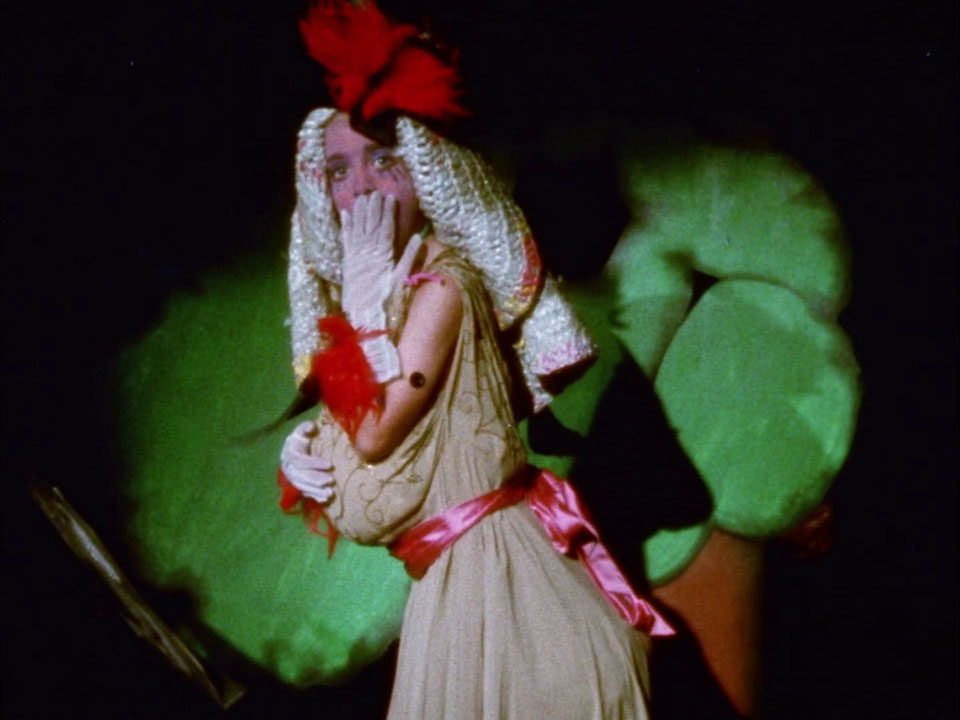
A scrapbook for Mandico completists – rushes and backgrounds with a mood-music mixtape. Extended shots of a multiple-stabbed dude, a double-dicked light-up crystal statue, the usual. Then the second half is ape-people as model and photographer (both played by Elina Löwensohn) in split screen with dialogue (“I want you to magnify this dirty memory”).

Fellow Mandico completist Gianni helps spot the source films on lboxd:

Outtakes from previous shorts (Extazus, Niemand, A Rebours and HuyswomansHuyswomans is reproposed integrally) plus a brand-new short film about two anthropomorphic monkeys … the outtakes of Extazus have been released separately in a dvd box-set – Ultra Pulpe et autre chairs – with the title of A Black Sunset Upon a Violet Desert.


bonus shorts from Criterion Channel:

Dream City (1983, Ulysses Jenkins)

Music and theater performances and other assorted stuff, mixed together with muddy sound recording and early video chroma effects.


Black Journal: Alice Coltrane (1970, Stan Lathan)

Short, effective doc portrait on Alice at home and playing music. Beyond a few photographs previously seen, this is now everything I know about Alice.


And we got access to that animation streaming site that I already forgot the name of, and watched two of this year’s oscar-nominated shorts that I already forgot the name of.

Hidden (2020, Jafar Panahi)

Meta-remake of Panahi’s Three Faces. Camera 1 is a dash-mounted phone, Camera 2 is held by his daughter Solmaz in the back seat. A woman they know has asked them to help convince a girl with an incredible singing voice to join a theater group, but the girl’s mom won’t let her leave the house and keeps her hidden behind a sheet.


Where Are You, Jafar Panahi (2016, Jafar Panahi)

The most heated I’ve seen Panahi, who rants about the government preventing him from making dramas about social issues and saying they force him to turn the camera on himself. Majid Barzegar in the car, I assume they’re talking about his film A Very Ordinary Citizen, from which Panahi’s cowriting credit was removed. The reason for the drive is to visit Kiarostami’s grave, but Panahi doesn’t get out of the car, sends Barzegar alone with the flowers.


Letter From Your Far-Off Country (2020, Suneil Sanzgiri)

Writing, culture, politics in India… stock footage and mothlighting and history. Some things I haven’t seen before: rotating 3D models within a film frame with sprocket holes, seamless blending of different techs and formats. I got lost in the names and events, but it’s a cool and dense piece.


At Home But Not At Home (2020, Suneil Sanzgiri)

More history, Goa vs. Portugal. Full of scenes from classic films. Titles printed in the center of screen give translation or context or philosophy. Good music in both of these.


Vever (2018, Deborah Stratman)

This fits in surprisingly well with the previous few, with philosophical titles in center screen and big music. Color film from 1975 Guatemala, a phone interview with the cinematographer. This turned out to be a mix of some big-time artists – footage and interview by Barbara Hammer, text/audio by Maya Deren, drawings and music by Teiji Ito.


Sycorax (2021, Patino & Pineiro)

They sit in a public square, “casting” their Tempest from the townsfolk passing by, but no Witch Sycorax is found so they hold tryouts… 14 women and we watch the whole thing. Another collaboration – theater and trees, featuring some really nice nature crossfades and very green fern branches.


No Archive Can Restore You (2020, Onyeka Igwe)

Either these are outtakes from A So-Called Archive or Igwe has found another abandoned, termite-infested media library. “Commerce, gentlemen – commerce brought us to Africa.” Slow roving camera, the audio is sounds that might’ve once filled the spaces.

The Realist (2013)

Intense flicker film, Ken Jacobs style. I think they’re stills, flickering between two perspectives not very far apart, like wearing 3D glasses and opening just one eye, then just the other. All mannequins, sometimes telling a male-gaze story, more often just taking in the scenery. Looks like unstaged setups at first, guy wandering into the mall with a camera, but gets increasingly posed – mannequins in a gallery against suit-fabric backgrounds… hands floating in a swimming pool. If I’m not reading too much narrative into it, seems to follow a sharp-dressed man leaving his modeling gig and hitting the gray city, dreaming wistfully of all the colors in the world, and getting hit by a truck and going to mannequin heaven.

Nicely synched to orchestral music (it figures that the one time I approve of an a/g film soundtrack it turns out to come from a Tzadik album). As with the timelapse movies, getting good stills from this is impossible, since the best bits occur between the frames, joined by the flicker edits. This would’ve been a lot of flicker to see in a theater – even on my laptop a couple of shots made my stomach flip. He thanks Lewis Klahr, yep. The artist describes it as a “doomed love story,” says the film is named after a 1950’s stereo camera. Michael Sicinski wrote about this in Mubi, comparing it to the only Kubelka film I’ve (barely) seen.

The neighbors definitely think he’s a murderer if they saw him filming this in the yard:


Traces 1-5 (2012)

More flicker photography with alternating frames of different halves of a photograph. This time instead of beautiful music, we get helicoptering static, the sound of the photos overlapping onto the optical soundtrack. Usually I’m against punishing a/g soundtracks but in this movie, without the the interest of the mannequins and bright fabrics, he’s filming rocks and leaves and sidewalks, so “hearing” the images is the most engaging part. Not the same work as Traces/Legacy (2015), which Sicinski also wrote about… this won an award at the Ann Arbor Fest, which I am only just discovering is an experimental fest with online screenings in March.


Speechless (2008)

The flickeriest, most melty-abstract one yet, and it’s built around extreme closeups of vulvas (taken from medical viewmaster slides!), edited against other textures (beach grass <> pubic hair), the music a pleasant drone.


Noema (1998)

Looped shots of people and camera changing position in porn films, the moments between the action, with a lock-groove score… then a montage of scene-change pillow shots with the sound of an event audience. The artist: “the repetitive and curious iterations of movement become furtive searches for meaning within their own blandness.”