I figured double-featuring this film maudit with The Sixth Sense would mean that at worst, only half of my evening would be wasted. Most people agree this is terrible, but as an established Trap enjoyer, maybe I’d join the sickos calling it a masterpiece? Turns out I’m in an even smaller group: those who thought it was fine. A solidly constructed, terrifically shot thriller showcasing the most idiotic human behavior. Maybe idiocy is the point – this isn’t humanity at its finest, it’s the same dummies who choked the planet into violently defending itself – but there’s no excuse for those two stupid boys knocking at the cabin until they get shotgunned, or for Zooey Deschanel. All told, a slight improvement on Long Weekend (The Happening of the 1970s, which shows up on best horror lists).

Opens with the Cabin in the Woods girl on a park bench as the mass suicides begin in the densest cities and spread into ever less-populous spaces. Marky (whose brother Duddits was in Sixth Sense) is dismissed by Principal Cameron, then he and Zooey take colleague John Leguizamo’s daughter so John can go on a doomed hero mission towards his wife in New Jersey (the garden state, oh no). The three get a ride from hotdog-obsessed plant growers. Marky tries to make everything about himself, but the hotdog husband (Turturro’s evil brother in O Brother) has a good sense of what’s going on, while TV news hosts blame the government. Later they get a meal from an ornery white-haired woman (The Horde’s psychiatrist in Split) who refuses all news from the outside.

“Be scientific, douchebag” – the movie has a healthy sense of humor about itself, Marky talks to a plastic plant like it’s holding him hostage, and of course characters try to run away from the wind. Some disquieting death scenes via gun and glass and lawnmower, multiple oblique 9/11 references. Victims’ language malfunctions right before death – this the same year as Pontypool.

Adam Nayman in Cinema Scope calls it “deeply stupid”:

This idea of needing to split off from the herd to survive is endemic to the apocalypse sub-genre, but it has a greater significance for Shyamalan. Simply put, the guy has an isolation fetish … when Elliot concludes, “We’ve got to get away from other people,” it’s more than a plot point: it’s the author’s rallying cry.

Dude survives the suicide pact with his now-dead girlfriend thanks to three blood donors: architect Eric, cop Lok, and cute girl with mental illness Joy. Now they’re all seeing blood visions and being haunted by the bald-capped dead girl. This drives them all nuts – Eric throws blood around at the girl’s funeral, a possessed Lok kills his dad, both men (and the surviving lover) die and Joy ends up in an asylum. Grim movie, to the point of stealing the Requiem for a Dream music during the blood transfusion scene.

tfw you have mental illness:

Woman throws a baby down a waterfall. Later, Agnes (star of The Dreamed Ones) marries Wolf, and I don’t approve of their traditional wedding game of chicken-whacking. As an outsider from a neighboring town with apparently very different customs, Agnes is the most awkward of the local girls. Lot of slooow pans and slooow pulls into frame, and scenes always cut right after something curious happens. Wolf won’t have sex with her, and his mom (a regular of this film’s producer Ulrich Seidl) keeps bossing Agnes around – she becomes depressed so the “doctors” put leeches on her and poke her with pins. The neighbor killed himself so they toss him on the bone pile – Agnes avoids his fate by killing a random boy. If people in Olden Times didn’t desire to continue living, the best route to heaven was to kill some kid, confess to a priest, then be executed in town square. This is explained by an intertitle before the end credits, alas too late, since we just watched a boring two-hour movie illustrating the same thing.

Unhappy couple:

Lenz in the boneyard:

I love 45 minute movies, make more please. This is peak creepy K.Kurosawa. In my current state of mind the knife murders felt pretty normal, the real horror was when chef Mutsuo Yoshioka (who had small parts in Foreboding and Onoda) embarrassingly blew a job interview. I can’t tell if his wife (Tomoko Tabata of The Hidden Blade) is also affected or if she’s just obsessively Japanese. After the chef’s student commits suicide in class, the chef kills another student (Takashi Shimizu, whose previous movie Sana was also a horror about people hearing a weird sound). Comes to no real conclusion as to what is happening or why. Made with a new DP and Hamaguchi’s editor.

Adam Nayman in Film Comment:

A sudden act of violence that passes the narrative baton from Tashiro to his middle-aged instructor Takuji is staged with the same slow, inexorable inexplicability as the murders in Cure (Kurosawa doesn’t so much avoid jump scares as invert their affect; his set pieces are drenched in the numb, hypnotic dread of sleep paralysis). In lieu of a sociopathic Dr. Mesmer figure puppet-mastering the action, Chime dispenses with an antagonist — and a hero — altogether, and simply offers glimpses at a society in the throes of some profound, collective malfunction. To invert the title of a film by one of Kurosawa’s former students, the film unfolds in a space where evil does, indeed, exist.

A strange one, a noirish story-in-a-story about a bagman who gets friendly with the young girl he’s driving around, the narrators possibly making up the story as they go. It all leads to kidnapping and murder and suicide and mermaids. I chose this one because the director (who also made Saturday Fiction with Gong Li and Purple Butterfly with Zhang Ziyi) had a new film at Cannes, which unfortunately nobody liked. The bagman also starred in Wang Xiaoshuai’s Frozen, and Zhou Xun (who played the girl and the other girl) was in Wang’s Beijing Bicycle and also Tsui Hark’s Dragon Inn sequel (not his Dragon Inn remake).

The bagman and his charge:

The narrator’s girlfriend:

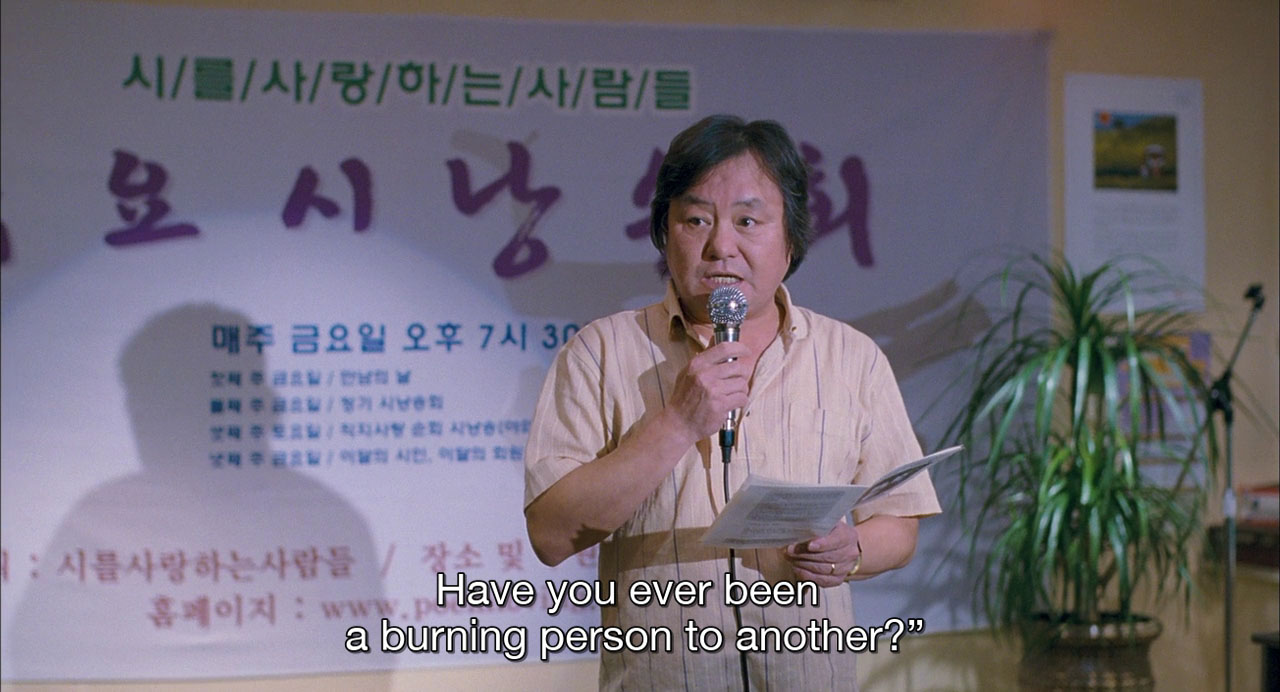
Grandma (major 60s/70s actress Yoon Jeong-hee) takes care of grandson Wook, whose friend group raped a classmate until she suicided. She tries to get enough cash from the rich disabled guy she attends for the payoff to the dead girl’s mom. Her Alzheimer’s diagnosis adds to her inner struggle but doesn’t affect the plot. When she visits the dead girl’s mom but talks only of apricots is it because the disease made her forget her reason for coming there, or was she distracted by the poetry or nature, or is she avoiding hard conversations. I have no qualms with her fellow poets but the employers, the fathers, the kids – most people in the movie are living comfortably, contemptibly.

I spend at least an hour a day saying this:

Robert Koehler in Cinema Scope 43:

There is no simple cause and effect between the initially cautious [Alzheimer’s] diagnosis and her decision to sign up for a poetry class … That doesn’t mean, however, that the viewer is denied such a cause-and-effect reading if they choose one, and Lee isn’t a filmmaker to either encourage or discourage it. This is perhaps the most notable aspect of the evolution of Lee’s screenwriting – rewarded at Cannes with the screenplay prize – starting from the unmistakable determinism of Green Fish and the elegant but closed geometrics of Peppermint Candy. Like his camera, which allows viewers to make their own compositions and choices within the larger frame, his narrative approach trusts in granting characters their own lives, so much so that one gets the sense that they frequently surprise Lee himself with the choices they make.

Auteurist foreshadowing:

Wenders apparently working without a script, just putting two guys together and following them around – a good idea, turns out.

Rudiger* Vogler isn’t a writer/photographer this time but a traveling film-projector maintainer. He picks up rider Hanns Zischler after watching him roar his Volkswagen into a river, and they barely speak, just proceed along the route of small movie theaters in western East Germany.

One night they’re woken by a guy despondent over his wife’s suicide – second Wenders in a row where a suicide causes a mood shift. Hanns walks off to the town where his father lives, visits/harasses him at his newspaper office. After this cathartic visit he thinks Rudiger should also have a cathartic visit home, so they borrow a motorbike and sidecar. After all the not-talking, they do finally get drunkenly combative and introspective, but part on pretty good terms.

Hanns and the sad man in the jukebox-equipped back of the truck:

Commentary says the photography was an homage to Walker Evans, the photographer who also inspired Upland Stories. I’ve seen the rider in a few things, including Clouds of Sils Maria and Dr. M. Man who lost his wife was in a bunch of Fassbinders – he’s the landlord in Fear Eats the Soul. Alice’s mom (of the Cities) works at a theater in one town, a Lang Mabuse actor plays the rider’s dad.

*Okay, first all my old posts‘ diacritics went bad, and now my macbook isn’t letting me make new ones by holding down vowel keys.

Alice’s mom with Rudiger:

Shadowplay:

Essential equipment for long drives:

We try to keep Shocktober light and not end up watching psychosexual nazi stories, I don’t know how this keeps happening. A visually striking Spanish movie about ugly shit, the Apt Pupil of its time.

Nazi pedo (who was also in The Boys From Brazil, appropriately enough) is stuck in iron glass lung, cared for by wife Griselda (Almodóvar regular Marisa Paredes) and kid Rena. Then crazy Angelo moves in with his weird eyebrows claiming to be a nurse, actually a witness to the nazi’s final victim before the suicide attempt that landed him in the lung. I thought it a revenge plot but Angelo tells the old guy he wants to be his protege, so, no good guys in this. Nice giallo-lite as he stalks the wife through the house and hangs her, then he starts kidnapping random local boys and reenacting murders from the man’s journals in nazi cosplay. This is almost worth it for the way the music tears itself apart in the climax when Angelo is killing his idol and taking his place.

Rena is okay with Angelo wrecking the place:

RIP Anthony Hickox – on the day he died, I watched a film by his father. Vincent Price is in disguise as a fake cop, not helping some housing bigwig evict murderous squatters. Turns out Price is back from the near-grave, having suicided in front of the critics association after losing an acting award, rescued by cartoonish winos and become their king. Daughter Diana Rigg handles his above-ground affairs while Price contrives new ways to kill his tormentors (beheading in sleep, being fed their own beloved dog on a fake game-show set) in connection with his Shakespeare roles. They don’t necessarily deserve to die for thinking Price is a cheesy actor, but for other reasons, they mostly do. In fact it’s annoying that the boring critic Ian Hendry gets to survive, but I can’t stay mad at a movie that stages a swordfight on trampolines.

I forget which Shakespeare play this was: