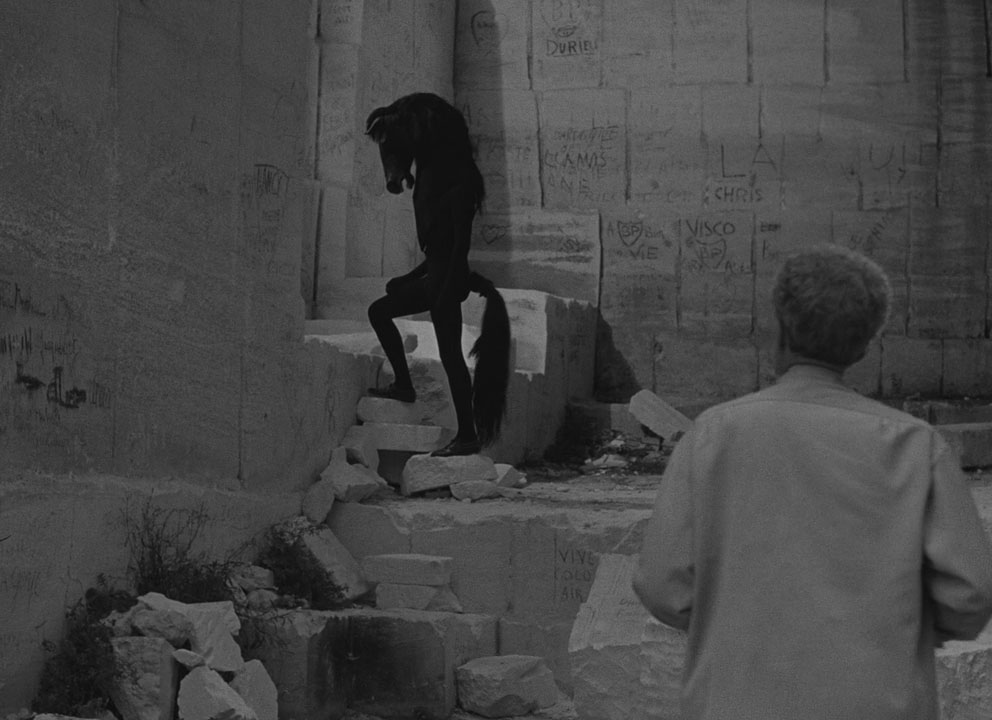
After an accident, Hiroshi (Tadanobu Asano of the Thor movies, star of Bright Future and Ichi the Killer) wakes up uncommunicative, barely knowing who he is. He returns to med school and begins a four-month class where he dissects the body of his girlfriend Ryoko who died in the crash, while he experiences lucid dreams (or returning memories, or a split consciousness) in which he spends time with Ryoko.

So it’s another trauma movie from Tsukamoto, about pain and memory and body horror – though this is a quiet and restrained movie, and we hardly see any surgery, so it’s not so much a horror movie as the poster would have us believe. This was made before two of my faves, Haze and Nightmare Detective. Employing crossfades and slow zooms into splotchy patterened walls, it effectively represents Hiroshi’s dark, blurry mindset without going into the usual Tsukamoto shaky-cam histrionics.

Ryoko:

Her parents:

Hiroshi’s own parents had apparently given up on his future before the crash and are warily glad that he’s back in med school – dad is Kazuyoshi Kushida of Oshima’s Sing a Song of Sex, and mom is Lily of Oshima’s Dear Summer Sister. Hiroshi makes the odd decision to contact the girlfriend’s parents and let them know that he’s cutting her up. They take this news better than I would’ve figured, and as the mom (the cinematically named Hana Kino of Ôbayashi’s Beijing Watermelon) is dying of cancer, dad (Jun Kunimura: the unlaughing lord in Scabbard Samurai, lead gangster of Why Don’t You Play In Hell?) seems to appreciate Hiroshi’s company. There’s also another emotionally disturbed med student, Ikumi, who blames herself for a professor’s suicide, and seems to exist in the movie mostly as an audience surrogate to stare in disgusted wonder at Hiroshi as the other students slowly abandon him.

Ikumi:

I keep watching Porumboiu films because of my blind trust in the Cinema Scope critics – maybe one day his movies will click into place. At least they are always unusual, and always short, and I am always up for a short, unusual movie, so dude has got my number, even if I haven’t got his.

The man who was once injured playing football and has since decided that it wasn’t an issue of personal violence but of the game’s very structure, and has devoted years to devising alternatives, is a family friend of the director I think, and we’re not encouraged to write him off as a crank necessarily, but to pay attention to his ideas. Although it’s hard when he’s interviewed during his day job by a woman he completely can’t help, the movie briefly becoming a parody of failed bureaucracy, then he carries on “I feel a bit like those heroes. I’m here, filing documents, but in my double life I revolutionise sport.” He removes the right-angles from the playing field, then devises defense/offense zones so fewer players can end up in the same spot – the whole thing seems a bit silly, then gets kinda beautiful with its utopian philosophy at the end.

Water and ice, beautiful and frightening on the big screen.

Sometimes you lose all sense of scale until you see birds flying off the icebergs.

Metal soundtrack… egrets in a flooded cemetery.

Nice sailing scenes – so much winching! I want to show this to dad, but I know he’ll fall asleep long before the sailing begins.

Dedicated to Sokurov.

Creepy opening song by Baby Jane… not creepy in the standard SHOCKtober sense, just that it’s a packed 1917 theater full of women in old-timey hats who inexplicably love a maudlin tune competently sung by a cute kid (semi-competently dubbed, anyway).

In 1935, Jane’s sister Blanche is a movie star and the studio is pissed that her contract says they also have to produce films starring her drunk, untalented little sister Jane (untalented-Bette is represented by Ex-Lady clips, fair enough). Fun’s over when Blanche’s legs get crushed by a car in her own driveway. Thirty years later, the two ex-stars live together, griping back and forth.

Blanche (Joan Crawford, whose film career had dried up since Johnny Guitar) loves her pet parakeet, so of course it’s the first victim – just more evidence that The Shallows was special for letting its birdie survive. Crawford is quietly desperate as her sister isolates her and goes increasingly, dangerously crazy over the next couple days (“You aren’t ever gonna sell this house, and you aren’t ever gonna leave it”). Bette Davis, who it appears had been working more steadily, seems kinda one-note wide-eyed eccentric-horrid, so it’s delightful when she “acts,” impersonating her sister’s voice over the phone.

Just as the situation and dialogue are getting tiresome, the movie introduces sweet Victor Buono, hilarious as a pianist who answers Jane’s newspaper ad to accompany her Baby Jane comeback act. The plot only keeps functioning because Blanche doesn’t yell when he’s over, but she becomes more desperate later after Jane kicks the hell out of her for using the phone, the movie getting better as it gets crazier. Bette scares off Victor, crushes the housekeeper’s skull with a hammer, and takes her dying sister to the beach.

Played Cannes with The Leopard and Harakiri. Nominated for all the Most Acting awards at the oscars, but luck be damned, a Helen Keller movie came out the same year, so it only won for costume design. The same director/star/novelist/screenwriter combo followed up with Hush…Hush, Sweet Charlotte.

The wikis say this is a Grand Guignol horror movie, but this is less well-defined than last night’s Giallo genre (black-gloved assassin kills people with knives – admittedly kind of a crap genre). Apparently it involves naturalism, and its followers claim that all horror movies are Grand-Guignol-influenced because they involve people doing some things that real people really do. The Guignol wikis also reference John Zorn and say the GG’s lead actress was “raped at least 3000 times,” so maybe let’s not linger on this.

A mutating fiction containing documentary-like scenes – unlike his other films, which sometimes have people playing versions of themselves but would never be confused for docs – the fictional part being written by the doc participants as the movie goes along. There is a teacher named Dogfahr, a crippled alien boy, and lots of transformations.

The woman who gives the film its title:

The last major work I’d never seen by A.W., unless anyone wants to argue for The Adventures of Iron Pussy. It’s unique, but not one of my faves. Why do the closing credits appear 10 minutes before the end of the movie, then just shots of young kids playing? “The woman turned into a tiger”, a precursor to Tropical Malady?

Dennis Lim for Criterion:

Mysterious Object at Noon revels in the myriad ways a story can be transmitted. A performance troupe acts out its segment in a traditional song-and-dance routine. A pair of deaf girls use sign language. Sometimes we watch and listen to the narrators as they concoct new installments; sometimes we see their fabulations dramatized, occasionally with voice-over or intertitles to move things along. The scenario grows at once darker and more absurd as it progresses, its lurid developments living up to the film’s pulpy Thai title, Dogfahr in the Devil’s Hand.

Katy and I settled in for a month of pre-code Stanwycks on Criterion and… we only made it through this one. The new doc featuring Catherine Russell and Imogen Sara Smith was certainly more engaging than the film. It’s short though, full of nurses undressing and Stanwyck solving the mystery of why her employer’s chauffeur (Clark Gable, a couple years before It Happened One Night) is slowly killing the children of the house, punching lots of people, and somehow staying employed. Stanwyck gets romanced by a bootlegger (Hell’s Angels star Ben Lyon), saves the children, and I think Gable gets murdered offscreen. Costarring Joan Blondell, who appeared in the other 1931 William Wellman movie I’ve seen.

In late 1970’s Paris, Anne, the boss of a porn film company (pop star Vanessa Paradis) has to deal with being dumped by her editor (You and the Night‘s Kate Moran) and being investigated for the murder of one of her actors, actually perpetrated by a masked psycho wielding bladed sex toys.

Anne decides to deal with this by filming a porn parody of the investigation called Homocidal and casting herself as the murderer.

As actors keep dying, she visits a bird museum, discovers the victims are visited by a blind grackle, an extinct bird, and tracks down the story of a tormented youth, burned half to death by his father for being gay, come to the city as a scarred, homocidal adult.

Also featuring Nicolas Maury (You and the Night, Heartbeat Detector) as Anne’s blonde director, and Yann’s fellow-traveler gender-bending filmmaker Bertrand Mandico as the dramatic, floppy-haired cameraman.

With the giallo lighting, M83 music, movie theaters and rare birds, this was mostly up my alley.

Michael Sicinski on letterboxd:

If there’s one dominant hetero influence at work in Knife+Heart, it’s Brian De Palma. This is a sexualized murder mystery, based in part on who has the power of the gaze, who has been sidelined by desire, and how killing is a perverse sexual substitute. And even as the gravity of life and death are acknowledged, Gonzalez shares with De Palma a taste for the ridiculous, a recognition that movie violence can exorcise psychological demons precisely because it is not real, and the more outlandish the better.

After Ape and The Alchemist Cookbook, Potrykus joins some others (Ben Wheatley, Bruno Dumont) in that select group of recent filmmakers who I can’t quite say I love, but I feel I need to see everything they’ve made right away.

Abbie (Ape-man Joshua Burge) spends the entire 90-minute movie in his undies on the couch. First he’s attempting a “challenge” timed by abusive older brother Cam (David Dastmalchian of Ant Man and the Wasp). It’s established that Abbie has never completed a challenge, and now he’s attempting something involving rounds of a skateboarding video game with drinks of milk in between, and we know where the movie is headed when he secretly pees in the milk jug while Cam is downstairs finding his Billy Mitchell issue of Nintendo Power. After Abbie’s terrible, disgusting failure, he gets “one more final, ultimate challenge” – to stay on the couch and defeat Mitchell’s unbeatable Pac-Man record before Y2K.

Abbie convinces a friend (Andre Hyland, The Death of Dick Long) to come help, but Dallas just watches tapes of Abbie embarrassing himself, eats all his food and ditches. Adina Howard (a mid-90’s music star) comes over with food and comics, says the final level of Pac-Man is unbeatable but gives Abbie some tips. He practices mind control on her guy Cortez (hey, it’s Cortez from Alchemist Cookbook!), offers 10k of his winnings to the exterminator to leave the couch in place and bring sandwiches, and he uses an endless supply of duct tape and videotape to operate and document his tiny kingdom.

Is the entire first 80 minutes worth suffering through to reach the final act, in a post-Y2K wasteland, when Abbie finally rises from the couch and uses the telekinetic powers he has honed in his seclusion to explode the head of his returning brother? Probably, yeah.

Claire (Aisling Franciosi of a Gillian Anderson TV show and a Ken Loach movie) is a poor, doomed to a life of servitude for some past crime, then she has a very bad day when her husband and baby are murdered by soldiers and she is repeatedly raped. It’s a bleak movie, but at least it’s got… I don’t really know what it’s got besides the bleakness. Sometimes there are shots looking straight up at the sky through the trees, but this dwarfing of the action by towering nature only serves to make our heroine seem more trapped and insignificant. Plus, those shots didn’t hold up on the 4:3 DCP projection from my vantage at front of the theater – neither did the forest in general.

She teams up with “Billy,” an aboriginal with a similarly tormented past, to track and slay the soldiers (led by Sam Claflin of My Cousin Rachel), who continue to behave just horribly, betraying and murdering everyone along the way until the soldiers get to a major town and are welcomed by society, so our heroes must got on a final suicide mission to clean up. Harry Greenwood (son of Hugo Weaving) dies first, doesn’t make it to town, but Damon Herriman (I saw him playing Charles Manson yesterday) fights to the end. Kent’s followup to The Babadook, which was Ash’s final movie.