A movie with only women in it – a feat unmatched until the upcoming Ghostbusters remake!

Norma Shearer (love interest of He Who Gets Slapped) ends up divorcing her husband after super-gossip Rosalind Russell (His Girl Friday) gleefully reveals that he’s having an affair with perfume salesman Joan Crawford (Johnny Guitar)… but Norma gets him back in the end, after Joan doesn’t work out. So essentially he goes on a two-year affair, then all is forgiven (an extra divorce/marriage/divorce thrown in to please the censors).

After leaving her man, Norma teams up with Joan Fontaine (Rebecca, Letter from an Unknown Woman), Paulette Goddard (Modern Times) and Mary Boland (Ruggles of Red Gap) in Reno. Crawford steals another man, this time from Countess Mary Boland, who reveals that his fortune’s actually hers, so her man and Crawford can go be broke together.

Features a weird full-color fashion show in the middle of the movie.

Amusing vampire comedy, directed and starring people from Flight of the Conchords. Shot reality-style (the film crew wore crosses), set mostly in the New Zealand house shared by four vamps: Taika Waititi with a sweet Andy Kaufman smile, fashionable Jemaine Clement, rough ex-nazi Jonathan Brugh and a Nosferatu horror named Peter in the basement. They turn a clueless new guy called Nick, who goes around town bragging he’s a vampire, attracting the vampire hunter who kills Peter. But Nick gets to stay because everyone loves his mortal friend Stu. The great ending twist is that the werewolves (led by Conchord manager Rhys Darby) turn Stu instead, which ends up uniting the two groups.

I actually only started watching it because Edge of Tomorrow was gonna take an hour to copy. Didn’t seem like an amazing comedy, just lightly enjoyable, though admittedly much better than a vampire reality show had any right to be. But Slant and Dissolve gave it masterpiece-level ratings and it made the front cover of Film Comment. And now it’s opening in town, which should teach me to wait a few months before watching new acclaimed indie films.

N. Rabin:

What We Do In The Shadows brilliantly juxtaposes the mundane with the supernatural, where superhuman creatures of the night are subject to the demands of a chore wheel and complain about five years of no one doing the bloody dishes (i.e dishes covered with blood). The movie gets terrific comic mileage out of the contrast between the decked-out ghouls and the ramshackle, go-nowhere town where they do their dark yet tedious bidding.

O. Ivanov:

As we watch the vampires make new friends and become reacquainted with old lovers, the film reveals itself to be a thoughtful and moving treatise on aging gracefully. Confronted with endless cycles of loss and regret, the vampires avoid melancholy by embracing the inexhaustible possibilities of love and friendship that life offers to even its unholiest creations.

A good night, with the energetic director in attendance, introducing then discussing her film. It’s an impressive feat too, an animated feature made by a very small team, 2D animation composited onto paper mache backgrounds. Not completely crazy about the movie since it felt like a wearying illustrated audiobook after a while with her relentless narration, but it’s a mostly charming work about her family history of depression and suicide.

Grandma is well educated but runs off with her nationalist entrepeneur boss and bears eight children in a secluded forest, as Latvia is fought over by Russians and nazis and nationalism becomes irrelevant. She raises the kids, tends the animals, carries buckets of water up the hill all day while the entrepeneur works for years on his anti-Russian manifesto, which is burned when discovered by the kids years later. It’s said that grandma would have drowned herself but she kept floating because she didn’t know to put rocks in her pockets. Signe explores her family history while dealing with her own periodic depression, learning about strange and suicidal cousins, before returning to her own feelings and the way she deals with them through art.

I just stared at Tom Hardy alone in a car for ninety minutes and I still wouldn’t recognize the guy if he knocked on the door right now to borrow a cup of sugar. He’s sort of a Jude Law/Edward Norton/Ewan McGregor type, I guess. Not that he wasn’t very good in his one-man show, driving from the suburbs toward London because a one-night-stand is having his baby, explaining along the way to his wife and his job, where he’s supposed to be working all night to prep for a huge construction project in the morning. The job wastes no time in firing him, but he walks his subordinate through all the needed steps, dealing with a couple of emergencies, taking breaks to comfort the pregnant woman he barely knows who is alone in a London hospital. Locke finds his wife and kids less easy to negotiate with, and she ultimately decides he won’t be welcome back. It’s a real-time journey, the second I’ve watched in just over a week, and during the rare times he’s not on the phone, he justifies himself to his dead father in the rearview mirror, who abandoned his mom before Locke was born then tried to come back into his adult life.

Kiarostami probably loves the script, a man alone in a car (I was just thinking of his Certified Copy while watching the Before movies, too). It must’ve been hell to figure out how to shoot and edit. Lots of bleary night-driving cinematography. You wonder how the filmmakers will keep us interested visually, but soon the actors take charge and never let go. Alongside Hardy (whom I’ve seen and not noticed in a few movies) there’s Andrew Scott (Moriarty in Sherlock) as the coworker taking over the big job (he’s very good, and a couple publications mistook the actor for Chris O’Dowd), Ruth Wilson (of The Prisoner Remake, she won a golden globe last week for The Affair) as Locke’s wife, Olivia Colman (Peep Show, Look Around You) as the woman having Locke’s baby, Ben Daniels (of Doom, haha, remember Doom?) as Locke’s now-former boss, and Alice Lowe (Andrew Scott’s My Life In Film costar, also in Darkplace) as a nurse. Steven Knight wrote Amazing Grace, but after a couple more like Locke I might forgive him for that.

A. Nayman: “Refreshingly, there’s no suggestion whatsoever that we’re watching an ‘everyman’ here, but rather a highly unique individual whose intelligence and resolve are liabilities when applied in the wrong direction.” Rosenbaum voted it one of the ten best of the year, calls it “a heroic, existential western that essentially focuses on the hero’s endurance in relation to a series of moral and practical challenges, which inevitably becomes a series of moral and practical challenges for the audience.” Dissolve: “a harrowingly focused portrayal of a man at risk of being defined by his greatest mistake. … Eventually, the highway is completely superimposed over Hardy’s face, conflating the road with the man driving on it until it’s no longer clear where he’s going, or who he might be when he gets there.”

All I knew about this movie was the theme song, as memorably covered on a Henry Kaiser album. So I am well aware that the man who shot Liberty Valance (he shot… Liberty Valance), he was the bravest of them all. But who is this man? As the movie opens, a big-time politician (slow-talking Jimmy Stewart in old-age makeup) arrives in a one-horse town to grieve a dead cowboy (John Wayne, spared the makeup), and once the flashbacks begin one wonders if Wayne is too obvious a candidate to shoot Liberty Valance, and perhaps it’ll be Stewart. Then it pulls out a twist ending – Stewart thought he shot Liberty but missed, while Wayne shot Liberty dead from another angle and let Stewart take the credit. Stewart’s a pacifist law-and-order kind of guy, on his way to the capital to tame the wild west through government, the downfall of Wayne’s way of life, and Stewart takes Wayne’s girl Vera Miles with him.

We just rewatched The Lady Eve, and it occurred to me that Liberty Valance is like a Preston Sturges movie in a couple of ways. All the character names are colorful (Ransom, Liberty, Pompey, Link Appleyard, Dutton Peabody, Major Cassius Starbuckle), and so are all the actors playing them. No boring, blank-faced white guys injected for plot purposes, instead everyone adds to the movie’s personality. Vera Miles comes closest to being a default movie character, without much life of her own, but then the emotional finale unexpectedly belongs to her, as she wonders if she married the wrong man. Stewart and Wayne are allowed to act very much themselves, Stewart with his stuttering vowel elongation, Wayne acting cool and calling him pilgrim. Then you’ve got Lee Marvin as Valance, Andy “Friar Tuck” Devine as the coward sheriff, John Carradine as a pompous politician – even the great Lee Van Cleef as a henchman. It’s all more tortured and serious than Rio Bravo, but similarly a great movie to hang out with.

“I hope this will be good for us… but especially for me.”

Watched during Sundance Week! During Sundance 2015, I managed to watch three movies from Sundance 2014. There are lots of movies from last year that I mean to catch up with, and this seems as good a scheme as any.

Seems like a hard movie to enjoy, a non-comedy with a total asshole lead character (played by Jason Schwartzman, a puppy dog with a severe hairstyle). But the movie only occasionally seems to sympathize with him, and it takes sidetracks into the lives of the people he knows: his long-time girlfriend Ashley (Elisabeth Moss, star of Top of the Lake and Mad Men), his novelist mentor Ike (Jonathan Pryce), and that novelist’s daughter Melanie (new Marvel superhero Krysten Ritter). After the finale, which is particularly harsh towards Philip, allaying my fears that the movie expected me to care about a terrible person’s sense of well-being, I decided maybe Perry set out to make a movie centered on the selfish prick who shows up in minor roles in other movies, usually to make the sympathetic lead characters look good in comparison or to motivate some kind of action on their part. Philip and Ike become friends but can’t seem to motivate each other, because they’re both the selfish prick.

“I want you to contextualize my sadness.”

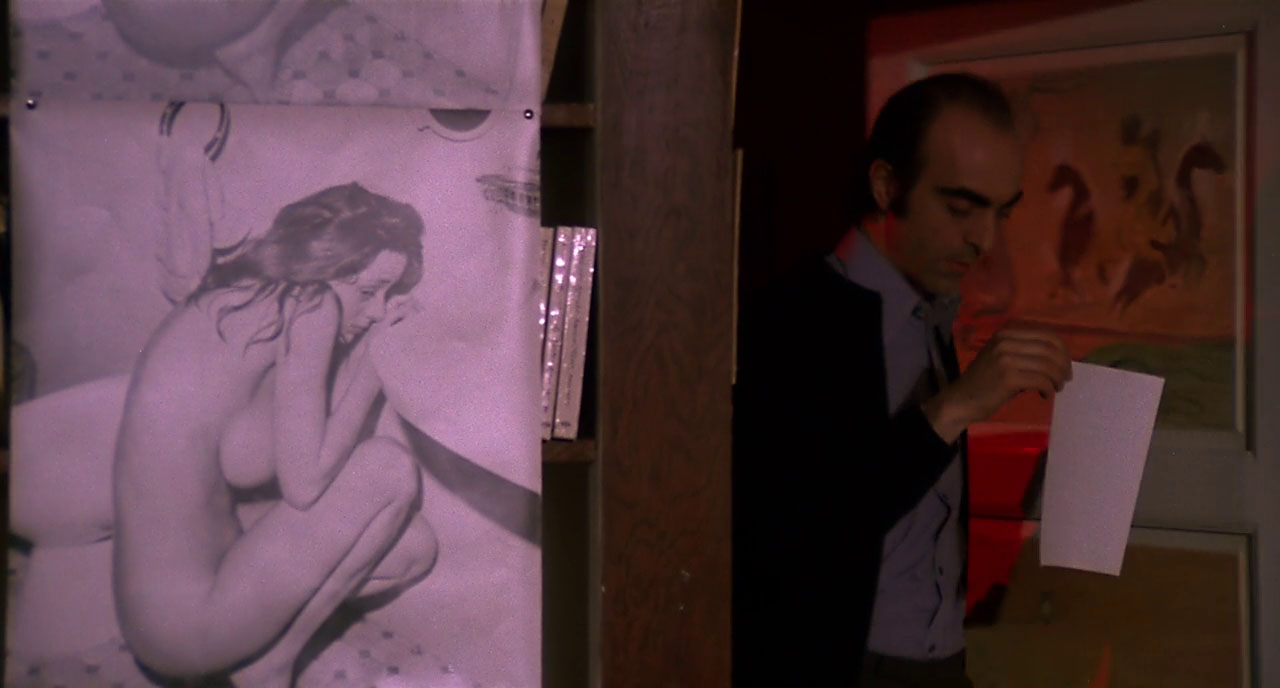
I didn’t much enjoy Perry’s The Color Wheel, and don’t care for his handheld camera work (although it seemed better here, in color), but can’t ignore a critical mass of critical acclaim – don’t want to sleep on a masterpiece. This wasn’t, but it’s got good acting and some hilarious/horrible moments, like Philip’s response to a student asking for a recommendation: “Here’s a piece of paper with some staples in it. Wish I could be of more help.” Casting Jason Schwartzman and making a movie about white middle-class sadsacks and father issues, decorated with 1970’s book jackets and omniscient narration, Perry might want to hang with Noah Baumbach and Wes Anderson.

Josephine de la Baume, lead vampire of Kiss of the Damned, plays Philip’s fellow English teacher, who poisons the department against him. The Color Wheel’s Kate Lyn Sheil played one of Philip’s exes, and Eric Bogosian (Joe McCarthy stand-in of Witch Hunt) narrated. Edited by Robert Greene, who made a splash last year with his own Actress.

“Tonite only”, that’d be Friday the 13th, Sept. 2013.

My favorite prickly response to the movie comes from M. D’Angelo, who finds the narrator’s grammatical errors and misuse of words “entirely typical of [Perry’s] approach to filmmaking in general. Everything here feels like the work of someone inexpertly trying to synthesize challenging elements of books he’s read and movies he’s seen… which is what ambitious young artists do, to be sure, but they’re generally not celebrated this fervently until after they exit the blatant juvenilia phase.”

A.R.P. on not making “calling card films” to get hired in Hollywood:

There is an ineffable “do not hire” quality to Listen Up Philip, apparently, that shows experienced manufacturers of entertainment that whomever made this film is most likely hard to work with.

Mouchette has a crappy home life and actively hates everyone at school, throwing clumps of mud at them every day after classes. Her dad shoves her around, prevents her from having any fun, and her mom is dying, leaving Mouchette to take care of the baby. Meanwhile trapper Arsene and groundskeeper Mathieu have a Rules of the Game rivalry going on, also a romantic rivalry for the local barkeep. Mouchette sulks silently, preoccupied with sex and death, is raped by Arsene during a rainstorm, has a series of unsympathetic encounters with the townspeople after her mother dies, then drowns herself.

Bresson: “It can’t be summarized. If it could, it’d be awful.”

Pay close attention to the words of a song sung at Mouchette’s school and you can detect references to the overall theme of the film:

Opens pre-credits on Mouchette’s mom crying alone, before we know who she is, “What will become of them without me?” Tony Rayns in the commentary says the movie is about the disappearance of a person from human society. Sound effects from footsteps and futzing about with props are prominent, like in Rivette movies, although sometimes looped audio (and even visuals in the final shot) is noticeable. Camera focuses on hands and bodies, moving away from downturned faces. It’s a short movie, setting up all the players and conflicts efficiently in its first ten minutes with spare dialogue. Adapted from the same novelist as Diary of a Country Priest.

Godard made the trailer, in which a voiceover says it’s “about the rape of a young girl – in short, a film that is christian and sadistic.”

Repetition:

RB: “Adolescents are more flexible than adults. They’re interesting because of their mystery, their inner force. What I find interesting is thrusting a child, a young girl, into a situation that’s terribly mean, even nasty, and seeing how she reacts.”

R. Polito:

Shooting on Mouchette started soon after Bresson finished Au hasard Balthazar, and Mouchette seems a combination of the suffering Marie and the donkey, Balthazar, much as the hunting (rabbits) and poaching (partridges) episodes once again analogue human and animal misfortunes.

Much more interesting visually than it looked from trailers and posters, which were all Joaquin looking into the distance while talking to Siri, sometimes smiling. More interesting emotionally too. Phoenix’s beloved operating system grows and learns at an accelerated rate, like if Short Circuit’s Johnny Five had internet access, finally admits to having simultaneous romantic relationships with hundreds of humans, and soon afterward leaves all the lonely humans alone with each other to further explore her own consciousness. It’s kinda beautiful and terrifying in a Terminator Skynet sense.

The somewhat-happy ending leaves Phoenix with Amy Adams, a longtime friend who bonded with her own OS while divorcing her husband. Also featured: Rooney Mara (Zuckerberg’s ex in Social Network) as the wife divorcing Phoenix, Olivia Wilde as a blind date whom Phoenix is too damaged to pursue, Portia Doubleday as a Siri sex surrogate, Chris Pratt as a coworker, and the very human voice of Scarlett Johansson. Won a million awards, including a screenplay oscar.

Another tough, superb movie from Anthony Mann, who might be my favorite Mann this year (based on early reviews of Blackhat). We saw some plot threads coming a mile away: the baddie James Stewart has tracked for years is his brother, who killed their father over some greedy business. We’re told during a shooting competition overseen by Wyatt Earp himself (Will Geer, train conductor in The Tall Target) that they’ve got the same training. That day in Dodge, Jimmy wins himself the rare and valuable rifle of the film’s title, and his brother Dutch Henry (Stephen McNally of Criss Cross) immediately steals it and rides off.

America in the 1870’s was populated mainly by horrible drunk murderous gamblers, and we meet a procession of them. Dutch loses the rifle to a trader (John McIntire, sheriff of Psycho) in a card game, who is later (deservedly) murdered for it by Indian chief Rock Hudson – yes! Jimmy teams up with Millard Mitchell (ol’ prospector of The Naked Spur), later kills Chief Rock during an Indian battle vs. the cavalry led by Jay Flippen (who played an Indian himself in Run of the Arrow). The rifle is handed off to the shitty Steve (Charles Drake of All That Heaven Allows) to protect his fiancee Shelley Winters (not recognizable from The Tenant). Steve lasts all of one more scene, seeking refuge at the same house where criminal Waco Johnny (Dan Duryea, the Scarlet Street pimp) decides to have a police shootout with his men. Waco kills Steve, takes the rifle and the girl to his planned meeting with Dutch Henry (Jimmy Stewart’s evil brother, remember?). Jockeying to outdo each other in the bad guy department, Waco and Dutch hit a bank, followed closely by Jimmy Stewart, who kills Waco then chases Dutch into the mountains, finally killing him too, earning himself back the rifle and probably the girl.

I guess Tony Curtis played one of Dutch’s men, not that we noticed. Wikipedia claims it was supposed to be a Fritz Lang project with a different story, Stewart more obsessed with the rifle.