Pure cinema! Young, wired Denis Lavant flees girlfriend Julie Delpy to help Hans and Marc (Michel Piccoli) on a heist in place of Lavant’s murdered father, and falls for Piccoli’s girl Juliette Binoche. Camera races Lavant down the street. Amazing skydiving scene (the editing, the parachute’s-eye top-down shot, the sheer audacity). It’s a spare story, and Lavant dies at the end, mourned by both girls. Delpy and Binoche had both previously appeared in Godard films, were later the stars of White and Blue, respectively.
Author: Brandon
Brandon's the guy who runs this site.
The Past (2013, Asghar Farhadi)
Quite excellent. A twisty secrets-and-lies family drama without any of the twists feeling contrived, and with none of the characters feeling less than sympathetic.
Marie (Berenice Bejo, star of The Artist) gets her separated husband Ahmad back to Paris for a divorce so she can marry Samir (Tahar Rahim, star of A Prophet). Marie’s two daughters and Samir’s son are moody because of family upheaval. But it turns out teenage Lucie (Pauline Burlet, a young Piaf in La Vie en Rose) is also moody because she might be partly responsible for Samir’s current wife being in a coma. Samir’s employee at the dry cleaners (Sabrina Ouazani of a couple Kechiche movies) may also be partly responsible, but some details surrounding her near-suicide remain unknowable at the end.
Beaten out by Blue is the Warmest Color at Cannes, The Great Beauty at the Globes, and something called Me, Myself and Mum at the Cesars. Cinema Scope called it muddled, tedious and inept. “Farhadi’s direction is actually somewhat more serviceable than his writing, if you have a taste for television-style two-shots and bland compositions,” ouch.
Babette’s Feast (1987, Gabriel Axel)
Lovely natural-light drama spanning many years in the lives of two puritanical Danish sisters. Muchache Man Lorens loved one of them, and the following year a French singer loved the other, but the sisters end up with only each other – and French cook Babette (played by the great Stephane Audran of so many Chabrol films).
sister Filippa and Mr. Papin the opera singer:

sister Martine and Lorenz:

Eventually it’s revealed that Babette was head chef at a world-class French restaurant, and after preparing the sisters’ very simple meals for thirty years, she spends her lottery winnings on one extravagant dinner for the sisters and their church friends (including a visiting Mustache Man Lorens).
Katy and I liked it. We watched on Valentine’s Day, coincidentally the week director Gabriel Axel died, and during the first earthquake I’ve felt while living in Atlanta. Adapted from a Karen Blixen story. IMDB claims it’s the current pope’s favorite movie.

M. Le Fanu:
We can agree, at any rate, that Audran’s performance is serene and authoritative. Could the woman she is playing have been based on a once living person? At bottom, one never really knows where stories come from, especially the good ones. Dinesen’s story has an absolute “rightness” about it that we recognize from classical fairy tales. Its tone, its humor, its kindness, its flashes of sardonic wit, the ease and confidence of its storytelling—all these attributes seem, at times, self-perpetuating, and independent of mere human agency. It is as if the best stories, miraculously, write themselves. Axel’s film manages to capture this anonymous and folklorish quality. Faithful to the story, he has made grace visible, and given us, in addition, a wonderful lesson in courtesy.

Out 1: Spectre (1972, Jacques Rivette)
Finally out on video, I got to watch this seven years after seeing Out 1 in theaters.
Rosenbaum calls the two films “radically different,” but to me, it often felt simply like a shorter version of Out 1. Of course, having seen the longer version, I can’t help noticing major differences. The two theater groups’ rehearsal footage is almost entirely gone. Renaud’s disappearance with Quentin’s money is obliquely shown, and the ensuing city-wide hunt for him is even more obliquely included, in the form of black-and-white stills from those scenes inserted between regular scenes, accompanied by a low buzzing noise. There are other appearances of stills, some from deleted scenes from the longer version, sometimes callbacks or flash-forwards to scenes within Spectre.

Admittedly the 13 group felt like a much bigger deal in Spectre, more of a central conspiracy to the film, and I was able to follow the relationships and stories of offscreen characters Pierre and Igor much better, but I can’t tell if they’re really more sharply in focus in Spectre than Out 1, or if during Out 1 itself I was too busy trying to keep the many onscreen characters straight to follow much Igor drama. But looking through articles I quoted in my original Out 1 writeup, Rosenbaum said Out 1 was shaped by “the successive building and shattering of utopian dreams” and Lim says it “devotes its second half to fracture and dissolution,” and that theme and structure didn’t feel as true of Spectre.


The buzzing stills interrupt and fragment primary scenes, and there appears to be more cross-cutting between scenes than in the long version. Conversations sometimes cut off in the middle and never return. The stills appear in greater frequency at times, and disappear for long stretches at others – for instance, when Thomas first visits Sarah at the beach house and convinces her to return to Paris, the whole scene with its long shots plays out without interruption. Sometimes the editing is telling different stories than the dialogue – when Rohmer’s Balzac scholar says “secret societies,” it cuts to the Prometheus group, not returning to Rohmer for a long while.
Obade is far, an 8-hour drive southeast from Paris


Rivette:
They aren’t single frames, but simply production stills. When we tried a shorter version, our first montage ran five and a half hours. Then to make a commercially feasible length, we used the stills to tighten the editing, much the way that Jean-Luc uses titles more and more in his films, as in La Chinoise. Every time there was an editing problem he had recourse to a title. But finally we spent more time on these photos than on anything else, because there were a priori so many possibilities. We wanted the relation between the film and the stills to be neither too close nor too distant, so it was very difficult to find just the right solution. Then we added the sound to the stills. They didn’t work without sound, because the silences interrupted either noises that were very loud or others that were just murmurs. Silence didn’t produce the effect we wanted. I wanted something purely artificial: what we have is just a meaningless frequency, as if produced by a machine, which interrupts the fiction — sometimes sending messages to it, sometimes in relation to what we’ve already seen or are going to see, and sometimes with no relation at all. Because there are stills from scenes, especially toward the end, which don’t appear in the body of the film and are frankly quite incomprehensible.
Hand-off:
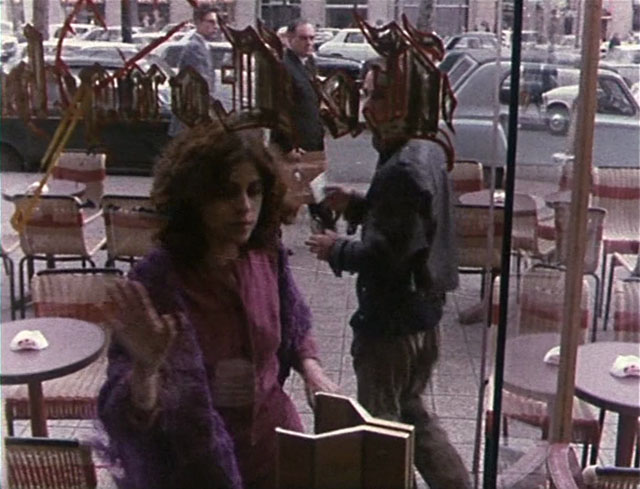


At the halfway point, after Colin, Frederique and Emilie/Pauline just appeared in the same scene, it lets loose with a whole montage of the buzzy stills. When Rivette says “there is a moment, one single shot even, in which almost all the fictions intersect, as if all these lines had to pass through a ring. This shot we put squarely in the middle: it comes just before the intermission,” is this the scene he means? There was no intermission in the DVD version, but it seems likely.

Ten of the 13: Thomas, Lili, Sarah, Pauline, Lucie (legal advisor), Warok, Etienne (chess player), The Ethnologist, Igor (never seen), Pierre (never seen). Four more whom I suspect: Elaine (because she discusses Lili’s disappearance with Lucie), Marie (because she gives Colin the letters), Iris (because Pauline speaks freely about Igor and her blackmail plot in front of her) and Georges (unseen character I mentioned in my Out 1 writeup, though I can’t recall who he is).
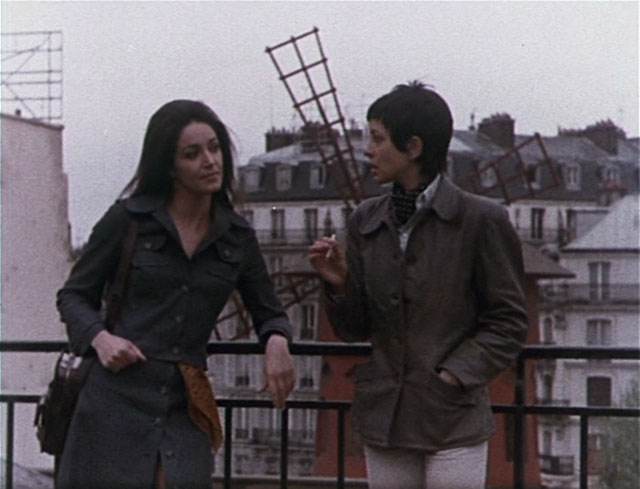
But let’s not read too much into the conspiracy. Rivette again:
In Out, I was already more careful, because the idea of the “thirteen” came rather late. For a long time we thought that the characters might never meet; perhaps there would be five or six completely different stories. We just didn’t know. Still, I had the idea that something should bring them together, and so it was Histoire des treize. But it was just a mechanism. In Paris and, even more, in Out, I don’t take the whole idea of the search for meaning seriously. It was a convenience to bring about the meetings, but it didn’t work with either film, because they were taken to be films about a search. I tried and failed to make people understand, as the film progressed, that this search led to nothing: at the end of Paris, we discover that the Organization doesn’t exist; and the more Out progresses, the more evident it becomes that this new organization of the thirteen which appeared to have been formed never really existed. There had only been a few vague conversations between completely idealistic characters without any real social or political roots. In each case there was a first part where we assembled a story of a search, and a second part where little by little we wiped it out… When I decided to use Histoire des treize, it was as a critique of Paris, which tried to show more clearly the vanity of this kind of utopian group, hoping to dominate society. It begins by being fascinating and tempting, but in the course of the film comes to be seen as futile.
equipage equipage equipage equipage equipage equipage equipage:


“Listen baby, I’m not Marlon. Marlon is on the waterfront.”

Lili and Pauline are somehow connected in running the shop (which advertises Bob Dylan bootlegs for sale in the window), and Sarah sneaks in and out. I thought Sarah was hanging out in the basement, but when they knock out Lorenzo’s man and drag him downstairs, it doesn’t look like much of a place to spend time. Lili is later said to have stolen a million francs and disappeared – but from Lorenzo or from the cases full of important-looking papers beneath the shop, I’m not positive.

Both theater groups begin with “rehearsals” that seem more like acting warm-up activities, then into vague explorations of theme and character. Each group gets a shot in the arm from the entry of a new member – Sarah to Prometheus and Renaud to Thebes. But Renaud’s ideas don’t work for Lili, and she begins to retreat from the group. In the end, both groups have dissolved because their most recent members have left, followed soon by leaders Lili and Thomas to Obade.
More important differences in the ending: Thomas doesn’t have his beachside breakdown, and Frederique doesn’t die (not sure that she even meets Renaud).

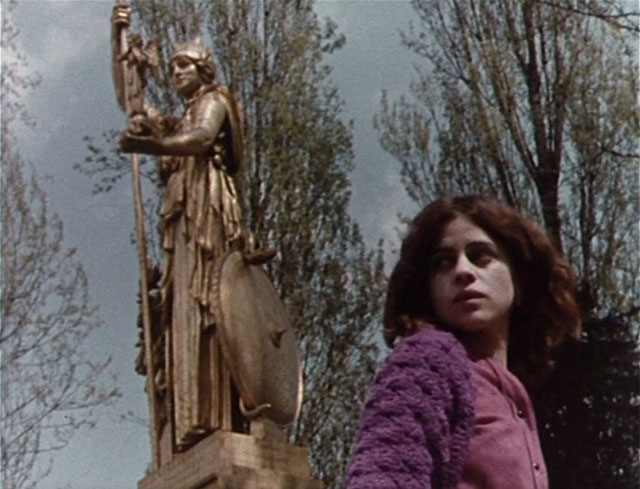
Shortly before Pauline’s lover Igor reappears (in the form of a phone call to the beach house), this maybe-strangely-translated conversation – Lili: “Why do you imagine Igor’s in a room here?” Pauline: “Imagine someone is a half, or a full year trapped in a house. No one notices. In the basement, on the floor, in a room.” Lili: “But this is a dream.” Then they agree to search the house for him, but there’s one section to which nobody has the key, and later when the key mysteriously appears, Pauline searches the unoccupied rooms beyond, staring into the infinite mirror. I find this piece of the film interesting since Bulle Ogier (Pauline) would appear in Rivette’s next film as a ghost trapped within a dream house.

Rosenbaum: “The coded messages Leaud intercepts are significantly different in the two films.” Different how? Also: “Much as Thomas Pynchon in Gravity’s Rainbow bears witness to mid-century paranoia by turning imaginary plots into real ones and vice versa, Rivette has a chilling way of both suggesting explanations and dispersing them in this monumental, maddening epic.”

Rivette:
There are some sequences which I think are failures, but after a certain number of hours, the whole idea of success and failure ceases to have any significance. Some things that I couldn’t use in Spectre are all right in the longer version. The whole actor-spectator relationship is totally different in Out, because there the actors are much more actors than characters. There are many more scenes where the sense of improvisation is much stronger, even to the point of admitting lapses, hesitations, and repetitions. There are some of these in Spectre, but relatively few, because we treated it much more as a fiction about certain characters. In the longer version, the dramatic events are a lot more distant from each other, and between them are long undramatic stretches… contrary to what most people believe, one doesn’t learn any more in the long version than in the short one.

On the meaning of the opening title “Paris and its double”:
I wanted the two titles to indicate that the film was shot in April and May 1970 – that, for me, is the important thing, since there are many allusions in the dialogue to that period. It should be evident that the group of thirteen individuals had probably met and talked for some time until May 1968, when everything changed and they probably disbanded.

David Thomson:
Out 1: Spectre begins as nothing more than scenes from Parisian life; only as time goes by do we realize that there is a plot — perhaps playful, perhaps sinister — that implicates not just the thirteen characters (including Léaud, as the mystery’s self-styled detective), but maybe everyone, everywhere. Real life may be nothing but an enormous yarn someone somewhere is spinning.


Natan (2013, Paul Duane & David Cairns)
Not as relentlessly Decasian as the trailer suggests, actually settles down into a normal storytelling groove of interview material for a good while, but punctuated by Natan’s papier-mache-headed stand-in, a few effects shots of a wall of posters, and that voiceover by The Film Itself. These are all evocative additions – the poster gallery returns re-postered before and after the nazi invasion, and some of the scant footage of Natan himself, at his trial, has him repeatedly covering his head with a newspaper. This is already more thoughtful stylistic presentation than most documentaries get, then the voiceover and bookending Melies stories put it over the top.

Plus the story is killer, one of those subjects that researchers dream of – a chance to correct the wrongs of history. Bernard Natan isn’t set up as a saint, but at the very least an important figure in history, a founder of French cinema who deserved a better end and reputation than he got. The directors even scored an interview with the academic who brought the unfounded rumors and nazi-era smears into the modern age, a villain of the picture though he doesn’t seem to realize it.

R100 (2013, Hitoshi Matsumoto)
Girl gets her makeup just right, returns to dinner table with nervous dude, kicks him in the head. Outside she tosses him down the stairs then reveals herself as a dominatrix superhero.

Then this happens (mouseover to see this):

Takafumi (Nao Omori, title star of Ichi the Killer), it turns out, has joined a club in which he’ll get attacked by dominatrices at random times and places. But the girls start showing up in situations that threaten his family and work life.

The title appears 40 minutes in. Then a spy warns Takafumi to quit the club before it’s too late.

A voice-throwing girl humiliates our guy in the hospital room of his comatose wife. Then the title again. And now a bored film crew discusses the intent of their hundred-year-old director, pictured as a bearded dude in a screening room.

Takafumi fails to get sympathy from the police. The girls get his young son involved, tie them both up. After one girl falls down his stairs and dies, he immediately gets a threatening phone call accusing him of murder. So he’s on the run from ninja dominatrices, the spy from before (“we’re an agency that fights anti-social elements”) is helping, and I’m figuring it’s gonna end somewhat like The Game (it doesn’t).

Takafumi is armed, starts shooting dominatrices – “in the end, masochist turns to sadist.” Meanwhile the CEO (wrestler Lindsay Hayward, one of the tallest women in the world) arrives at the women’s swimming-pool lair, cursing and screaming in English. Total war ensues.

Ends with a flashback montage of the entire movie, Takafuni pregnant posing for a photo shoot, and the hundred-year-old director getting his kicks (mouseover for kicks).

My copy was very brown.
Everyone Else (2009, Maren Ade)
Watched because Ade is one of Cinema Scope’s 50 Under 50, and this movie in their top ten of 2009. I didn’t love her previous feature The Forest for the Trees, but CS insisted that it gets better – and they’re right.

Gitti works in the music business and boyfriend Chris in architecture/renovation. They’re on vacation, unsuccessfully trying to avoid Chris’s frenemy/colleage Hans with his celebrity clothing designer wife Sana. Constants with Chris and Gitti seem to be social blunders around others (and sometimes worse, like when Gitti threatens Sana with a knife) and shitty, selfish behavior towards each other (this is usually Chris), culminating in Gitti leaving him and flying home early.
Shot handheld but nicely, with no incidental music, just a study of a few days with a couple who might not be meant for each other. Chris is Lars Eidinger of the new Peter Greenaway movie and Gitti is Birgit Minichmayr of Downfall and The White Ribbon.

E. Hynes in Reverse Shot: “Ade’s film is a perfectly complete portrait of romantic entanglement. Being on the inside can be brutal, but few things are as worthy of the trouble.” His appreciation of the movie is essential reading, made me reconsider it and realize what greatness people have been seeing in this unassuming character drama.
Kent Jones (who also reveals that Claire Denis loved it):
Where did she summon such a taut balance between tenderness and absolute ruthlessness, the kind of ruthlessness every filmmaker needs and few have the courage to exercise, the kind of tenderness few allow themselves the ability to summon on the set? … Everyone Else is a film of terrible power and absolute freedom, and it’s obvious that it’s only the beginning of the exploration.

Summer Without Gitti (2009, Maren Ade)
Chris is bored, makes dolls out of bits of ginger root, finally finds Hans. They climb trees. Hans goes away and Chris is bored and sad again. I watched this before the feature, but it’s obviously more clever in hindsight, Ade having re-edited scenes and outtakes from the feature to remove all presence of Gitti.
The Miners’ Hymns (2011, Bill Morrison)
Slow-motion stock footage and photographs of miners and their mines, with slow-motion color helicopter shots of their present-day locations, accompanied by slow-motion music. The movie doesn’t tell a conventional story, allowing you to apply your own knowledge and bias to the visuals. In my case what came to mind was Harlan County USA, Ace in the Hole and every Freakwater song (plus some Mekons/Freakons, Johnny Miner). Anyway, nothing hopeful or positive. The helicopter shots seem to back this up, showing these sites erased by history, covered up with parking lots, shopping centers and housing developments, unmourned. But it ends on a happy note, a massive parade of Durham-area miners marching into a cathedral.

Since each is under an hour, you could easily double-feature this with Coal Money, or maybe more appropriately, Profit Motive and the Whispering Wind.


Eyes Wide Shut (1999, Stanley Kubrick)
Thinking about this movie again thanks to Room 237. It’s nice to sit down with a “proper film” like Wolf of Wall Street, an austere classic like Winter Light, an idiosyncratic puzzle like Upstream Color, but in some ways, Kubrick knocks them all on their asses. From the start it has a commanding power and grace that seems unreal. It’s a motherfucker of a movie.
At a party, Dr. Bill meets his med school friend (Pianist Nick) and two hot babes, but he escapes upstairs to help save host Sydney Pollack’s prostitute from an overdose, while Bill’s wife Alice (for once, seemingly not a Lewis Carroll reference) dances drunkenly all night with a suave Hungarian.

That night, Alice accuses Bill of infidelity, mocks his total confidence in her by confessing an infatuation with a naval officer last year.

Called away because friend Marion’s father has just died, she confesses her love for Dr. Bill just before her boyfriend arrives.

After being pushed aside by rowdy homophobes, Bill allows himself to be taken inside with prostitute Domino (Vinessa Shaw of The Hill Have Eyes Remake), who has masks on her walls, foreshadowing many masks to come, but after a call from his wife he leaves.

Bill comes across the bar where his pianist friend (Todd Field of The Haunting Remake) plays, and wrestles the details of Nick’s next engagement out of him.

Fully flowing wherever this weird evening will take him, Bill goes to a costume shop to get a mask and cloak, awakens the proprietor (Rade Serbedzija, Boris the Blade in Snatch) who discovers his young daughter fooling around with a pair of Japanese men in wigs.

To the masked ball, where it turns out Bill is immediately suspected for having arrived via taxi. Much nudity, an actually-pretty-tame orgy, and taunting masks everywhere as Bill gets caught and kicked out.

The next morning things aren’t going too well for people Bill met last night. Nick has disappeared (according to hotel clerk Alan Cumming), the costume shop man has reached an “arrangement” with the wig men and offers to rent out his daughter to Bill, Domino got news that she’s HIV positive, and Pollack’s prostitute (who Bill suspects was his rescuer at the masked ball) has turned up dead.

Pollack has Bill over to talk him down, and Bill arrives home to see his wife has found the mask, so he tells Alice everything.

The next day they go toy shopping with their daughter. Alice: “Maybe I think we should be grateful – grateful that we’ve managed to survive through all of our adventures, whether they were real or only a dream.”

Cruise plays so overconfident that his character seems on the verge of being a huge asshole, flashing his doctor’s license all over town like a cop, but he also plays unhappiness and remorse so well that it’s hard to judge. Kidman spends too much of her screen time drunk or stoned, moving and speaking very slowly, but nails the last few scenes.
I enjoyed Rosenbaum’s article, and a detailed analysis of symbols on Vigilant Citizen. I knew I’d easily find such a thing, based on the level of Kubrick analysis/lunacy displayed in Room 237.
From an amazing article by Tim Kreider in Film Comment (although note that he buys into the Room 237 theory of The Shining being about the massacre of the Native Americans):
The real pornography in this film is in its lingering, overlit depiction of the shameless, naked wealth of end-of-the-millennium Manhattan, and of the obscene effect of that wealth on the human soul, and on society. National reviewers’ myopic focus on sex and the shallow psychologies of the film’s central couple, the Harfords, at the expense of every other element in the film – the trappings of stupendous wealth, the references to fin-de-siecle Europe and other imperial periods, the Christmastime setting, or even the sum spent by Dr. Harford on a single illicit night out – suggests more about the blindness of the elites to their own surroundings than it does about Stanley Kubrick’s inadequacies as a pornographer. … Kubrick’s films are never only about individuals. (Sometimes, as in the case of 2001, they hardly even contain any.) They are always about civilization, about human history.