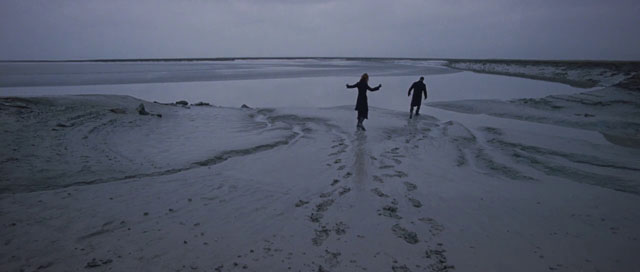
Much more breathing room in the interview than in the Hubley episode, and Frampton, as always, is great fun to listen to. He discusses getting to know Ezra Pound and experiencing his Cantos (a difficult, book-length piece of modernist poetry full of obscure references), which sound like they could easily have influenced HF’s work, but sadly his story gets cut off to show Maxwell’s Demon, then Surface Tension (minus the first part, the man with a clock), accompanied by good descriptions. Frampton tries to explain exactly what kind of filmmaker he is, and they struggle into a very good HF intro to Lemon (excerpted on the Criterion disc), then they do an honest-to-god audio commentary over the silent film. Some talk of Frampton’s work as a professor then an excerpt from Critical Mass.

Pas de Trois (1975)

Oooh, haven’t seen this one appear anywhere else. Footage from the New York State Fair, the “stripper” tent lit by strobes, then a little girl dancing in a different area. HF shoots the dancers, but also the strobes, a crack in the tent where someone peers through, and a fishtank, all accompanied by another HF/RG commentary.

Description found online: “An analysis of film’s persistent relationship to sexuality, mediated by allusions to early cinema’s flicker, and other aggressive qualities of the cinematic apparatus.”

“This is probably something that will never transpire,” HF says about the final form of Magellan – sadly, he was right. He discusses his plan for Magellan, thoughts on sound vs. silent film, and shows a collection of “Lumiere Bits,” what Criterion calls the Pans, short for the Panopticons. Somewhere there’s a program called Straights of Magellan: Drafts and Fragments collecting 49 of these. Of the kid with the frog, “this is my one-minute horror movie.” There’s also a cat toying with captured bird, 3D pattern on a sidewalk, saw cutting wood, a few more.

HF, interviewed elsewhere about these: “A catalogue or compilation of films which were limited to exactly one minute – 1440 frames. They were to be an homage not so much to the early cinema of the Lumieres as to an aspect of film that I feel has been lost.”

At a certain point, what has tended to happen previously happened again: I set out to make a simple inventory or catalogue of the appearances of the world, which I imagined might run to a few hundred short films, but as I actually began to gather these film segments they began to organise themselves – to my discomfiture – in a manner that I suppose is determined by my own immersion in montage: one thing suggests another, and if you have five things there seems to be some best order in which they should be seen. The bits of film, which were as opaque as an isolated word, seemed somehow to be demanding a more intricate organisation than I had originally planned. At first I thought that simply meant sorting them into more intricate categories; I had originally imagined that there would be four categories – ‘ordinary, extraordinary, exotic, and erotic views’ – which were the categories used by the Lumieres. So I attempted a more complex sorting, which led to the question of an equilibrium among the categories … What basically evolved from that proposed inventory – or catalogue, or storehouse – is a work whose working title is currently Magellan. This is composed of parts, not all of which consist of one-minute segments, not by any means. It’s not a work that can be diagrammed in linear fashion, since it uses the grid – among many others – of the cycle of the solar year. In other words, it’s a calendar. That is to say, it rotates like a wheel, or rather like a series of wheels that rotate within one another. I now expect, when and if the whole thing is completed, that it will be, very roughly, thirty-six hours long. Within those thirty-six hours there are a series of rough categories – well, the categories are actually quite exact, but they name parts that overlap each other on a kind of twodimensional map of the work. Those categories are ‘Straits’ and ‘Clouds’ [of Magellan], and there’s a section which corresponds to a ‘Birth of Magellan’ (itself comprised of subsections), and there’s another which relates to adolescence. Then there’s a ‘Death’ and even, heaven help us, a ‘Resurrection’.

States (1967)

White-on-black streaks of falling water and/or sparks, and rising smoke, alternating. Lovely, put me right to sleep.

Heterodyne (1967)

A large amount of black, with quick single-frame bursts of a color wash, a shape, or a colored shape. Gets boring pretty quickly. I played Mogwai’s You’re Lionel Richie which didn’t work at all. Frampton says “it was made in abject (if blissful) ignorance of Paul Sharits’ early work.”

Watched again with William Tyler’s Terrace of the Leper King after fixing an interlacing issue. Much better! The film still lasts twice as long as it is interesting, but I enjoy the anticipation/response of each burst of colors and shapes.

Snowblind (1968)

Watched with Yo La Tengo’s Ashes on the Ground, very enjoyable. A study of shifting lighting, motion and focus effects on layered fence patterns, pretty simple as far as HF films go. Internet doesn’t mention the identity of the patient man behind the fences, but I don’t think it’s Michael Snow.

Artificial Light (1969)

A minute-long scene of some artist-types chatting around a table, with cuts and dissolves, ending with a zoom into a photo of the moon. But this is repeated twenty times, each with a different variation. Once their faces are whited-out, once the picture flickers on and off, sometimes they’re colored or processed in different ways, flipped upside down and run in reverse. Quite an amusing movie. Apparently it was Frampton’s entry point from typical 1960’s avant-garde into structural films – and only a year later he’d put out Zorns Lemma.

Music played: Ennio Morricone – Music For Cinema: The Complete Edition, disc 4, though only track 6 really worked with the movie.

Noctiluca (1974)

Colored circles, reminding me of searchlights across a chain link fence, and sometimes of the MasterCard logo. Music played: “Stalker Dub” from John Zorn’s Nosferatu, which worked nicely. Intended for day two of Magellan.

Autumnal Equinox (1974)

Watched on Frampton’s 77th birthday. Shot in a slaughterhouse, but not terribly comparable to Blood of the Beast, since HF shoots everything too close with his trademark jittery camera movements. I wish there’d been fewer tongues and eyeballs, but it was mostly bearable, more textural than representational. Still, a motherfucker of a film, very red and gloopy and horrible. Music played: Autechre’s Exai tracks 10-13, which worked well, so I’m glad I resisted the urge to play Ty Segall’s Slaughterhouse.

Aubrey Plaza (more upbeat here than as April Ludgate) works for douchebag magazine reporter Jake Johnson (of the similarly-titled No Strings Attached) checking up on a shady fellow (Baghead director Mark Duplass) who posted a classified ad looking for time travel partners. Aubrey falls for him, but he predictably discovers her identity as reporter, putting their partnership on shaky ground. They’re followed all along by the most ineffectual government agents ever, while Jake spends a couple days with an ex and hooks up his socially awkward flunky with some loose young girls. I was happy to see Mr. Show’s Mary Lynn Rajskub as the magazine boss, and Katy was excited to see Kristen V-Mars Bell as Duplass’s ex-girlfriend who leads Aubrey that he’s maybe nuts after all, before she decides to trust him at the end and they disappear in his floating time machine.

Happily, the seemingly time-filler sidetracks actually add up to something. Aubrey and Jake state they want to travel back in time to prevent people they love from dying. Duplass is living in a weird place between past and present, fixated on his ex-girlfriend Bell, who he falsely tells Aubrey has died. Meanwhile Jake is trying to relive his past in multiple ways, by leading the young flunky towards a sexual experience, and reconnecting with his own youthful fling Liz, who finally proves to be too mature for Jake.

A fair pick to win all the oscars: a based-on-true-story thriller about a daring Hollywood-assisted hostage rescue with a happy ending. Affleck casts himself as a world-weary CIA hostage expert working for Malcolm’s Dad, who teams up with movie producers Alan Arkin and John Goodman to rescue U.S. embassy workers in newly Ayatollah Khomeini-run Iran hiding out at the Victor Garber-led Canadian embassy.

Comic book legend Jack Kirby did storyboards for the fake movie that the CIA pretended to be shooting while collecting hostages. Shot full of 1970’s grain by Rodrigo Prieto (25th Hour, Frida, Broken Embraces) and edited by William Goldenberg, who was double-nominated for Zero Dark Thirty (and won for this).

First of three Ozu movies within a few years in which Setsuko Hara is named Noriko. Here she’s a young woman (but not so young anymore) living with her absent-minded professor father (Chishu Ryu of Tokyo Story), refusing thoughts of marriage so she can take care of him. She hangs out with Aya, a cousin about her age, and her dad’s assistant Hattori, who is already engaged to another woman. Elder relatives meddle as usual: an irritating aunt (Haruko Sugimura) insists Noriko should marry, and twice-wed uncle Onodera offers a different perspective on marriage. Finally Noriko’s dad forces her hand, lies that he’s marrying an aquaintance so she’ll leave home and live her own life. It’s a movie full of very small revelations, building to a huge emotional moment. The movie has told us that Noriko will adjust to married life and grow to love it, though she seems unhappy on her wedding day, and her dad has said that he wants only what’s best for his daughter, but he cries when he’s finally alone. Most relationship movies end with a wedding, but this one has a very different take.

The meddling aunt starred in Naruse’s Late Chrysanthemums (not this one), also in the final segment of Kwaidan, and uncle Onodera was in Pigs and Battleships. This was Hara’s first film for Ozu, having previously starred in Kurosawa’s No Regrets For Our Youth. Katy liked, but can’t figure out its top-twenty placing in the Sight & Sound list.

M. Atkinson for Criterion:

Ozu’s Zen-infused sensibility translates on film to something like the art form’s nascent formal beauty: patiently watching little happen, and the meditative moments around the nonhappening, until it becomes crashingly apparent that lives are at stake and the whole world is struggling to be reborn. … Late Spring is a hushed battlefield where no one is right or wrong. We watch the infliction roll out inexorably, wishing there were a cheesy, American-style resolution somewhere on the horizon in which all of the well-meaning characters could be happy. But that’s not Ozu. Ozu is the natural energy of Noriko’s generous grin, dispensed selflessly in all social situations, until she realizes where her life is helplessly headed – and the blood-cooling shock of seeing that resilient smile finally drop.

“The turning point is the uninterrupted, eight-minute performance of a Noh drama during which Noriko suddenly becomes aware of her father’s apparent interest in an attractive widow and realizes he may not actually need her after all.” From a good James Williams article in Film Quarterly on the influence of Late Spring on Claire Denis’s 35 Shots of Rum:

Certain episodes correspond exactly: for example, the Noh play and the Nightshift sequence, the final trip together to Kyoto and the journey to Lubeck (both feature a scene where the pair sleep side-by-side like lovers), an abortive concert, and the focus on preparations for mar- riage rather than the ceremony itself … What particularly interests her in Late Spring is its representation of the “strong yet awkward” father figure that resonates so powerfully with her own family background.

I got a collection of the Screening Room series, in which Robert Gardner (a great filmmaker himself) interviews creators of avant-garde, animated and short films and shows their work. The plan is to watch some of these and supplement them with other shorts by the filmmakers. In the Hubleys’ case I’ve got plenty, since I bought all their DVDs when they were in print – probably watched most of the films a decade ago but now I can’t remember one from the other, so need to see again. Since I already had all these movies (except possibly Children of the Sun) I would’ve appreciated more time spent in conversation with Gardner, but when this aired I’m sure it was more important to show the work itself.

Eggs (1970)

Birth and Death share a car, drive through civilization debating (over)population. Then Quetzalcoatl shows up and sends them both to a new planet, announcing that the old one is on its own. The dialogue recording is a little too beatnik, but it’s a nice film, good one to start the program. John mentions to Garner that an advantage of animation is being able to tackle huge social issues in the abstract.

The Hat (1964)

One of my favorites, with Dizzy Gillespie and Dudley Moore as two border guards riffing on the idea of war and artificial boundaries after one drops his hat onto the wrong side of the line.

I also flipped through their book adaptation of The Hat, an attempt to turn the rambling dialogue into written form (with illustrations)… doesn’t seem to have worked as well.

Children of the Sun (1960)

Child play and fantasies (accurate to a fault), ending with a weird string-music motion child collage.

Zuckerkandl (1968)

Opening narrator sounds like WC Fields. An illustrated speech given by Robert Maynard Hutchins about Freud student Dr. Zuckerkandl, who is animated as a tiny man with an amusing accent. Mostly I distracted myself watching him and thinking about animation and missed the part where he’s supposed to be the father of modern times. Oh nevermind, internet says it’s a fiction/parody of psychology, which I suppose accounts for all the laughter during Hutchins’ speech. Regardless, another weird choice for an animated film.

Moonbird (1959)

The cutest of their children-voices movies that I’ve seen – Mark and Hampy dig a hole, lay bait (candy) and set a trap to catch the elusive moonbird. Won the oscar over a Speedy Gonzalez, a biblical Disney and an Ernest Pintoff musical short.

The Adventures of * (1957)

Fun, visually exciting short about how aging crushes your imagination and sense of fun – but with a happy ending.

Urbanissimo (1967)

Another favorite. A farmer is startled by a giant, resource-scarfing mobile city that steals his fruits and spits out canned fruit. Entranced by the music of the city (a nice jazz score by Benny Carter) he drops everything and runs after it. Presented by the National Housing Agency of Canada.

Dig (1972)

Educational short about geology. Adam is going to the store for milk when he falls deep into the earth’s crust. Guided by a talking rock (Jack Warden, the president in Being There) he learns about quakes, salt, stalactites, different kinds of rock, fossils, volcanoes. Songs ensue, including “So Sedimentary,” which Dump has covered. Blacklisted actor Morris Carnovsky protects “the tomb of the earth,” through which they go back through prehistoric eras. Finally Jack returns to his mom (Maureen Stapleton, Emma Goldman in Reds) with his new pet rock (and no milk).

“There’s nothing in the world that can’t be quantified.”

Hyped as a mindblowing modern Russian sci-fi story, but I found it overall disappointing – sleek and mildly weird, but not terribly interesting.

Boring mega-rich Viktor and youth-obsessed wife Zoya (Justine Waddell, lead nurse in The Fall) team up with her brother, totally awful TV announcer Mitya (or Dmitri?), and a jockey for some reason, flying to a tiny town around an abandoned science experiment in the middle of nowhere, where Dmitri falls for fellow tourist Anna. The five spend the night inside a giant cosmic-ray accumulator, and supposedly now they will never age.

“In nature there are no ethically neutral substances.” Viktor is obsessed with these blue-glowy glasses that can detect the amount of good and evil in anything. His wife Zoya runs off and has an affair with the jockey, who has killed some guys at work and needs to escape. Dmitri/Mitya starts making an on-air mockery of his job. A girl named Taya has come back with them from the Target, is going to meet her boyfriend in front of the ballet. Their affair had become too intense so they agreed to separate for 30 years. Same thing is happening to Dmitri and Anna, so they make the same agreement.

Dmitri and Anna:

Zoya and youth-mask:

At the end, Viktor is killed, then Zoya commits suicide as the jockey leaves town in hiding. It’s a pretty tightly paced movie for being three hours long, but the eternal youth aspect, the good/evil thing and the relationship weirdness never come together, so I didn’t see its point. I don’t mean to be obvious and compare every Russian movie to Tarkovsky, but you’ve got a movie about a few travelers who visit a mysterious, underpopulated area and are exposed to radiation that changes their physiology and behavior, which sounds like Stalker meets Solaris – just much less subtle and mysterious.

Isaac (Ricardo Trepa, star of Eccentricities) is called to a rich estate in the middle of the night to take final photographs of a just-deceased girl (Pilar Lopez de Ayala, star of In the City of Sylvia), whose image he falls in love with, then it starts coming to life in his photographs (if MdO can embrace digital sfx then anybody can). Isaac spends his days photographing field laborers and his nights dreaming of Angelica, to the concern of his meddling landlady Justina. Excellent shot at the end: sick Isaac rises trance-like from bed, pushes the doctor aside then collapses, as his spirit continues out to the balcony and flies away with Angelica.

Mouse-over to hallucinate like Isaac does:

There are few indications that the movie is set in any recent decade until we see cars in the last half hour. This is by design: old-fashioned, simple-living photographer Isaac seems overly interested in old-fashioned things. I’m not sure of the significance of his being Jewish, but it’s mentioned a lot.

Film Quarterly explains:

As a Jew, Isaac is a stranger to the community, but he’s fascinated by Portugal’s religion, dying agricultural traditions, and quasi-mystical, late-romantic literature. (The Strange Case of Angelica grew out of a film Oliveira wanted to make in the 1950s, dealing with Jews who migrated to Portugal after World War II.)

I didn’t spot Leonor Silveira, but trusty ol’ Luis Miguel Cintra (Inquietude, Non) stays at the same boarding house. That’s him above with Ana Maria Magalhães of The Age of the Earth.

Mouse-over to awaken Isaac from his dream:

Douro, Faina Fluvial (1931, Oliveira)

The DVD guys have kindly included Oliveira’s first short, documenting workers on the river (as Isaac documents them in the fields – but not precisely). He pulls shots in and out of focus, gets in every striking angle he can muster, edits still and motion shots together in jarring ways. Definitely some staged situations. A truck driver, distracted by a passing plane, bumps an ox cart which then runs over a young man. The man is okay, but starts beating the oxen in anger until a policeman shows up, and he and the beasts make up.

I only played a few minutes of the very good (so far) commentary, instead watched an Oliveira monologue. He is against television, pornography and violence. He is for fantasy, Melies and Avatar. He methodically lists all the well-known great filmmakers, saying they’re the ones who maintain proper separation between the private and public spheres – an ethical discussion that I didn’t follow, then methodically lists the exact same filmmakers a few minutes later as if we didn’t just go over this. Cinema as an art should be “a reflection of the more critical, richer, graver and higher aspects of the human condition.”

A different kind of trilogy, three filmmakers born in different decades each makes his own feature film set in the same town at the same time, rotating around a central event: a convicted murderer escapes from a hospital and kills again.

Quotes in italics below are from Dennis Lim’s great article in Cinema Scope, which is what got me watching the trilogy in the first place.

Beats Being Dead (Christian Petzold)

Clean-looking picture. Follows young hospital flunky Johannes. Broken up with Sara, a hospital director’s daughter, he picks up a girl he sees getting dumped by a band of motorcycle thugs and takes her home. Johannes proves to be a bit of a stalker, and Ana sees him following her everywhere, which is why I keep thinking this movie was the chapter entitled Don’t Follow Me Around, but no, that’s the next one. Hard to tell Johannes’s intentions – he seems entranced with Ana, but at the end I wonder if he was using her to get back with Sara. She’s not a good match for him – makes lots of bad decisions then cries about them. Either way, he does end up with Sara after Ana attacks her at a company party, and they go off to Berlin together. Johannes never realizes that the door he clumsily left open at the hospital last week allowed the killer to get free, nor that the killer eventually stalks Ana (just like Johannes has been doing) and kills her as he’s driving out of town.

Petzold inscribes cold, hard truths of class and money into almost every scene, fusing erotic tensions with socioeconomic ones.

Don’t Follow Me Around (Dominik Graf)

A deceptive story with a grainier look and a less driven feel than the first movie. Psychiatrist Jo (Jeanette Hain of that Kate Winslet movie The Reader) is dispatched to Dreileben to assist the police with the manhunt. Jo arrives, stays with old friend Vera and her husband Bruno, who seem to be having relationship trouble. The escaped-killer plot is mostly dropped as she sets her investigative skills towards her friend, discovering that they both dated the same man shortly before they met. Meanwhile, Jo’s work in town is cryptic until halfway through the movie it’s revealed that she never came to work on the killer case, but to investigate corruption, leading to the arrest of six local officers. Once this is wrapped up, Jo does work on the other case, enlisting an artist to bait the killer. Meanwhile, Vera leaves home suddenly, paying a visit to the mutual unseen ex, returning having learned more secrets as the movie reveals that he’s the father of Jo’s daughter. Despite (or because of) its sidetracks, it’s the most richly engrossing of the three movies.

Talky and witty, packed with revealing tangents and glancing micro-observations. Shot by Michael Wiesweg in soft-toned Super 16 – a striking contrast to the crisp, controlled visuals of the other two entries – Graf’s film makes a virtue of skittishness. The distractable camera snoops, wanders, lingers on odd details, and the narrative likewise keeps shifting its attention.

One Minute of Darkness (Christoph Hochhausler)

This one suffers from having nothing much to say. It follows the killer, Molesch (Stefan Kurt, who got to play Albert Speer in a Hitler movie), whose history, escape, various sightings, then capture have already been addressed in the other two movies. Here we see the escape in greater details – Molesch wandering through a back door (left open by Johannes) while in hospital to see his just-deceased mother. Then it’s on to narrow escapes (movie briefly becomes The Fugitive during a bridge scene), police incompetence, and Molesch’s unlikely (but quite typically movie-likely) truce with a runaway girl. And just as inspector Marcus (I love that the music has ringing tones, in tune with his tinnitis) figures out that Molesch was innocent of his original crime, Molesch of course kills Ana from the first movie (after stopping to burn down his dead mum’s house).

[the titular piece of missing surveillance footage] speaks to the impossibility of certainty in the absence of observable evidence, the danger of imposing stories onto what we cannot know for sure. This conundrum is, of course, intimately linked to the de-dramatized cinema of the Berlin School: the fear of narrative as, to quote Hochhausler, something that “contaminates the picture,” a lie, and what’s more, a lie that could become the truth.

Petzold has made at least two films I’ve read about: Barbara and Jerichow. Graf has done a lot of television, including something called Doktor Knock, which is what I’m going to name my metal band. Hochhausler made a few films I’ve never heard of.

Graf was born in 1952, Petzold in 1960, Hochhausler in 1972, and each has a distinct relationship to the now decade-old “new German cinema” that has come to be imprecisely known as the Berlin School. Graf, a respected senior figure and a stalwart of German television, predates the Berlin School’s emergence, and has criticized what he sees as the reticence and passivity of many of the films. Petzold is often identified as one of the movement’s de facto founders, part of the pioneering wave that studied at the dffb in the ’80s and ’90s. Hochhausler belongs (with Benjamin Heisenberg and Ulrich Kohler) to the Revolver-aligned second generation, whose careers have progressed and diverged in ways that reflect the constant sense of flux, born of habitual self-examination, that defines this loose group.

Indiewire:

Dreileben is not an epic story. A term like that is generally saved for adventures that are years long or involve arduous journeying. Instead of offering something like that, these three German filmmakers have given us a very dense, abstruse, enclosed saga; full of knotty liaisons and unsolved conflicts … Coincidences are played with often (some big, some small, some even unnoticeable) and certain elements/traits, such as deafness, carry over to different characters and situations. Rather than composing a grand narrative, the directors went above and beyond to provide a wealth of substance and meaning.

A really lighthearted spy romp, in which forced-into-retirement secret agent Walter Matthau spends some time with his girl Glenda Jackson (of a string of Ken Russell movies) and decides to write a tell-all book about the agency while his former bosses, led by humorless Ned Beatty (con man Hoover in Wise Blood), try to locate and possibly kill him. In typical PG-rated 1980’s style, Ned fails and is repeatedly humiliated, and Matthau (who proves himself awful at accents, languages and disguises) escapes detection despite having a bestselling book with his picture on the cover.

How spies work:

Stately Glenda:

KGB Chief Herbert Lom (known for the Pink Panther series) joins in the chase towards the end, along with sympathetic CIA guy Sam Waterston (simultaneously of Heaven’s Gate). Matthau rents his ex-boss’s house in Adairsville GA (wooo!) and arranges to have it destroyed. There are some plots that rely on perfect timing and coincidence, as in all spy movies, but it’s a well-meaning little movie, so I was rooting for it.

Matthau’s son, Lom, Beatty and Waterson: