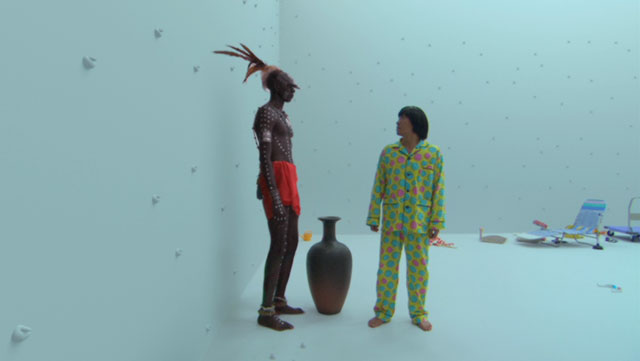
Michel Simon (returning from Le Chienne) is Boudu, a crazily bearded homeless guy who grows despondent over the disappearance of his dog and jumps into the river. Hundreds gather to gawk, but one man, a bookseller who was watching Boudu before he jumped, leaps in to save him. The bookseller (Charles Granval of some Duvivier films) is congratulated and given awards for taking the poor man in, so he can’t throw him back out, even though Boudu is wrecking his house and interfering in the bookseller’s affair with his housekeeper Anne Marie. Finally Boudu wins the lottery (!), and so marries lovely Anne Marie, but just after the wedding, floating down the river with the whole family, Boudu topples their canoe and floats away, happily returning to his hobo life.

Simon at his most Charles Laughtonesque:

I can’t figure out if it’s an attack on bourgeois society, or simply an attack on everything. It opens with a couple of telling scenes. Boudu loses his dog, asks the police for help and they tell him to fuck off. A rich woman loses her dog a few minutes later and everyone in the park takes up searching for it. Then a fancy man drives up and Boudu opens the door for him. The man searches all his pockets for cash to give in return, until finally Boudu is tired of waiting and gives the guy five bucks. It’s a very fun comedy, much lighter than La Chienne and with an exuberant performance by Simon. Richard Brody calls Boudu a “walking principle of anarchy, insolence, and truth,” who “punctures the pretenses of decent society with the riotousness of a fifth Marx brother.”

There’s a scene with Jean Daste as a student visiting the book store, and immediately afterwards, a shot of barges on the river. I figured Daste + Michel Simon + barges = a L’Atalante reference, not realizing that this movie was released two years earlier.

Jean Daste with Charles Granval:

Renoir: “The success surpassed all hopes. The public reacted with a blend of laughter and fury.”

Based on a play, which was remade for television in the 70’s, again in the 80’s with Nick Nolte then in 2005 with Gerard Depardieu.

It could be fun to think of this movie as a sequel, since Michel Simon ended Le Chienne as a cheerful hobo, his former life and marriage in tatters. But the accountant of Le Chienne was too mild to turn into a Boudu. Also, his beard wasn’t nearly awesome enough.

C. Faulkner

This is the period of the Depression in France, which accounts for the indifferent remark by a working-class character on the bridge that, of late, people have been throwing themselves into the Seine with regularity.

There is a sense that Boudu exteriorizes something that is in Lestingois himself, that the bookseller has summoned him up from the dark reaches of the personal and social unconscious. Boudu is everything at the center of the self and within society that has been discarded, ignored, or repressed. This “boudu” belongs to filth, to waste, to the unassimilable; he is an instinct, an urge, a drive. (What kind of name is Boudu? Does it connote a substance? An action? A disposition?) This “boudu” is something “savage” (so says Madame Lestingois), summoned involuntarily, that both attracts and repels, in equal measure, and over which Lestingois has no control, as the balance of the film proves.

Assistant director Jacques Becker plays a ranting poet in the park:

Often I just don’t know what is happening. A title card says “the commisars”, now people are marching with guns, groups are handing scraps of paper to a man who’s collecting them on his bayonet, then a title says “To the telephone office!” What did all those things mean?

It was all very important at the time, a film portrayal of recent political upset and revolution, but with my lack of background in Russian history, most of the movie seems a blur of dates and places and crowds, the significance of most scenes lost, and very few of the alarmingly great compositions of other Eisenstein films. There’s some of the dramatic editing of course – when the crowd is fired upon it seems like single-frame edits, unreal. I don’t think Trotsky comes off well in the end. At least I managed to get used to the unnecessary sound effects all over the DVD.

60’s-style cool in a cinemascope stripe, more Seijun Suzuki than Red Angel. The upstart Tiger motor company tries to release a new sports car but the larger Yamoto company is trying to steal their ideas and sabotage their success. Asahina is a young Tiger engineer expected to become department head after the new car’s launch, but after going along with his bosses in the spy game – including selling out his girl to get trade secrets – he walks out at the end, saying Tiger has become as dirty as their competitors.

A test car crashes dramatically. Asahina’s girl Masako works at a bar, tries to get the competitors to talk. Tiger employees attempt to sell fake designs to Yamoto, but Yamoto has already stolen the real plans. A designer is kidnapped. A triple-crossing reporter gets payment from all sides. A board meeting is filmed through the window and a lip-reader employed to translate. A collector buys the first car off the line, rigs its destruction on train tracks and says the car was a lemon, drawing big publicity. The Tiger employee responsible for the leaks is discovered and kills himself. It’s all pretty action-packed for a movie populated by motor engineers.

The IMDB only feels like listing a few of the actors. Our moral hero was Jiro Tamiya, who costarred in a popular series of films known as Bad Reputation or Tough Guy. His girl was Junko Kano – didn’t act for long, not in anything else I’ve heard of. Bald Tiger unit boss Onada was Hideo Takamatsu of A Wife Confesses. Hiraki, fresh-faced son-in-law of the hospitalized company head, was Eiji Funakoshi, star of Fires on the Plain and Blind Beast.

AV Club:

Throughout his career, Masumura displayed a flair for the ludicrous, and frequently skewered his countrymen’s Westernizing pretensions by mocking the ways in which the new religion of business was costing them their souls. Black Test Car is largely effective because Masumura plays the story relatively straight. Shooting in stark black and white, in crowded rooms framed at cramped angles, Masumura keeps the mood tense and coaxes performances that are earnest without becoming campy. The boardroom chatter—along the lines of, “People want speed and luxury!”—coupled with the fast-paced editing make Black Test Car play like a darkly sophisticated live-action episode of Speed Racer.

Set in 1926. The same cast as Love Unto Death – again putting Sabine Azema together with Pierre Arditi. This time they are happily married until Andre Dussolier comes around to visit, in a half-hour dinner-conversation opening scene. Sabine beins a passionate affair with Andre, her husband’s old classmate at music school, now an accomplished violinist. Unlike Love Unto Death (which I think I prefer), the only music we hear is played by the characters.

A red curtain declares the start of act 2. Pierre is sick, has been sick for a couple weeks, and cousin Fanny Ardant calls a doctor one day while Sabine is away. This is trouble because he starts asking questions, like what are the drops that Sabine has been giving her husband ever since shortly before he became ill. On top of Pierre’s illness, his wife is becoming hostile, disappearing for long periods of time.

Red curtain, act 3. Sabine killed herself three years earlier and her cousin Fanny has married Pierre, and knows about her cousin’s affair with the violinist. She tries to keep the secret from Pierre but he suspects, visits Andre and challenges him. Andre holds his own, never admits the affair, and Pierre drops it. Movie seems to end on a hopeful, reconcilatory note as they play music together.

A small-scale, controlled film, with theatrical staging (just a few locations) but thoughtful camera work. The girl cheating while her man is performing his music reminds me of To Be Or Not To Be (or Unfaithfully Yours). Sabine and Pierre won Cesar awards, but Resnais lost to Alain Cavalier and Therese.

I was going to choose something to quote from J. Rosenbaum’s 1988 article on the film, reprinted in Placing Movies, but it’s such a long and thoughtful piece, I don’t feel like chopping bits out of it.

As I said, reading the Canyon Cinema book just made me want to see more of their films, and so I held a solo screening of some video reproductions of films from their archives.

Notes on the Circus (1966, Jonas Mekas)

Doc footage from his seat at the Ringling Bros. circus, edited to a pulp after the fact, divided into four sections.

1. nervous, jittery views of circus acts: trapeze, clowns, animal acts.
2. more of the same, but towards the end of this section the editing goes hyper and adds superimpositions.
3. picks up where the end of 2 left off. This is likely more fun than an actual circus.
4. all energy, focus be damned.

The guitar/harmonica folk music worked pretty well alongside the images. Mekas repeats songs just as he repeats shots (the same woman doffs her white coat and ascends the trapeze at least three times).
Canyon claims “no post-editing of opticals,” so was he rewinding and re-exposing the film while sitting at the circus?

Here I Am (1962, Bruce Baillie)

A pre-Wiseman verite doc on a local school for mentally disturbed children. Why is the caretaker giving the kids cigarettes?!? Non-sync sound (no narration) with added cello. Nicely paced, and very well preserved. Canyon called it “never before released,” but before when? The DVD notes say it was part of a homegrown newsreel program. “Like the school itself, the camera gives the kids center stage and moves at their pace.”

Fake Fruit Factory (1986, Chick Strand)

Shaky, handheld doc of women who work at the titular factory, talking about sex and food and work, interrupted in the middle by their annual picnic. Non-sync sound, I think – hard to tell since close-ups of hands and bodies and fake fruit are favored over faces. Canyon gets the title wrong on their website and botches the description. Wasn’t Strand one of their founders?

SSS (1988, Henry Hills)

Oh wonderful, a dance film. Many dancers in many locations, all wearing hilarious clothes, rapidly edited in a pleasing way, punctuated by a few seconds of black every once in a while. Best part is the music, orchestral then cartoonish, sounds like a DJ with some electronics, all by Tom Cora, Christian Marclay and Zeena Parkins (and recorded by Kramer). Canyon says “filmed on the streets of the East Village and edited over three years.”

Money (1985, Henry Hills)

No music this time, but lots of musicians and some dancers. Seems like a hundred people on the street were interviewed about money (some were given scripts to read) then their every word was chopped out of context and edited against everyone else, sometimes forming new sentences or patterns from different sources, sometimes just spazzing out all over, interspersed with the musician and dancer clips. Somewhere in there were John Zorn, Fred Frith, Tom Cora, Eugene Chadbourne, Ikue Mori, Bill Laswell, Christian Marclay and Derek Bailey. I’ll bet they play this at every Tzadik party. Hills would seem to have a love for music, a sense of humor and tons of patience. Canyon: “thematically centered around a discussion of economic problems facing avant-garde artists in the Reagan era. Discussion, however, is fragmented into words and phrases and reassembled into writing. Musical and movement phrases are woven through this conversation to create an almost operatic composition.” Good poster quote by J. Hoberman: “If time is money, this 15-minute film is a bargain.”

( ) (2003, Morgan Fisher)

Composed entirely of insert shots from other films. Could be the most intricate murder/conspiracy film of all time, what with all the plots and notes and watches and gambling and guns and knives and secret goings-on. I wish it’d had music. Didn’t recognize a single film, and I couldn’t even find any of the sources by searching character names spotted on notes and letters with IMDB. Shadowplay would be ashamed of my b-movie image-recognition prowess. I really want to do a remake, but the logistics and time involved would be hefty. Fisher is only glancingly mentioned in the Canyon book, but I had this and wanted to watch it.

Thom Andersen:

Fisher appreciates inserts because they perform the “self-effacing… drudge-work” of narrative cinema, showing “significant details that have to be included for the sake of clarity in telling a story,” and he made ( ) to liberate them… to raise them from the realm of Necessity to the realm of Freedom,” to reveal their hidden beauty.

Oh Dem Watermelons (1965, Robert Nelson)

Much talk about this one in the book. A silent, still shot of a watermelon lasts an age, then a singalong with an old racist song – or is it an ironically racist new song? – then some melon smashing with pioneering use of the shaky-cam. The song starts repeating and becomes irritating, as must all avant-garde film soundtracks. This time, Steve Reich is to blame. There’s stop-motion and Gilliam-style cut-out animation. My favorite bits are the dog that appears to poop out a watermelon, and the melon slowly crushed by construction equipment. Made as an intermission film for a theatrical racial satire, Nelson claims to have been inspired by Louis Feuillade.

Samadhi (1967, Jordan Belson)

Eclipses and auroras, perhaps the eyeball of a wizard, five spherical minutes with a blowing, groaning soundtrack.


Samadhi (c) Jordan Belson

The Way To Shadow Garden (1954, Stan Brakhage)

The camera stalks creepily around an empty room. A clean-cut young man comes home, struggles with a glass of water and the bed, dances, reads a book. The camera continues its subtly creepy assault, lingering on light bulbs, but otherwise I’m thinking this is Brakhage’s most performance-based film that I’ve seen, a wordless narrative episode. But then the man claws his eyes out, the film stock reverses, and he seems to find the shadow garden, all blind light and shubberies. The first half makes me think Brakhage could’ve made some killer Sirkian dramas if he’d had the urge.

The Potted Psalm (1947, Sidney Peterson & James Broughton)

Shots of people and things. A graveyard. A snail. An accordion. A funhouse mirror. Dolls suicide. A woman eats a leaf. The cameraman has a beer and a cigarette.

Not the first Sidney Peterson movie I’ve watched, and I still don’t get what he is on about. Kino made an interlaced transfer, hired a woman whose Casio can make neat sounds to record a horrible score.

I had a bunch more in mind to watch, but I suppose I’ll get to them another day.

I first heard about this book (and Canyon, probably) at this screening at the Nashville Film Festival presented by Dominic Angerame, executive director of Canyon.

Had been meaning to buy it ever since. Coincidentally, the day after I placed my order, Dominic posted a letter declaring that Canyon “can no longer continue as it was originally conceived and changes need to be made that are appropriate to our present day and age.” I wish that such changes included more screenings like the one at NaFF (perhaps in two years, for Canyon’s 50th anniversary) since the book didn’t captivate me the way the films do. I guess infighting between partners and artists at an indie film distributor isn’t so exciting to me.

Divided into sections representing phases of the company’s history: Formation, Incorporation, Revitalization, Intellectualization, Maintenance

Little discussion about films themselves, but much about who gets paid what percentages, festival screenings and censorship, the difficulty of raising funds and the disparity between the famous members (Bruce Conner, Stan Brakhage) whose films rent out more than half the other members combined. Mostly interesting were the reprintings of original Canyon newsletter articles.

Some favorite pieces:
Saul Landau’s account of a 1964 police seizure of Jean Genet’s Un Chant d’Amour
Robert Nelson’s 1968 summary of the Brussels festival films, followed by miscellaneous notes, then another summary of the Bellevue festival.
Robert Pike’s story about a three-minute film called God Is Dog Spelled Backwards
Brakhage’s story of the making of The Text of Light
James Broughton’s “How to Cope with the Question Period”
A couple of Kuchar cartoons
Larry Jordan’s “Survival in the … Film Market of 1979”
Warren Sonbert on film syntax

Vincent Gallo was amazing in this, won an acting award in Venice. He plays a soldier captured by U.S. forces after blowing up three guys with a rocket launcher – at least that’s what I thought. A couple things I read online suggest that he lifted the launcher off another soldier in the cave, or found it there when he was just stumbling by, but that wasn’t how it looked to me. Anyway, he kills enough people over the course of the movie – and is antagonized and tortured enough – that it’s clear (even from the title) that the movie isn’t making him out to be evil nor especially sympathetic. He is trying to stay alive in the midst of social and military conflict. He doesn’t manage, but not for lack of trying. The movie’s many action scenes are tense and powerful, the images are often poetic, and with Gallo’s great performance on top of that, this has become one of my favorite recent films.

After the initial attack, Gallo is pursued by helicopters and deafened by a rocket strike. He’s interrogated and waterboarded, then escapes when a prisoner transport truck tumbles off-road in what turns out to be Poland. He tries to surrender and make himself known to his captors, but sees a chance and kills a couple of guys instead, escaping into the wilderness – later pursued by dogs and falling into a river to escape. Now he’s in the snow on unfamiliar ground, eating insects and berries to survive, starving, having delusions. He hitches a ride on a logging truck and kills a logger, then in the movie’s weirdest scene, assaults a nursing mother to get milk. He ends up at a sympathetic mute woman’s house (Emmanuelle Seigner of The Ninth Gate and Bitter Moon), for one night of rest and recovery. But by now he’s mortally wounded, escapes on a white horse but doesn’t last long.

M. Atkinson:

As a filmmaker with a puzzling half-century of peculiar projects and long silences and catholic passions behind him, Skolimowski has always been a marginal figure, erratically appearing and helming films so disparate he’s a living disputation to the auteur theory. His work defines him as a searcher, a road movie antihero still looking for his mythical home on the horizon. One of the most interesting nomads in a film culture filthy with them, Skolimowski was cut loose from the Eastern Bloc in the late ’60s and has been roaming the plains of the global industries ever since, coming full circle in his new film, lost in the icy Carpathian wilderness.

It’s a film designed to be noticed, a film about the Afghanistan war that doggedly, even perversely, resists overt politics; an on-location survival saga shot with a recognizable American-indie star (Vincent Gallo) who has not a word of dialogue; a physically rough ordeal that’s meticulously staged and framed on the razor’s edge between pulp excitement and arty poeticism but never quite tumbles into either camp.

Another rockin’ John Wayne/Walter Brennan movie, although this one seems more Westerny than Rio Bravo, what with the cattle drives and Indian attacks. Wayne is a Texas rancher who builds a cattle empire after losing his sweetie to Indians while crossing the Red River years earlier. Now he and his young protege Monty Clift (his first year in Hollywood, five years before From Here To Eternity) take a long, difficult drive north since cattle prices have crashed down south, hoping they’ll hit a railroad town before they hit bandits or Indians. The men mutiny when Wayne becomes a slavemaster, Clift takes over, and there’s a pretty badass showdown between the two at the end, culminating in a happy reconciliation.

Harry Carey Jr. (in one of his first movies) makes the mistake of talking about his lovely wife waiting at home, so he gets killed in a stampede brought on by some idiot who steals sugar from chef Brennan – the movie’s way of saying that life is meaningless. Harry Carey Sr. (in one of his last movies) plays the happy-ending cattle buyer at their destination town. And John Ireland (the coward Robert Ford in I Shot Jesse James) is set up as Clift’s big rival, then his plot thread fizzles out. IMDB says Hawks wanted Cary Grant for the part – I guess Ireland wasn’t an exciting enough player to justify adding another twenty minutes to the film. Remade in the 80’s with James Arness, Ray Walston and LQ Jones.

As usual after we watch a Hawks movie, Katy and I shared an uneasy conversation about auteurism. She accused me of being a Hawksian auteurist, but I still can’t tell a Hawks movie from, say, a Billy Wilder or William Wellman movie. I just tend to like them is all.

I shouldn’t have to look up web articles about this movie since I have the BFI Film Classics book, but it turned out to be way boring. Senses of Cinema talks up Wayne’s oedipal relationship with Clift, then Intl. Cinema Review compares Clift’s and Ireland’s competitive gunfight to an orgasm, so apparently the movie was all about sex and Katy and I didn’t realize.

“Everything’s prepared. We’ve left nothing to chance.”

A tight, charismatic perfect-crime heist movie. Guys with gambling problems, mean wives, fake personas (one pretends to be a priest) and mounting debts join forces under the instruction of a cranky ex-soldier. Turns out they’re all ex-soldiers, specially selected (aren’t they always) for their former military skills. Two heists ensue – first to get military weapons from a training complex (arguably the more exciting of the two), then a gas-mask assault on the bank (definitely the more photogenic). They’re sold out by an eight-year-old witness, going straight from the celebration party (where nobody tries to scam anyone’s share – gentlemen indeed) to the paddy wagon.

The gang’s (mostly) all here:

The film’s writer (Bryan Forbes) is one of the criminal soldiers, as are the great Roger Livesey (years after his Powell/Pressburger films), Lord Richard Attenborough (Flight of the Phoenix), Nigel Patrick (Pandora and the Flying Dutchman) and Jack Hawkins (The Small Back Room, Zulu, Land of the Pharaohs).

Highly enjoyable little movie by Basil Dearden, about whom I still know nothing because I rented this and didn’t get the liner notes. Here we go: “elegantly crafted… noir-tinged dramas that burrowed into corners of London rarely seen on-screen.” Looks like the other three in the box set were more explicitly about British social problems.

M. Koresky:

A lively crime escapade with melancholy undertones, this examination of the instability of a generation of British men may have appealed to Dearden and Relph’s social sensibility: the film takes place more than ten years after the end of World War II, but its main characters are veterans who have not been able to fully reintegrate into civilian life. They find the normal patterns of postwar behavior alienating—going to work, living with wives and children—and are haunted by nostalgia for the masculine community of wartime.