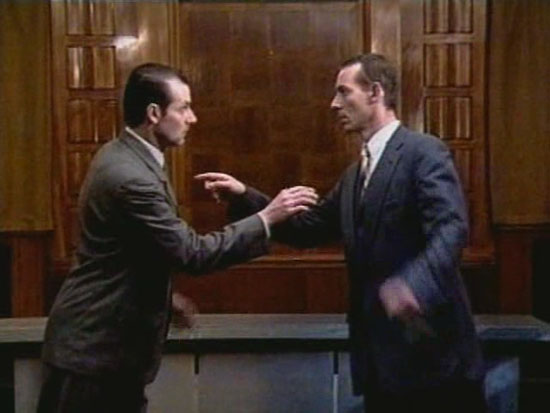
When the movie began, I immediately noticed Jean-Claude Brialy’s hair. Who is this guy? I’ve seen him in earlier films (Paris Belongs To Us, A Woman is a Woman and Le Beau Serge) and a later film (Phantom of Liberty) but I can’t remember him. I think he might be the guy on the right in my middle screenshot of Le Coup du berger but without the beard and the hair it is impossible to tell. That hair… so distracting. Laying on the couch, I alternated between taking in the luxurious outdoor camerawork and watching Brialy’s hair. The birds fought on me for the first ten minutes before Our Bird settled on the couch in front of my head and New Bird camped on my shoulder with his tail right in my eye. So I thought about the birds, and Brialy’s hair, and the sunlight in the film, then I realized that a half hour had passed and I still wasn’t paying attention to the dialogue.

Brialy & Laura:
image

So maybe not the ideal screening of Claire’s Knee… or maybe it was! Either way, I got the feeling that I liked the previous two movies better, despite expectations that this would be the masterpiece of the Six Moral Tales. Seems like the Tales are wearing themselves thin. Guy in picturesque location with distant girlfriend flirts with young girls but ultimately stays with his girlfriend… it’s La Collectionneuse again.

Claire:
image

This time the guy is bushy Brialy, spending the month before he gets married in his old home town (I think), possibly to sell the family home, though we never see him do anything productive. His co-conspirator (see also: Vidal in My Night at Maud’s) is an Italian writer with a distracting accent, Aurora. Brialy flirts first with big-haired 16-yr-old Laura, then with her (slightly older?) step-sister Claire, whose knee we don’t see until towards the end of the picture. Laura is happy to lightly play around and talk with Brialy but they both know there’s nothing serious, then he is briefly tempted by Claire, tries to break her up with her boyfriend, then comforts her when they are stranded in the rain together by rubbing the titular knee. He goes home to his fiancee, thinking himself a dark stranger who changed these two young girls’ lives, but Laura hardly seems to notice him in the last few days, and Claire is back with her boy two minutes after Brialy has left. Even if the rest of the story was nothing special, I liked this ending, which gives more of an inner life to the female characters than previous entries have done.

(R-L): Sad Claire, her knee, Brialy:
image

Beautifully shot by master of light Nestor Almendros the same year he did Bed & Board and The Wild Child for Truffaut. Hardly any of the actors besides Brialy had been in any films before, but most would appear in later Rohmer films from time to time. This won best film from both the U.S. and French critics societies, but lost a best-foreign Golden Globe (with fellow loser The Conformist) to an Israeli movie that isn’t out on video (which itself lost the best-foreign Oscar to The Garden of Finzi-Continis).

image

My (comparatively) negative feelings about this one extend to the DVD extras, too. First we’ve got a nothing TV interview with the cast, where we learn that Brialy has been Rohmer’s friend for a long time, and the girls somewhat enjoyed working on the film, and everyone is miffed that Rohmer won’t appear on the show himself. Then there’s The Curve by Edwige Shakti, a short based on a basic scenario by Rohmer. Shekti herself stars as the usually topless girlfriend of an art-obsessed young man. She challenges his remarks that he was drawn to her because she reminded him of different specific artworks. It’s a cute enough short, but its appeal lies more in watching the director’s breasts than in the uninteresting 30fps video work or the consciously Rohmer-talky dialogue.

The Curve:
image

It’s Iranian Month here – 2005 month flopped, and the 1920’s are just on break. This movie has been on my shelf for four years still in its cellophane, so it was my first pick.

image

Noqreh (above) lives in the ruins of Afghanistan immediately post-war in 2002 with her father, her brother’s wife, and the wife’s baby. She’s supposedly attending religious school, but secretly changes clothes and attends a progressive regular school when she’s out of sight of her very traditional muslim father. There’s trouble finding water, finding work, and keeping the baby healthy, then busloads of refugees move into the ruins so our crew moves into a crashed airplane.

image

Meanwhile, Noqreh is being courted by a poet (Razi Mohebi, above on the bike, assistant director of this film and Osama) and having discussions with everyone she sees (including, memorably, a French soldier) about the female president of Pakistan, presidential speeches, and ways that she herself could become president of Afghanistan. The refugees follow her family to the airplane, so they move into an abandoned palace, the most spectacular of their picturesque homes, though it has an oppressive air about it. Then the tragedy starts flying – the father decides they can’t live in such a godless city anymore, so they set off into the desert. On the way, he hears word that his son, the baby’s father has died from a landmine. Then in the desert they encounter a lost soul, a man who does not know where to go, who talks as the father buries the baby who has died from illness. It sounds depressing, and at the end it really is, but it’s a powerfully good movie – beautiful and interesting and moving, and likely shot in actual crashed planes and abandoned palaces while Afghanistan was still a war hotspot.

image

With writing, editing and production assistance from her father Mohsen and very nice cinematography from Ebrahim Ghafori. Would love to see her other movies.

image

People in line behind me:
– “You know I’ve seen this movie already, saw it last year.”
– “So… ‘What Is It’?”
– “I’m still not sure.”

Actor Crispin Glover (not to be confused with director Crispin Hellion Glover):
image

CH Glover brought his travelling show to our fair city, and hopefully attendance was high enough that he’ll return in a couple years with the follow-up. Started around 8:15 with The Big Slideshow, an actual slideshow during which Glover narrates from eight of his books. This was the highlight of the night – the books were fun, and the performance was mostly great (sometimes it seemed like he was speeding through a page as fast as he could make the words come out). Crowd seemed to like it – big applause after each book. I’d definitely watch that again. Then the notorious cult film What Is It? followed by a 90-minute Q&A.

I did not bootleg the film – all images are from the trailer
image

The experience of watching the film was unique. As far as I could tell, CH Glover was not in front of the theater scanning the audience for cameras during the whole screening, as I’d heard rumors that he’d do. There wasn’t enough story or atmosphere to make the film totally engrossing, so it felt less like something I am watching, more like something I am looking at. Certain parts seem intended for laughter or revulsion, for some audience reaction, but our audience was all cool cats, cultists, tattooed giant-earlobed punk hipsters (and there would’ve been even more of them if not for Drive-Invasion), so we got some of the laughter but little of the shock. Truly, I’ve sought out shocking movies before, some very good (Simon of the Desert), some very bad (Salo, Cannibal Ferox) but most bizarrely entertaining (Thriller: A Cruel Picture, Sex & Zen, El Topo, etc). This has got actors with Downs syndrome making out in the park, snails being killed on-camera, a blackface minstrel, the Johnny Rebel song “some n**gers never die (they just smell that way)”, Charlie Manson and Anton LaVey contributions, weirdo Glover himself playing some kind of underground king, S&M fantasies of Shirley Temple, and a man with cerebral palsy being masturbated by a topless woman in an animal mask. So nothing uniquely shocking except for that last one.

The inner sanctum:
image

Only “name” actor besides Glover is Fairuza Balk (the intense girlfriend in American History X), who plays the voice of a snail, distraught when her snail friend is smashed to bits by our hero. Ah, our hero, an actor with Downs syndrome playing a character who does not necessarily have Downs syndrome, he goes on a minor snail rampage then heads for the park, where he kisses a girl and gets in a fight. Tries to get back home but there are problems with the key. Finally he gets back home. Looking over the press notes, there’s also the outer sanctum (I guess that’d be the cemetery and other outdoor locations) the inner sanctum (where Glover sits above the masturbating of Steven C. Stewart, who plays “the young man’s uber ego”) and hangs out on a couch with two concubines where he presides over the killing of unfortunate Eric Yates (the far-out-looking guy wearing a garland in the press photos). Stewart topples Glover from the throne towards the end, which both represents the young leading man’s triumph over his difficulties with the key and the insects, and sets us up for the next film, which Stewart wrote and stars in.

The minstrel, injecting his face with snail juice:
image

The Q&A was very good and in-depth. CHG has some vocabulary tics though – if you removed all the times he said either “actors with downs syndrome playing characters who do not necessarily have downs syndrome” and “corporate-funded and distributed films”, you could shave twenty minutes off the talk. Discussed, in no order: the complete history of the making of What Is It?, the trilogy and the next film, It Is Fine! Everything Is Fine. (we watched the trailer for it), Glover’s future as a director (he’s going to make some small films in his new Czech studio before tackling the third trilogy feature It Is Mine), the disparity between his commercial acting and non-commercial directing careers (says he came to embrace the big-studio acting jobs after his Charlie’s Angels paycheck enabled him to shoot Everything Is Fine), Glover’s day narrating Brand Upon The Brain, and so on.

I think this is the basement of the inner sanctum:
image

So, back to the film itself, the camera and sound work were not stunning, the acting and story were not stunning, the symbolism and meaning were obscure, and ultimately it was just a weird movie. But it’s not necessarily a bad movie, like I’d feared it would be. I’m very glad I saw it, and seeing it around the same time as fellow outsider film Brand Upon The Brain and fellow critique of corporate media product La Commune makes it seem more interesting and important. Still, I’m hoping its just an introduction (like CHG said, he’s getting all the taboos out of the way now so people won’t focus on them in his next films) to two even better films.

From the director’s notes:
“Most of the film was shot on locations around my house, in my house, or on the set in SLC. One Graveyard was a location in Downey and one Graveyard was a set made with a backdrop in front of my house.” David Lynch may be an uncredited executive producer, or maybe that’s for part three, I’m not sure. The final edit of the film got caught up at an uncooperative post-house for five years! This is a good answer: “I will often be asked why I chose to work with people with Down’s Syndrome. I would say there are quite a few reasons but the one of the most important is that when I look in to the face of someone that has Down’s Syndrome I see the history of someone who has genuinely lived outside of the culture. When peopling an entire film with actors that innately have that quality it affects the world of the film.”

A total trip, better than I’d dared hope it would be. Would’ve been soooo nice to see in theaters, but I’ll settle for the multi-narrated DVD. Even more family-focused than Cowards, it also goes further inside the psyche of the Maddin character than that one did, with his flashbacks and memories and fantasies splayed out on the screen, cutting and fading into whatever “reality” he’s seeing at the time. Black and white, great-looking photography with subliminal flashes of color. Attractive and expressive actors do a great job with the gonzo plot before the editing rips it to pieces. More obsessions on dead fathers, hands (gloves), infidelity, sexual transgression, betrayal, and memory oh the memories!!

Shotput of butter!
image

Briefly: Adult Guy Maddin returns to his childhood home, an island lighthouse orphanage, by request of his dying mother. As he paints the place he remembers his life there with older sister Sis, forbidding faux-suicidal Mom, mysteriously hard-working Dad, twitchy traumatized friend Neddie, and leader of the orphans Savage Tom. One day teen detective Wendy Hale comes to the island, but after she falls for Sis (and Guy falls for Wendy), she disguises herself as brother Chance Hale, leading to much sexual confusion for poor Guy. With the kids, Wendy finds out the terrible secret, that Dad is stealing brain nectar from the orphans (and from Sis) and selling it. Sis awakens one night and kills Dad with a knife, Guy is adopted off the island, Dad is resurrected then both parents are exiled and, after Wendy leaves, Sis burns herself up like a moth in the lighthouse lamp. Back in the present, Guy is still obsessed with Wendy, tries to get to know his mother better, and there’s almost a semi-happy ending before the melancholy memories take over once more.

Conspirators! Guy in center, Sis on left, The Lightbulb Kid whispering:
image

New cinematographer (sorry, but you can’t tell), same editor as Cowards Bend The Knee (you can kinda tell), and music that I’d swear was influenced by the 60’s Russian song used in Heart of the World. Features no actors from anything else I’ve ever heard of (well, Guy’s mother was 33rd-billed in Henry Fool).

A rare glimpse of color:
image

The shorts on the disc are cool, too. It’s My Mother’s Birthday Today is a “biopic” (heh) of the “castrato” who sang with the live show – a few minutes of abstract business, with the vaguely Scott Thompson-looking guy making hard-boiled eggs and singing with a caged bird. Footsteps juxtaposes scenes from the movie with the sound crew in their lab doing foley effects, including some questionable techniques of bare-butt-slapping and horse’s-ass-kissing. Slower-cut than My Mother’s Birthday but even more fun to watch.

image

image

image

Story begins March 17, 1871 and ends two months later. Watkins introduces the movie via his two commune reporters (one of whom is played by Peter’s son GĂ©rard, who has also acted in They Came Back and Diving Bell and the Butterfly), showing the set (a factory on the former site of Georges Melies’ studio!) at the end of the shoot. The set is minimal – walls and rooms were constructed, and props seem accurate and well-placed, but you never doubt that you’re on a set – you can see the walls, the lights, sort of Dogvillian. And the camera – of course the actors talk directly to the camera, since this is a Peter Watkins film. The cameraman (Odd Geir Saether from Edvard Munch) is always mobile, always shooting full cartridges at a time to be (slightly) edited later on.

image

There are intertitles which comment on the action, fill in missing context, flash-back-and-forward, connect the revolutionary ideas of the commune with the present realities of France. People break out of character mid-scene to talk about the film and about their own present situations, to comment on the relevance of the film and of the commune – but they’re not talking to us, exactly, telling us what to do or think, it’s more that they’re working out their own thoughts and we can make what we will of it. That’s not to say the film is unbiased – it’s extremely pro-commune. The mass media is represented by a more traditionally shot right-wing telecast which gives twisted accounts of the events we see in the commune.

An official statement:
image

Most of the actors didn’t have screen credits before this one, but some have gone on to appear in other movies (The Barbarian Invasions, Eric Rohmer’s Lady and the Duke, Science of Sleep, Miracle at St. Anna, etc). They workshopped the story and their own roles, and came up with their own dialogue, full participants of the film. Some of this I learned from the very good hour-long doc on the disc The Universal Clock, which dares to ask questions (like whether Watkins is responsible for his own marginalization) as it discusses his career and the making of La Commune. This would actually be a fine standalone film to play before some of PW’s better movies for the uninitiated – it stands high above the usual DVD-extra fare.

Lots of death and guns in the movie, all offscreen. Nobody is ever shown killed, no actor ever plays dead:
image

There’s a lot to say about the Commune and I’m not gonna say it all here. I’m worn out on the topic from watching all seven hours on these DVDs, and I’m pretty sure I’ll remember the important stuff (plus PW’s excellent website has a good summary).

The hated bourgeoisie:
image

Was the film good, though? Well, it’s far from my favorite Watkins feature (I’d maybe put it above The Gladiators). While it’s not dry and academic, it’s not exactly immersive – and while I wouldn’t say there were unnecessary scenes or that it should’ve been shorter, it’s exhausting at its present length, a mountain of a movie. The guy’s got a point that films and videos should not have to fit the “universal clock” of a television schedule, but this one didn’t fit the clock of my work week, and even with Katy out of town and my evenings supposedly all to myself, it still took me three nights to watch. So it’s an extremely admirable production, in every sense, about an important topic, but unlike other monumentally long films (hello, Satantango) I’m in no hurry to see it again.

image

From acclaimed writer Hanif Kureishi and the not-acclaimed director of Buddha of Suburbia come this heartwarming tale of an angry young woman who gets softened up a bit by an elderly actor. Peter O’Toole did not win an oscar for his brave portrayal of an old man who dies at the end. I liked Richard Griffiths (Harry Potter, Sleepy Hollow) because I recognized him.

Picture a long shot of hospital room, 74-yo O’Toole (left) lying in bed semi-conscious, 24-yo Jodie Whittaker (right) standing facing him lifting her shirt over her breasts. Alas, the DVD was returned before I could take screen shots.

Dreaded having to watch this since I saw a hundred times the sappy trailer where P.O’T is embarrassingly caught spying on Jodie when she’s posing nude for a drawing class… went from “oh I could watch that” oscar-bait to “please do not ever let me watch that”, the way over-advertised films seem to do. But it wasn’t so bad… except for the ending.

Written by Hanif Kureishi, which I know is a Big Deal in the academic world but I’m not entirely sure why. Katy points out the complex characters and the offbeat ending (the father alone & lonely in his house). Cab-driving father is a lapsed muslim who has sex with prostitutes and does other non-muslim things, and his son decides to go hard-line and hang out with clerics and protest whore houses (and burn them down). Argument ensues, father does not win, son buzzes off and wife leaves father. I am having trouble with the details, unfortunately. When I think back two weeks to when I watched this, a sort of generic movie-of-the-week feeling comes to mind. I do remember the actors alright – Om Puri (Gandhi, Code 46) and Akbar Kurtha (Syriana) were good as father and son, respectively. Rachel Griffiths (Blow, Jude) I suppose was the prostitute, and we were treated to a phoned-in performance from Stellan Skarsgard in the midst of his breakout year in Hollywood (from Breaking the Waves and Insomnia to Amistad and Good Will Hunting). Stellan is a rich immoral businessman who pays Om Puri to drive him around and supply prostitutes – I keep thinking Stellan’s parties in empty warehouses will go all Hostel but they never do. Katy thought it was alright.

An amusing 80-min comedy, no masterpiece to be sure, but very likeable and occasionally funny. Harold Lloyd is the weak kid in a family of two burly brothers and sheriff dad. Medicine Show comes to town while dad is out and Harold was pretending to be sheriff, so he signs their permit, then can’t tell ’em to get out of town because he has fallen for the cute girl in the act. But note: she’s doing the show against her will along with two slimy characters who run off with the town’s treasury – and the sheriff is blamed! Can Harold Lloyd redeem himself by finding the abandoned ship where the criminals are hiding out and return to town triumphantly with the loot and the surviving thief before his dad is lynched? Yes.

Some real nice staging, more elaborately planned shots than the Keaton (see below; the Keaton was also seven years later, which might make a difference, but I think Keaton camera setups were pretty plain, just make sure the action is in the viewfinder), incl. a cool bit where he climbs a tree, higher and higher and the camera follows on a high crane. Movie also had a trained monkey, slingshots, a burning trailer, and laundry drying on a kite string, so you really can’t complain.

Could you bring yourself to hit this man? Could you?!?
image

Two of Harold’s family members had small parts in Citizen Kane, a medicine show guy was in Sunrise later the same year, and actor Ralph Yearsley who played Harold’s rival died aged 32 a year later. Lloyd was working at a pace of one movie per year, and this came after For Heaven’s Sake and before one of my favorites, Speedy, which would be his last silent film. Speedy also had Ted Wilde as credited director (though IMDB says Lloyd pretty much directed his own films), and Ted died the following year at age 36. IMDB also claims some uncredited direction on this movie by Lewis Milestone, who would soon make All Quiet on the Western Front. The General, Metropolis and October all came out in ’27, pushing the cinematic art ever forward, but so did The Jazz Singer, spelling doom for Keaton and Lloyd (but not for Lang or Eisenstein).

Also watched Neighbors, a 1920 Buster Keaton short which outshone the feature. Buster likes the girl next door, but her family won’t have him. Hilarity ensues. All you really needed for a great Keaton film was a basic premise and thirty brilliant gags – fully-developed plot/characters not required. Terrifically funny movie.

Buster gets into the neighbor’s third-floor window with help from the Flying Escalantes:
image

Blackface is funny; half-blackface is funnier:
image

Checked out a nicely high-quality (if slightly trapezoidal) digital projection of the new edition, pleasingly crowded for a Thursday night. On one hand, Metropolis was plenty long enough, and each scene has always seemed to go on a bit too long (Jimmy didn’t come, saying “I’ve slept through Metropolis enough times, thanks”), but it’s still nice to have more of the film available for study. Half the cut scenes involve “the thin man,” hired by Mr. Frederson to spy on his little raised-consciousness son, who only makes a cameo in the pre-Argentina footage. And it’s easy to tell the footage apart, since the new stuff comes from a scratchy, shrunken 16mm print.

Wrote nothing special in August 2008:

Katy doesn’t want to participate in 2005 Month or in Shocktober, so there’s a semi-theme-multi-month going on with 1920’s Movies instead, beginning with this, one of the most famous and celebrated of the 1920’s Movies.

image

image

image

image

EDIT DEC 2020: watched a restoration of the Giorgio Moroder version, of all the crazy things. The narrative intertitles remain, but for dialogue they use subtitles over the person speaking, a nice touch. The music is fine… if not for the vocal songs! I didn’t know about these… what a bad idea. But even a bad soundtrack cannot ruin Metropolis, and I guess Moroder’s efforts helped preserve the film, so it’s fine, new wave forever.

Keith Phipps in AV Club:

Where Lang’s film still looks timeless, Moroder’s music remains grounded in the time of Reagan and early MTV. (That’s doubly true of the songs, which sound like castoffs even by the standards of, say, Loverboy.) The film feels quaint in a way other incarnations of Metropolis don’t.