A very good movie, though it didn’t strike me as completely excellent – fascinating to see Watkins’ style applied to a fully fictional narrative. This movie’s complete obscurity and unavailability until two weeks ago on DVD really supports the director’s constant claims of marginalization. How can you continue your career when all your past work has been suppressed? It’s a glimpse at where PW’s career could have gone. Also interesting how all the reviews he quotes on the website attack the film’s shooting and editing style, calling it failed art, when I thought it was far more artfully put together than most movies of its time (although it’s not like I’ve seen BAFTA-winning A Man For All Seasons for comparison).

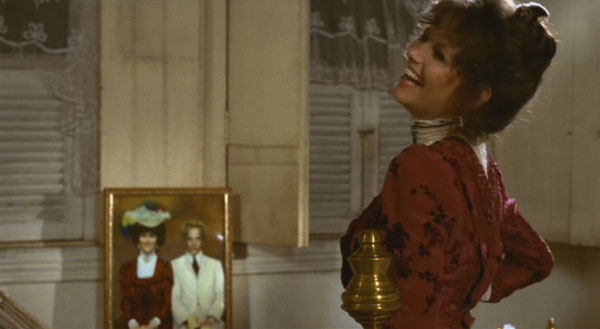
Paul Jones (former singer of top-ten UK band Manfred Mann) plays the top teen idol in Britain, Steve Shorter (sort of all four Beatles in one), who appeals to the youth with pain and rebellion, then is used by the government to promote peace and conformity. Sidetracks along the way for a love interest (who was supposed to be painting Steve’s portrait but that was dropped pretty quickly), TV commercials to push surplus apples, a Mr. Freedom reminiscent (not least of all for its effective cheapness, walls covered in tin-foil) “Steve-mart” superstore, and concert footage including the very nazi-rally-like concert finale (15 years before Pink Floyd’s The Wall). Sure Steve is a tool of the establishment, but he plays it too consciously, usually with an uncomfortable expression on his face (even in public).

Polish cinematographer Peter Suschitzky has had an awesome career, starting with The War Game, going through this and Gladiators, to Jacques Demy, to Ken Russell and Rocky Horror, to Empire Strikes Back and Krull, now shooting all David Cronenberg’s films since Dead Ringers (with time out for Mars Attacks). All great-looking films.

Watkins:

American novelist Norman Bognor and I adapted the script, which we retitled ‘Privilege’, to emphasize the significance of Steven Shorter as an allegory for the manner in which national states, working via religion, the mass media, sports, Popular Culture, etc., divert a potential political challenge by young people.

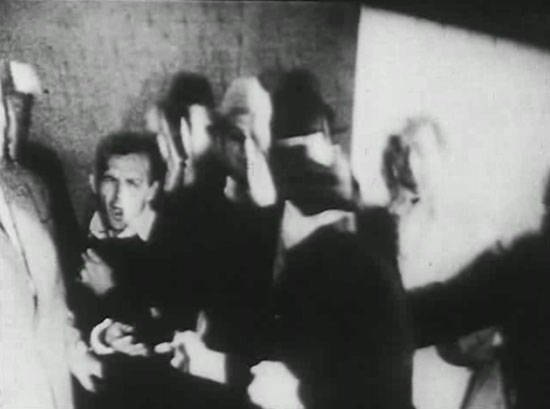
1970: the first ticker-tape parade in Britain’s history:
image

Arty love interest Jean Shrimpton:
image

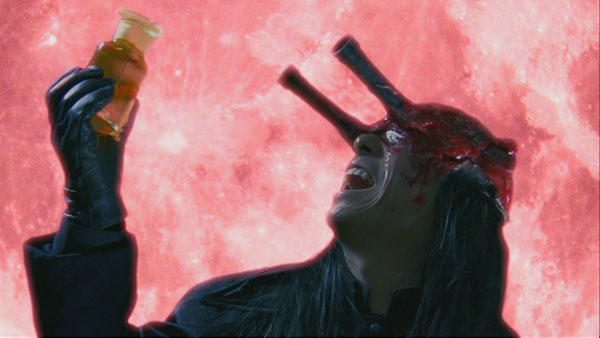
Steve goes all Mike D. on this advertising billboard:
image

Behind the scenes on the apple commercial:
image

Set for the big rally:
image

Steve drives the message home:
image

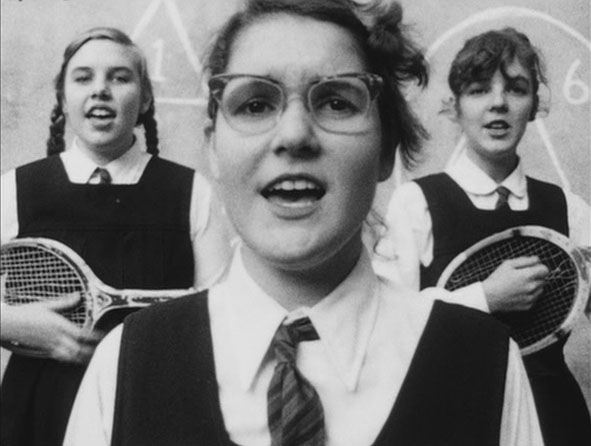
Unlike the cop-out Boogie Nights reissue, this DVD includes the short bio-doc which was the inspiration for the film: Lonely Boy, about teen idol pop singer Paul Anka and his unreasonable screaming female fans. Lonely Boy was released in ’62, the same year he was second-billed (alphabetically, ha!) in The Longest Day with John Wayne, Robert Ryan and Sean Connery. Three years earlier Paul was in the MST3K classic Girls Town. The doc is good, made by two Oscar-nominated Canadians named Wolf and Roman, b/w in “verite” style, but there are voiceovers and lots of editing, so I’m not sure the label is appropriate. Anka is a cutie but his songs aren’t all that. He’s says to the camera that “it’s all about sex”, his manager admits to a nosejob, this was in ’62! Fun to watch them together, since Privilege steals a couple scenes wholesale from the doc.

Lonely Boy:
image

Anthology films are never great, but are usually at least interesting, so I was surprised when this one started out great. But of course it was just front-loaded, and got less great as the other episodes appeared. Didn’t realize at the time that the great one was by Ermanno Olmi (a director who, like Ronald Neame yesterday, has done a couple criterion-dvd-released movies that I know nothing about). Was less of a straightforward story than the other two – an important-seeming older guy leaves business meeting and boards train with this woman’s help, then sits in the dining car thinking about writing the woman a letter, thinking about falling in love with her, all the while surrounded by other passengers incl. a bunch of army and security guys. Doesn’t sound like all that, but I really dug it, balancing the tense (because of the army guys) train ride with the flashbacks and an almost-love story, seemed very beautifully done.

In the third part, Loach lowers the class level a few more notches (after the woman in Kiarostami’s piece had already knocked it down a little) portraying three excitable young men with shit jobs who have been saving up to see this soccer match in Rome. On the train, one shows off his soccer ticket to a refugee kid, who takes the opportunity to swipe his train ticket. The soccer kids realize what has happened – do they demand their ticket back themselves, have the train personnel mediate, or let the cute kid and his poor jail-threatened family keep the ticket then run away from the cops at the station while fellow soccer fans run interference? The latter, and valuable lessons about humanity are learned by all. Actually I found it pretty lame, a crappy version of the triumphant ending of Offside. A valuable lesson about humanity is learned at the end of the first segment as well, the man getting a glass of milk for the mother of a baby in the standing-room section – not the highlight of that segment, but still less hacky than this one’s ending.

In the center slot, Kiarostami shows a kid assigned (through some community service program) to assist a general’s widow, a horrible woman who steals one man’s seat but does not steal another man’s cell phone, and gets into unbudging arguments with both of them. Meanwhile our kid is trying to have a surreal conversation with a young girl who remembers him from his hometown – he never noticed the girl before but she’s a friend of his younger sister. The conversation seems like she’s telling him about someone else, as if he doesn’t remember his own past, but maybe she remembers his past from a different angle; she only knows the parts he had been ignoring. We don’t get much about this guy in the present, what he’s like, but finally the widow gets to be too much and he hides from her somewhere on the train, letting her exit confused without him (with baggage help from the cellphone-argument man, a minor version of the Valuable Lesson About Humanity).

An alright movie – not much innovation in story or composition or anything else, but I’m glad I watched it, and I might make Katy check out that particularly moving first segment sometime if she’s got a half hour to kill.

image

image

image

On the DVD: a 40-min behind-the-scenes doc where we learn that it took a while to come up with the transitional segments to join the three main pieces. That’s something I could’ve been told in under forty minutes, thanks.

August is 2005 Month! Katy’s not participating in this one because she thinks it’s stupid, so I watched The Regular Lovers by myself. The idea is that I miss lots of really good top-ten-list movies each year, and after three years have gone by, they’re mostly out on video so it’s time to catch up. So sometime next year I’ll have 2006 Month, and so on.

“Have you seen Before the Revolution? You know, by… (stares into camera) BERTOLUCCI?”

Yes, it’s an answer film to B.B.’s The Dreamers from a couple years earlier, which starred Garrel’s son Louis (also of Ma mère and the recent Love Songs). In the Cinema Scope interview, Philippe doesn’t seem angry or bitter over B.B.’s film, nor does he say that Bertolucci told the story wrong and that his is the real story of May ’68. He diplomatically says that there are many stories, and this film is another of them. Philippe also, modestly, doesn’t even take full credit for the final film, calling it a collaboration between himself, Rivette cinematographer William Lubtchansky, and Godard (’64-’67) editor Francoise Collin – “it depended very much on who was most awake at a given morning.” So maybe this isn’t a Bertolucci attack, the historical correction to a previous film that The Lives of Others set out to be.

So did I like it? Not so much. The high-contract black-and-black-and-white cinematography was arresting, and Garrel lives in his scenes and characters for a long time, stretching out moments and silences, which I like, but the movie didn’t grab me. I don’t feel much kinship to the May ’68 obsessives out there. I can sympathize, but I’m worlds away from understanding the feeling, what the kids of Paris thought they were doing and what actually went on. The mood I get from this film and Grin Without a Cat and even The Dreamers is the same kind of thing from the end of Fear & Loathing in Las Vegas, the end-of-the-dream “breaking the wave” speech, only angrier.

Lead characters are named Francois and Antoine – couldn’t be in reference to Truffaut & Doinel, could it? Reviewers insist this movie is a French New Wave homage, but it doesn’t feel like anything actually released in the early 60’s. A doomed, doomed feeling pervades, especially in the second half. The first half I was having trouble telling all the young male characters apart, but that’s okay because there wasn’t much Story, only Revolution – the fighting in the streets eaten up by the total blackness on the edge of the frame, the blackness finally taking over in the occasional iris-out (another cool camera trick: twice you see flashes as they shot to the very end of a film reel). The second half is a doomed, doomed love story, with Francois finally left behind by his sculptor girl (Clotilde Hesme, also in Love Songs) and killing himself with pills, his dead body discovered by cops in the final shot, cops he’s spent the rest of the movie running from (when he wasn’t smoking opium at home with his buddies).

Other differences from the Bertolucci film: no sex onscreen (nothing more than kissing), no talk of cinema (other than the mention of B.B. himself). The stylistic bits (the photography, iris tricks and intertitles, bursts of piano music, a loud dance scene) don’t seem to be trying to make the movie stand out, make it self-consciously weird or interesting, which is good because today (the year of The Wackness) it takes much more to make a movie seem weird. Rather these quirks seem to fit in quite naturally. It’s getting strong comparisons to The Devil, Probably, another film I didn’t much understand. Part of this is my fault – I didn’t pay as much attention as I could’ve during the first half, and I watched it on DVD where it’s clearly a Theatrical Experience movie. Maybe I’ll try again sometime, or just skip back to another Garrel movie.

Character notes I took: “blonde girl Charlene is marrying Yvan… Luc is blonde guy… rich Jean wants black hair girl to pose… Antoine also rich.” IMDB doesn’t list character names, but I’m not dying to know where else I can see each particular ennui-filled young Frenchman so that’s okay.

image

image

image

image

A British comedy starring stiff, beefy American Gregory Peck (Robert Osbourne explained that American actors could reap tax benefits from working abroad a few months a year), based on a Mark Twain story, an early film work by the man who would become the Criterion-celebrated director of Hopscotch and other films I know nothing about.

Penniless Peck is given the titular note by two hyper-rich pranksters (IMDB says that in 2002 dollars, we’re talking about a hundred million bucks) who have a bet that he can/can’t live for a month solely on the appearance of wealth without ever cashing the check (or, presumably, getting a job). Peck hires a mute weightlifter to help him out, gets some suits and a swanky hotel, and falls for a young noblewoman (Jane Griffiths, of not much else). A few close calls and but Peck makes it through the month and presumably gets the job (worth somewhat less than a hundred million bucks) and the girl.

More jokes about not paying your tailor, twenty years after the Lubitsch movies. Not paying your tailor is hilarious to the British! A pretty good light movie. Katy and Jimmy enjoyed it more than Hamlet Goes Business.

Katy wanted to close out 1930’s Month with something Great, an acknowledged classic, something she is supposed to have seen but hasn’t, so I picked the one-time Greatest Film of All Time, Rules of the Game.

An amazing looking film indeed, with some fabulous, intricate staging. Some character, actor and plot notes before I forget them yet again:

image

from left to right:
1 Andre the pilot (Roland Tautain, played “the sailor” in Lang’s Liliom) just completed some impressively long news-making flight in order to impress Christine.
2 Octave (Jean Renoir, in his final role as a film actor. He wouldn’t make another film in France until The Golden Coach 14 years later). Friend to all, father figure and wannabe-lover to Christine, a short-lived fantasy. He turns darker (along with everything else) towards the end, realizing he’s a comic figure leeching off his rich friends, goes off to make a belated attempt to be self-sufficient.
3 Robert (Marcel Dalio, had appeared in Renoir’s Grand Illusion and would later have smallish parts in films by Hawks, Fuller (China Gate), Huston and Wyler), very rich but insecure, likes noisy mechanical inventions, has a gorgeous wife in Christine but also a long-standing affair (which he is trying to break off) with Genevieve (Mila Parély, would play one of Belle’s selfish sisters in Jean Cocteau’s Beauty and the Beast).
4 Austrian Christine (played by Austrian Nora Gregor, had been a star in the 20’s and 30’s, starring in Carl Dreyer’s Michael, killed herself ten years after Rules of the Game only having appeared in one movie since), a bit naive, thinks she belongs with Robert and that Andre is just a friend, until she catches Robert with Genevieve and it shakes her up.

image

Robert (right) with his “double”, Marceau the poacher (Julien Carette, my favorite actor in the group. He also appeared in the previous three Renoir films, later died from smoking in bed). Marceau wants respectability, gets hired by Robert as an indoor servant, but that doesn’t work out so well, goes off on his own at the end.

image

Christine again (left) with servant/friend Lisette (Paulette Dubost, was in Truffaut’s The Last Metro forty years later, also a couple by Max Ophuls in the 50’s), who is more devoted to Christine and her own position than she is to husband Edouard Schumacher (below). She’s Christine’s lower-class double, married to one man but wanting another.

image

Gaston Modot (Edouard) had been in films since 1909 and would keep it up till the 60’s, appearing in one of Renoir’s final films The Testament of Doctor Cordelier (and previously in Elena and Her Men, Grand Illusion and a couple others), also The Lovers and Children of Paradise. Even cooler, he played the main guy in L’Age d’Or. Edouard is jealous for his wife for good reason, since she’s happy to flirt with Marceau. He blasts through the house with his shotgun aiming for Marceau, later teams up with Marceau and aims for Octave, whom he suspects of hooking up with Lisette in the greenhouse. But due to costume changes he doesn’t realize it’s Andre with Christine in the greenhouse, and Edouard kills Andre.


Katy was disappointed, and disputes it being the greatest film of all time. Personally it’s only my third-favorite of the six Renoir films I’ve seen. I do love it, but I wonder about the best-film-ever label (recently surpassed by the new Batman on the all-time lists, actually), so let’s go to the DVD extras.

Ah, my old nemesis P.Bog reads the commentary, but it was written by Alexander Sesonske.

Renoir called it “a frivolous story” shot to avoid talking about the war… about “a rich, complex society where we are dancing on a volcano.”

Of André Jurieux’s radio speech in the opening scene: “His angry charge of disloyalty violates the rules of the game from the very start.”

Critics cried that Renoir cast an Austrian actress and a French jew to represent the French aristocracy.

“In a society of sharp class distinctions, Octave appears as a classless character.”

Plot shows two matched sets of husband/wife/lover/mistress and interceding friend:
1. Robert/Christine/Andre/Genevieve – Octave
2. Edouard/Lisette/Marceau/Christine(?) – and maybe Octave again.

Initially “The servants seem more sensitive to impropriety than their masters.”

“Those who know Renoir films may recognize a familiar figure, for Marceau is the incarnation of that nature god or pan figure who often graces those films from Tire-au-flanc in 1928 on. In a world where nothing is natural, it only appropriate that the nature god should appear as a little poacher in disguise and be pursued with deadly intent by a gamekeeper… But his influence remains the same. When he appears, erotic influences stir in human hearts. That these impulses are destructive rather than creative becomes one more Renoir comment on the corruption of this world.”

When the ghost tells Hamlet to avenge his death, he calls Hamlet stupid and H replies “Get on with it, it’s cold and I don’t want to be late for dinner.” This ain’t your gramma’s Hamlet!! It’s a black-and-white Finnish satire of the business world. In corporate Finland, there are no good guys, no sympathetic souls, just murderous fiends who all want to get ahead. Thus, it turns out Hamlet poisoned his own father, and in the end he is dispatched by the family chauffeur, a spy for the workers’ union.

Movie does have its funny parts (which include Polonius’s mustache), but I regret I can’t say it was a total delight to watch. Not a chore, either, and not mediocre or a waste of time, just a mild success, a Jarmusch-reminiscent dark comedy. All that Shakespeare probably held it back (although he cut all soliloquies and cut the story to a sleek 85 minutes). I’m still optimistic, wanna check out more Kaurismäki soon.

Our… hero?
image

Polonius and his mustache:
image

I liked the music… this band got to play a whole song in the middle of the movie. Note found online: “the film features a live performance of the song Rich Little Bitch by Melrose, a Finnish rock trio very popular at the time when the film was made.”
image

Choice Kaurismaki quote: “When I was young, I would sit in the bath and ideas would come to me. But I’m not young any more, so now I just sit in the bath.”

image

Christina Ricci is a horribly deformed girl with a pig nose. That’s the premise, anyway… maybe I’m a pervert, but I thought Ricci still looks extremely cute, even with the pig nose. Katy says that might be the point. Movie has got me all confused about myself and my image of women!

That guy who is in everything yet I can’t ever remember him because he looks and acts completely unremarkable (not Shia The Beouf, that other guy) stars as a loser gambler who gets to know Penelope before he sees the nose, and so learns to love her for her true self. But originally he was hired by Peter Dinklage to spy on Penelope, and when she finds out, misunderstandings ensue! As Penelope’s parents, Catherine O’Hara and Richard E. “How To Get Ahead In Advertising” Grant have nothing much to do, but it’s nice to see them. Inexplicably shelved for a couple years before its video release, this is a harmless Reese Witherspoon-produced chick flick with very Pushing Daisies-looking production values and plenty of Peter Dinklage being his adorable self (with an eyepatch!). If there was a Retarded Ratings Scale just for chick flicks and kids movies, this would score pretty high.

Producer Reese lends her star power to the beleaguered flick. Note that is a mask.
image

Here’s without the mask:
image

ALWAYS nice to see the smiling face of Nick Frost:
image

Okay, okay, billions of rabid fans, you win. It’s a good movie, and Heath Ledger is great in it. He plays insane like no one else, and when he walks out of the hospital in a nurse’s uniform stabbing at his remote control prompting a cliched huge explosion while he casually keeps walking, it’s one of the awesomest things at the movies all year. But… top-selling film of all time and #1 on IMDB or not, I still find it the third-best Batman movie. Full of episodic cliffhangers (maybe as tribute to the comic books?), which is the only way in which it reminded me of Fantomas. Batman/Wayne, as a character, is almost absent, replaced by gadgets and friends and a dead girlfriend (Maggie G.) whom he mourns for all of four seconds before going on to kill two-face and take the blame for two-face’s crimes himself, so the sucker public will go on believing in Harvey Dent, the district attorney who almost cleaned up this town before going insane and killing a buncha people. Some role model. Now Batty is on the run from Commissioner (finally) Gordon and I think Morgan Freeman quit his gadget-man job and neither of us can remember if the Joker died (which is a bad sign – nobody forgets how Nicholson’s Joker ended up – and while I’m in these parentheses, the soundtrack was no Batdance neither) and the Hong Kong financier is dead (burned alive on a pile of money = irony) and I guess the mob is in control of Gotham again, just with less money.

Batman has banding issues:
image

I dunno, might have to see again sometime when expectations are gone. I spent a lot of the runtime complaining about stuff, either in my head or directly to Katy.

Watchmen trailer looks cool, anyway.

I’m gonna get this out of the way:
“It’s like Kafka meets Lovecraft in Ingmar Bergman’s Nosferatu!”
Criterion can feel free to quote me on the upcoming blu-ray edition of Vampyr.

Not an official 1930’s Month selection since I watched it by myself while Katy was enjoying reality TV in the other room. I don’t have a hella lot to say about this movie other than it is a masterpiece of mood and weirdness, a slow, trippy phantom dream of a vampire flick. Love how three of my favorite movies are by Dreyer and those three are almost nothing alike.

Allan Gray, dreamer and occultist, drifts into town, gets a room, starts seeing weird things right away. Old guy comes in, gives Allan book on vampires, says “she must not die” then goes home and dies himself. “She” is probably one of his two daughters, Leone, who gets bitten. With help of the frozen-faced other daughter, blank-faced Allan goes off into the world of shadows… but unlike most movie heroes, he never actually does anything. The thankless house servant discovers that the lead vampire is a woman named Marguerite Chopin so he opens her tomb and stakes her, releasing the spirit of the dead father whose ghostly head scares the doctor’s henchman into falling down the stairs, while Allan himself is busy having out-of-body experiences while his body is carted off in a coffin. The death of the vampires fixes everything, Leone wakes up happy and Allan and Gisele stroll together into the sunlight as the doctor drowns in flour, trapped in the mill by the house servant. If that doesn’t all make sense, well, I don’t think a straightforward storyline was the point of this film.

an evil doctor drowning in flour:
image

Assorted gems from the Tony Rayns commentary:

What Vampyr has in common with Penelope: distributor shelved it for a year before release (Tony didn’t phrase it that way).

Main dude who played Allan Gray was no actor, but a fashion journalist, a rich baron who financed the movie. “I think Dreyer makes astute use of his blankness in this role.”

Allan Gray as a blank-faced corpse:
image

Allan Gray as a blank-faced ghost:
image

On the film’s style: “it’s full of disjunctions; it’s full of unorthodox editing, unorthodox framing and unorthodox cutting. None of it fits together in the way that one has come to expect classical storytelling in film to do… constant dislocations.” Has a lot to do with subjectivity, opening titles introduce Allan Grey as an occultist, a dreamer. Film came hard on the heels (eww) of L’Age d’Or and Blood of a Poet – indie weirdo films were briefly in fashion in Paris at the time.

At the nineteen minute mark – “etc., rendering indistinct and uncertain the offscreen spaces of the film,” he’s still going on about how weird a film it is. Like I know.

Lead vampire Marguerite Chopin talking with the Doctor (who may also be a vampire) around 19:30 is the first scene not directly witnessed by Allan Gray, but by an animated skull on the dresser. Hmmm. Allan himself is out with “the grave undigger and the world of shadows,” awesome.

Like The Passion of Joan of Arc, made up of many short shots, also many close-ups, but Joan was extremely planned, each detail carefully chosen, Vampyr by contrast is a very cluttered film, but every detail counts. Reading that again, I’m not sure that I see the difference he’s talking about.

Sybilla Schmitz (below) who plays daughter Leone (one of the only pro actors here) had a small part in Pabst’s Diary of a Lost Girl – her real-life story of morphine addiction was the prototype for Fassbinder’s story Veronika Voss.
image

Three choice quotes:

– “It’s almost like a Mike Leigh film in a sense in that people are passing cups of tea.”
– “It’s a kind of anti-Griffithian cross-cutting – but let’s not get too film-theoretical about this.”
– “He’s informing himself how to slay vampires. This, needless to say, is more than seven tenths of a century before Joss Whedon and Buffy. The modus operandi for slaying a vampire hasn’t changed all that much.”

Commentary mentions why Vampyr was a long-coming follow-up to Joan of Arc (legal/financial battles), but why was it over a decade before Dreyer’s next proper film, the hugely excellent Day of Wrath? Oh, IMDB says everyone hated Vampyr so he went back to being a journalist after that. Also there’s whole documentaries on the DVD so I should not blame the commentary for lack of stuff.

His spirit released, the old man’s head seeks vengeance:
image

Cast/crew photo. I think that’s Dreyer on the left with his hand up. Dig how Allan Grey stays in character, haha
image

Didn’t know that Pál “Lonesome” Fejös did a remake of Fantômas – it came out the same year as this and featured the actor who played the murdered master of the house in Vampyr (Maurice Schutz, below, also of Passion of Joan of Arc).
image


From the Casper Tybjerg doc/essay:

He pronounces it sorta like “Vam-pure”. I’d been wondering.

Dreyer: “I just wanted to make a film different from all other films”

All films shot on actual locations. Movie was shooting as early as April 1930.

Art director Hermann Warm also worked on Caligari, some early 20’s Murnau films, and Lang’s Destiny.

Two overtly Christian scenes were removed before the film’s release. And German censors had him tone down the staking scene and remove some shots from the drowning-in-flour scene – they’re restored in this documentary.

image