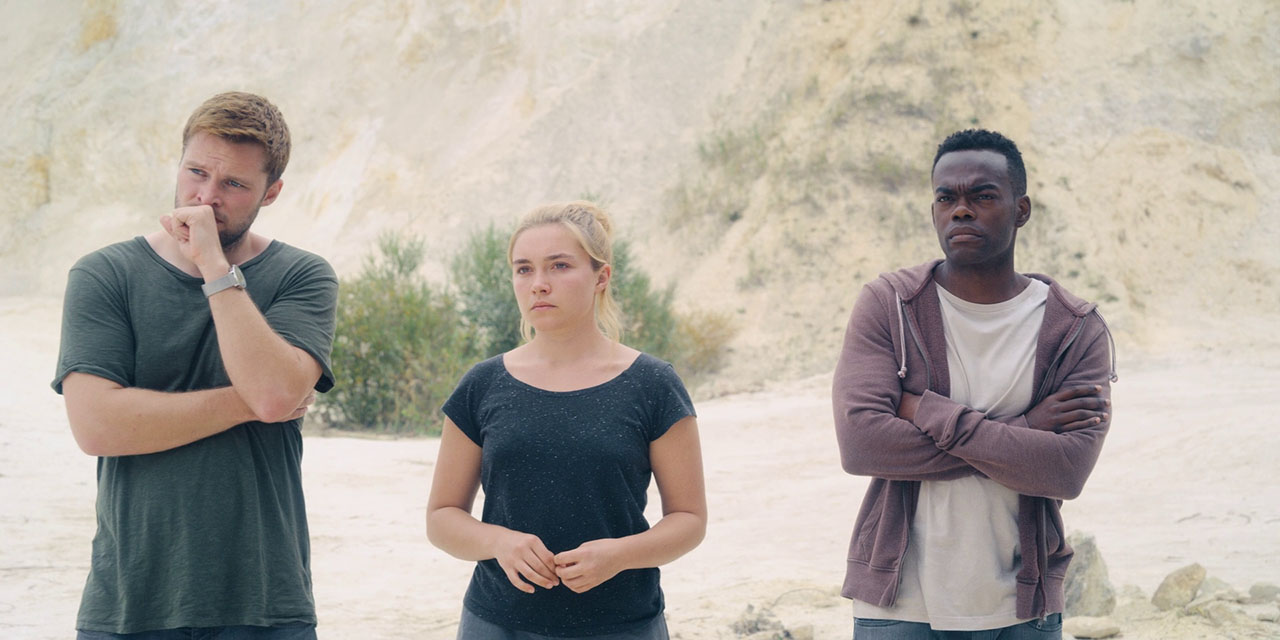
“You know how insulted I am by mediocrity.” Timely quarantine movie about Shirley Jackson not leaving her house for months… come to think of it, The Invisible Man also had a bit about Moss not leaving the house.

Rose and Fred (stars of Assassination Nation and Indignation) take live-in jobs assisting Myth & Folklore professor Michael Stuhlbarg and his reclusive wife, celebrated author Shirley Jackson. Shirley is writer’s-blocked until she takes interest in a local missing girl. Rose becomes the girl and starts Persona-ing Shirley, who begins to return to work.

Great music (by Tamar-kali, who also did The Assistant), bass and piano with choir. Good actors, obviously, otherwise it’s less my thing than her other movies, pretty traditional screenplay plus dream sequences.

At True/False we saw a couple movies by Everson: the one-take-whatever Partial Differential Equation, and the very great Hampton. So I’m checking to see what else is out there.


Workers Leaving the Job Site (2013)

Silent handheld shot of the titular workers leaving the titular job site. Five minutes in – an edit! But it just cuts to another minute of the same thing. My least favorite film of workers leaving a job site, after the Lumiere and the Kaurismaki – or maybe it’s a tie for last with the Farocki.


Three Quarters (2015)

Silent again, medium shots of two guys doing magic tricks with cards and string and quarters, a hundred times more fun than watching them leave the job site.


Ears, Nose and Throat (2016)

1. Grainy outdoor night photography with fireflies, punctuated by left/right hearing-test tones.

2. Doctor with unsynched sound explains to patient that she has misaligned vocal cords and that’s why her voice gets tired.

3. She’s in a sound booth, unsynched again, telling about an argument she witnessed leading neighbor Chris to kill his friend DeCarrio. We’re outside the booth and I’m wondering if the opening scene was where the shooting happened.

4. We’re in the sound booth with her, hearing the tones she’s hearing.

5. Back at doctor’s office, room tone.

Ohhhhhh wow, DeCarrio was the director’s son, and the sound-booth woman a witness to his murder. That is a hell of a thing to make a film about.


Music from the Edge of the Allegheny Plateau (2019)

Two music performances, living room gospel and pickup truck rap, merged at the end by messing with the sync. The film title plus shots of a woman looking at a hillside through binoculars gives a (geo-)anthropological feeling, like the music is in the land and you can find it if you look hard enough.


Black Bus Stop (2019)

College(?) kids having non-sync discusions with imprecise focus and framing, start talking about a black bus stop and the sound doubles up on itself, cut to night with performance-art stances and choreographed performances and songs, I think all of them school/greek-related… then back to the meta-cacophony about the bus stop. Shot at the University of Virginia at Charlottesville, codirected with History Department chair Claudrena Harold.

Lemonade for children… all the Beyoncé glam you could ever desire, plus “black is beautiful” lyrics and Lion King dialogue. That said… those visuals, and costumes, and dances, all 100% all the time. So this is probably the best extended music-video of a tie-in album to a movie remake that could possibly be made.

Filmed in at least six countries, with a few special guests we recognized and plenty we did not. Segment directors include The Burial of Kojo guy, and someone who recently collaborated with Terence Nance… the cinematographers worked with Spike Lee and Solange (and John Mulaney), the production designers did Black Panther, Moonlight, and Room. Anyway, the youth of today is gonna grow up with images from this and Black Panther in their heads when they hear the word “Africa,” which is certainly a change from the “starving children on TV ads” impression I grew up with.

I know we have to be precious about everything now, and make time in our redlining documentaries for a guy to play a flute solo, but it’s sometimes nice to choose a topic, do the research, and put out a well-edited interview/narrator doc about that topic and how it fit into the history and culture. It’s also nice to take a thing whose name is synonymous with failure and close your doc with women who say they loved the failed thing, and it was the best thing in their lives, and you believe them and it makes you love it too. The topic here was a complex of high-rise low-income housing in St. Louis, which would’ve been great if it’d stayed 1956 forever, but instead turned into a Colossal Youth ghost story mixed with a The Wire crime scene, before being demolished in 1972.

Criterion had a bunch of these movies, and I needed something to watch in weekday installments during a horrid week.

Jackie is tired of training with his mocking grandpa.

So he joins a gang and dresses like an idiot servant and a pretty girl to hustle suckers into fighting him.

But eventually he’ll have to content with the evil wizard who killed his dad (and grandpa).

Is he up to the task? Totally, yes.

Grandpa was James Tien of the Bruce Lee movies. Baddie Yen Shi-Kwan was in the first two Once Upon a Time in China movies. The year after starring in Drunken Master, this was 25-year-old Jackie Chan’s directorial debut.

I thought I’d be a clever boy and watch the 2020 remake followed by the 1940 sequel and see which is better. Neither really holds a candle to the James Whale movie, but remake definitely has the edge over this clunky, cheapie sequel. As far as German directors who worked with their wives, directed versions of The Indian Tomb, and emigrated to the USA in 1933 go, I prefer Lang – who made his own sequel with the word “Return” in the title this same year. Fellow German Curt Siodmak (Robert’s idiot brother) was beginning his Hollywood writing career, having wowed his home country with classics like F.P. 1 Doesn’t Answer.

Nan Grey (a soft-voiced automaton) was supposed to marry a very young Vincent Price (a full decade before The Baron of Arizona), but he’s inconveniently on death row because he killed his brother… or DID he?? (he did not). Fortunately, Price is friends with another man with a dead brother – O.G. I.M.’s bro Frank (John Sutton would also appear in Return of The Fly). Frank, not a great scientist (he lets cigar-smoking cops into his chemical lab), turns Price invisible to spring him from prison, then hopes he’ll find a cure before Vince goes mad (the movie lets this drop, Vince never starts slipping). So this time the girl’s in on the plan and the invisible man’s a good guy – kinda anticlimactic as far as horror sequels go.

I.M. sits down for a nice meal with his girl and his brother’s killer:

Cedric Hardwicke (Hitchcock’s Suspicion) likes Nan and is sadly obvious about it, seems so glad to have Vince out of the way that you almost suspect him of having murdered the brother, ah, of course he did, as Vince learns after playfully tormenting a drunk whom Cedric confided in. Movie is extremely British, and plods along… the dialogue obvious, the invisibility effects good but some other filmmaking techniques lacking (they have animals “die” by freezing the picture, a non-barking dog is overdubbed by a very-barking dog). Vince kills the killer and I suppose nobody can prove it was him, then gets his body back.

Mouseover to watch a guinea pig get visible:
image

Elisabeth Moss escapes her abusive guy and holes up with A Wrinkle in Time star Storm Reid and her cop dad (Aldis Hodge, the condemned in Clemency). The good news is the abusive guy is soon reported dead, but the bad news is he’s an “optics genius” and is actually just invisibly stalking her, after faking death with the help of his shitty brother. The first body appears at the 1hr 12min mark – that’s a minute longer than the entire original movie, in which the I.M. killed dozens. Eventually, I.M.2020 starts killing cops (and Moss’s sister), after working to discredit and destroy Moss – but not kill her, since she’s pregnant. She returns to their ultra-modern rich-tech-movie-guy house, finds that after the genius’s “death” someone covered all his equipment in giant plastic sheets but left their dog untended, grabs the backup suit and becomes The Invisible Woman. Skimming letterboxd reviews, it seems I wasn’t the only one reminded of Gone Girl (thinking of the Neil Patrick Harris scenes).

I grabbed Frantic back when I was watching a bunch of Polanski movies, then forgot about it… until one day, having misjudged the length of a flight due to time zone calculations being difficult while my mind is addled from dramamine, I watched the 45-minute Tarkovsky then found myself with a free hour, so as I often do when tired, I reached for the dumbest thing on my hard drive.

Ford, after telling everyone in sight that he’s after “the white lady:”

It’s quite a silly premise, though overall somewhat sturdy, with some convincing particulars for an 80’s movie. Harrison Ford’s wife (The Horde’s psychiatrist in Split) is kidnapped after grabbing the wrong suitcase at the Paris airport, so HF tracks down the drug mule suitcase owner (Emmanuelle Seigner, the future Mrs. Polanski) to unwind the conspiracy, figuring out that the captors are after a nuclear bomb triggering device. Along the way, we’ve got a woman in black on a Paris rooftop (I didn’t take Polanski for a Feuilladian) and music by the late Ennio Morricone, and nightclub scenes by Grace Jones, who must’ve sponsored this movie.

Seigner, screaming out the ass of a getaway car:

Timid Sasha gets up, runs through a brutal hierarchy of shithead children, through all the mirrors and reflections on water that young Tarkovsky can muster, attends a disappointing violin lesson, then things are looking up when he befriends a steamroller driver from the courtyard.

I figure the kid’s gonna get beaten up at some point, and he does, so the real tension is from wondering what will happen to the violin. Will it survive, will the shithead kids destroy or deface it, or will they break Sasha’s spirit so he destroys it himself, a la young Jodorowsky in Endless Poetry? Well it’s the first one, but there’s a scene when he’s run off to watch buildings get demolished with his steamrolling buddy and the shitheads find the violin left behind, then it’s untouched when Sasha returns, so I’d like to think there’s more to that story and it got cut for time. Remarkable little movie, with beautiful color on the blu-ray.