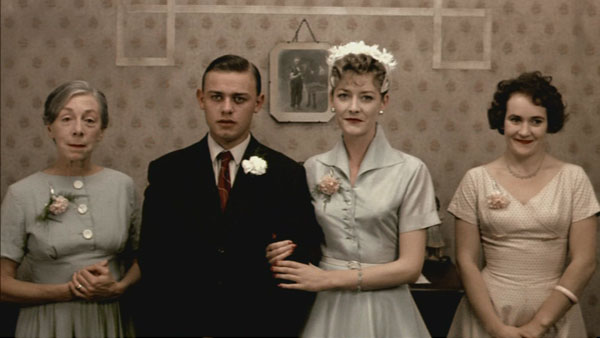
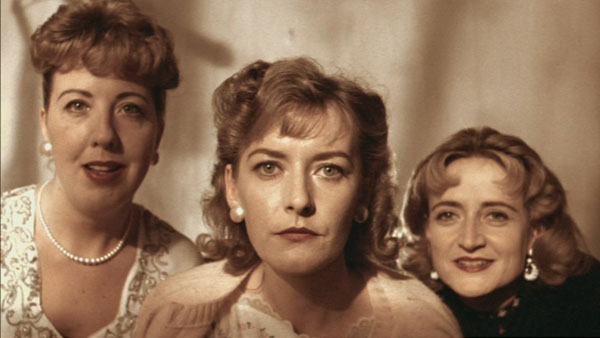
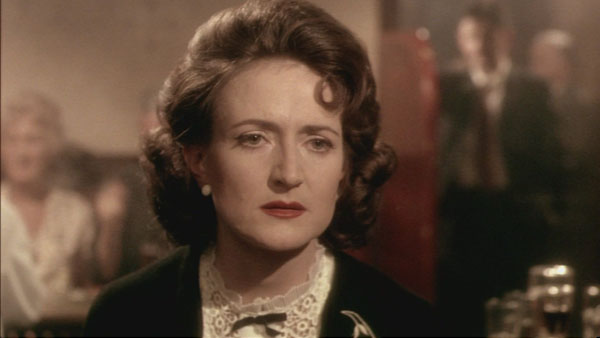
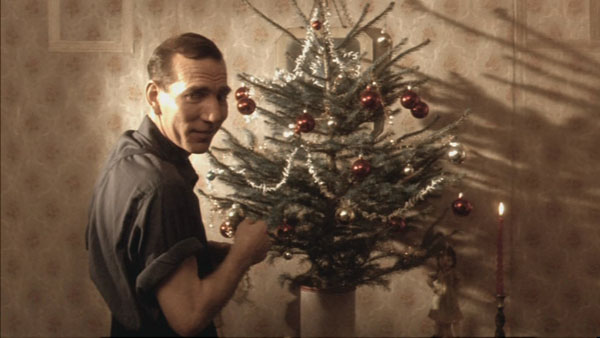
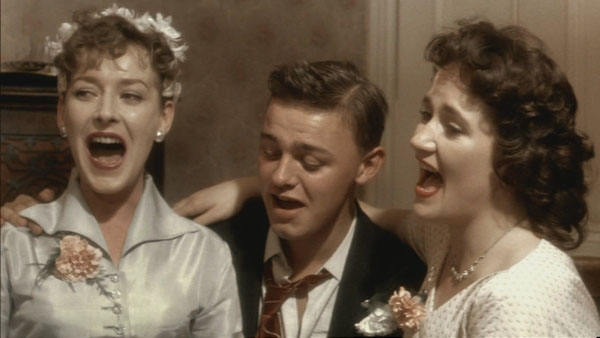
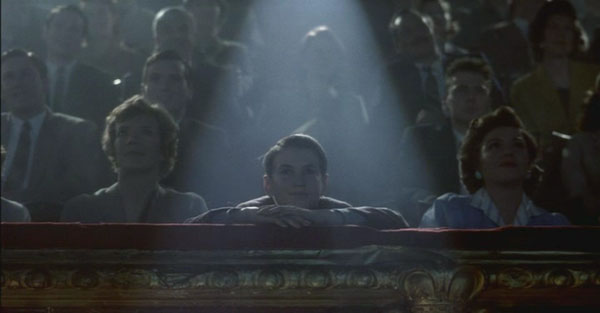
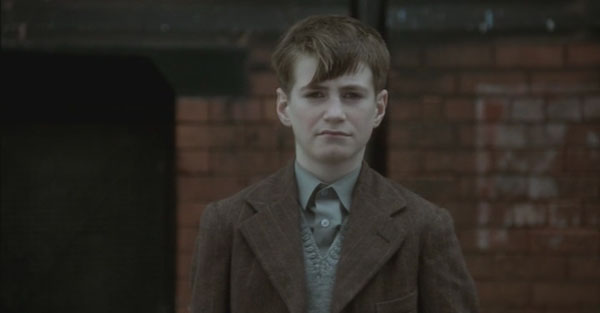
A total trip, better than I’d dared hope it would be. Would’ve been soooo nice to see in theaters, but I’ll settle for the multi-narrated DVD. Even more family-focused than Cowards, it also goes further inside the psyche of the Maddin character than that one did, with his flashbacks and memories and fantasies splayed out on the screen, cutting and fading into whatever “reality” he’s seeing at the time. Black and white, great-looking photography with subliminal flashes of color. Attractive and expressive actors do a great job with the gonzo plot before the editing rips it to pieces. More obsessions on dead fathers, hands (gloves), infidelity, sexual transgression, betrayal, and memory oh the memories!!

Shotput of butter!
image

Briefly: Adult Guy Maddin returns to his childhood home, an island lighthouse orphanage, by request of his dying mother. As he paints the place he remembers his life there with older sister Sis, forbidding faux-suicidal Mom, mysteriously hard-working Dad, twitchy traumatized friend Neddie, and leader of the orphans Savage Tom. One day teen detective Wendy Hale comes to the island, but after she falls for Sis (and Guy falls for Wendy), she disguises herself as brother Chance Hale, leading to much sexual confusion for poor Guy. With the kids, Wendy finds out the terrible secret, that Dad is stealing brain nectar from the orphans (and from Sis) and selling it. Sis awakens one night and kills Dad with a knife, Guy is adopted off the island, Dad is resurrected then both parents are exiled and, after Wendy leaves, Sis burns herself up like a moth in the lighthouse lamp. Back in the present, Guy is still obsessed with Wendy, tries to get to know his mother better, and there’s almost a semi-happy ending before the melancholy memories take over once more.

Conspirators! Guy in center, Sis on left, The Lightbulb Kid whispering:
image

New cinematographer (sorry, but you can’t tell), same editor as Cowards Bend The Knee (you can kinda tell), and music that I’d swear was influenced by the 60’s Russian song used in Heart of the World. Features no actors from anything else I’ve ever heard of (well, Guy’s mother was 33rd-billed in Henry Fool).

A rare glimpse of color:
image

The shorts on the disc are cool, too. It’s My Mother’s Birthday Today is a “biopic” (heh) of the “castrato” who sang with the live show – a few minutes of abstract business, with the vaguely Scott Thompson-looking guy making hard-boiled eggs and singing with a caged bird. Footsteps juxtaposes scenes from the movie with the sound crew in their lab doing foley effects, including some questionable techniques of bare-butt-slapping and horse’s-ass-kissing. Slower-cut than My Mother’s Birthday but even more fun to watch.

image

image

image

Story begins March 17, 1871 and ends two months later. Watkins introduces the movie via his two commune reporters (one of whom is played by Peter’s son Gérard, who has also acted in They Came Back and Diving Bell and the Butterfly), showing the set (a factory on the former site of Georges Melies’ studio!) at the end of the shoot. The set is minimal – walls and rooms were constructed, and props seem accurate and well-placed, but you never doubt that you’re on a set – you can see the walls, the lights, sort of Dogvillian. And the camera – of course the actors talk directly to the camera, since this is a Peter Watkins film. The cameraman (Odd Geir Saether from Edvard Munch) is always mobile, always shooting full cartridges at a time to be (slightly) edited later on.

image

There are intertitles which comment on the action, fill in missing context, flash-back-and-forward, connect the revolutionary ideas of the commune with the present realities of France. People break out of character mid-scene to talk about the film and about their own present situations, to comment on the relevance of the film and of the commune – but they’re not talking to us, exactly, telling us what to do or think, it’s more that they’re working out their own thoughts and we can make what we will of it. That’s not to say the film is unbiased – it’s extremely pro-commune. The mass media is represented by a more traditionally shot right-wing telecast which gives twisted accounts of the events we see in the commune.

An official statement:
image

Most of the actors didn’t have screen credits before this one, but some have gone on to appear in other movies (The Barbarian Invasions, Eric Rohmer’s Lady and the Duke, Science of Sleep, Miracle at St. Anna, etc). They workshopped the story and their own roles, and came up with their own dialogue, full participants of the film. Some of this I learned from the very good hour-long doc on the disc The Universal Clock, which dares to ask questions (like whether Watkins is responsible for his own marginalization) as it discusses his career and the making of La Commune. This would actually be a fine standalone film to play before some of PW’s better movies for the uninitiated – it stands high above the usual DVD-extra fare.

Lots of death and guns in the movie, all offscreen. Nobody is ever shown killed, no actor ever plays dead:
image

There’s a lot to say about the Commune and I’m not gonna say it all here. I’m worn out on the topic from watching all seven hours on these DVDs, and I’m pretty sure I’ll remember the important stuff (plus PW’s excellent website has a good summary).

The hated bourgeoisie:
image

Was the film good, though? Well, it’s far from my favorite Watkins feature (I’d maybe put it above The Gladiators). While it’s not dry and academic, it’s not exactly immersive – and while I wouldn’t say there were unnecessary scenes or that it should’ve been shorter, it’s exhausting at its present length, a mountain of a movie. The guy’s got a point that films and videos should not have to fit the “universal clock” of a television schedule, but this one didn’t fit the clock of my work week, and even with Katy out of town and my evenings supposedly all to myself, it still took me three nights to watch. So it’s an extremely admirable production, in every sense, about an important topic, but unlike other monumentally long films (hello, Satantango) I’m in no hurry to see it again.

image

From acclaimed writer Hanif Kureishi and the not-acclaimed director of Buddha of Suburbia come this heartwarming tale of an angry young woman who gets softened up a bit by an elderly actor. Peter O’Toole did not win an oscar for his brave portrayal of an old man who dies at the end. I liked Richard Griffiths (Harry Potter, Sleepy Hollow) because I recognized him.

Picture a long shot of hospital room, 74-yo O’Toole (left) lying in bed semi-conscious, 24-yo Jodie Whittaker (right) standing facing him lifting her shirt over her breasts. Alas, the DVD was returned before I could take screen shots.

Dreaded having to watch this since I saw a hundred times the sappy trailer where P.O’T is embarrassingly caught spying on Jodie when she’s posing nude for a drawing class… went from “oh I could watch that” oscar-bait to “please do not ever let me watch that”, the way over-advertised films seem to do. But it wasn’t so bad… except for the ending.

Written by Hanif Kureishi, which I know is a Big Deal in the academic world but I’m not entirely sure why. Katy points out the complex characters and the offbeat ending (the father alone & lonely in his house). Cab-driving father is a lapsed muslim who has sex with prostitutes and does other non-muslim things, and his son decides to go hard-line and hang out with clerics and protest whore houses (and burn them down). Argument ensues, father does not win, son buzzes off and wife leaves father. I am having trouble with the details, unfortunately. When I think back two weeks to when I watched this, a sort of generic movie-of-the-week feeling comes to mind. I do remember the actors alright – Om Puri (Gandhi, Code 46) and Akbar Kurtha (Syriana) were good as father and son, respectively. Rachel Griffiths (Blow, Jude) I suppose was the prostitute, and we were treated to a phoned-in performance from Stellan Skarsgard in the midst of his breakout year in Hollywood (from Breaking the Waves and Insomnia to Amistad and Good Will Hunting). Stellan is a rich immoral businessman who pays Om Puri to drive him around and supply prostitutes – I keep thinking Stellan’s parties in empty warehouses will go all Hostel but they never do. Katy thought it was alright.

An amusing 80-min comedy, no masterpiece to be sure, but very likeable and occasionally funny. Harold Lloyd is the weak kid in a family of two burly brothers and sheriff dad. Medicine Show comes to town while dad is out and Harold was pretending to be sheriff, so he signs their permit, then can’t tell ’em to get out of town because he has fallen for the cute girl in the act. But note: she’s doing the show against her will along with two slimy characters who run off with the town’s treasury – and the sheriff is blamed! Can Harold Lloyd redeem himself by finding the abandoned ship where the criminals are hiding out and return to town triumphantly with the loot and the surviving thief before his dad is lynched? Yes.

Some real nice staging, more elaborately planned shots than the Keaton (see below; the Keaton was also seven years later, which might make a difference, but I think Keaton camera setups were pretty plain, just make sure the action is in the viewfinder), incl. a cool bit where he climbs a tree, higher and higher and the camera follows on a high crane. Movie also had a trained monkey, slingshots, a burning trailer, and laundry drying on a kite string, so you really can’t complain.

Could you bring yourself to hit this man? Could you?!?
image

Two of Harold’s family members had small parts in Citizen Kane, a medicine show guy was in Sunrise later the same year, and actor Ralph Yearsley who played Harold’s rival died aged 32 a year later. Lloyd was working at a pace of one movie per year, and this came after For Heaven’s Sake and before one of my favorites, Speedy, which would be his last silent film. Speedy also had Ted Wilde as credited director (though IMDB says Lloyd pretty much directed his own films), and Ted died the following year at age 36. IMDB also claims some uncredited direction on this movie by Lewis Milestone, who would soon make All Quiet on the Western Front. The General, Metropolis and October all came out in ’27, pushing the cinematic art ever forward, but so did The Jazz Singer, spelling doom for Keaton and Lloyd (but not for Lang or Eisenstein).

Also watched Neighbors, a 1920 Buster Keaton short which outshone the feature. Buster likes the girl next door, but her family won’t have him. Hilarity ensues. All you really needed for a great Keaton film was a basic premise and thirty brilliant gags – fully-developed plot/characters not required. Terrifically funny movie.

Buster gets into the neighbor’s third-floor window with help from the Flying Escalantes:
image

Blackface is funny; half-blackface is funnier:
image

Checked out a nicely high-quality (if slightly trapezoidal) digital projection of the new edition, pleasingly crowded for a Thursday night. On one hand, Metropolis was plenty long enough, and each scene has always seemed to go on a bit too long (Jimmy didn’t come, saying “I’ve slept through Metropolis enough times, thanks”), but it’s still nice to have more of the film available for study. Half the cut scenes involve “the thin man,” hired by Mr. Frederson to spy on his little raised-consciousness son, who only makes a cameo in the pre-Argentina footage. And it’s easy to tell the footage apart, since the new stuff comes from a scratchy, shrunken 16mm print.

Wrote nothing special in August 2008:

Katy doesn’t want to participate in 2005 Month or in Shocktober, so there’s a semi-theme-multi-month going on with 1920’s Movies instead, beginning with this, one of the most famous and celebrated of the 1920’s Movies.

image

image

image

image

EDIT DEC 2020: watched a restoration of the Giorgio Moroder version, of all the crazy things. The narrative intertitles remain, but for dialogue they use subtitles over the person speaking, a nice touch. The music is fine… if not for the vocal songs! I didn’t know about these… what a bad idea. But even a bad soundtrack cannot ruin Metropolis, and I guess Moroder’s efforts helped preserve the film, so it’s fine, new wave forever.

Keith Phipps in AV Club:

Where Lang’s film still looks timeless, Moroder’s music remains grounded in the time of Reagan and early MTV. (That’s doubly true of the songs, which sound like castoffs even by the standards of, say, Loverboy.) The film feels quaint in a way other incarnations of Metropolis don’t.

A very good movie, though it didn’t strike me as completely excellent – fascinating to see Watkins’ style applied to a fully fictional narrative. This movie’s complete obscurity and unavailability until two weeks ago on DVD really supports the director’s constant claims of marginalization. How can you continue your career when all your past work has been suppressed? It’s a glimpse at where PW’s career could have gone. Also interesting how all the reviews he quotes on the website attack the film’s shooting and editing style, calling it failed art, when I thought it was far more artfully put together than most movies of its time (although it’s not like I’ve seen BAFTA-winning A Man For All Seasons for comparison).

Paul Jones (former singer of top-ten UK band Manfred Mann) plays the top teen idol in Britain, Steve Shorter (sort of all four Beatles in one), who appeals to the youth with pain and rebellion, then is used by the government to promote peace and conformity. Sidetracks along the way for a love interest (who was supposed to be painting Steve’s portrait but that was dropped pretty quickly), TV commercials to push surplus apples, a Mr. Freedom reminiscent (not least of all for its effective cheapness, walls covered in tin-foil) “Steve-mart” superstore, and concert footage including the very nazi-rally-like concert finale (15 years before Pink Floyd’s The Wall). Sure Steve is a tool of the establishment, but he plays it too consciously, usually with an uncomfortable expression on his face (even in public).

Polish cinematographer Peter Suschitzky has had an awesome career, starting with The War Game, going through this and Gladiators, to Jacques Demy, to Ken Russell and Rocky Horror, to Empire Strikes Back and Krull, now shooting all David Cronenberg’s films since Dead Ringers (with time out for Mars Attacks). All great-looking films.

Watkins:

American novelist Norman Bognor and I adapted the script, which we retitled ‘Privilege’, to emphasize the significance of Steven Shorter as an allegory for the manner in which national states, working via religion, the mass media, sports, Popular Culture, etc., divert a potential political challenge by young people.

1970: the first ticker-tape parade in Britain’s history:
image

Arty love interest Jean Shrimpton:
image

Steve goes all Mike D. on this advertising billboard:
image

Behind the scenes on the apple commercial:
image

Set for the big rally:
image

Steve drives the message home:
image

Unlike the cop-out Boogie Nights reissue, this DVD includes the short bio-doc which was the inspiration for the film: Lonely Boy, about teen idol pop singer Paul Anka and his unreasonable screaming female fans. Lonely Boy was released in ’62, the same year he was second-billed (alphabetically, ha!) in The Longest Day with John Wayne, Robert Ryan and Sean Connery. Three years earlier Paul was in the MST3K classic Girls Town. The doc is good, made by two Oscar-nominated Canadians named Wolf and Roman, b/w in “verite” style, but there are voiceovers and lots of editing, so I’m not sure the label is appropriate. Anka is a cutie but his songs aren’t all that. He’s says to the camera that “it’s all about sex”, his manager admits to a nosejob, this was in ’62! Fun to watch them together, since Privilege steals a couple scenes wholesale from the doc.

Lonely Boy:
image

Anthology films are never great, but are usually at least interesting, so I was surprised when this one started out great. But of course it was just front-loaded, and got less great as the other episodes appeared. Didn’t realize at the time that the great one was by Ermanno Olmi (a director who, like Ronald Neame yesterday, has done a couple criterion-dvd-released movies that I know nothing about). Was less of a straightforward story than the other two – an important-seeming older guy leaves business meeting and boards train with this woman’s help, then sits in the dining car thinking about writing the woman a letter, thinking about falling in love with her, all the while surrounded by other passengers incl. a bunch of army and security guys. Doesn’t sound like all that, but I really dug it, balancing the tense (because of the army guys) train ride with the flashbacks and an almost-love story, seemed very beautifully done.

In the third part, Loach lowers the class level a few more notches (after the woman in Kiarostami’s piece had already knocked it down a little) portraying three excitable young men with shit jobs who have been saving up to see this soccer match in Rome. On the train, one shows off his soccer ticket to a refugee kid, who takes the opportunity to swipe his train ticket. The soccer kids realize what has happened – do they demand their ticket back themselves, have the train personnel mediate, or let the cute kid and his poor jail-threatened family keep the ticket then run away from the cops at the station while fellow soccer fans run interference? The latter, and valuable lessons about humanity are learned by all. Actually I found it pretty lame, a crappy version of the triumphant ending of Offside. A valuable lesson about humanity is learned at the end of the first segment as well, the man getting a glass of milk for the mother of a baby in the standing-room section – not the highlight of that segment, but still less hacky than this one’s ending.

In the center slot, Kiarostami shows a kid assigned (through some community service program) to assist a general’s widow, a horrible woman who steals one man’s seat but does not steal another man’s cell phone, and gets into unbudging arguments with both of them. Meanwhile our kid is trying to have a surreal conversation with a young girl who remembers him from his hometown – he never noticed the girl before but she’s a friend of his younger sister. The conversation seems like she’s telling him about someone else, as if he doesn’t remember his own past, but maybe she remembers his past from a different angle; she only knows the parts he had been ignoring. We don’t get much about this guy in the present, what he’s like, but finally the widow gets to be too much and he hides from her somewhere on the train, letting her exit confused without him (with baggage help from the cellphone-argument man, a minor version of the Valuable Lesson About Humanity).

An alright movie – not much innovation in story or composition or anything else, but I’m glad I watched it, and I might make Katy check out that particularly moving first segment sometime if she’s got a half hour to kill.

image

image

image

On the DVD: a 40-min behind-the-scenes doc where we learn that it took a while to come up with the transitional segments to join the three main pieces. That’s something I could’ve been told in under forty minutes, thanks.

August is 2005 Month! Katy’s not participating in this one because she thinks it’s stupid, so I watched The Regular Lovers by myself. The idea is that I miss lots of really good top-ten-list movies each year, and after three years have gone by, they’re mostly out on video so it’s time to catch up. So sometime next year I’ll have 2006 Month, and so on.

“Have you seen Before the Revolution? You know, by… (stares into camera) BERTOLUCCI?”

Yes, it’s an answer film to B.B.’s The Dreamers from a couple years earlier, which starred Garrel’s son Louis (also of Ma mère and the recent Love Songs). In the Cinema Scope interview, Philippe doesn’t seem angry or bitter over B.B.’s film, nor does he say that Bertolucci told the story wrong and that his is the real story of May ’68. He diplomatically says that there are many stories, and this film is another of them. Philippe also, modestly, doesn’t even take full credit for the final film, calling it a collaboration between himself, Rivette cinematographer William Lubtchansky, and Godard (’64-’67) editor Francoise Collin – “it depended very much on who was most awake at a given morning.” So maybe this isn’t a Bertolucci attack, the historical correction to a previous film that The Lives of Others set out to be.

So did I like it? Not so much. The high-contract black-and-black-and-white cinematography was arresting, and Garrel lives in his scenes and characters for a long time, stretching out moments and silences, which I like, but the movie didn’t grab me. I don’t feel much kinship to the May ’68 obsessives out there. I can sympathize, but I’m worlds away from understanding the feeling, what the kids of Paris thought they were doing and what actually went on. The mood I get from this film and Grin Without a Cat and even The Dreamers is the same kind of thing from the end of Fear & Loathing in Las Vegas, the end-of-the-dream “breaking the wave” speech, only angrier.

Lead characters are named Francois and Antoine – couldn’t be in reference to Truffaut & Doinel, could it? Reviewers insist this movie is a French New Wave homage, but it doesn’t feel like anything actually released in the early 60’s. A doomed, doomed feeling pervades, especially in the second half. The first half I was having trouble telling all the young male characters apart, but that’s okay because there wasn’t much Story, only Revolution – the fighting in the streets eaten up by the total blackness on the edge of the frame, the blackness finally taking over in the occasional iris-out (another cool camera trick: twice you see flashes as they shot to the very end of a film reel). The second half is a doomed, doomed love story, with Francois finally left behind by his sculptor girl (Clotilde Hesme, also in Love Songs) and killing himself with pills, his dead body discovered by cops in the final shot, cops he’s spent the rest of the movie running from (when he wasn’t smoking opium at home with his buddies).

Other differences from the Bertolucci film: no sex onscreen (nothing more than kissing), no talk of cinema (other than the mention of B.B. himself). The stylistic bits (the photography, iris tricks and intertitles, bursts of piano music, a loud dance scene) don’t seem to be trying to make the movie stand out, make it self-consciously weird or interesting, which is good because today (the year of The Wackness) it takes much more to make a movie seem weird. Rather these quirks seem to fit in quite naturally. It’s getting strong comparisons to The Devil, Probably, another film I didn’t much understand. Part of this is my fault – I didn’t pay as much attention as I could’ve during the first half, and I watched it on DVD where it’s clearly a Theatrical Experience movie. Maybe I’ll try again sometime, or just skip back to another Garrel movie.

Character notes I took: “blonde girl Charlene is marrying Yvan… Luc is blonde guy… rich Jean wants black hair girl to pose… Antoine also rich.” IMDB doesn’t list character names, but I’m not dying to know where else I can see each particular ennui-filled young Frenchman so that’s okay.

image

image

image

image