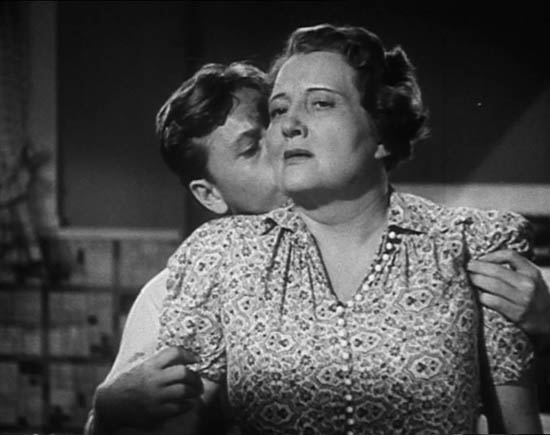
An awesome little movie that my memory is already threatening to lose since I watched it right in between two Japanese mind-fucks, Glory to the Filmmaker and Sukiyaki Western Django. This is an English-language documentary by a French filmmaker about two British couples who raised each other’s children after a mix-up at the hospital. One mother knew it, or at least strongly suspected, and constantly fussed over what should be done, tried desperately to stay in contact with the other family, wrote letters to George Bernard Shaw, and so on. Other mother was unconvinced that there was a problem and just carried on. Unexpected end result is that one of the girls grew up twice loved as the other.

Excellent, interesting movie… well-considered storytelling with tons of cool framing tricks and window/mirror effects. All of the people involved gamely play themselves, relaying events and participating in recreations. Listening to them talk, you wouldn’t think these to be the kind of people to go along with a comic sort of retelling of their painful pasts for a foreign camera crew, but thankfully they did. A quirky sort of movie, but in a good way. Each member of the camera crew was shown during the closing credits – I think that’s a first for me.

It seems that Kitano wants to make a new film. He is unsure of himself… only gets four words into the title (in a hasty typeface) before giving up.
image

He tries a bunch of different genres:
image

But none of them are working out. It’s all been done before.
image

Wait… what about a comedy with a girl, her mother and a duck puppet?
image

Yes! Kitano is triumphant… he shall film this comedy!
image

Throw in some more characters… a cross-dressing mad scientist and his giant robot:
image

Aaaaand we’re off:
image

But wait, things are starting to fall apart. The film crew is spotted, effects and costumes and backgrounds are revealed to be artificial. The narrative is making no sense.
image

Finally a series of giant explosions destroy it all… the comedy, the genre stories, all the Kitano identities and characters and false sets!
image

The title! Glory! No uncertainty anymore!
image

Kitano’s final diagnosis:
image

My most important discovery about this film is that Marilyn Monroe’s performance (specifically her facial gestures) is the basis for Dean Stockwell’s Ben in Blue Velvet. Look into their eyes. Discovery #2 is that the film had a sequel (based on the sequel to the source novel), Gentlemen Marry Brunettes, but the only two people who worked on both movies were star Jane Russell and the costume designer. Not even the studio was the same. Discovery #3 was that this film was based on a novel!

Very great movie, starring Marilyn and Jane Russell at about the halfway point of their respective film careers. Mismatched friends on a pleasure cruise to France, Marilyn is a gold digger who is no genius but still smarter than she ever lets on, and Jane wants to find a good man, money or no money. Tommy Noonan (charlie ford in I Shot Jesse James) is Marilyn’s very rich wimp of a fiance who is content to be loved for his money. Elliott Reid (mostly a tv actor, starring in an indie film later this year) is the private eye whom Noonan’s father hires to spy on the girls aboard the ship and who falls in love with Jane. George Winslow (apparently a pretty famous child actor at the time) is hilarious upper-class kid Henry Spofford III. And the great Charles Coburn (The Lady Eve) is Piggy Beekman, a diamond mine owner who bumps into Marilyn. Piggy ends up giving a diamond tiara to Marilyn, Piggy’s wife reports it stolen, and Jane has to sub for Marilyn in a climactic courtroom scene, even stripping down and performing her “Diamonds are a girl’s best friend” (better than marilyn’s version, according to Katy) in court to stall for time.

The Howard Hawks irreverent/comic worldview and his “alternative forms of social and sexual arrangements outside of Hollywood’s idealisation of the nuclear family” are in proud effect here. The songs are great, Marilyn is great, and Jane manages not to be blown off the stage nor does she act out to overcompensate. Katy liked it too!

First saw this when I was seven. Mostly memorable for being the only (?) movie I ever watched with aunt Nora. Otherwise I remember it being a pretty cool, very weird space movie which no other kids would discuss with me when I got back home to Texas because no one else had seen it.

image

Little did I know I was witnessing the feature film debuts by two new stars, Ethan Hawke (left) and River Phoenix (with the glasses).

image

Also this kid, Jason Presson, who was just as good but never got as far as his costars in the movie world (despite a cameo in Gremlins 2).

image

And Ethan’s love interest Amanda Peterson, who got her own romantic comedy starring role two years later before disappearing from the screen. She was barely in this movie, the token female character. Ethan kisses her at the end in the above cloud-flying dream-sequence, to show that he has grown up a little bit from his adventures, and to show that despite all this fooling around in basements with his boy friends, he sure ain’t gay. River still might be.

image

There’s a schoolyard villain, 17-yr-old Bobby Fite, but the coolest character is of course Dick Miller (above) as a helicopter pilot who sees the kids’ spaceship and single-mindedly tracks them down. A villain, perhaps, a stuffy adult authority figure come to put an end to their fun, but when he arrives at the clearing and sees them taking off in the ship, his reaction is unexpectedly sweet… he just smiles and stays behind the trees.

image

Computer effects by ILM, makeup by Rob Bottin (fresh off The Thing), music by Jerry Goldsmith, with James Cromwell as River’s absentminded father… a respectable crew. Not at all a bad movie, but I have a hard time summoning up much excitement for it… just a cute little journey with a refreshingly unexpected conclusion.

image

Nerdy German kid River is friends with picked-on dreamer Ethan. They love drive-ins, sci-fi and horror movies (hello, Joe Dante). Both begin to have a shared dream (the circuit board above), so River builds the board to the dream’s specs and has himself a computer-controlled floating forcefield. After teaming up with bully-baiting Jason, a tough loner kid from an unhappy home, they build a ship (called the Thunder Road, using a seat from a tilt-a-whirl) and test it out, surrounding it with the force field and buzzing their town, using alien technology to peep through Amanda’s window. After another dream which reveals the circuitry for a magical oxygen-generation board (?), they head out to infinity and beyond. Some wacky shenanigans with a giant spider aboard the alien craft that captures them, then they meet the aliens, a boy and a girl. Kids first lines: “I’ve waited all my life to say this… we come in peace.” A stunner from the aliens: “ehhh, what’s up doc?” Cartoony sound effects everywhere, kids don’t seem to know what’s going on, layers of TV shows and static all over the screen. Finally the alien craft is captured by a much much huger alien craft piloted by the parents of the TV-addict earth-meddling kid aliens who first met our heroes, and River’s gang returns to earth vaguely disillusioned. But we end on the kissing cloud dream, so it’s alright.

Bad science: “It was airtight – I couldn’t feel myself speed up or slow down.”

“They’re heeeere” reference to Poltergeist, which Goldsmith and ILM also worked on.

It’s the late 60’s, early 70’s, and Chris Marker has got himself a Great Cause. Inspired by Aleksandr Medvedkin (Alexandre Medvedkine) and by political and social unrest in France and elsewhere, Marker and his friends have decided to read lots of Lenin, to try to make films that change the world, and ultimately to try putting film production into the hands of the people, the workers.

Marker hadn’t been greatly involved with the French New Wave movement, but he was present at the end of it, contributing to the 1967 omnibus film Far From Vietnam, wherein Marker, Resnais, Godard, Ivens, Lelouch, Varda and Klein voiced their support for the communist north vietnamese, while Rohmer, Rivette, Truffaut and Demy stayed out of it, pursuing their own romantic ideals.

Marker, Godard and others started making purely political works and stopped putting their names on their films, using collective names. I can’t find copies of some of these films (Cinetracts, Battle of the Ten Million) and can’t find English subtitles for most others (Far From Vietnam, Sixth Face of the Pentagon, À bientôt j’espère, Les Mots ont un sens), so it’s pretty much just these two, The Train Rolls On and Embassy. I’m filling out the rest of the timeline by quoting heavily from Catherine Lupton‘s amazing book on Marker.

1967-1977
Marker goes “beyond the privileged status of the auteur-director into the humbler and less visible functions of producer, fund raiser, editor, facilitator and general fixer, ensuring the exposure through [production company] SLON of other people’s work while continuing to make his own (unsigned) films.”

FAR FROM VIETNAM, 1967
“Under the auspices of SLON (which also happens to be the Russian word for elephant), Marker instigated, edited and wrote the commentary for Far From Vietnam, a collective portmanteau film made to protest against American military interventionism in Vietnam.”

A BIENTOT, J’ESPERE, 1968
In support of striking workers in southeast France, they started on “a film about the strikes, entitled A Bientot, j’espere (‘Hope To See You Soon’).” Workers complained that the film was pessimistic, that they came off as victims. “Marker’s response to these criticisms was that he and Marret would always be outsides to the workers’ lives, and that the logical step forward was for them to begin making their own films.” And so the Medvedkin group was born.

CINETRACTS, 1968
After the May ’68 business, “The Estates General of the Cinema sponsored a series of collective short documentaries recording the May events from the perspective of students and striking workers. Following an idea suggested by Chris Marker it also produced the Cinetracts. These were a series of anonymous, combative and often strikingly eloquent visual pamphlets, filmed on silent black and white 16mm-negative stock using easily assembled materials – still photographs, collages and texts – in order to respond quickly to unfolding events. Marker, Godard, Resnais, Jean-Pierre Gorin (who formed the Dziga Vertov Group with Godard), Philippe Garrel and Jackie Raynal were among the better-known contributors to the series alongside young militants with no prior experience of film.”

LES MOTS ONT UN SENS, 1970
“Number 5 in the [SLON counter-information newsreels] series, On vous parle de Paris: Maspero, les mots ont un sens (‘Maspero, Words Have Meaning’), is an affectionate portrait of the left-wing publisher and bookshop owner Francois Maspero, who was a contributor to Far From Vietnam and would later publish the commentary to Le Fond de l’air est rouge. Maspero is one of the most satisfying and likeable of Marker’s films from this period, achieving an exemplary balance of quirky human warmth with a clear and inventive form of political argument.”

1970-71
Marker worked as a still photographer on Costa-Gavras’s film The Confession, then made a film about the shoot called Jour de Tournage, and a film on the controversy surrounding The Confession, number 6 in the newsreel series, Le Deuxieme proces d’Artur London.

BATTLE OF THE TEN MILLION, 1970
“Both [Les mots & Artur London] consider the question of how committed socialists and revolutionaries can acknowledge past mistakes, undergo productive self-criticism and still maintain their basic political beliefs, in a climate where their political opponents on the right take such criticism as proof of the total failure of communism. … This dilemma comes sharply to the fore in The Battle of the Ten Million, a clear-eyed account of the failure of Fidel Castro’s ambitious project for Cuba to achieve a 10-million-ton sugar-cane harvest in 1969-70.”

LE TRAIN EN MARCHE, 1971
“The French version of Happiness was accompanied in cinemas by Le Train en marche, an introduction to Medvedkin, Happiness and the film-trains based around an animated interview with Medvedkin filmed in a train depot in the Paris suburd of Noisy-le-Sec. Its core motifs are the eye, the hand and the train.”

image

A 10-min intro about trains in the 1920’s traversing russia/asia acting as bookmobiles, then a change of narrator voice when Medvedkin is introduced, and his story takes us away. His crew watched and filmed the techniques of successful and unsuccessful farmers and showed the films to each other to help increase production, then moved on to steel plants.

Medvedkin: “We realized that the cinema could be not just a means of entertainment, a way of arousing aesthetic emotions, but also a great and forceful weapon capable of reconstructing factories, and not just factories but the world, making it a better place. Such a cinema in the hands of the people was a powerful weapon.”

In the last bit, he talks about his motivation for filming Happiness, which makes sense now that i know Le Train en marche was screened as an introduction to that film.

A pretty straightforward documentary with english voiceover rather than subtitles on my copy, using archive footage (but none from the actual cine-trains, which had all been lost). No cats or owls or tricks, though halfway through the movie, Marker reveals the camera crew filming Medvedkin.

From the sound of it, Marker’s Medvedkin Group has at least partially succeeded. In CM’s own words: “I think that it’s this fabled and long forgotten bit of history… that underlies a large part of my work – in the end, perhaps, the only coherent part. To try to give the power of speech to people who don’t have it, and, when it’s possible, to help them find their own means of expression. The workers I filmed in 1967 in Rhodesia, just like the Kosovars I filmed in 2000, had never been heard on television: everyone was speaking on their behalf, but once you no longer saw them on the road, bloody and sobbing, people lost interest in them. To my great surprise, I once found myself explaining the editing of Battleship Potemkin to a group of aspiring filmmakers in Guinea-Bissau, using an old print on rusty reels; now those filmmakers are having their films selected for competition in Venice.”

VIVA LA BALEINE, 1972
“Ecological politics are not usually mentioned as being among Chris Marker’s preoccupations, but they are at the heart of a short film he co-directed with Mario Ruspoli in 1972, Viva la baleine / Long Live The Whale… a sharply politicized re-take on Ruspoli’s anthropological study, which now sets the archaic practices of the Azores whaling communities in the context of a pointed condemnation of industrialized whaling.”

CHILE & PATRICIO GUZMAN, 1973-75
Marker traveled to Chile to make a film about the new socialist government under Salvador Allende but “discovered that the Chilean filmmaker Patricio Guzman and his colleagues already had the job in hand” so CM instead helped bring their films to France and contributed financial assistance for Guzman’s later three-part The Battle of Chile, 1975, after the government’s 1973 takeover by a military dictatorship.

EMBASSY, 1973
In late ’73, “Marker transposed recent events in Chile into a remarkable fictional document, L’Ambassade (Embassy). As a fictional commentary on the contemporary political world, Embassy invites comparison with La Jetee. Despite their evident differences, the films share a measured, inexorable narration, and a catastrophic transformation of Paris that leaves a small group of survivors trapped.

image

“Wednesday, 2 days after the coup”

Lupton’s notes: “An unexpected response to Pinochet’s 1973 coup d’etat in Chile. A Super-8 film apparently found in an embassy -as it’s written in the original title-, where political activists had taken refuge after a military coup d’état. But the events -and their setting- are not what they first appear to be.”

8mm film with no direct sound. Also English voiceover rather than subs on this one, a bored-sounding reporter voice.

“You are all motherfuckers as dumb as corpses quarrelling in the grave. The only lesson to draw is that all political directions have gone bankrupt.”

I admit I snickered at the ending. Shades of Cradle Will Rock as the “truth” behind the film is revealed: “From a window of the embassy I took my last shot, the van that was leading them into exile from that city we had known when she was free: Paris.”

THE LONELINESS OF THE LONG DISTANCE SINGER, 1974
La Solitude du chanteur de fond fused personal friendship and the pressing political concern of the moment by filming the rehearsals and final performance of [Yves] Montand’s one-man benefit concert for Chilean refugees, held at the Paris Olympia on 12 February 1974 and his first stage appearance for six years. … [Loneliness] was released in December 1974 with the dormant If I Had Four Camels [completed in ’66], but it was the Montand film that attracted critical accolades, as a fond and revealing homage to one of France’s best-loved film actors and popular entertainers. … Loneliness is a minor masterpiece of observational documentary…”

SPIRAL, 1975
Marker helped initiate and wrote the commentary for the film Spiral, helmed by a French sociologist expelled from Chile, Armand Mattelart, and editors Jacqueline Meppiel and Valerie Mattelart. “The title of the film, Spiral, derived from its proposed spiral structure of seven successive phases of right-wing reaction leading up to the coup of 1973, many of which also delved back in history to consider, for example, the past roles of the military and the United States in Chilean affairs.” The film was largely edited from archive footage, then matched to a 3-hour Marker-written commentary and edited to 155 minutes for final release. “Although Marker was not involved at every point of the film’s production, Spiral nonetheless stands as an instructive precursor to Le Fond de l’air est rouge. It develops the same intricate marshalling of archive resources as Marker’s later film, representing the arraignment of conflicting social forces at a given moment in history by playing off film extracts informed by different political perspectives against each other.”

Hope I’m able to see more of the above films sometime. Learning French would help. Meanwhile I’m either tackling Grin Without a Cat next, or taking a Patricio Guzman or Alexander Medvedkin sidetrack before heading boldly forth into the 1980’s.

Co-directed with Vincent Paronnaud. Tied with Silent Light for the jury prize at Cannes.

Beautifully illustrated and well-animated story, alternately light and heavy, following author/director Marjane’s life from the mid-late 70’s to the mid 90’s. I have to grudgingly admit that the people who say the second half of the film isn’t as good are kinda right, but overall it’s such a wonderful movie, the kind that I wish I could make everybody watch: an artistic movie promoting peace, cross-cultural understanding and individual integrity. I love that the phrase “the price of freedom” is invoked not to justify the loss of lives in a “freedom fighting” war, but as a personal cost, that Marjane’s final flight from Iran to France for the sake of her personal freedom will mean never seeing her grandmother again.

Since I don’t know anything about Iranian history or politics, here’s a timeline combining this movie’s events with stuff from wikipedia and IMDB:

1921 – Qajar Dynasty ends, the “good” Shah is in power
1941 – Shah’s son takes control
1950s- new Shah becomes “increasingly autocratic”
1963 – The House Is Black
1969 – The Cow
1969 – Marjane Satrapi born
1970 – Kiarostami’s first short film
1974 – The Traveler
1977 – The Report
1979 – Shah leaves the country, Iran becomes an Islamic Republic under supreme leader Ayatollah Khomeini
1980 – Iraq invades Iran
1984 – Marjane goes to Vienna
1987 – Where Is The Friend’s Home?
1987 – The Cyclist
1988 – Iraq/Iran war ends
1989 – Ayatollah Ali Khamenei becomes supreme leader
1989 – Khameini issues fatwa against Salman Rushdie
1989 – Marjane gets married in Tehran
1990 – Close-Up
1994 – Marjane gets divorced
1995 – The White Balloon”
1997 – Taste of Cherry
1998 – The Apple
1999 – The Wind Will Carry Us
2000 – The Circle
2000 – Persepolis book published
2001 – Kandahar
2002 – Ten
2005 – Mahmoud Ahmadinejad is president (still under Khamenei)
2006 – Offside

“It’s your negative insinuendo!”

Whoops, I accidentally watched two bizarro hyperactive cult movies in a row from the criterion collection (Mr. Freedom and now this). In their words: “Based on Peter Barnes’ irreverent play, this darkly comic indictment of Britain’s class system peers behind the closed doors of English aristocracy. Insanity, sadistic sarcasm, and black comedy—with just a touch of the Hollywood musical—are all featured in this beloved cult classic.”

If there’s one thing you remember about The Ruling Class, it should be to not watch it again. It feels too much like other cult classics: loud, overlong, and funny but in a pained sort of way. O’Toole has a powerful character though and a wildly good performance. He’s Jesus for more than half the movie, then becomes much more dangerous when he starts appearing to be normal.

“How do you know you’re God?”
“It’s simple; when I pray to him I find I’m talking to myself.”

Definitely doesn’t count as a musical, though it has three or four scenes of Dennis Potter-style singalong. Might actually count as a horror. Gets more terrible and less funny as it progresses, closing with a shrill and mighty scream. Kind of good as political satire in that respect… the ol’ Catch-22 approach of drawing ’em in with humor and then unleashing the message, that these are very bad people in important positions of power and they should be stopped.

Lindsay Anderson fave Arthur Lowe is the only actor here who also worked on “Kind Hearts and Coronets”. He’s hilarious as the butler who inherits a fortune from the old Earl, then keeps his job but openly mocks everyone he works for.

I won’t make fun of “Species II” director Medak for this one, since he seems like a good sport, although now I realize he also made that dismal Masters of Horror episode “The Washingtonians”, another way over-the-top, shrill political piece.

Ian Christie:
“In revolting against naturalism, we should not forget that Medak (a refugee from Hungary) and Barnes were in good company. Roeg and Cammel’s Performance (1970) had plunged fearlessly into bravura fantasy… while such otherwise very different filmmakers as Kubrick and Anderson had also forsaken realism in their two great “state of the nation” films of the same period: A Clockwork Orange (1971) and O Lucky Man! (1973). And Medak’s fellow countryman, Peter Sasdy, was leading Britain’s horror specialist Hammer into post-Freudian terrain with Hands of the Ripper (1971), another tribute to the enduring fascination with the Whitechapel murderer.

“There are also some remarkable purely filmic inventions. The image of Dr. Herder embracing the police cut-out silhouette of Lady Claire has an eerie pathos, and the chilling final scream that rings out over the brooding exterior of the Gurney mansion after Jack has stabbed his wife, flushed with his acclaim in the House of Lords, seems to unite the bloody poetry that Hammer aspired to with a real protest against Britain’s decaying aristocratic tradition.

And an interesting connection to “The Trap”, which I’m in the middle of watching, also via Christie:

“R. D. Laing’s account of schizophrenia as essentially family-induced—a logical response to irrational pressures—was proving influential as a counter argument against advocates of ECT and drug treatment; and this is the backdrop to The Ruling Class’ elaborate staging of Jack’s madness and its “cure,” through a surreal confrontation with his opposite, the “electric messiah.”

Resnais films a 1925 libretto by André Barde (which was also filmed in 1931, but nobody seems to know much about that version) with much of the same crew and cast as his 1997 Same Old Song. Movie is shot like a straight period piece in hazy color (or was it my DVD which was hazy?), almost like a play, with longish wide shots and not many close-ups. Comedy/musical style, characters look into camera and talk to the audience. Songs are decent, nothing memorable or amazing, with subtitles annoyingly translated to rhyme in English. No big setpiece numbers, in fact it abruptly changes scenes just as one was about to begin. A few interesting cinematic bits – when characters leave the room they are seen fading away accompanied by a sound of fluttering birds.

I like the movie a lot, enough to see it a second time and show it off to Katy (assuming correctly that she’d like it a bit more than Private Fears). But is it simply a cute, charming light-hearted musical? Is Resnais Trying To Say Something Here? Does this fit in with the grand cinematic master’s important themes of life & death, memory & time, his intricate puzzle-box editing schemes? Of course, I’ve watched the 50’s and 60’s movies and then jumped 35 years through time to watch Not On The Lips, so I’m missing a significant amount of development. Before jumping all over the internet for theories on what’s going on with this film, the only clues I have are the fading-out/fluttering-birds bits. The story is set around the time Resnais was born, and all these characters would be long dead… ghosts still inhabiting their stage-play world performing to a nonexistent audience? Is that stretching it? Anyway, most of the other author of online reviews are suffering from the same lapse as I am, comparing this one to Hiroshima and Marienbad instead of, say, Smoking or Stavisky. I’ll get to ’em all soon though. For a start I’m picking up that most of his works since 1980 have been about artifice and theatricality rather than time and memory.

What am I missing? “Alex” says “Resnais has often made extensive play between beautiful surface spectacle and underlying reality a central feature of his work.” He points out that rich steelmen Eric and George both have weird sexual hang-ups, and says that George is seen reading a far-right-wing newspaper and sings a racist song (must not have been translated that way on our DVD). Then Alex tries to make a point about how the less-rich Charley and Faradel are more thoughtful but less successful with women, but he’s lost me there.

Alex: “Both Valandray and Thompson are portrayed as quite unattractive figures. Many critics have painted Thompson’s portrayal as anti-American, but Resnais’ Georges Valandray is, if anything, much more darkly presented. Georges sings a strange song (“I was pushed aside”) that is openly racist and anti-immigrant (cutting heavily against the thesis that the movie is purely light-hearted). Georges is specifically shown reading the far-right-wing newspaper of the 1920s and 1930s, Action Francaise. In addition, Georges’ eros is shown up as highly flawed – he gives several bizarre speeches comparing love-making to steel-making, speeches which attempt to explain why he values virginity so highly, yet the speeches come off perverse and even disturbing, while the all of Georges’ other speeches are very elegant and pleasing.”

Michael Sicinski on the late films:
“Instead of using complex editing schemes to delve into Proustian time, late Resnais uses distancing techniques to explore both artifice and the false temporality of cinema. Like a more populist Manoel de Oliveira, Resnais has concerned himself with the relationship between theatre and cinema, particularly the theatre’s immediacy and the way his stagy films embalm this immediacy into irrevocable distance. Some, like Smoking / No Smoking, highlight this with theatrical gimmicks (multiple characters played by only two actors) whose awkward transition into cinema turns a light middlebrow entertainment into something eerily impenetrable. Others such as Mélo and Same Old Song, use artifacts from the past to undercut the cinematic present with the past’s obdurate alterity. Not on the Lips is another experiment in this vein, and my befuddled reaction to it has to do with my inability to access it on any level other than the intellectual.”

Greg Muskewitz:
“The operetta is a genuine reflection on the deceptiveness — albeit playful deceptiveness — of the human condition that Resnais has so creatively carved out in his long-spanning oeuvre.”

Rosenbaum:
“The characters’ exits are marked by lap dissolves that make the actors appear to evaporate, accompanied by the sound of fluttering wings — something Resnais says he did for musical and rhythmic reasons.”

“Like Melo, which adapted a serious boulevard play of 1929, Not on the Lips offers a profound history lesson — one that becomes tricky once one realizes that despite the close attention to 1925 details, it has no visible relation to any French film made during that period. It’s like an artifact from a parallel universe where film history took a different turn. In this respect, it’s unlike Resnais’ previous flirtations with musicals: Stavisky (1974), with its lovely Stephen Sondheim score; Life Is a Bed of Roses (1983), with its operatic segments; and Same Old Song (1997), which appropriates Dennis Potter’s use of lip-synched pop songs. Despite its playful allusions to theater — shadow-play silhouettes to introduce actors, an unrealistic lighting change in the midst of a monologue, a finale that musically thanks the audience for not leaving early — Not on the Lips is closer to a dream than a pastiche, a fantasy grounded in memory and imagination.”

Story via IMDB:
“Gilberte, in middle-age, flirts with men but loves her husband Georges, wishing he were more demonstrative. He’s negotiating a deal with an American, Eric Thomson, who turns out to be Gilberte’s first husband from an annulled and secret stateside marriage. Along with her sister Arlette, Gilberte begs Eric not to tell Georges about the marriage. Meanwhile, a young artist, Charly, pursues Gilberte while Arlette tries to match him with the young Huguette, who loves him.”

The Eric Thomson sham is carried off, and when their hand is forced, the sisters claim that Arlette is the ex/wife… she kisses Eric, sparks fly. Charly goes to hanger-on Faradel’s bachelor pad to meet Gilberte but finds himself happily with Huguette. Gilberte makes up with husband Georges. Faradel doesn’t necessarily end up with meddling landlady Madame Foin, but wouldn’t that make for a quadruply happy romantic ending?

Two sisters: Isabelle Nanty is the girl who gets set up with Dominique Pinon in Amelie… Sabine Azéma is the pious/sexy caretaker in Private Fears and has been in everything else since the early 80’s:
image

Jalil Lespert, of Le Petit lieutenant, whom Katy says looks like Crispin Glover:
image

Lambert Wilson: dan the barfly in Private Fears, also in The Belly of an Architect, plays evil frenchman parts in recent hollywood movies:
image

A hopping party:
image

Love behind the hedges – there’s Audrey Tautou at lower-right. Georges, on the left, played Lionel in Private Fears and like Sabine Azema he has been in all of Resnais’ movies since ’80 except for I Want To Go Home.
image

L: best supporting actor winner Darry Cowl, R: Daniel Prévost from The Dinner Game
image

A happy ending:
image

I liked this little trick where Georges and Gilberte are talking in the hall, then they get edited into the kitchen mid-conversation:

image
image
image
image
image
image

“Something is going to happen.”

I enjoyed the movie a lot, more than the other post-breakdown Rivette films I’ve seen. Along the way, tried to draw connections to his other work and figure out what it all means. Might be difficult since I haven’t watched related works Duelle and Noroit yet, but this was supposed to be part one of the still-unfinished four-part series, so I thought it might work.

We’ve got such Rivette favorite themes as…

Performance and ritual:
image

…secrets hidden in an old house:
image

…and a sinister photograph:
image

We’ve got such late-period trademarks as the fade to black after each scene, the ordinary household details of daily life, and the minimal music score.

So yeah, I followed the story, tried to figure out what was happening and why, and guessed I had an alright grasp of things. Bopped around the web looking for opinions.

DVDverdict didn’t like it much:

Béart and Radzilowicz, improbably matched as lovers but fine as actors, go through their paces with all due seriousness, but in the end there’s little momentum, little of interest, and little reward. At the core of the story is forbidden love, and what we will do in its name, but Rivette’s proficient, clinically precise filmmaking refuses to embrace the one element of his story upon which even Marie and Julien’s personal tragedies hinge.

On a separate review on the same site, DVDverdict rather did like it:

One’s growing realization that the strange emotional affect of the characters, and dialogue that sometimes comes off as artificial and intellectually abstract, are both servants of plot and not merely pretentious art film conceits is a great source of delight.

Then I hit up Senses of Cinema, which proved that neither I nor DVDverdict had any idea what we were watching, and made me feel bad all week for not having thought of any of this stuff by myself.

Before getting into that, despite author Michael J. Anderson’s statement that “a traditional analysis which details the plot and characterisations utilised in the narrative is of little use in talking about Rivette’s film,” I’m gonna lay those out just so I don’t forget ’em later.

Julien (Jerzy Radziwilowicz, Walser in Secret Defense) works from home as a clock repairman, alone but for his cat.
image

He dreams of a chance encounter with Marie (who he met one time a year earlier) that ends with her trying to stab him. Goes out and has a chance encounter with Marie, who agrees to go out for coffee but never shows up. So he goes back to blackmailing Madame X (Anne Brochet, of Intimate Strangers and a 1992 French Phil K. Dick adaptation), who runs a phony business and may have killed her own sister.

Finally Marie (Emmanuelle Béart, of La Belle noiseuse, Strayed, an Assayas, some Chabrols and Mission: Impossible) mysteriously reappears. They’re both lonely and attracted to each other, and he soon asks her to move in. Cue transition from part 1 (“Julien”) to part 2 (“Julien et Marie”).

Julien et Marie:
image

The two have hot role-playing sex together, finishing each other’s erotic stories. Marie moves in but remains mysterious, spends her free time secretly rearranging an upstairs room, and sometimes disappears to a hotel and has to be tracked down. She is let in on the blackmailing plot, but while Julien is meeting with Madame X, Marie appears to be meeting with X’s dead sister (Bettina Kee of Va savoir).

More dead than alive:
image

Things get more ghostly when Marie also appears to be dead, having killed herself months earlier after an argument with her then-boyfriend, as we move to parts 3 (“Marie et Julien”) and 4 (“Marie”). Keeping in mind the dream at the beginning and the unreal tone to the meeting pictured above, I start to wonder which parts of the story are actually happening.

Marie acts more strange, starts chanting in a foreign language, and remodels the upstairs room to look exactly like the one in which she hung herself, then is stopped by Julien when she tries to ritualistically repeat that action. The blackmail plot plays out, and the two sisters meet and work things out.

image

“Now I am yours. You are mine. Where I must go you will accompany me. For what I must do you will help me. Don’t fail me, or you will lose the very memory of me.”

Julien rebels and it happens. Marie disappears to him, though we still see her. This is where an ordinary ghost story would end… he broke the rules and the prophecy came true… but Marie becomes real again, her blood is restored and they get their happy ending.

image

Oh, and I’d read an article on Kino Slang a while back about this movie but had forgotten and thought it was referring to Duelle. Fun to watch the documentary moments in the film as Julien’s cat responds to the camera crew and boom mic offscreen.

Alas, 30 years on, Rivette gets reproached when in Histoire de Marie et Julien he crystalizes some of his former narrative terror and anti-illusionism into one brief shot of a cat on a man’s chest recoiling from the camera and the boom, the whole appartus bearing down on them in a tracking shot. A Bazinian anti-illusionism. Once the camera settles, the cat stares up at the boom mic. Perhaps the man is “covering” for the cat when he looks up too and says “nosing around upstairs again?

image

On to the great analysis from Senses of Cinema:

Rivette structures his film not as a dream or a series of dreams, but instead eviscerates any distinction between dream and reality, establishing a logic present only in fiction – there is no distinction between consciousness and subconsciousness, dream and reality, life and death, but rather, all is fiction.

With the opening “Julien” intertitle, Rivette suggests that this character may be constructing the narrative: for instance, there is simultaneous depiction of desire (that Marie needs him, that she is free, that they meet on the street; and more directly later in the film, a cut from Marie stroking Julien’s arm to the pair making love) and anxiety (the knife, the fact that she stands him up) woven throughout the opening section of the film. Yet, this evident focalisation – the narrative being told through Julien – does not last, as Marie quickly becomes a co-creator of the pursuant narrative. In a more directly self-aware moment of creation, for instance, Marie speculates about two sisters in a photo that she and Julien are examining: “one is dead, the other alive.” Likewise, Marie asks Julien to tell her about the “forest”, which leads into an erotic fantasy narrated first by Julien, and then by Marie herself. (At this point they are co-creators of the narrative, taking turns constructing the incident.) Moreover, there are also scenes in which Julien plays no part at all, such as a mysterious nocturnal meeting – that once again Rivette suggests may be a dream – between Marie and the dead woman from the photo, who imparts a fragment of information and gives her a secret hand signal. And then there are also the subsequent intertitles: “Julien and Marie”, “Marie and Julien” and “Marie”, which similarly denote shifting narrative perspectives.

Indeed, if anything, Marie seems to occupy a special place in the narrative, as it is she and not Julien who seems aware of the fact that they are in a narrative.

And there’s more about the theatricality of the film… stuff that I should’ve been able to catch. Ugh… next time I need to either try harder, or find articles to read BEFORE watching the movie. Maybe I’ll try that with Duelle then see if I can fend for myself with Don’t Touch The Axe.

image