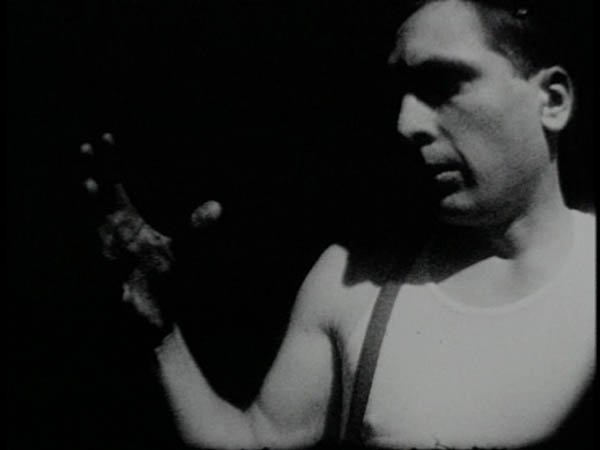
Congoma-player Marigo hasn’t paid the rent in a few months, so his landlady (the griot from Touki Bouki) has confiscated his instrument until he pays up.
image

With no way to earn a living, Marigo buys a lotto ticket from an optimistic dwarf acquaintance.
image

Marigo has got the winning number… but he pasted the ticket to his front door behind a poster of Yadikoon (“an African robin hood”), so he has to take the whole door to the lottery office.
image

…along the way, dreaming of the rich life…
image

…only to be told that the ticket needs to be detached from the door to be authorized.
image

So Marigo makes a run for the beach and uses the pounding surf to remove the ticket, dancing and dreaming on the rocks, losing his poster but getting the ticket off successfully, screaming ecstatic laughter.
image

I pretty much loved it.

Culturebase.net:
“We have sold our souls cheaply!“, Mambety concludes, though he never described himself as a political director. Yet his films always refer to the economic reality of his country, which is entirely dependent on the World Bank, monetary funds and French economic policy. This is true for his last two films. They were part of a trilogy on “The story of small people.” “Le Franc” and “La petite vendeuse de soleil” are from parables on the lives of people who must ask themselves the same question every morning, namely how to gather the most fundamentally necessary means to survive. The small people in this trilogy are the counterparts to the greed of the hyenas in his longer feature films.”

Filmref.com:
“Mambéty introduces the trenchant idea that the power of the imagination to raise post-colonial African consciousness does not exist in fanciful, but ultimately empty, idle dreams or wistfully dwelling over a lost – and stolen – noble past (a theme that is also articulated in Jean-Marie Téno’s films, as well as Ousmane Sembene’s Borom Sarret), but in a certain wide-eyed innocence and naïve determination that recovery and advancement are still possible with dedicated effort.”

California Newsreel:
“In both films there are conspicuous references to Yadikoon, a semi-legendary figure who in popular memory became a kind of Senegalese Robin Hood, robbing from the rich to give to the poor. In Le Franc, the main character, Marigo has a poster of Yadikoon in his room. Mambety himself named a foundation he established for Dakar’s street children after Yadikoon.”

The only hits I get from “Yadikoon” on google are from articles on these films, so either he’s a Mambety-created character or we are all spelling his name wrong.

Also watched “Echek” again, fun little flick by Adan Jodorowsky:
image

A suicidal man haunted by memory is picked by a massive computer system as the ideal candidate to send to the past in a time-travel experiment. But enough about La Jetee, here’s a full-length full-motion movie from six years later.

I don’t know if the computer was aware that the man had killed his woman on vacation in Glasgow by turning up the gas while she slept, or if the scientists were aware that the man would be able to re-experience his past having no free will to change it. The results are, of course, a fragmented Resnais film jumping back and forth willy-nilly through the last 2-5 years of this guy’s life.

Star Claude Rich, who looks somewhat like Michael Showalter from The State, was in Jean Renoir’s final film The Elusive Corporal and would later play the offscreen cranky father in Coeurs.

Rich is with this girl Wiana (Anouk Ferjac from The War Is Over) sometimes, but mostly he’s with young Catrine (Olga Georges-Picot, who wasn’t in many memorable films before she killed herself in ’97). He is occasionally happy with Catrine, but he cheats on her and she knows it. They’re both depressive, and she has no life outside of their relationship, doesn’t enjoy vacation, is becoming more of a burden.

Now I’m told that some of the “past events” that Claude experiences are actually dreams he had. Wonder if the hot girl in the mirrored bathroom asking him to wash her back was one of those.

Just a dream? Carla Marlier (Zazie‘s aunt):
image

After being trapped for who knows how long bouncing through time and memory (90 minutes as the movie’s running time, or infinitely longer?), Claude finds himself reliving his attempted suicide by gun. Does he manage to affect his past this time by succeeding where before he had failed? His body appears on the hospital grounds, and the technicians run out to collect him, with a final shot of Claude’s mouse companion still caught inside his glass dome in the machine.

image

The mouse appears earlier, running across the beach right around the moment that Claude was supposed to be sent back (it was to be one year ago, for a duration of one minute).

The time machine:
image

This idea of time travel doesn’t seem like it’d be very useful to the scientists, rather more like traveling through your own memory than actually moving in time… though it does show that Claude’s body disappears when he travels. And the scientists, besides having invented/created the thing, don’t seem very capable of handling the machine or Claude.

image

Holm says “it was a weird film that was openly laughed at in the States.”

Andy says “If we become stuck in our own time loop of visiting the past the memories can become too overwhelming. Suicide in context of the movie becomes a means to end or break the flow of time and memory.”

The time machine premise seems like a useful tool for Resnais to explore the obsessive cross-cutting of memory that he’d already played with in Muriel and Marienbad.

Resnais: “There are absolutely no flashbacks or anything of the sort.”

image

image

image

image

Watched again June 2008 with a group. Very plain look to the sets, clothes… not a visually stylish movie except in the editing. I like it more the second time around. Would like to watch a higher quality copy next time.

September 2014: wish come true, a restored 35mm print at Filmstreams.

IMDB says it’s “believed to be Africa’s first avant-garde film”. Think it’s the earliest African film I’ve seen period other than the not-so-avant-garde Black Girl & Borom Sarret.

It’s a semi-comic story of horned-motorcycle-drivin’ Mory and his college student girlfriend Anta riding around Dakar, Senegal looking to steal enough money to get them to the paradise that is Paris. After successfully robbing a gay rich dude and unsuccessfully robbing a wrestling match, she boards the boat but he is overcome by nationalistic cow-related panic and runs back into town. There’s a woman “Aunt Oumy”, local griot, yells at them, they imagine returning to town rich and famous, Oumy singing for them. I did kinda like it even though I don’t have much to say about it.

Rosenbaum says “one of the greatest of all African films and almost certainly the most experimental … The title translates as Hyena’s Voyage, and among the things that make this film so interesting stylistically are the fantasy sequences involving the couple’s projected images of themselves in Paris and elsewhere.”

From wikipedia, Mambety “sought to expose the diversity of real life”, and his “editing and narrative style are a confluence of the ancient griotic tradition of tribal storytelling and modern avant-garde techniques. Mambéty was interested in transforming conflicting, mixed elements into a usable African culture, and in his words, reinvent[ing] cinema.”

Shortly before he died, Mambety was asked what he would do next. “I will finish the third part of the trilogy about ordinary people. After that, I will make Malaika, the third part of the trilogy about the power of craziness. The first two were Touki Bouki and Hyènes. Then I will consult God about the state of the world.”

Sex on the beach:
image

Wild child in a tree:
image

Griot in a riot:
image

Fantasy riches:
image

Also watched Episodes from the Life of Jekyll and Hyde by Paul Bush, a few-minute piece using the soundtrack to one (or a few) Jekyll & Hyde movie and ultra-fast-cutting two actors together into some kind of stop-motion nightmare… where the Secret Adventures of Tom Thumb meets Alone, Life Wastes Andy Hardy. Cool.

image

image

Two or three years ago I completed a holy quest to track down and watch every movie by the extremely great Samuel Fuller. This directly led to the creation of this journal, because it turns out that I don’t remember movies very well when I just watch them one after another and never think about them again or discuss them with anybody so now it’s as if I’ve seen no (or just a few) movies by Samuel Fuller instead of all. Fortunately they’re all worth revisiting (except maybe for Underworld USA or Shark! or Madonna And The Dragon) so they’ll all show up here eventually, and maybe I’ll remember them better this time.

So here’s Park Row… selected by John Sayles, aired by Turner Classic, and digitally botched by Comcast (god, they’re worse than ever). Such a sappy and idealistic little flick for the first 30 or 40 minutes, about a fiery newspaper man (Gene Evans) who dreams of starting his own paper and whose dreams come true when a booze-buddy (vet actor Herbert Heyes) turns out to be a rich investor. His little-paper-that-could is run on honest journalism, ingenuity, and dedicated employees including Italian typesetter Mr. Angelo, linotype inventor Mergenthaler (sculptor Bela Kovacs), reckless bridge-jumping reporter Steve Brodie (George O’Hanlon, voice of George Jetson) and young type-sorter and paper-hawker Rusty.

The movie doesn’t show or narrate the events… it reports them. Sam was a newspaper man, a writer, photographer, and a war vet… and all of those come out in this movie, as the second half turns into a war between Evans and his rival paper’s editor Charity Hackett, and not just of wits… wagons run off the road, news stands destroyed, fist fights, even bombs thrown through windows, highlit by an awesome tracking shot that Sam reportedly created by strapping the camera to a man’s back and having him run after Evans, weaving through the movie’s single street set. The movie’s still corny, and at the end Charity admits defeat and offers to fold her paper, in love with the uncompromising Evans. But the grittiness and the sentimentality ramp up simultaneously and complement each other in a way Sam wouldn’t manage again until “The Naked Kiss”.

Excellent movie. It sneaks up on you.

Thirty.

Silent World by Jacques Cousteau and Louis Malle beat it for the golden palm at cannes, but it took the “human document” award. The film print said “grand prix” but it doesn’t even look like that award was handed out in ’56. The print also calls Ray “Roy”, but those two seem interchangeable by the IMDB. Supposed to be India’s Rashomon, the one that brought Indian film to the world’s attention.

Daunting to watch a movie known for 50 years as a masterpiece… well-illustrated when I walked into the room early and saw a bunch of freshman watching the end of Citizen Kane.

Oooh, my fourth 50’s film in a week. This came out less than a decade after Bicycle Thief, its inspiration, and the year after Senso, La Strada, Seven Samurai and Saga of Anatahan.

Ray’s first film, with great music by then-unknown Ravi Shankar. Rich drama, very moving and awesomely shot. I kind of expected to be underwhelmed, but I loved it (probably more than the film students around me who sighed a lot and started fidgeting and text-messaging towards the end) and maybe even cried a little. Some of the students did too, so there’s hope for them.

Little Apu is born to overburdened mom, underemployed dad, always-in-trouble sister and elderly aunt. Sis’s friend is getting married. Apu goes to school. Dad gets work with the landlord but isn’t paid for months. Sis steals a necklace. Mom fights with aunt while trying to make sure kids are fed and staying out of trouble. One horribly powerful fight scene when, after the necklace dispute, mom drags sis out of the yard by her hair, collapses against the inside of the door while through the wall we can see Sis crying on the other side.

image

The scene is edited and scored with such force, seems like it couldn’t be the work of a first-time film director working before his country even had a proper film industry. Anyway, Sis gets sick and dies right before father comes home from the big city (he’s barely in the film) bearing money and gifts. Death scene (during a horrid rain storm) is at least double what the hair-pull fight scene was, with the music peaking into the scream that we never hear from the mother. In the finale, the family is moving to a new town to start again, Apu finds the necklace and throws it in a lake.

Movie feels like a masterpiece despite my pedestrian plot description.

When looking for screenshots I found this scene that wasn’t in the print we watched. The parents have a rare conversation about their lives and bring up moving out of town for the first time.
image

Ray: “The cinematic material dictated a style to me, a very slow rhythm determined by nature, the landscape, the country. The script had to retain some of the rambling quality of the novel because that in itself contained a clue to the authenticity: life in a poor Bengali village does ramble.”

Ray in ’82: “All artists owe a debt to innovators and profit by such innovation. Godard gave me the courage to dispense largely with fades and dissolves, Truffaut to use the freeze.”

Truffaut walking out in ’56: “I don’t want to see a film about Indian peasants.”

Apu:
image

His sister in the rain, celebrating a short-lived freedom:
image

Outcast auntie:
image

Sad parents:
image

Update, Jan 2010: Katy liked it, but says she saw the sister’s death coming.

“I’m very happy to announce that we’ve destroyed at least half of the country. I hope now they’ll understand that aggression does not pay.”

That sums up the whole movie. It’s so obvious and loud and obnoxious and garish and that’s probably just what it intends to be. But it makes for an unpleasant viewing experience. I can’t imagine this movie screening in theaters without walkouts by exasperated viewers saying “I GET it already” (but probably saying that in french).

All-American titular superhero is introduced blithely massacring a black family in the middle of their dinner. Then Dr. Freedom (Donald Pleasence) calls to tell him that his French equivalent Captain Formidable has been killed and commies are invading France from neutral Switzerland. It’s up to Mr. Freedom to save the ungrateful French, not for any love of the country but to stop the dreaded domino effect and protect the world from communism.

Doesn’t play like a proper movie at all. Sometimes it feels like an advertisement (America’s priorities are more Capitalist than Democratic), and sometimes like a bunch of people goofing around and pretending to make a movie. The dubbing ain’t great, either.

Some funny touches: the american embassy in France is a wal-mart full of dancing girls. And sometimes the cheapness of the project turns into a lo-fi charm. Superfrenchman is played by a balloon with easily confused henchmen, and the also-inflatable Red China Man breathes frozen fog that settles on the ground.

Freedom of course ends up destroying most of France, his french guide Marie-Madeleine turns out to be a commie traitor, Russian Moujik Man is somewhat of an ally but can’t really be trusted. Freedom, not too fazed by the death of all his compatriots and followers, prevails through violence. Sadly it’s not a dated period piece and what Klein’s saying about American foreign policy applies perfectly well today.

Criterion: “Delightfully crass, Mr. Freedom is a trenchant, rib-tickling takedown of gaudy modern Americana.” It’s funny to think how many Criterion completists will soon own this movie.

Movie plays better in stills. When considering the screen shots I took, it seems almost like a good movie, clever and funny and ramshackle without the loud, boisterous, stagey dialogue to distract. In other words, it’s a much better movie when you’re not actually watching it. And since Klein was renowned in the 50’s as a still photographer and appears in Marker’s still-composed La Jetee, I’ve kept more screenshots than the film might deserve.

The introduction of Marienbad star Delphine Seyrig as Marie-Madeleine, yowza.
image

Dr. Freedom:
image

Captain Formidable is played by classy French icon Yves Montand:
image

“Anti-freedomism is at a new high.” Can’t get enough of that dress. Note Marie-Madeleine’s placement in front of the red portion of the map, foreshadowing the revelation that she is a communist spy. Just kidding.
image

Over a temporarily fallen Freedom, L-R: Moujik Man, Red China Man, Jesus & Mary
image

Freedom celebrates the defeat of Superfrenchman… I don’t remember exactly what went on here:
image

Forcing the maid to taste the poisoned food she brought. Nice shot setup:
image

I love this shot so much. The matching hair, the goofy look on Freedom’s face, the unexplained picture of Hitler hanging on Marie-Madeleine’s wall:
image

Serge Gainsbourg very nearly survives to the end:
image

Freedom! Now available in a convenient spray!
image

An extremely lame waste of time. Uninteresting doc about uninteresting man who claims to be a zen chef then undermines both parts of that description. I was willing to bet that the director was one of his middle-aged female students so enamored with his personality that she simply had to make this movie to show the rest of the world how fascinating he is… but she turns out to be a professional filmmaker with more than 25 works to her name, most of them fictional. Oops. As for our chef, I think he wants to look cool on camera, but he overdoes the dorky humble shtick and ends up looking like a mixed-up hippie who has gotten where he is by faking it. Either way, Hal Holbrook and Catherine Keener were much more convincing and entertaining as mixed-up hippies in “Into The Wild”.

I hate to be so down on the movies Katy picks, but I can’t help myself any more than she can pretend to enjoy watching “ace in the hole” or “pennies from heaven”.

This felt like an obvious and uninteresting adaptation of an alright story about the partitioning of India and creation of Pakistan as symbolized by a conveniently diverse group of friends in Lahore and as seen through the eyes of a young innocent.

The young innocent is rich-girl Lenny-baby (of a neutral parsee family) whose hindu caretaker Ayah (a cover girl from Fire) is one of the friends. Also in there are muslims Hassan The Masseur (guy from Bollywood/Hollywood) and Dil The Ice Candy Man (Lagaan), a sympathetic sikh whose name I can’t find right now, and Lenny’s cousin Adi who has an arranged marriage to a short old man.

I took it as a history/culture lesson, though I had to ask Katy lots of questions because this movie doesn’t spell out as much as Water did for the uninitiated. Had the feeling of a postcard yearning for old peaceful times, so I didn’t see the violent atrocities of the second half coming… turns into a giant bummer.

peaceful days:
image

friendly chat:
image

an ice-candy betrayal, baby:
image

Billy Wilder: “My delight… is ’cause everyone has been looking down on movies as something kind of third-rate until, thank god, the invention of television. Now we have something to look down on.”

Not quite a film noir, I don’t think, but close. Continues the string of 50’s movies I’ve watched lately, but this one’s from back in the year of Day the Earth Stood Still / Thing From Another World and Fixed Bayonets / The Steel Helmet.

It’s a damn well-made movie, as the commentary track helpfully illustrates, but Katy didn’t like it because of unlikeable characters (which is why when she asks if she’ll like “there will be blood” I tell her no) and Jimmy fell asleep since we started it at midnight. It’s about a desperate newspaper man whom Sam Fuller would have despised, making the news himself and conspiring to suppress other reporters while building up a sensationalistic story to glorify his own reporting and get himself back on top. At least when it fails, he recognizes what he has done and owns up to his own role in the trapped miner’s death, though by Code rules, the reporter dies too, stabbed by an equally hot-tempered and strong-willed woman.

A deeply-dimpled Kirk Douglas stars (shortly before doing Big Sky and Bad and the Beautiful) alongside Jan Sterling (who did High and the Mighty with John Wayne before retreating to television) as the miner’s wife who wants out but plays her part as a concerned wife out of greed for tourist cash. Professional villain and Preston Sturges actor Porter Hall is Douglas’s very straight-laced, belt-and-suspenders small-town newsman boss. Corrupt sheriff Ray Teal ended up famous for playing sheriffs, and his unhelpful deputy is Gene Evans, the newspaper man in Park Row. Porter Hall was dead in two years, and the guy who played the miner’s dad (John Berkes) died one week after the film’s release.

Our heroes:
image

Evans and Berkes:
image

Porter Hall:
image

I’d pay to see some great S&M amusement:
image

Kirk Douglas addresses his “fans” from the mount:
image

A sad father surveys the aftermath:
image